
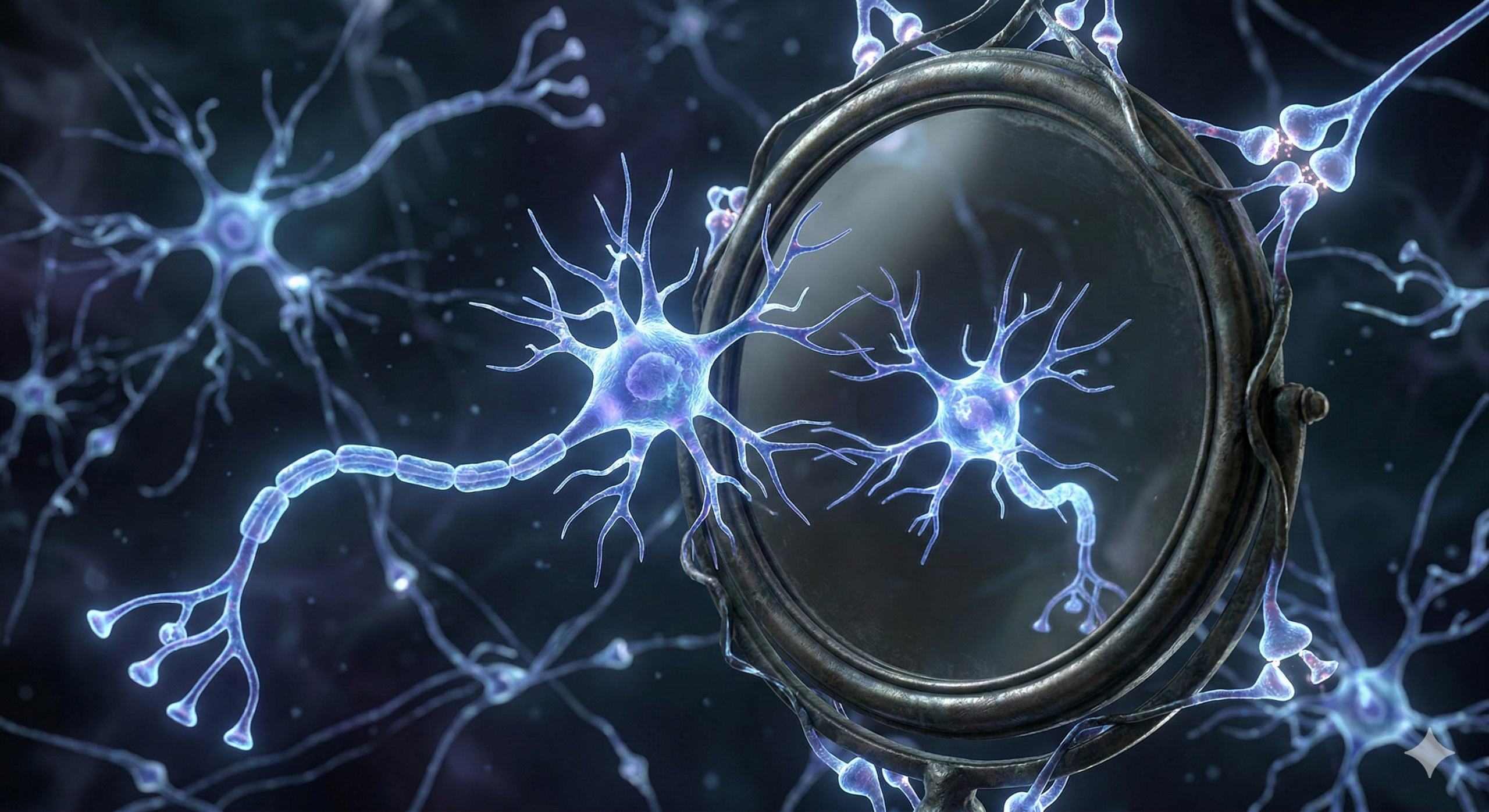
You’re sitting across from a patient. They’re talking about something ordinary. Scheduling conflicts. Work stress. Nothing obviously emotional.
Thirty seconds later, they’re crying.
If you’ve been doing this work long enough, you know exactly what I’m describing. The feeling arrives before the tears. Sometimes before the patient even knows they’re close to crying.
How does that happen?
The Mirror Neuron Myth
The popular explanation goes like this: your brain contains “mirror neurons” that fire both when you perform an action and when you watch someone else perform it. These cells let you literally feel what another person feels. They’re the biological basis of empathy. Some accounts claim they make up the majority of neurons in your brain.
It’s a beautiful story. It’s also mostly wrong.
Mirror neurons are real. They were discovered in 1992 by researchers at the University of Parma studying macaque monkeys. The same neurons that fired when a monkey grabbed food also fired when the monkey watched a researcher grab food.
But here’s what the popular accounts leave out.
Mirror neurons don’t make up the majority of your brain. They don’t even make up the majority of neurons in the regions where they’re found. Single-cell recording studies show they represent roughly 10 to 17 percent of neurons in the premotor cortex and inferior parietal lobule. They’re a specialized minority, not a dominant population.
The human brain contains approximately 86 billion neurons. About 69 billion of those are in the cerebellum, which handles motor coordination, not empathy. The cortical regions implicated in mirroring contain roughly 16 billion neurons total. And within those regions, mirror neurons are a small fraction.
More importantly, cognitive neuroscientist Gregory Hickok has systematically dismantled the claim that mirror neurons explain action understanding. If these cells were solely responsible for understanding others’ actions, then damage to motor areas would impair comprehension. It doesn’t. Patients with frontal lobe damage who can’t produce speech can still understand it perfectly. The mirror system isn’t where understanding happens.
So if mirror neurons aren’t the explanation, what is?
Your Brain Is a Prediction Machine
The dominant theory in modern cognitive neuroscience isn’t mirroring. It’s predictive coding.
Your brain doesn’t passively receive sensory information and then figure out what it means. Instead, it’s constantly generating predictions about what’s going to happen next. It builds internal models of the world based on everything you’ve learned, and then compares those predictions against incoming data.
When prediction matches reality, processing is efficient and effortless. When there’s a mismatch, you get a “prediction error” that forces the brain to update its model.
This is why experienced therapists are better at sensing emotional shifts than novices. It’s not that their mirror neurons work better. It’s that they’ve accumulated thousands of hours of associative learning. They’ve paired specific micro-behaviors with specific emotional outcomes so many times that their predictive models are highly accurate.
When you sense that your patient is about to cry, your brain has already detected the precursors: a subtle hitch in their breathing, a micro-contraction of the muscles around their eyes, a slight drop in vocal pitch. You’re not consciously registering these cues. But your predictive model is.
And here’s the key insight: in predictive coding, anticipating an event activates the same neural networks as experiencing the event itself.
Your brain generates an internal simulation of the patient’s crying in order to predict it. That simulation produces real physiological effects in your body. The heaviness in your chest, the tightness in your throat. You’re not mirroring what they’re doing now. You’re simulating what they’re about to do.
The Body Knows First
But where does the raw data for these predictions come from?
This is where Polyvagal Theory enters the picture.
Stephen Porges identified something he calls “neuroception”: the nervous system’s capacity to detect safety, danger, or threat entirely below conscious awareness. Your autonomic nervous system is constantly scanning the environment for social cues, processing information about tone of voice, facial tension, postural shifts, and breathing patterns faster than your conscious mind can register.
The vagus nerve is the primary conduit here. And critically, about 80 percent of vagal pathways are afferent, meaning they carry information from body to brain, not brain to body. Your gut feelings aren’t metaphorical. They’re literal sensory data traveling up the vagus nerve.
When a patient is suppressing tears, their physiology is in flux. The effort of holding back emotion restricts breathing, alters heart rate variability, and changes the natural rhythm of their voice. Your neuroceptive system detects these shifts instantly.
Before your cognitive brain can formulate the thought “something’s happening,” your autonomic nervous system has already received the signal and generated a corresponding shift in your own body. That’s the somatic countertransference. That’s the “gut feeling.”
High-Speed Transmission
How does this visceral information reach conscious awareness so quickly?
Part of the answer involves von Economo neurons, also called spindle neurons. These are unusually large, elongated cells found primarily in the anterior cingulate cortex and the insula. They exist only in highly social mammals: humans, great apes, elephants, and some cetaceans.
Because of their size, von Economo neurons transmit signals extremely fast. They act as a high-speed relay system, carrying interoceptive information (sensations from inside your body) directly to the regions responsible for conscious awareness and decision-making.
When you experience that sudden intuitive flash that your patient is about to cry, von Economo neurons are transmitting the visceral shift from your insula to your anterior cingulate cortex in milliseconds. The insight arrives whole and immediate, preceding logical deduction.
Patients with frontotemporal dementia who lose these neurons show catastrophic deficits in empathy, social awareness, and self-control. The cells matter.
What Actually Happens
So let’s put it together. You’re sitting with a patient. Here’s what’s happening in your nervous system:
Your neuroceptive system detects micro-behaviors. The patient’s breathing becomes slightly irregular. The muscles around their eyes tighten almost imperceptibly. Their vocal pitch drops. These changes occur seconds before conscious emotion emerges. Your vagus nerve carries this information to your brainstem and insula.
Your body responds. Via vagal afferent pathways, you experience a corresponding physiological shift. Chest tightness. Throat constriction. A vague heaviness. This is somatic countertransference.
Von Economo neurons relay the signal. The visceral information travels at high speed from your insula to your anterior cingulate cortex, reaching conscious awareness as a “gut feeling.”
Your predictive model activates. Based on thousands of previous clinical encounters, your brain has learned that these specific micro-behaviors precede crying. Your superior temporal sulcus and prefrontal cortex generate a prediction: tears are coming. This prediction itself activates the neural networks associated with sadness, amplifying your somatic experience.
Theory of Mind maintains the boundary. Your medial prefrontal cortex and temporoparietal junction categorize this emotional information as belonging to the patient, not to you. This prevents overwhelming emotional contagion and allows you to use the intuition clinically rather than being consumed by it.
The whole process takes less than a second. And none of it requires conscious effort.
Why This Matters Clinically
Understanding the actual neuroscience changes how we think about clinical intuition.
First, it’s learnable. Mirror neuron theory implied that empathy was hardwired. If you had it, you had it. If you didn’t, you didn’t. Predictive coding says otherwise. Your intuitive accuracy depends on the quality of your learned associations. More clinical experience, more exposure to emotional expression, better predictions. This is why supervision matters. This is why diverse caseloads matter.
Second, somatic countertransference isn’t mystical. It’s physiological data traveling through the vagus nerve. You can train yourself to notice it. You can learn to distinguish your own emotional states from transmitted patient states. Somatic approaches to therapy leverage this capacity deliberately.
Third, the body matters. Therapists who ignore their own physical sensations are missing critical clinical information. The tightness in your chest isn’t noise. It’s signal. Polyvagal-informed practice teaches clinicians to use their autonomic responses as diagnostic tools.
Fourth, burnout has a biological basis. If your nervous system is constantly receiving and processing patient distress through vagal pathways, you’re not just “feeling stressed.” You’re experiencing genuine physiological load. Co-regulation is real, which means dysregulation is also real. Self-care isn’t indulgence. It’s autonomic maintenance.
Research on Therapist Crying
One of the most striking pieces of evidence for anticipatory intuition comes from research on therapist crying in therapy.
Studies show that in about 73 percent of cases where therapists cry, the patient is already crying. That’s expected. But in 27 percent of cases, the therapist experiences the urge to cry, or actually sheds tears, while the patient is not yet crying.
Think about that. More than a quarter of the time, the therapist’s tears precede the patient’s. The therapist’s nervous system is detecting and responding to emotional distress that the patient hasn’t yet consciously expressed.
This isn’t telepathy. It’s neurobiology. The therapist is perceiving physiological precursors (respiratory changes, facial tension, postural shifts) and responding somatically before the conscious emotional discharge occurs.
The Real Architecture of Empathy
Mirror neurons make for a compelling story. One special class of cells that let us feel what others feel. Simple. Elegant. Wrong.
The actual architecture of clinical empathy is distributed, multi-systemic, and learned. It involves:
Autonomic detection via vagal neuroception. Rapid transmission via von Economo neurons. Predictive modeling via Bayesian inference in the prefrontal and temporal cortices. Somatic simulation in the insula and anterior cingulate. Cognitive regulation via Theory of Mind networks.
It’s more complicated than the mirror neuron story. But it’s also more useful. Because if empathy is learned and multi-systemic, then it can be trained, refined, and protected.
The next time you feel your patient’s tears before they fall, you’re not experiencing magic. You’re experiencing millions of years of evolved social cognition, refined by thousands of hours of clinical learning, operating through the most sophisticated prediction engine in the known universe.
Your nervous system has been practicing for this moment your entire life.
Joel Blackstock, LICSW-S, is the Clinical Director of Taproot Therapy Collective in Birmingham, Alabama. He specializes in complex trauma treatment using qEEG brain mapping, Brainspotting, and somatic approaches.






















0 Comments