

The Neuroscientist Who Gave Consciousness a Mathematical Formula
By The Clinical Team at GetTherapyBirmingham.com
Why Understanding the Integration of Experience Matters for Therapy
Before we explore the revolutionary work of Giulio Tononi, we need to understand why his ideas about consciousness have profound implications for anyone working in the healing professions. Tononi did not merely propose another theory of how the brain generates awareness. He proposed something far more radical. He proposed that consciousness is identical to a specific type of information, that this information can be measured mathematically, and that the degree of consciousness in any system corresponds to how much that system integrates information beyond what its parts could do separately.
For therapists, this framework offers something unprecedented. It offers a way to understand not just whether someone is conscious but how conscious they are, what the quality of that consciousness is, and why certain conditions disrupt the integration that consciousness requires.
Consider the experiences that bring people to therapy. The fragmentation of trauma, where experience shatters into disconnected pieces that cannot be integrated into a coherent narrative. The dissolution of dissociation, where aspects of self become walled off from each other, unable to communicate or cohere. The overwhelming flooding of panic, where the integrative capacity of consciousness is swamped by signals it cannot organize. The emptiness of depression, where experience loses its richness and meaning, becoming flat and undifferentiated.
All of these conditions can be understood as disorders of integration. They are conditions where the normal capacity of consciousness to bind information together, to create unified experience from disparate inputs, breaks down in various ways.
Tononi’s Integrated Information Theory provides a precise framework for understanding what integration means and how it can be disrupted. It explains why the cerebellum, despite having more neurons than the cerebral cortex, does not generate consciousness, because its structure does not support integration. It explains why consciousness fades during dreamless sleep and seizures, because the brain’s capacity to integrate information collapses. And it suggests that restoring consciousness means restoring integration.
For clinicians working with trauma and dissociation, this framework provides both theoretical grounding and practical guidance. It helps us understand that what we are trying to accomplish in therapy is not simply processing memories or changing beliefs but restoring the brain’s capacity to integrate information into unified conscious experience.
Understanding Tononi’s work will not give you new techniques to apply mechanically. But it will deepen your understanding of consciousness itself, of what it means for experience to be unified or fragmented, of why certain conditions feel the way they do, and of what healing ultimately requires.
From Italian Medicine to American Neuroscience
Giulio Tononi was born in Trento, a city in the northern Italian Alps. He studied medicine at the University of Pisa, one of Italy’s oldest and most distinguished universities, where Galileo himself once held a mathematics chair. After completing his medical degree, Tononi specialized in psychiatry and served as a medical officer in the Italian army before earning a doctorate in neuroscience at the prestigious Sant’Anna School of Advanced Studies in Pisa.
This dual training in psychiatry and neuroscience would prove crucial to his later work. Psychiatrists confront disorders of consciousness daily, from the fragmentations of dissociative disorders to the distortions of psychosis to the dimming of severe depression. Neuroscience offered tools for understanding the brain mechanisms underlying these experiences. Tononi would spend his career building bridges between these perspectives.
From 1990 to 2000, Tononi worked at The Neurosciences Institute, first in New York and then in San Diego. The Institute was founded by Nobel laureate Gerald Edelman, who had won the Nobel Prize in Physiology or Medicine in 1972 for his work on the immune system and had turned his attention to understanding the brain. Edelman developed a theory called Neural Darwinism, which proposed that the brain develops and learns through a process analogous to natural selection, with neuronal groups competing for survival based on their success in responding to the environment.
The collaboration between Tononi and Edelman proved extraordinarily productive. Together they developed the “dynamic core hypothesis,” a model of consciousness that emphasized the importance of reentrant connections between brain regions. Their 2000 book A Universe of Consciousness: How Matter Becomes Imagination synthesized this work for a general audience.
But Tononi was already developing ideas that would go beyond the dynamic core hypothesis. He was becoming increasingly interested in a fundamental question. What makes certain physical systems conscious and others not? What is the essential difference between a brain that experiences the world and a computer that processes information without experiencing anything at all?
The Birth of Integrated Information Theory
In 2004, Tononi published a paper that would transform consciousness science. Titled “An information integration theory of consciousness” and published in BMC Neuroscience, the paper proposed what has become known as Integrated Information Theory, or IIT.
The theory began not with the brain but with experience itself. Tononi adopted a methodological strategy inspired by Descartes. We can doubt many things, but we cannot doubt that we are conscious, that experience exists. Whatever theory of consciousness we develop must be consistent with the undeniable reality of subjective experience.
Tononi identified five essential properties of consciousness, which he called axioms because they seemed self-evidently true upon reflection.
First, consciousness exists intrinsically. Experience exists for the experiencer, not for some external observer. This is what philosophers call the first-person perspective.
Second, consciousness is structured. Every experience has composition, containing multiple distinguishable elements such as colors, shapes, sounds, and feelings that are organized in specific ways.
Third, consciousness is informative. Each experience is what it is and is thereby different from countless other possible experiences. When you see a blue book, your experience specifies that particular configuration of features and thereby excludes all other possible experiences you could be having.
Fourth, consciousness is integrated. The elements of experience are not separate but unified. When you see a blue book on a desk, you have one experience of a blue book on a desk, not separate experiences of blue, of book, of desk that somehow need to be combined. The unity is intrinsic to the experience itself.
Fifth, consciousness is exclusive. Each experience has definite boundaries. It includes certain elements and excludes others. You experience this and not that, now and not some other time.
From these axioms about experience, Tononi derived postulates about what must be true of any physical system that has experiences. The key insight was that consciousness requires integration. A conscious system must generate information as a whole, above and beyond what its parts could generate independently.
This led to the central concept of the theory. Phi, symbolized by the Greek letter Φ, is a measure of integrated information. It quantifies how much information a system generates as a unified whole compared to what its parts could generate separately. According to IIT, Φ corresponds to the quantity of consciousness. The higher a system’s Φ, the more conscious it is.
The Mathematics of Experience
What makes IIT distinctive among consciousness theories is its mathematical precision. Tononi and his collaborators have developed rigorous formalizations that allow Φ to be calculated, at least in principle, for any physical system whose causal structure is known.
The calculation is complex. It requires identifying all possible states of a system, all possible ways those states can influence each other, and measuring how much information is generated by the whole system compared to what would be generated if the system were partitioned into separate parts. The partition that reduces integrated information the most is called the “minimum information partition,” and Φ is defined as the information lost at this partition.
This mathematical framework makes specific predictions. A system with high Φ will be conscious. A system with zero Φ, meaning it can be partitioned into independent parts without losing information, will not be conscious at all. And different values of Φ correspond to different degrees of consciousness.
The mathematics also specifies the quality of experience, not just its quantity. The particular pattern of informational relationships within a system defines a shape in what Tononi calls “qualia space.” This shape corresponds to the specific quality of the experience, its particular feel. Two systems with the same Φ but different informational structures would have experiences of equal intensity but different character.
This is an ambitious claim. It suggests that the mathematics can capture not just whether something is conscious but what it is like to be that thing. The taste of coffee, the pain of a headache, the joy of reunion would all correspond to specific mathematical structures in qualia space.
Why the Cerebellum Is Not Conscious
One of the most striking predictions of IIT concerns the cerebellum. The cerebellum contains more neurons than the entire cerebral cortex. It is essential for motor coordination, timing, and learning. Yet damage to the cerebellum does not affect consciousness directly. Patients with cerebellar lesions may be clumsy or have difficulty with precise movements, but they remain fully conscious.
This is puzzling from many perspectives. If consciousness is simply a matter of neural activity, the cerebellum should contribute substantially given its massive neuron count. But IIT explains why it does not.
The architecture of the cerebellum is fundamentally different from the cerebral cortex. The cerebellum is organized as a kind of parallel processor. Information flows through in relatively independent channels. There is not the kind of dense, recurrent, integrative connectivity that characterizes the cortex.
According to IIT, this means the cerebellum has low Φ. Despite its many neurons, it can be partitioned into relatively independent components without much loss of information. The system does not generate information as an integrated whole. Therefore, it is not conscious.
This prediction aligns perfectly with clinical and experimental observations. The cerebellum contributes to many cognitive functions, but it does so unconsciously. Its outputs affect conscious experience only when they reach the cortex, which has the integrative architecture necessary for consciousness.
Measuring Consciousness in the Clinic
One of the most significant practical applications of IIT has been the development of methods for measuring consciousness in patients who cannot report their experiences.
Consider patients in comas, vegetative states, or locked-in syndrome. These individuals may or may not be conscious, but because they cannot communicate, we have difficulty knowing. Traditional clinical assessments rely on behavioral responses, which can be misleading. Some patients who appear completely unresponsive may actually be aware.
Tononi and his collaborators, particularly Marcello Massimini, developed a technique called the “zap and zip” method. A magnetic pulse is applied to the cortex using transcranial magnetic stimulation (TMS), creating a brief perturbation. The brain’s response to this perturbation is recorded using electroencephalography (EEG). The complexity of this response is then measured using compression algorithms similar to those used to zip computer files.
The key insight is that conscious brains respond to perturbations with complex, differentiated, integrated patterns. Unconscious brains respond with simple, stereotyped, or fragmented patterns. By measuring the complexity of the response, researchers can assess the brain’s capacity for integration, which according to IIT corresponds to its capacity for consciousness.
This method, called the Perturbational Complexity Index (PCI), has shown remarkable results. It can distinguish between conscious and unconscious states with high accuracy. It can identify preserved consciousness in patients who appear vegetative but are actually aware. And it tracks the loss and recovery of consciousness during anesthesia and sleep.
These clinical applications demonstrate that IIT is not merely philosophical speculation but a framework that generates testable predictions with real clinical value.
The 2024 Adversarial Collaboration
In 2024, consciousness science witnessed a landmark event. The Cogitate Consortium, funded by the Templeton World Charity Foundation, completed an adversarial collaboration directly comparing the predictions of IIT against those of the Global Neuronal Workspace Theory developed by Stanislas Dehaene and colleagues.
The two theories make different predictions about where in the brain consciousness arises. IIT emphasizes the posterior cortex, particularly areas with the dense recurrent connectivity necessary for integration. Global Workspace Theory emphasizes the prefrontal cortex and the process of “ignition” that broadcasts information globally.
The study involved 256 human participants who viewed visual stimuli while their brain activity was measured with multiple imaging techniques. The results, published in Nature, were nuanced.
IIT received partial support. The study confirmed that information about conscious content was primarily located in the posterior cortex, as IIT predicted. Sustained activity during conscious perception was observed in these regions, again consistent with IIT.
However, not all of IIT’s predictions were confirmed. The specific patterns of synchronization predicted by the theory were not reliably observed. And both theories faced challenges from the data.
Tononi and his collaborators responded to these results, clarifying aspects of the theory and arguing that some predictions had been misinterpreted. But the study represented exactly the kind of rigorous empirical testing that any scientific theory of consciousness must face. The field continues to gather evidence that will eventually adjudicate between competing theories.
Sleep, Consciousness, and Integration
Tononi’s work on consciousness emerged partly from his research on sleep. He has been a leading figure in sleep science, and the connection between sleep and consciousness has been central to his thinking.
During deep dreamless sleep, consciousness fades. We do not experience the passage of time. The subjective world disappears until we awaken or begin to dream. Why does this happen?
According to IIT, consciousness fades during deep sleep because the brain’s capacity for integration collapses. During wakefulness, the cortex maintains complex patterns of activity with information flowing between regions and being integrated into unified experience. During deep sleep, this integration breaks down. Neural activity becomes more local and stereotyped. Different brain regions stop communicating effectively.
This has been confirmed experimentally. The zap and zip technique shows that during deep sleep, the brain’s response to perturbation becomes simple and fragmented. The Perturbational Complexity Index drops dramatically. Integration is lost, and with it consciousness.
Dreaming presents an interesting contrast. During REM sleep, when most vivid dreaming occurs, the brain shows complex patterns of activity more similar to wakefulness than to deep sleep. Accordingly, PCI values during REM sleep are higher, and of course we are conscious during dreams, experiencing rich subjective worlds entirely generated by the brain.
Tononi has also developed a major hypothesis about the function of sleep. The synaptic homeostasis hypothesis, developed with his longtime collaborator Chiara Cirelli, proposes that sleep serves to renormalize synaptic strength after the increases that occur during waking learning. During wakefulness, synapses strengthen as we learn. During sleep, they are pruned back to sustainable levels. This maintains the brain’s capacity for plasticity while preventing runaway potentiation.
What Integrated Information Theory Teaches Us About Trauma
For clinicians working with trauma survivors, Integrated Information Theory offers deep insights into the nature of traumatic experience and its treatment.
The core insight is that trauma disrupts integration. The defining feature of consciousness according to IIT is the capacity to integrate information into unified experience. Trauma attacks precisely this capacity.
Consider what happens during overwhelming threat. The brain is flooded with signals, from threat detection systems, from the body, from sensory input. These signals may be too intense, too fast, too chaotic to be integrated normally. The experience fragments. Aspects of what is happening are processed in parallel but never bound together into coherent experience.
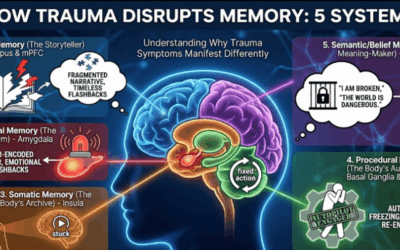
This provides a framework for understanding traumatic memory. Unlike ordinary memories, which are integrated narratives that can be consciously recalled and reflected upon, traumatic memories often remain fragmented. They intrude as sensory flashes, emotional surges, bodily sensations that have never been integrated with narrative understanding. They are experienced as happening now rather than being remembered as past.
Dissociation represents an even more severe disruption of integration. In dissociative states, aspects of experience that should be unified become separated. The person may feel disconnected from their body, from their emotions, from their sense of self. Different aspects of experience may be processed in parallel without being integrated into unified consciousness.
From an IIT perspective, dissociation represents a reduction in Φ. The system becomes partitionable into relatively independent components. The whole no longer generates information as an integrated unity. Consciousness becomes fragmented.
This suggests that effective trauma therapy must somehow restore integration. The goal is not simply to revisit traumatic memories but to help the brain integrate what was fragmented. This means bringing together sensory experience, emotional experience, bodily sensation, and narrative understanding into unified conscious experience.
Techniques like EMDR can be understood through this lens. EMDR involves holding traumatic material in awareness while simultaneously engaging in bilateral stimulation. This may facilitate the integration of traumatic material with other aspects of experience, allowing what was fragmented to become unified.
Brainspotting and Somatic Experiencing work with subcortically stored traumatic material, helping it to be consciously processed and integrated with cortical experience. They bridge the gap between fragmented somatic experience and integrated conscious awareness.
The therapeutic relationship itself supports integration. The therapist provides a stable, coherent context within which fragmented experience can be held and gradually unified. The attuned presence of another person may help the client’s brain restore its integrative capacity.
Major Publications and Contributions
Giulio Tononi has authored over 300 scientific publications and several major books that have shaped our understanding of sleep, consciousness, and the brain.
His 2000 book A Universe of Consciousness: How Matter Becomes Imagination, co-authored with Gerald Edelman, presented the dynamic core hypothesis and explored how neural processes give rise to conscious experience.
His 2012 book Phi: A Voyage from the Brain to the Soul presented Integrated Information Theory in an unusual and creative format. The book follows an aging Galileo on a dream journey where he encounters Francis Crick, Alan Turing, and Charles Darwin, each guiding him through different aspects of consciousness science. The book combines rigorous science with art, literature, and philosophical reflection.
His 2018 book Sizing up Consciousness: Towards an Objective Measure of the Capacity for Experience, co-authored with Marcello Massimini, focused on the clinical applications of IIT, particularly the development of methods for measuring consciousness in non-communicating patients.
Among his most influential scientific papers is his 2004 paper “An information integration theory of consciousness” in BMC Neuroscience, which first presented IIT to the scientific community. His 2008 paper “Consciousness as integrated information: A provisional manifesto” in Biological Bulletin provided an expanded statement of the theory. The 2014 paper “From the phenomenology to the mechanisms of consciousness: Integrated information theory 3.0” in PLoS Computational Biology, co-authored with Masafumi Oizumi and Larissa Albantakis, presented a major revision and mathematical formalization of the theory. Most recently, the 2023 paper “Integrated information theory (IIT) 4.0” in PLoS Computational Biology represents the current state of the theory.
A Timeline of Life and Work
1960s Born in Trento, Italy
Late 1980s Completes medical degree at University of Pisa, specializes in psychiatry
Late 1980s Serves as medical officer in Italian army
Late 1980s Earns doctorate in neuroscience at Sant’Anna School of Advanced Studies, Pisa
1990 Joins The Neurosciences Institute in New York, begins collaboration with Gerald Edelman
Mid-1990s Moves with the Institute to San Diego
1998 Publishes “Consciousness and complexity” with Edelman in Science
2000 Publishes A Universe of Consciousness with Edelman
2000 Joins University of Wisconsin-Madison
2003 Proposes synaptic homeostasis hypothesis with Chiara Cirelli
2004 Publishes foundational IIT paper in BMC Neuroscience
2005 Receives NIH Director’s Pioneer Award for sleep research
2008 Publishes “Consciousness as integrated information: A provisional manifesto”
2012 Publishes Phi: A Voyage from the Brain to the Soul
2014 Publishes IIT 3.0 with Oizumi and Albantakis
2017 Receives Klaus Joachim Zülch Prize from Max Planck Institute
2017 Receives Farrell Prize in Sleep Medicine from Harvard Medical School
2018 Receives Humboldt Research Prize
2018 Publishes Sizing up Consciousness with Massimini
2023 Publishes IIT 4.0 with collaborators
2024 Cogitate Consortium publishes adversarial collaboration results testing IIT predictions
Present Continues as Distinguished Professor in Consciousness Science and David P. White Chair in Sleep Medicine at University of Wisconsin-Madison
The Continuing Quest
Giulio Tononi has devoted his career to one of the most profound questions science can ask. What is consciousness? What makes matter experience the world? What is the difference between a system that merely processes information and one that actually feels something?
His answer, Integrated Information Theory, remains controversial. Some researchers praise it as the most rigorous and promising theory of consciousness ever developed. Others criticize it as unfalsifiable or pseudoscientific. The 2024 adversarial collaboration showed that the empirical picture is complex, with some predictions confirmed and others challenged.
But controversy is appropriate for a question as deep as consciousness. We should not expect easy answers. What Tononi has provided is a framework for asking the question precisely, for making predictions that can be tested, and for connecting the science of consciousness to clinical applications.
For therapists, Tononi’s work provides a way of understanding what we are trying to accomplish. We are trying to restore integration. We are trying to help fragmented experience become unified. We are trying to support the brain’s capacity to generate information as an integrated whole.
This understanding does not replace clinical skill or therapeutic presence. But it grounds our work in a scientific framework that makes the mysteries of consciousness, and its disorders, more comprehensible. And that comprehension can make us better healers.
Want to learn more about how consciousness science informs trauma therapy? Contact GetTherapyBirmingham.com to explore brain-based approaches to healing.
Bibliography
Primary Sources by Giulio Tononi
Edelman, G.M., & Tononi, G. (2000). A Universe of Consciousness: How Matter Becomes Imagination. New York: Basic Books.
Tononi, G. (2012). Phi: A Voyage from the Brain to the Soul. New York: Pantheon Books.
Massimini, M., & Tononi, G. (2018). Sizing up Consciousness: Towards an Objective Measure of the Capacity for Experience. Oxford: Oxford University Press.
Laureys, S., & Tononi, G. (Eds.). (2011). The Neurology of Consciousness: Cognitive Neuroscience and Neuropathology (2nd ed.). Academic Press.
Foundational Papers on Integrated Information Theory
Tononi, G. (2004). An information integration theory of consciousness. BMC Neuroscience, 5, 42. Available at: https://bmcneurosci.biomedcentral.com/articles/10.1186/1471-2202-5-42
Tononi, G. (2008). Consciousness as integrated information: A provisional manifesto. Biological Bulletin, 215(3), 216-242. Available at: https://pubmed.ncbi.nlm.nih.gov/19098144/
Oizumi, M., Albantakis, L., & Tononi, G. (2014). From the phenomenology to the mechanisms of consciousness: Integrated information theory 3.0. PLoS Computational Biology, 10(5), e1003588.
Tononi, G., & Koch, C. (2015). Consciousness: Here, there and everywhere? Philosophical Transactions of the Royal Society B, 370(1668), 20140167.
Albantakis, L., et al. (2023). Integrated information theory (IIT) 4.0: Formulating the properties of phenomenal existence in physical terms. PLoS Computational Biology, 19(10), e1011465.
Clinical Applications
Casali, A.G., et al. (2013). A theoretically based index of consciousness independent of sensory processing and behavior. Science Translational Medicine, 5(198), 198ra105.
Massimini, M., et al. (2005). Breakdown of cortical effective connectivity during sleep. Science, 309(5744), 2228-2232.
Sleep Research
Tononi, G., & Cirelli, C. (2003). Sleep and synaptic homeostasis: A hypothesis. Brain Research Bulletin, 62(2), 143-150.
Tononi, G., & Cirelli, C. (2006). Sleep function and synaptic homeostasis. Sleep Medicine Reviews, 10(1), 49-62.
Tononi, G., Boly, M., & Cirelli, C. (2024). Consciousness and sleep. Neuron, 112(10), 1568-1594.
The Cogitate Collaboration
Ferrante, O., et al. (2024). Adversarial testing of global neuronal workspace and integrated information theories of consciousness. Nature. Available at: https://www.nature.com/articles/s41586-025-08888-1
Resources on Integrated Information Theory
Center for Sleep and Consciousness, University of Wisconsin: https://centerforsleepandconsciousness.psychiatry.wisc.edu/
Integrated Information Theory Resources: https://centerforsleepandconsciousness.psychiatry.wisc.edu/integrated-information-theory/
Internet Encyclopedia of Philosophy Entry on IIT: https://iep.utm.edu/integrated-information-theory-of-consciousness/
Wikipedia Entry on IIT: https://en.wikipedia.org/wiki/Integrated_information_theory
Background on Consciousness Science
Edelman, G.M. (1989). The Remembered Present: A Biological Theory of Consciousness. New York: Basic Books.
Koch, C. (2012). Consciousness: Confessions of a Romantic Reductionist. Cambridge, MA: MIT Press.
Dehaene, S. (2014). Consciousness and the Brain: Deciphering How the Brain Codes Our Thoughts. New York: Viking.
Trauma, Dissociation, and Integration
Van der Kolk, B. (2014). The Body Keeps the Score: Brain, Mind, and Body in the Healing of Trauma. New York: Viking.
Frewen, P.A., & Lanius, R.A. (2015). Healing the Traumatized Self: Consciousness, Neuroscience, Treatment. New York: W.W. Norton.
Lanius, R.A., et al. (2015). Trauma-related dissociation and altered states of consciousness: A call for clinical, treatment, and neuroscience research. European Journal of Psychotraumatology, 6, 27905. Available at: https://pmc.ncbi.nlm.nih.gov/articles/PMC4439425/
Related Philosophical Work
Chalmers, D.J. (1996). The Conscious Mind: In Search of a Fundamental Theory. Oxford: Oxford University Press.
Nagel, T. (1974). What is it like to be a bat? Philosophical Review, 83(4), 435-450.







0 Comments