
Greek Revival: The Psychology of the Democratic Mask and the American Shadow
To understand the explosive dominance of Greek Revival architecture in the United States between 1820 and 1860, one must first recognize the profound psychological insecurity of a fledgling nation desperate for historical legitimacy. The American republic was a radical, highly unstable political experiment. Having recently fought two wars against the British Empire, the American populace was deeply eager to completely sever any visual or psychological ties to the hierarchical, royalist associations of Colonial and Georgian architecture. The culture required a new architectural identity, one that projected absolute permanence, ancient wisdom, and democratic purity. They found their aesthetic savior in the ruins of antiquity. Spurred by widespread American sympathy for the Greek War of Independence in the 1820s, a cultural phenomenon known as Philhellenism swept the nation, heavily documented in the historical archives of the National Endowment for the Humanities. Greek Revival became the first truly national architectural style of the United States. However, it was not merely an aesthetic choice; it was a psychological costume. By wrapping their banks, capitols, and plantation homes in the monumental columns of the Parthenon, Americans were desperately attempting to borrow the perceived immortality of ancient Athens to mask the terrifying fragility of their own young, fractured country.
Dialectical Materialism and the Hypocrisy of the Democratic Temple
When subjected to the rigorous analysis of dialectical materialism as outlined in classical Marxist theory, Greek Revival architecture emerges as one of the most profoundly contradictory movements in human history. The style was universally championed as the ultimate spatial expression of freedom, equality, and democratic virtue. Yet, the brutal material conditions that funded these colossal “Temples of Democracy” told a much darker story. In the American South, the explosive wealth required to build towering, white-columned plantation mansions was generated entirely by the horrific, mechanized exploitation of chattel slavery. The architecture was a beautiful, structural lie designed to legitimize a brutal economic hierarchy. The very hands that carved the intricate Corinthian capitals and erected the soaring Doric columns were often enslaved, a stark paradox frequently explored by the Society of Architectural Historians in their analyses of the Antebellum South.
This dialectical tension was also evident in the physical materials used for construction. Authentic ancient Greek temples were constructed of solid, load-bearing marble and limestone. The American republic, however, lacked both the ancient masonry traditions and the immediate capital to replicate this authenticity on a massive scale. Instead, American builders utilized abundant native timber, erecting wooden columns and brick facades, which they then covered in stucco and painted brilliant white to simulate the appearance of stone. As we note in our exploration of the psychological forces that move our buildings, this widespread architectural deception reflects an entire culture “faking it until they make it.” The wood-painted-as-marble technique was a material manifestation of an insecure society attempting to project an image of monumental wealth and unshakeable stability while standing on deeply unstable, combustible foundations.
Jungian Depth Psychology: The Persona and the Unconscious Shadow
Through the lens of analytical psychology, Greek Revival architecture serves as the ultimate historical example of the Jungian Persona. The Persona is the idealized, flawless mask that an individual—or in this case, an entire nation—presents to the outside world to gain social acceptance while hiding its darker, unacceptable realities. The brilliant white, perfectly symmetrical facades of Greek Revival buildings were designed to project total rationality, enlightened governance, and moral purity. However, as the C.G. Jung Institute defines the Shadow archetype, whatever is repressed by the Persona grows larger and darker in the unconscious. The pristine white columns of the American republic were actively repressing the massive cultural Shadow of indigenous genocide, slavery, and violent political division.
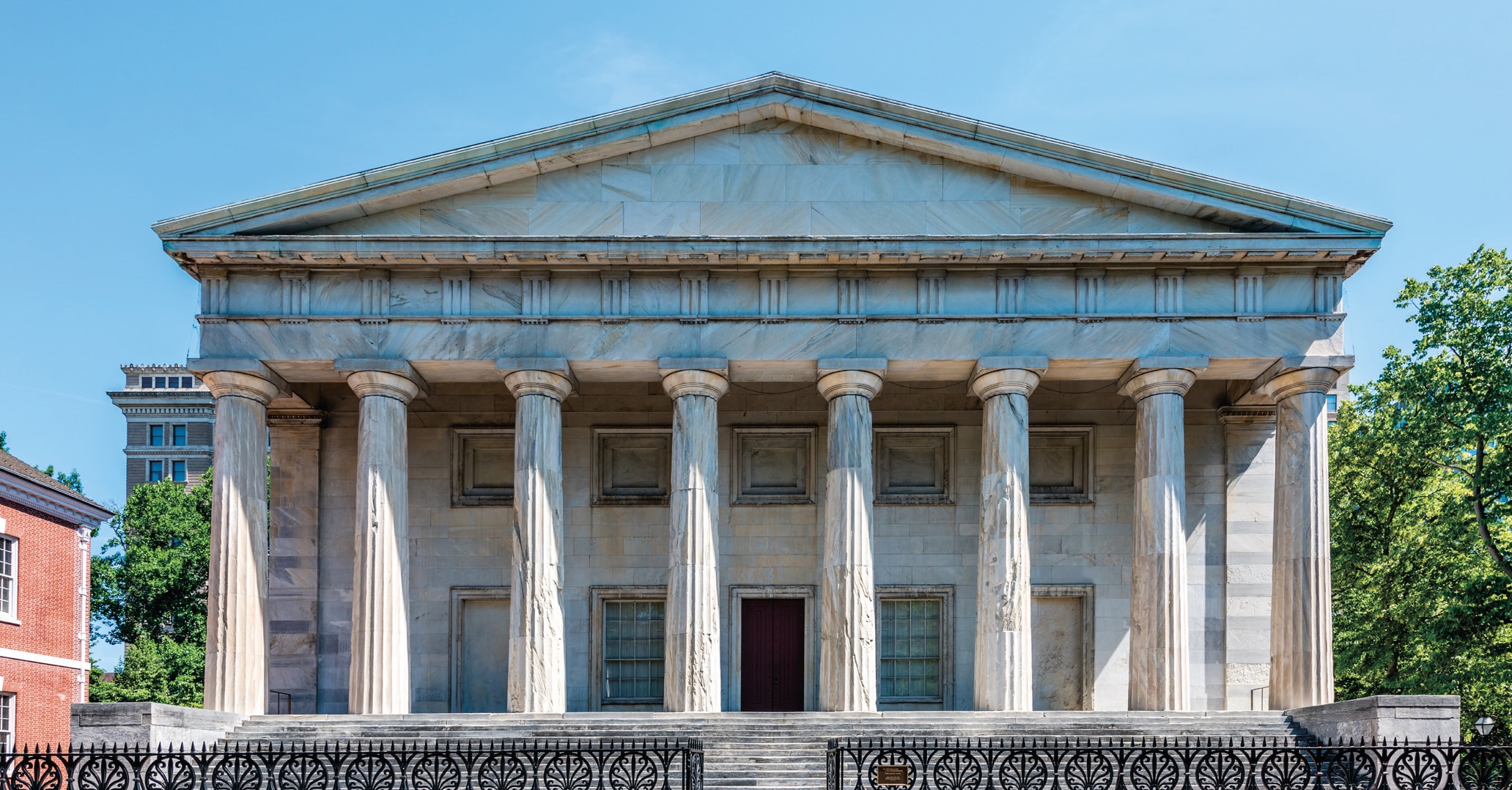
Simultaneously, the movement was a desperate psychological reaching for the Wise Old Man archetype. By copying the exact proportions of the Erectheion or the Parthenon, American architects like Benjamin Henry Latrobe and William Strickland were attempting to channel the ancient wisdom of Socrates and Pericles. This aligns seamlessly with the theories of Leon Krier regarding the architecture of the archetype. The human mind requires an environment that connects it to an ancient lineage. By transforming a frontier courthouse or a Philadelphia bank into a Greek temple, the architects were instantly manufacturing historical gravity. We see this psychological manipulation perfectly preserved at the Second Bank of the United States, managed by the National Park Service. The building was designed to look like the Parthenon specifically to convince a highly suspicious, economically volatile public that their paper money was as permanent and unshakeable as ancient stone.
The Innovators and the Architecture of Institutional Ego
The visionaries who engineered this psychological aesthetic understood exactly how to manipulate spatial design to soothe the anxieties of the masses. The Metropolitan Museum of Art’s expansive archives on the American Greek Revival highlight how architects like Thomas U. Walter and Robert Mills weaponized classical proportions to build the federal government’s ego from the ground up. Before the Greek Revival, Washington D.C. was a muddy, unimpressive swamp. By erecting the massive Treasury Building and designing the soaring, classical dome of the United States Capitol, these architects gave the federal government an aura of divine, unchallengeable authority.
When examining how spatial design shapes the architecture of the unconscious, we understand that standing beneath a fifty-foot Doric portico forces the individual ego into a state of physical and psychological submission. The monumental scale of these buildings was designed to dwarf the citizen, demanding awe and compliance. In an era where the nation was constantly threatening to tear itself apart over the issue of state’s rights and westward expansion—a chaotic period documented thoroughly by the Library of Congress’s National Expansion and Reform timeline—the heavy, unmoving aesthetic of the Greek temple was the only visual language capable of projecting the illusion of a unified, indivisible republic.
The Fall: The Civil War and the Death of the Noble Illusion
Why did an architectural style that so thoroughly dominated the American landscape ultimately fall out of favor so abruptly? The death of the Greek Revival was not caused by a mere shift in aesthetic taste; it was slaughtered by the American Civil War. The brutal, mechanized, and deeply bloody conflict between the North and the South completely shattered the psychological illusion that the United States was a noble, enlightened republic guided by ancient democratic reason. The mask was ripped off, and the terrifying American Shadow was dragged into the daylight.
Following the war, the gleaming white columns of the Greek Revival were no longer viewed as symbols of democracy; they were irredeemably tainted, permanently associated with the defeated, slave-holding aristocracy of the Antebellum South. The traumatized post-war psyche could no longer tolerate the rigid, hypocritical symmetry of the classical temple. As we have seen in our analysis of the Frankfurt School and the architecture of modern trauma, a society that has experienced catastrophic violence will fundamentally alter its built environment to cope with its grief. The culture pivoted violently away from the rational restraint of the Greeks, seeking emotional catharsis and messy, expressive individuality. This led directly to the explosion of the dark, spiritual anxieties of Gothic Revival architecture and the highly chaotic, hyper-ornamented frenzy of Victorian Eclecticism.
Today, as we catalog these massive societal coping mechanisms in the dictionary of the psychology of architecture, Greek Revival stands as a poignant and tragic monument. It remains a beautiful but haunting reminder of a time when an insecure nation desperately tried to build a utopian dream out of wood and white paint, refusing to acknowledge the profound moral rot eating away at its foundation.







0 Comments