
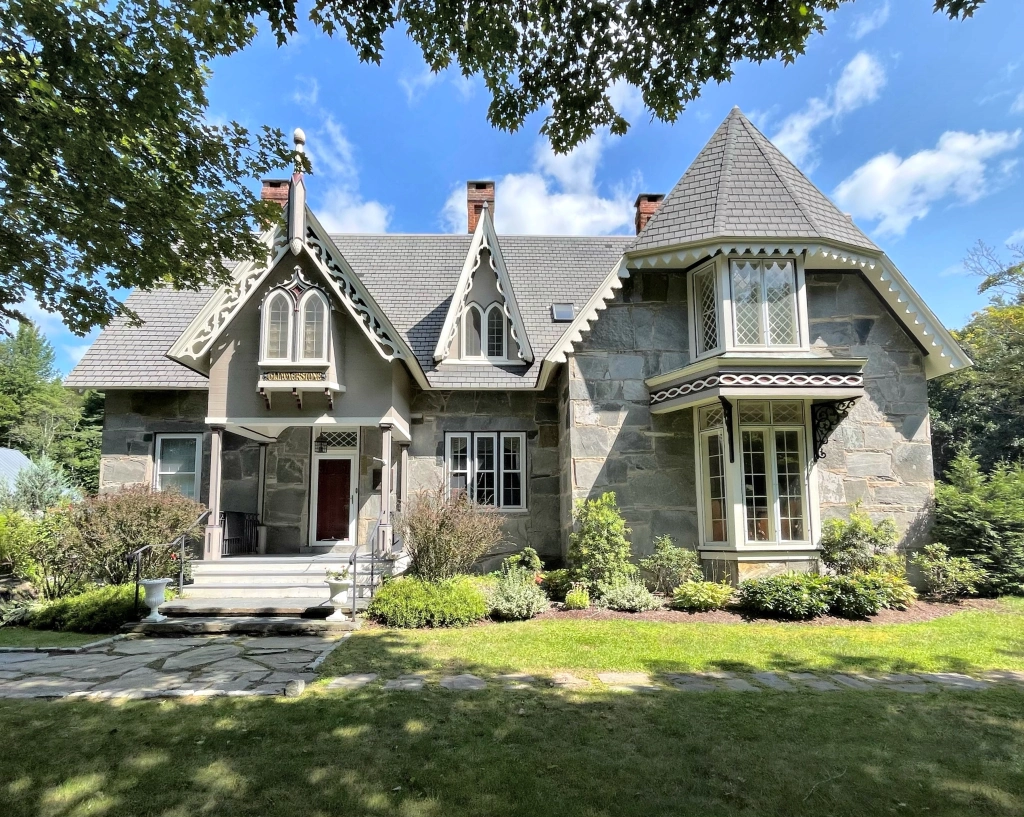
Gothic Revival: The Psychology of the Shadow, Industrial Trauma, and the Spire
To understand the sudden, explosive resurgence of pointed arches, gargoyles, and towering spires in the 18th and 19th centuries, one must recognize the profound spiritual terror of the era. Gothic Revival architecture was not merely a nostalgic aesthetic trend; it was a violent psychological reaction against the hyper-rationalism of the Enlightenment and the brutal, mechanical alienation of the Industrial Revolution. For decades, classical architecture had dictated that human environments must be perfectly symmetrical, strictly logical, and mathematically subdued. However, as the British Library’s historical archives on the Industrial Revolution demonstrate, this era of “reason” resulted in smoke-choked skies, mechanized child labor, and overcrowded urban slums. The collective human psyche suffered a catastrophic rupture. The world had been stripped of its magic, its mystery, and its spiritual depth. In response to this suffocating, factory-driven reality, society unconsciously reached backward, resurrecting the medieval Gothic style as a desperate psychological shield to protect the human soul from the machine. As we analyze the psychological forces that move our buildings, Gothic Revival stands as the ultimate architectural manifestation of spiritual panic.
Dialectical Materialism and the Industrial Paradox
The dialectical materialism of Gothic Revival is defined by a massive, unavoidable hypocrisy. The architects and patrons of this movement deeply despised the soulless, mass-produced reality of modern capitalism, yet they were entirely dependent on it to construct their medieval fantasies. As defined by the Marxist framework of dialectical materialism, every cultural movement contains its own inherent contradictions. The Gothic Revivalists preached a return to honest, pre-industrial craftsmanship, but they utilized the cutting-edge technological advancements of the 19th century to achieve it. The soaring, impossibly high ceilings and delicate window traceries of Victorian Gothic churches were often secretly held together by modern structural cast iron.
This paradox was acutely felt by the era’s greatest architectural philosophers, particularly John Ruskin. As preserved by the Ruskin Museum, his writings argued that the factory system was morally degrading to the human worker, transforming men into mere cogs. He believed that the irregularities and imperfections of authentic medieval Gothic carving were proof of a free, spiritually alive craftsman. However, the movement ultimately succumbed to the very market forces it hated, fracturing into the chaotic, mass-produced pastiche of Victorian Eclecticism, where cheap, factory-made Gothic ornaments were plastered onto ordinary terrace houses. It was a textbook example of the Frankfurt School’s theories on the architecture of modern trauma: capitalism commodified the culture’s psychological cry for help and sold it back to them as a decorative trim.
Jungian Depth Psychology: Reclaiming the Shadow and the Self
Through the lens of analytical psychology, the Enlightenment’s obsession with pure reason was an attempt by the conscious Ego to entirely eradicate the unconscious mind. But the unconscious cannot be destroyed; it can only be repressed. The Gothic Revival was the spectacular return of the Jungian Shadow. The C.G. Jung Institute describes the Shadow as the irrational, emotional, and dark aspects of the human psyche that society deems unacceptable. By embracing dark, cavernous interiors, asymmetrical rooflines, and terrifying gargoyles, Gothic Revival architecture allowed society to safely externalize and process the dark, terrifying emotions that Neoclassicism had outlawed.
Simultaneously, the movement was a desperate reaching for the Self archetype, which represents total psychological integration and transcendence. The defining feature of Gothic architecture is its overwhelming verticality. The clustered columns and towering spires physically force the human eye upward. In a rapidly secularizing world dominated by horizontal train tracks and sprawling factories, the Gothic spire was a psychological anchor, attempting to reconnect humanity with the divine. This aligns perfectly with Leon Krier’s observations on the architecture of the archetype, proving that human beings require spatial environments that evoke awe, humility, and a connection to something larger than their own economic output.
The Innovators, Insecurity, and the Ego’s Defensive Castles
The pioneers of this movement were often individuals wrestling with profound cultural insecurities. The earliest and most theatrical manifestation of the style was Strawberry Hill House, a bizarre, dreamlike villa constructed by Horace Walpole in the 18th century. Walpole’s creation was a pure expression of Romantic architecture’s embrace of emotion and escapism, utilizing papier-mâché and wood to fake the appearance of ancient stone. It was a wealthy man’s ego-defense mechanism against the mundane reality of modernity.
As the movement matured, it was weaponized by institutions to project ancient authority. When the British government needed to rebuild after a devastating fire, they hired Augustus Pugin to design the new Palace of Westminster (the Houses of Parliament) in a rigid, awe-inspiring Gothic style. The British Empire was undergoing terrifyingly rapid social changes, facing the rise of the working class and the erosion of the aristocracy. By wrapping the seat of modern industrial government in the visual language of medieval kings and bishops, the state was performing a massive psychological manipulation. It asserted historical continuity and divine right, attempting to soothe the profound insecurities of a ruling class terrified of revolution.
The Lasting Legacy of the Medieval Dream
Gothic Revival architecture eventually collapsed under the weight of its own historical contradictions, heavily documented in the Victoria and Albert Museum’s Gothic Revival archives. As the 20th century dawned, the horrors of mechanized global warfare made the romantic idealization of the past feel absurd and offensive. The architectural world demanded honesty in materials and stripped away the fake gargoyles in favor of steel and glass. Yet, the psychological footprint of the movement remains completely indelible.
When we examine how spatial design shapes the architecture of the unconscious, we understand why universities and churches still instinctively default to Collegiate Gothic forms today. We intuitively associate pointed arches and stained glass with profound academic and spiritual gravity. As we catalog these massive societal shifts in the dictionary of the psychology of architecture, the Gothic Revival stands as a vital warning: whenever a culture attempts to completely sterilize the human environment through pure logic, efficiency, and industry, the human psyche will always violently rebel, tearing down the sterile grid to build a dark, mysterious castle in its place.













0 Comments