
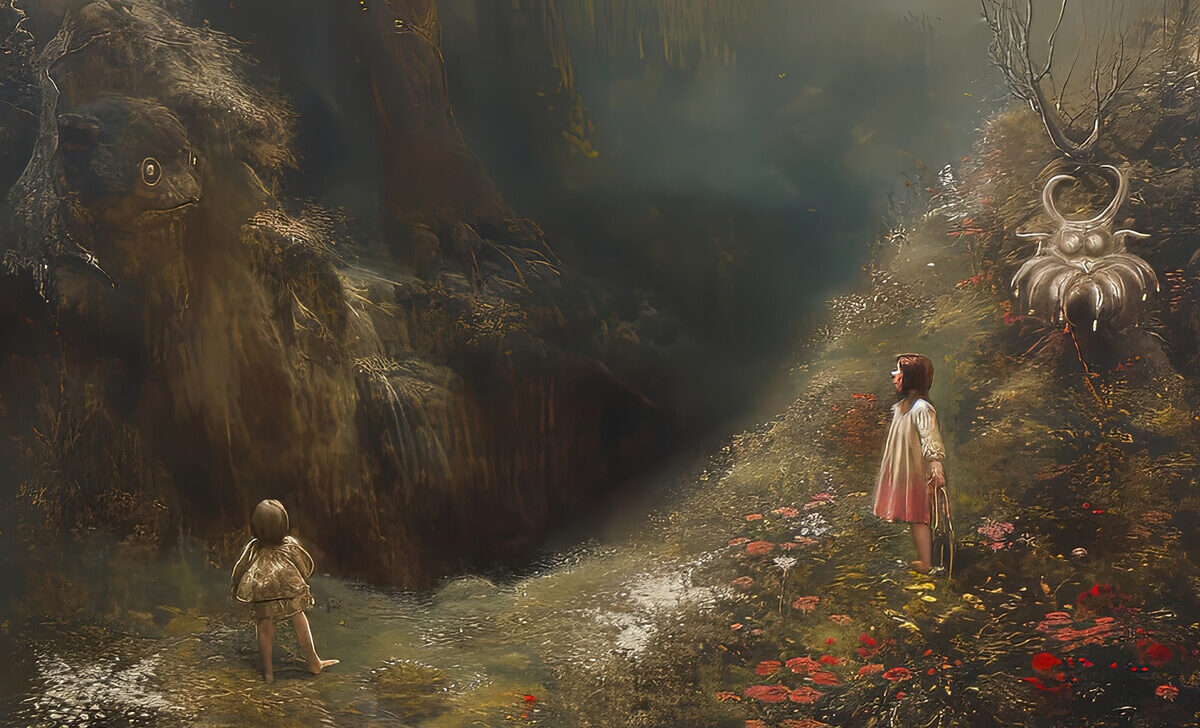
Monsters in dreams are images of fear that the psyche gives a body: the vampire, werewolf, zombie, ghost, witch or creature that chases, bites or haunts the dreamer. In Jungian psychology they are usually read as shadow figures, the disowned parts of ourselves, and sometimes as the echo of real trauma. Asking what the monster wants is often more useful than running from it.
Key takeaways
- Being chased is the most commonly reported dream theme, and monsters are one of the psyche’s most frequent ways of picturing threat.
- Jungian psychology reads most dream monsters as shadow figures, carrying traits, feelings and wishes the dreamer has disowned.
- Each monster has its own emphasis: vampires and drain, werewolves and instinct, zombies and conformity, ghosts and the unfinished past.
- A nightmare that replays a real event points to a stuck trauma memory and calls for trauma processing before symbolic interpretation.
- Dream work and active imagination turn toward the monster, ask what it wants and often change it from enemy into ally.
Why do monsters show up in our dreams?
Monster dreams are among the most ordinary dreams people have. When Tore Nielsen and colleagues gave the Typical Dreams Questionnaire to 1,181 first-year students at three Canadian universities, being chased or pursued was the most widely reported dream theme of all, recalled by roughly four in five students.11 The pursuer is often a person, but it is just as often an animal, a shape or something with no name.
Dream researchers have offered biological answers to why this happens. The Finnish psychologist Antti Revonsuo proposed his threat simulation theory in 2000: dreaming evolved as a night-time rehearsal space where the brain practises seeing and escaping danger, which is why dreams overrepresent chases, attacks and aggression compared with waking life.12 On that account a monster is simply the most efficient way to present danger.
Depth psychology adds a second question. Even if the brain rehearses threat, it chooses a particular threat, on a particular night, in a particular costume. Carl Jung treated that choice as meaningful. He argued that dreams compensate for the one-sidedness of the conscious attitude, bringing forward what waking life has left out.2 The neuroscience of what dreams are explains how the brain builds a dream; the symbol explains why this one.
Are monsters archetypes or shadow figures?
In Carl Jung’s model, an archetype is an inherited pattern of perception and response that sits in the collective unconscious, the layer of the psyche shared by all humans. We never see the archetype itself, only the images it produces in myth, art and dreams. The devouring beast, the walking dead and the restless spirit appear across many cultures, which is why Jung’s circle read them as archetypal images rather than private inventions.3
The archetype most often wearing a monster’s face is the shadow. Jung described the shadow in Aion (German 1951, English 1959) as the part of the personality the ego refuses to recognise in itself: traits, wishes and feelings that do not fit the person we believe we are. Because we do not see it in ourselves, we meet it projected outward, onto other people or, at night, onto dream figures.1 The Jungian shadow is the single idea most needed for reading monster dreams.
Jolande Jacobi, who worked closely with Jung, set out how a personal complex, an emotionally charged cluster of memories and feelings, borrows the energy and imagery of an archetype. Her Complex/Archetype/Symbol in the Psychology of C. G. Jung (1959) explains why a small private fear can arrive in a dream with mythic size.4 Integration, in this tradition, means gradually recognising what the figure carries and taking some of it back into conscious life. Jung called the lifelong version of that process individuation.2
What does a vampire mean in a dream?
The literary vampire took its modern shape in John Polidori’s “The Vampyre” (1819) and Bram Stoker’s Dracula (1897): an aristocratic predator who survives by draining the life of others. In dreams the vampire often appears when someone feels drained by a relationship, an employer or a family role. The dream gives the exhaustion a face and a mouth.
Jung also asked dreamers to read figures on the subjective level, as parts of the dreamer rather than portraits of other people.2 On that reading the vampire may be our own hunger: a wish to take without giving, or a habit of feeding on other people’s approval. Murray Stein, in Jung’s Map of the Soul (1998), lays out this objective and subjective double reading clearly for new readers.
A typical example: a person who looks after everyone dreams of being pursued by a vampire and wakes feeling weak. Working with the dream, the question becomes who is really drawing the blood. Often the drain is the dreamer’s own pattern of overgiving, a pattern Alice Miller traced to children who learn to meet a parent’s needs before their own. The vampire then shows both the cost of that pattern and the starved part of the self that has learned to feed in secret.
What do werewolves mean in dreams?
Werewolf stories are ancient. Ovid’s Metamorphoses tells of King Lycaon turned into a wolf for his cruelty, and medieval and early modern Europe produced trials of alleged werewolves. The link with the full moon was fixed in popular imagination by folklore and by twentieth-century cinema. The core image is a civilised person who changes, against their will, into an animal.
Psychologically the werewolf stages the conflict between the persona, the social mask we wear, and instinct. It tends to appear in the dreams of people who keep anger, desire or aggression under tight control. The fear in the dream is the fear of losing control; the image also shows how much force is locked away. James Conger’s Jung and Reich: The Body as Shadow (1988) argues that much of what we disown lives in the body itself, which is one reason werewolf dreams are so physical. Animal forms of the shadow are a theme of their own, covered in how animals show up in dreams.
A typical example: someone dreams they are turning into a wolf and attacking a family member. The dream does not mean they want to hurt anyone. It usually points to resentment that has never been allowed into words. In therapy the work is to feel that anger safely, find what it is protecting, and give it a voice that does not need fangs.
What do zombies mean in dreams?
The zombie comes from Haitian folk religion, where the zonbi is a person whose will has been taken by a sorcerer. George Romero’s Night of the Living Dead (1968) turned it into the flesh-eating crowd, and his Dawn of the Dead (1978) set the undead loose in a shopping mall, where they wander because the mall was the place they went in life.
That film is the clearest key to zombie dreams. The zombie is the person who keeps moving without being present: conforming, consuming, working on autopilot. Dreams of zombie hordes often come during stretches when someone feels they are losing their individuality, or are surrounded by people who seem to have lost theirs. The horror is less the bite than the possibility of becoming one of them.
A typical example: a dreamer is chased by zombies through a mall. Exploring it, they may notice how much of their week is spent in numbed routine, scrolling and buying, and how afraid they are of stepping out of line. The zombie asks where life has gone dead and what would wake it.
What do ghosts mean in dreams?
Ghosts are the dead who have not finished. In dreams they usually stand for something from the past that still acts on the present: grief that was never mourned, guilt that was never spoken, a family history nobody talks about. Marie-Louise von Franz, in Shadow and Evil in Fairy Tales (revised edition 1995), read the spirits and revenants of folktales as unresolved psychic contents that keep returning until they are given attention.5
The Hungarian psychoanalyst Nandor Fodor, best known for The Search for the Beloved (1949) on birth trauma, also investigated hauntings and argued that poltergeist disturbances were bound up with the repressed conflicts of the living people in the house. The psychological point is the same: what we will not remember tends to haunt us. Regional history can haunt too, as in the psychology of Alabama’s ghosts.
A typical example: a person dreams that a dead parent visits the house, silent and grey. The work is often grief work: naming what was never said, the abandonment or anger mixed in with love, until the figure can either speak or leave.
Are trauma nightmares different from symbolic monster dreams?
Yes, and the difference matters. Many nightmares are symbolic: the monster is new, the setting is strange, and the dream changes from night to night. Post-traumatic nightmares behave differently. They often replay the traumatic event, or something close to it, with the same terror and the same body sensations, and they repeat with little change. Ross Levin and Tore Nielsen’s review of the research describes how nightmares in post-traumatic stress disorder reflect a failure of the brain’s ordinary overnight processing of fear, involving the amygdala, hippocampus and medial prefrontal cortex, and how the distress a nightmare causes is a separate problem from how often it occurs.13
Clinically, a replaying nightmare is first a sign that a memory is stuck, not a symbol waiting for interpretation. Over time, as processing resumes, trauma dreams often loosen and become more symbolic: the attacker turns into a monster, the flood becomes a tidal wave. That shift is usually a good sign. Donald Kalsched’s work on archetypal defences in trauma describes how the psyche also produces protective and persecuting figures after early injury, which helps explain monsters that seem to guard the dreamer as much as attack.
How do monsters reflect cultural fears?
Monsters are personal, and they are also public. The literary scholar Jeffrey Jerome Cohen opened Monster Theory: Reading Culture (1996) with the thesis that the monster’s body is a cultural body: each era builds its monsters out of what it fears, desires and excludes.9 Joseph Campbell described myth as the depersonalized dream and the dream as personalized myth, so that myths are public dreams.
The zombie wave of the 2000s and 2010s, from 28 Days Later (2002) to The Walking Dead (2010 to 2022), tracked fears of pandemic, societal collapse and anonymous crowds. The political scientist Daniel Drezner took the trend seriously enough to use a zombie outbreak to test theories of international relations in Theories of International Politics and Zombies (2011).10 Mathias Clasen has argued that zombies frighten us because they exploit evolved alarms about contagion and predators.
Vampire fiction keeps returning in new forms, from Stoker’s foreign aristocrat to the romantic heroes of recent decades, and it carries anxieties about sex, class and exploitation. Victoria Nelson’s Gothicka (2012) follows how the gothic supernatural has shifted from pure menace toward heroes and even gods. Taking these monsters into dreams and stories gives a culture somewhere to work through fears it cannot easily say out loud.
How do you confront a monster in dream work and active imagination?
In Jungian dream work the monster is not something to banish. It is a figure to approach. Robert A. Johnson’s Inner Work (1986) gives a four-step method for dreams: gather your associations to each image, connect the images to the dynamics of your inner life, form an interpretation, and do a small physical ritual that makes the meaning concrete.6 Robert A. Johnson trained in Zurich and wrote for ordinary readers, and his method remains a standard way into Jungian dream interpretation.
Active imagination goes further. Jung developed it between 1913 and 1916, after his break with Freud, as a way of letting an inner image move and speak while staying awake and engaged.8 Joan Chodorow gathered his writings on the method in Jung on Active Imagination (1997), and Barbara Hannah described its steps and pitfalls in Encounters with the Soul (1981).7 It differs from most meditation, which lets images pass; here you turn toward them, as explained in active imagination vs. meditation.
A worked example of dreamwork with a monster might run like this. The dreamer returns in imagination to the moment the creature appeared. Instead of running, they stop and look at it: its size, its colour, what it does with its hands. They ask it what it wants. The answer may be a word, an image or simply a feeling in the chest. They answer back honestly, including their fear. Johnson’s version of active imagination adds an ethical step, weighing what to do about whatever the figure asks, and a closing ritual act, such as writing the creature’s message down or taking a day of rest it asked for.6 Done this way, the monster often changes shape, shrinks or becomes an ally, and the energy it carried returns to the dreamer.
What do other common monsters mean in dreams?
Vampires
Exploitation, codependency and emotional drain, and the dreamer’s own hidden hunger or wish to take from others.
Werewolves
Primal instinct, fear of losing control, and anger or aggression held down too long.
Zombies
Conformity, loss of individuality, consumerism and life lived on autopilot under social pressure.
Ghosts
Unresolved past events, unprocessed trauma, guilt, and the need to grieve, forgive and release.
Mummies
The past preserved rather than lived, resistance to change, and family or ancestral patterns wrapped up and kept. Boris Karloff’s The Mummy (1932) fixed the image of the ancient dead who wake when disturbed; see the mummy in history and culture.
Frankenstein’s monster
Mary Shelley’s Frankenstein; or, The Modern Prometheus (1818) gives us a creature who turns violent after his maker abandons him. In dreams it can point to playing God, the unintended consequences of what we create, and the rejected part of the self that becomes dangerous because it was never loved.
Demons
Temptation, addiction, self-destruction and inner darkness. Jung described possession by an autonomous complex, a part of the psyche that takes over the ego, which is close to what demon dreams often picture.
Skeletons
Mortality and the transience of life, the old memento mori reminder that everyone dies, and sometimes the bare structure of a situation stripped of its flesh.
The Grim Reaper
The figure of Death with a scythe grew out of late medieval art such as the dance of death. In dreams it usually marks the fear of death and the unknown, or the ending of one phase of life so another can begin.
Witches
Fear of powerful women, the devaluation of feminine intuition and wisdom, and the shadow side of the mother archetype. Von Franz read the fairy-tale witch as the devouring mother; see the history of the witch archetype.5
How do therapists work with monster dreams?
At Taproot we start by asking which kind of dream it is. If a nightmare replays a real event, we treat it as a sign of a stuck memory and work with the nervous system first. Brainspotting, EMDR and somatic work help the body finish processing the experience, and as that happens the nightmares often fade or turn symbolic.
If the monster is symbolic, we work with it the way Jung and Johnson describe. We ask for the dreamer’s associations, notice where the fear sits in the body, and slow down the moment of meeting the creature. Parts work is a natural fit: the monster is often a protective or exiled part of the self that has been carrying anger, grief or need on the client’s behalf. People bring these dreams to therapy for anxiety, grief, burnout, people-pleasing, trouble with anger and the aftermath of trauma. The aim is not to make the monster vanish but to understand what it has been guarding.
Monsters in dreams are rarely just frightening pictures. They carry the parts of us that have been pushed away, the losses we have not mourned and, sometimes, the memories the body still holds. If a recurring creature keeps finding you at night, our therapists use Jungian dream work and trauma therapy to help you turn and face it; you can contact Taproot to begin.
Frequently asked questions
Why do I keep dreaming about being chased by a monster?
Being chased is the most commonly reported dream theme in large surveys of dreamers. Neuroscientists such as Antti Revonsuo see it as the brain rehearsing threat. Jungian therapists add that the chaser is often a shadow figure, something in your own life or personality you are avoiding, and that turning to face it in dream work usually tells you what it is.
What does it mean to dream about a vampire?
A vampire in a dream often points to feeling drained by a relationship, job or family role. Taken on Jung’s subjective level, it can also show the dreamer’s own hidden hunger, such as overgiving to win approval or a wish to take without giving. Asking who is drawing the blood usually opens the dream up.
Is a nightmare about my trauma the same as a monster dream?
Not quite. Post-traumatic nightmares tend to replay the actual event, or something close to it, with little change from night to night. Symbolic monster dreams change shape and setting. A replaying nightmare signals a memory the brain has not finished processing, so trauma therapy such as Brainspotting or EMDR is usually the first step before interpretation.
What does the shadow mean in Jungian dream interpretation?
In Carl Jung’s psychology the shadow is the part of the personality the ego will not recognise as its own: anger, desire, weakness or even talents that do not fit our self-image. Because it is unseen, it appears projected onto other people and onto dream figures, especially monsters, attackers and strangers of the same sex.
How can I face a monster in a dream?
Jungian methods such as Robert A. Johnson’s four-step dream work and Jung’s active imagination invite you to return to the dream image while awake, look closely at the monster, ask what it wants and answer honestly. Many people find the creature changes or softens. With frightening or trauma-linked material it is wiser to do this with a therapist.
Related reading
- What would a Jungian Ethics Look Like?
- Unlocking the Wisdom of Your Dreams: A Journey with the Authors of “Dream Wise”
- Embracing the Shadow of the Feminine Archetypes
- Shadow Work for Beginners: Is It Safe to Do Alone?
- Can Jungian Archetypes be Evidence-Based?
- The Trial of Carl Jung: Assessing a Legacy
References
- Jung, C. G. (1959). Aion: Researches into the phenomenology of the self (R. F. C. Hull, Trans.; Collected Works Vol. 9, Part 2). Princeton University Press.
- Jung, C. G. (1966). Two essays on analytical psychology (2nd ed., R. F. C. Hull, Trans.; Collected Works Vol. 7). Princeton University Press.
- Jung, C. G., von Franz, M.-L., Henderson, J. L., Jacobi, J., & Jaffé, A. (1964). Man and his symbols. Aldus Books.
- Jacobi, J. (1959). Complex/archetype/symbol in the psychology of C. G. Jung (R. Manheim, Trans.). Princeton University Press.
- von Franz, M.-L. (1995). Shadow and evil in fairy tales (Rev. ed.). Shambhala.
- Johnson, R. A. (1986). Inner work: Using dreams and active imagination for personal growth. Harper & Row.
- Hannah, B. (1981). Encounters with the soul: Active imagination as developed by C. G. Jung. Sigo Press.
- Chodorow, J. (Ed.). (1997). Jung on active imagination. Princeton University Press.
- Cohen, J. J. (Ed.). (1996). Monster theory: Reading culture. University of Minnesota Press.
- Drezner, D. W. (2011). Theories of international politics and zombies. Princeton University Press.
- Nielsen, T. A., Zadra, A. L., Simard, V., Saucier, S., Stenstrom, P., & Smith, C. (2003). The typical dreams of Canadian university students. Dreaming, 13(4), 211-235. https://doi.org/10.1023/B:DREM.0000003144.40929.0b
- Revonsuo, A. (2000). The reinterpretation of dreams: An evolutionary hypothesis of the function of dreaming. Behavioral and Brain Sciences, 23(6), 877-901. https://doi.org/10.1017/S0140525X00004015
- Levin, R., & Nielsen, T. A. (2007). Disturbed dreaming, posttraumatic stress disorder, and affect distress: A review and neurocognitive model. Psychological Bulletin, 133(3), 482-528. https://doi.org/10.1037/0033-2909.133.3.482




0 Comments