
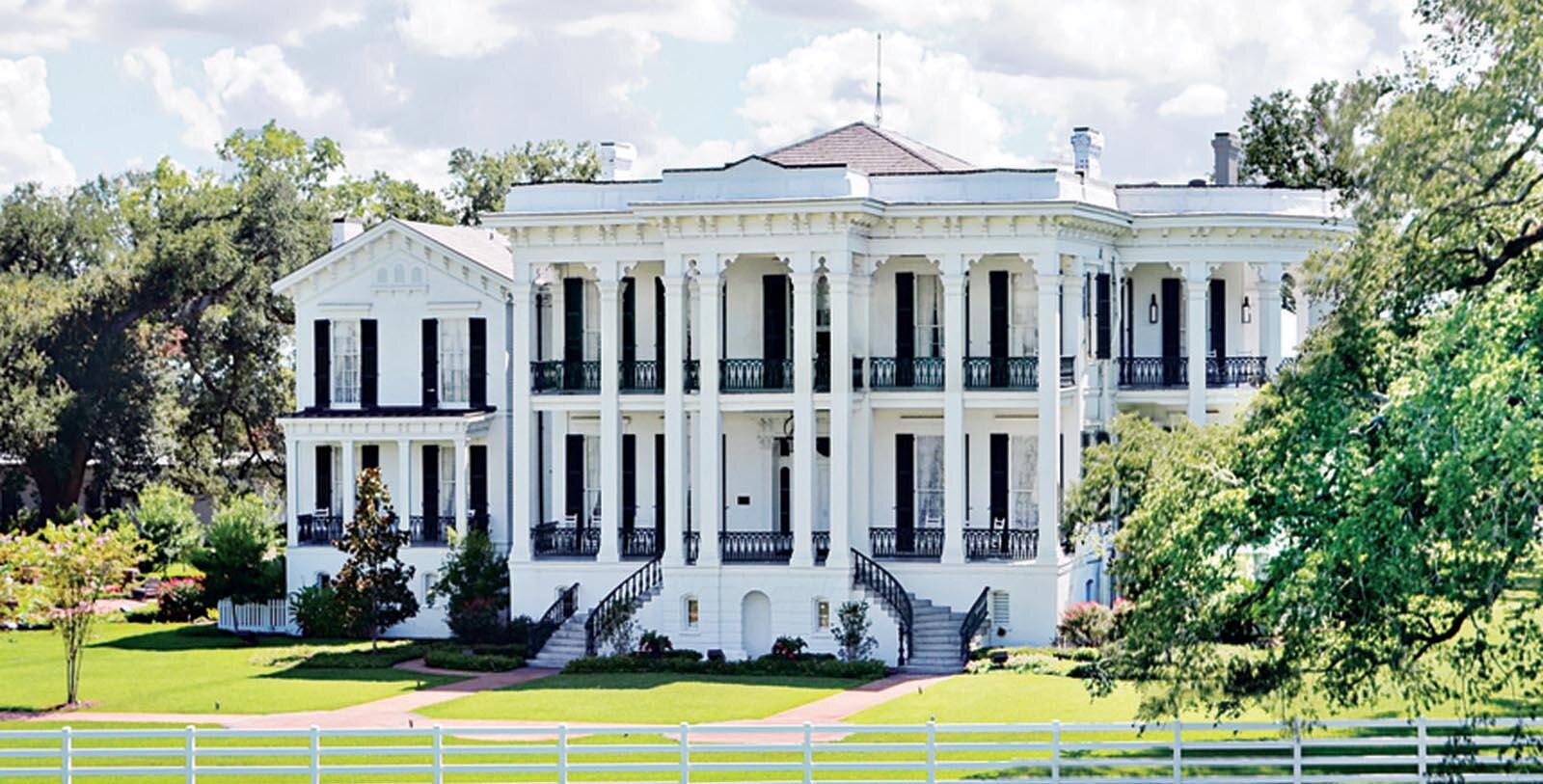
Romantic Architecture: The Psychology of Escapism, the Sublime, and the Faux Ruin
To dismiss Romantic architecture as a mere collection of whimsical cottages and fairy-tale castles is to completely ignore the profound cultural trauma that birthed it. Emerging in the late 18th century and dominating the 19th century, the Romantic movement was a desperate, violent psychological rebellion against the sterile rationalism of the Enlightenment and the brutal mechanization of the Industrial Revolution. Prior to this era, Neoclassicism ruled the Western world, demanding strict mathematical symmetry, logic, and absolute emotional control. But human beings are not machines. As the factory smoke blotted out the skies of London and Paris, the collective psyche suffered a catastrophic rupture. Romantic architecture became the spatial manifestation of an intense cultural anxiety—a desperate yearning to escape the suffocating grip of modern industry by retreating into emotion, irregularity, and the awe-inspiring terror of nature. This architectural shift was heavily driven by the philosophical concept of the Sublime, a concept deeply archived by the Tate Modern, which argues that true aesthetic greatness is found not in perfect beauty, but in that which evokes overwhelming emotion, vastness, and a thrilling sense of existential danger.
The Material Conditions of the Industrial Paradox
The dialectical materialism of Romantic architecture is steeped in profound, almost tragic irony. The architects and patrons of this era deeply despised the soot-choked cities created by the Industrial Revolution, yet they were entirely dependent on the wealth generated by those same factories to fund their rural, escapist fantasies. As explored in our analysis of the Frankfurt School and the architecture of modern trauma, the bourgeoisie attempted to cure their alienation from nature by purchasing highly curated, artificial versions of it. The era was defined by the aesthetic of the Picturesque, as documented by the Victoria and Albert Museum. Landowners would completely bulldoze perfectly good terrain to artificially construct meandering streams, jagged cliffs, and deliberately overgrown hermitages that looked like rustic landscape paintings.
Furthermore, the material construction of these buildings often contradicted their ancient, rustic facades. While attempting to simulate medieval stonework or organic woodland cabins, architects secretly relied on the cutting-edge technological advancements they publicly claimed to despise. They utilized new industrial materials like structural cast iron and plate glass to achieve soaring, airy interiors that traditional masonry could never support. This contradiction is perfectly embodied in the work preserved at Sir John Soane’s Museum in London, where classical ruins, gothic fragments, and modern lighting effects were chaotically assembled to create a deeply psychological, hallucinatory spatial experience.
Jungian Depth Psychology: The Child Archetype and the Faux Ruin
When we examine the psychological forces that move our buildings, Romantic architecture represents a massive societal regression to the Child archetype. Faced with the terrifying, adult responsibilities of the modern capitalist era, the culture unconsciously reached for innocence, wonder, and fantasy. The strict, paternal Animus of Neoclassical geometry was entirely rejected in favor of the maternal, organic Anima of nature. This psychological retreat is a cornerstone of Leon Krier’s theories on the architecture of the archetype, demonstrating how humanity requires environments that engage the imagination rather than merely fulfilling a functional, utilitarian purpose.
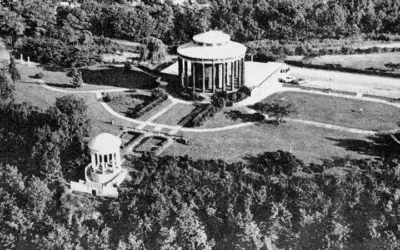
The most fascinating psychological symptom of this era was the obsession with the “faux ruin” or folly. Aristocrats spent vast fortunes hiring architects to build castles and temples on their estates that were intentionally designed to look as though they had been decaying for centuries. A perfect surviving example of this is the landscape garden at Stourhead, managed by the National Trust, which features a deliberately ruined Temple of Apollo. Psychologically, the faux ruin was an ego-defense mechanism. By artificially accelerating the decay of a building, the Romantics were trying to gain control over their deep existential fear of death and the relentless passage of time. They found comfort in the melancholic realization that nature would ultimately conquer all human endeavor.
Nationalism, Identity, and the Escapist Climax
As the 19th century progressed, the political landscape of Europe was fractured by rising nationalism. In an effort to forge distinct cultural identities independent of the homogenized, international Neoclassical style, architects began resurrecting local vernaculars. This intensely emotional search for roots directly overlapped with the spiritual anxieties of Gothic Revival architecture. Nations attempted to legitimize their modern empires by pointing to a heavily romanticized, entirely fictional version of their medieval pasts.
The absolute climax of Romantic architectural escapism occurred in the Bavarian Alps. King Ludwig II, deeply alienated from his political reality and obsessed with the operas of Richard Wagner, completely drained his kingdom’s treasury to build Neuschwanstein Palace. It was not a functioning fortress; it was a pure theatrical stage set, a massive psychological projection of a traumatized monarch retreating entirely into the collective unconscious. This aligns seamlessly with modern theories regarding how spatial design shapes the architecture of the unconscious. Ludwig could not cope with the industrialization of Germany, so he built a physically impossible, fairy-tale monument to hide inside.
The Fall: Exhaustion and the Shift to Eclecticism
Why did this deeply emotional, highly imaginative movement eventually collapse? Simply put, the culture became psychologically exhausted by its own lack of discipline. The intense, hyper-emotional aesthetics of Romanticism, as chronicled by the Metropolitan Museum of Art’s expansive history of the era, eventually lost their subversive edge. When emotion completely overrides rational structure, architecture loses its coherence. The style fractured, bleeding heavily into the chaotic, overstuffed aesthetic of Victorian Eclecticism, where architects simply copy-pasted historical elements from different centuries onto the same building without any underlying philosophical integrity.
Furthermore, as the 20th century dawned, the horrors of World War I completely shattered the romantic illusion that humanity was inherently noble or that a return to the past could save us. The faux ruins and sentimental country estates suddenly felt like offensive, bourgeois delusions in the face of mechanized slaughter. However, the movement’s DNA never fully vanished. Today, whenever we crave organic materials, asymmetrical floor plans, or long to escape the city through the modern practice of Biophilic Design, we are directly channeling the Romantic spirit. As we catalog these sweeping cultural defenses in the dictionary of the psychology of architecture, Romanticism stands as a vital reminder: human beings will always eventually rebel against architecture that attempts to treat them like machines.







0 Comments