
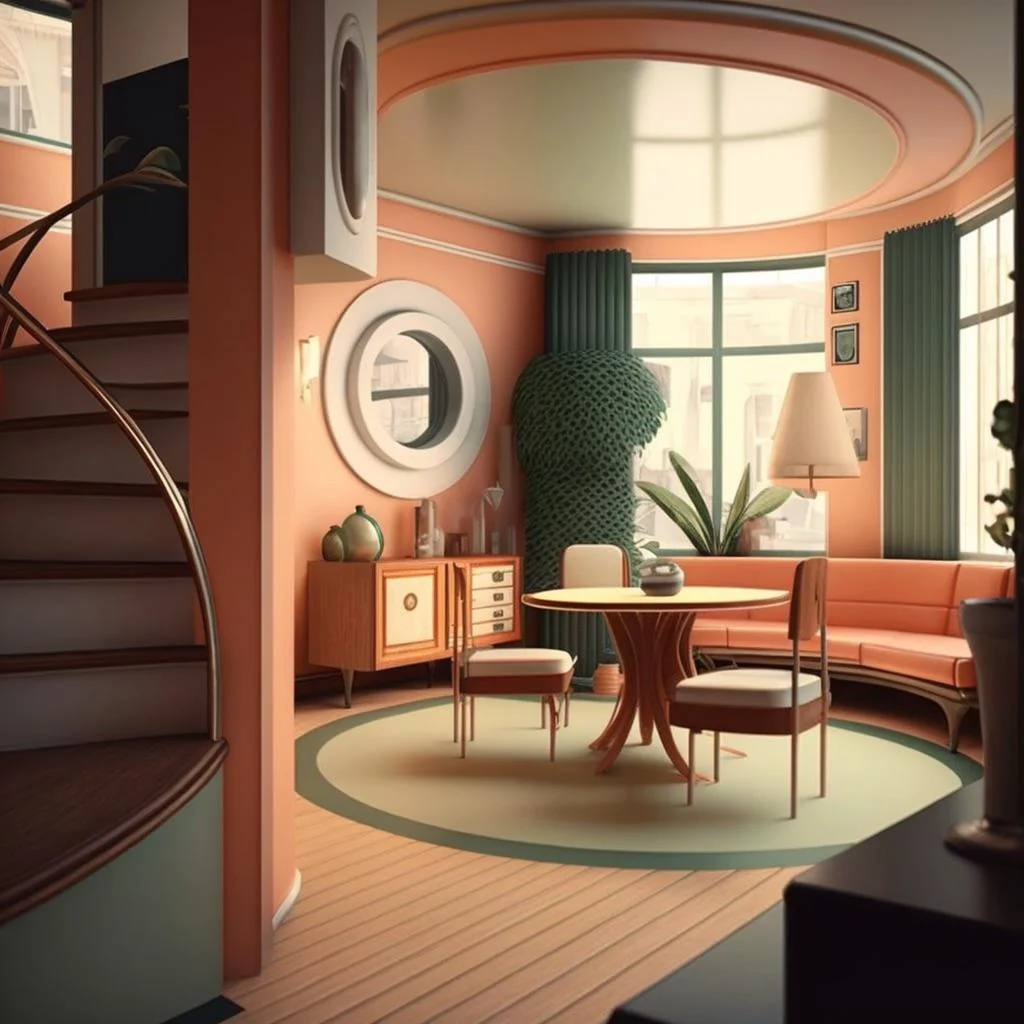
Art Deco was the dominant style of modern ornament in architecture and design from roughly 1910 to 1939, named after the 1925 Paris Exposition des Arts Décoratifs. Its chrome, setbacks, sunbursts and zigzags celebrated the machine, speed and mass-produced luxury. Psychologically, it can be read as a culture’s armor after the First World War and the 1918 influenza pandemic: glamour and control raised over grief.
Key takeaways
- Art Deco ran from roughly 1910 to 1939 and took its public debut, and later its name, from the 1925 Paris Exposition des Arts Décoratifs.
- New materials such as chrome, plate glass and Bakelite let machine-made glamour reach the middle class instead of only the wealthy.
- Read psychoanalytically, Deco’s polish, speed and control resemble the manic defense Melanie Klein and Donald Winnicott described in 1935: triumph over grief instead of mourning.
- Deco skyscrapers such as the Chrysler Building work like a Jungian persona, a corporate mask designed to impress and to conceal.
- The Depression produced Streamline Moderne, and wartime metal restrictions plus the rise of the International Style ended the era of applied ornament.
What was Art Deco, and where did it come from?
Art Deco is usually remembered as the look of the Roaring Twenties, but its roots run earlier and its moods run darker. French designers were already working in a geometric, simplified decorative idiom before 1914. Auguste Perret’s Théâtre des Champs-Élysées in Paris, finished in 1913 with reliefs by Antoine Bourdelle, is often cited as an early example. The Victoria and Albert Museum’s 2003 exhibition and catalogue, Art Deco 1910–1939, dates the style across that whole span and treats it as an international movement rather than a single decade’s fashion.1
The name itself came late. People in the 1920s and 1930s spoke of “le style moderne,” “modernistic” or “jazz modern.” The short label “Art Deco” spread after a 1966 retrospective at the Musée des Arts Décoratifs in Paris and the British historian Bevis Hillier’s 1968 book Art Deco of the 20s and 30s.2
The psychological climate matters for reading the style. The First World War killed millions with machine guns, artillery and gas, and the influenza pandemic of 1918 to 1920 killed tens of millions more. Clinicians who studied that war, from the “shell shock” doctors onward, described a generation carrying grief it had no language for, a theme traced in how therapists have understood war. The culture that came out of those years did not build quiet memorials alone. It also built gleaming, geometric, controlled surfaces.
Was Art Deco a manic defense against grief?
The phrase “manic defense” comes from psychoanalysis. Melanie Klein introduced it in her 1935 paper on manic-depressive states and developed it in “Mourning and its Relation to Manic-Depressive States” in 1940. For Klein, the manic defense protects the mind from the pain of loss through omnipotent control, a sense of triumph, and contempt for whatever is dependent or vulnerable. Mourning, by contrast, means letting the loss be felt.8
In the same year, 1935, Donald Winnicott read his own paper, “The Manic Defence,” to the British Psycho-Analytical Society. He described it as a flight from inner reality toward external reality and toward ideas of lightness, liveliness and movement, a way of denying deadness and depression inside.9
Applied to a whole culture, this is an interpretive lens rather than a measured finding, but it fits the evidence of the buildings closely. Deco answers loss with polish, speed and upward motion. It turns the machines that had just mechanized slaughter into chrome trim, ocean liners and radio cabinets. Writers associated with the Frankfurt School and the architecture of modern trauma made related arguments in real time. In his 1927 essay “The Mass Ornament,” Siegfried Kracauer looked at the Tiller Girls, the precision dance troupe whose identical legs moved like parts of one machine, and read them as the ornament of a rationalized, capitalist age: pattern without inner meaning.10 Art Deco is that same pattern made in stone and steel, a gleaming mask of order over a recent past that was anything but orderly.
The material conditions of mass-produced luxury
Before the war, architectural prestige in Europe and America was tied to the academic tradition: carved masonry, classical orders and the handcrafted ornament taught at the École des Beaux-Arts in Paris, the tradition behind Beaux-Arts architecture. Art Deco kept the love of ornament but changed its materials and its method of production.
Designers now had chrome-plated steel, aluminum, plate glass, terrazzo, reinforced concrete and new synthetic plastics. Bakelite, patented by the Belgian-American chemist Leo Baekeland in 1909 after work he began in 1907, was the first fully synthetic plastic. The American Chemical Society, which designated Baekeland’s original reactor a National Historic Chemical Landmark in 1993, describes how the material could be moulded cheaply into hard, glossy, dark forms.3 Radios, telephones, jewelry and clocks in Bakelite carried the Deco look into ordinary homes.
This is the core of the style’s psychology of class. Luxury was no longer only for the aristocracy. Through the machine, glamour could be stamped, polished and sold to a growing middle class. Birmingham’s own iron colossus, the Vulcan statue, comes from the same industrial imagination: a city that understood itself through its furnaces.
The movement took its name and its public debut from the Exposition Internationale des Arts Décoratifs et Industriels Modernes, held in Paris from April to October 1925. Pavilions such as Jacques-Émile Ruhlmann’s Hôtel du Collectionneur showed lacquer, exotic veneers and geometric inlay. The exhibition’s rules required work that was modern and original, and most of it set aside the whiplash vines and flowing organic curves of Art Nouveau in favor of crisp lines, stepped forms and stylized flowers.1
The skyscraper and the Jungian persona
When thinking about the psychological forces that move our buildings, Art Deco offers one of the clearest images of what Carl Jung called the persona. In The Relations between the Ego and the Unconscious (1928), Jung described the persona as “a kind of mask,” a compromise between the individual and society that is designed to make an impression on others and to hide what lies underneath.6 What the persona hides is close to what Jung called the shadow, the parts of us that do not fit the image. Readers new to these terms can start with a short introduction to Jungian psychology.
Art Deco skyscrapers are corporate personas in the most literal sense. In New York in the late 1920s, a booming economy and cheap credit funded a race for height. The architectural historian Carol Willis has shown that these towers were shaped as much by land values, rents and financing as by any architect’s vision.4 Their faces were advertising.
The Chrysler Building
William Van Alen’s Chrysler Building, completed in 1930, was briefly the tallest building in the world at 1,046 feet. Its crown of terraced stainless-steel arches, pierced with triangular windows in a sunburst pattern, was assembled in secret inside the tower and raised into place in October 1929. Its metal ornaments copy the company’s products: winged radiator caps at the 31st floor and steel eagle heads at the 61st. The building is a mask for the Chrysler brand and for the ego of a commercial age.
Ziggurats, sunbursts and chevrons
The stepped silhouette of these towers had a legal source as well as a symbolic one. New York’s 1916 Zoning Resolution required tall buildings to step back as they rose so that light could reach the street, and the resulting setback “ziggurats” were dramatized in Hugh Ferriss’s charcoal drawings in The Metropolis of Tomorrow (1929).5 Designers then leaned into ancient imagery. The opening of Tutankhamun’s tomb in November 1922 set off a craze for Egyptian motifs, and Mayan and Aztec stepped pyramids supplied more. Sunbursts, chevrons and ziggurats are very old symbols of the sun and of sacred power. In Deco they appear in a cleaned-up, geometric form, put to work projecting corporate strength.
Gothic spires, the hero and the god of commerce
The verticality of Deco is not the verticality of the heaven-reaching spires of Gothic Revival architecture. The contrast is clearest just before the Deco years. Cass Gilbert’s Woolworth Building, a Gothic Revival skyscraper finished in 1913, was nicknamed the “Cathedral of Commerce”: a commercial building still borrowing the clothes of spiritual longing. A generation later the Chrysler and Empire State buildings dropped the cathedral and kept the commerce. Their spires point to the company, the machine and the record.
In Jungian terms this is the energy of the hero archetype. Jung traced the hero myth at length in Symbols of Transformation, and Joseph Campbell mapped its stages in The Hero with a Thousand Faces (1949): the hero leaves the known world, faces a monster and returns with a prize.7 Read through that lens, the Deco skyscraper is a hero who has conquered nature by willpower and engineering, and who no longer needs nature at all. The historian Lewis Mumford later called this faith in the megamachine a kind of religion, an idea traced in the machine as false god. The “machine god” of Art Deco is its brightest early altar.
The Great Depression and the shift to Streamline Moderne
The party ended with the stock market crash of October 1929. Several of the great Deco towers, including the Empire State Building in 1931, opened into a collapsing economy and stood partly empty for years. Clients could no longer pay for gold leaf, rare woods and bespoke metalwork. The style adapted into what is now called Streamline Moderne: smooth rounded corners, long horizontal bands, porthole windows and “speed lines” in place of zigzag ornament.
Streamlining came from industrial design as much as from architecture. The historian Jeffrey Meikle traces how designers such as Norman Bel Geddes, whose book Horizons appeared in 1932, and Raymond Loewy applied the teardrop forms of aerodynamics to trains, toasters and pencil sharpeners, promising consumers that the future was moving fast even when the economy was not.11
This was an architecture of psychological escape, in Winnicott’s sense of a flight toward movement and lightness. Buildings that were not going anywhere were designed to look as if they were doing a hundred miles an hour.
The Hoover Dam
Public works carried the same need for forward momentum. The Hoover Dam, built between 1931 and 1936 and dedicated by Franklin Roosevelt in 1935, is an engineering monument dressed in Art Deco. The Los Angeles architect Gordon Kaufmann designed its streamlined towers and powerhouses, and the sculptor Oskar J. W. Hansen made the bronze “Winged Figures of the Republic” at its dedication plaza. The dam declared that the federal government could control the chaotic forces of a river and, by implication, of the economy.
Miami Beach and Tropical Deco
In places that needed tourists, the style adapted to the climate. Miami Beach hotels built from the mid-1930s into the early 1940s by architects such as Henry Hohauser and L. Murray Dixon added eyebrow sunshades, glass block and nautical railings. The Miami Design Preservation League, founded in 1976 by Barbara Baer Capitman, fought to save them, and the district was listed on the National Register of Historic Places in 1979.12 The famous pastel palette came mostly from the 1980s restoration, when designer Leonard Horowitz repainted façades in pinks, turquoises and lavenders. Even in its Depression form, then, Deco offered a cheap, theatrical façade of Hollywood glamour, and later generations kept adding to the mask.
The fall: fascism, World War II and the death of ornament
Why did a style so widely loved fade so quickly? The rigidity that made Art Deco comforting in the 1920s became a liability by the 1940s. Through the 1930s, late Deco blended into a monumental “stripped classicism”: simplified columns, flat surfaces, enormous scale. Governments of every kind used it, from Paul Cret’s Federal Reserve Board building in Washington to the Palazzo della Civiltà Italiana in Mussolini’s Rome and Albert Speer’s Reich Chancellery in Berlin. In the totalitarian versions the scale was designed to dwarf the individual and glorify the state. Wilhelm Reich’s analysis of fascism, first published in 1933, argued that authoritarian movements feed on a character structure shaped by rigid, authoritarian upbringing and the repression of feeling, the same armor this architecture made visible. By the time war came, those associations had soured the whole monumental vocabulary.
The material conditions of the Second World War finished the job. In the United States, the War Production Board’s Conservation Order L-41 of April 1942 halted most nonessential construction, and steel, chrome, copper and aluminum went to the war effort. Decorating a building with scarce metal was no longer just frivolous. It looked unpatriotic.
After the war, the culture was exhausted by heroic narratives and theatrical façades. Architecture turned toward the austere, unornamented rationality of Modernism, the movement later revived in Modernism and Neo-Modernist principles. The ideas behind it were older. Louis Sullivan wrote in 1896 that “form ever follows function.” The Viennese architect Adolf Loos gave his lecture “Ornament and Crime” in 1910, arguing that ornament wasted labor and materials and was a sign of cultural backwardness.14 Henry-Russell Hitchcock and Philip Johnson named “the International Style” in their 1932 Museum of Modern Art exhibition and book.13 Its leading figures had fled Europe: Walter Gropius reached Harvard in 1937 and Ludwig Mies van der Rohe moved to Chicago in 1938. Their glass towers became the new corporate persona, with the ornament removed.
What does Art Deco teach a therapist?
Art Deco is a useful picture of something we see in therapy every week: a polished, controlled surface built over a loss that was never mourned. The individual version looks like relentless productivity, perfectionism, a curated image, constant motion and a quiet contempt for one’s own need. These are the marks Klein and Winnicott described. They work, often for years, until something breaks the façade.
In Jungian therapy, the work is not to smash the persona. Everyone needs one. The aim is to loosen a person’s identification with it so the ego can meet what the mask was built to hide. Donald Kalsched’s writing on archetypal defenses and the healing of trauma describes how such protective systems form after early injury and why they deserve respect even as they are softened.
The armor is also physical. Bracing, shallow breath, a fixed smile and an inability to sit still are the body’s version of chrome and steel. Somatic therapy and Brainspotting work with those held states directly, so that grief stored below words can move. At Taproot, we combine that body-based work with depth psychology, attending both to the images a person lives by and to what their nervous system is guarding.
Why Art Deco still matters
Art Deco remains one of the most loved styles in the world, and for good reason: it is beautiful, confident and full of craft. It is also a record of a generation’s attempt to engineer its way out of suffering, a chrome-plated shield that held off the anxieties of the interwar years until the world went to war again. If your own life has started to feel like a gleaming façade over something unspoken, the therapists at Taproot can help you find what is underneath. You can contact Taproot Therapy Collective to begin.
Frequently asked questions
Why is it called Art Deco?
The name is a shortening of the Exposition Internationale des Arts Décoratifs et Industriels Modernes, held in Paris in 1925. People at the time called the style le style moderne or modernistic. The label Art Deco caught on only after a 1966 Paris retrospective and Bevis Hillier’s 1968 book Art Deco of the 20s and 30s.
What are the main features of Art Deco architecture?
Art Deco architecture uses stepped setbacks, vertical emphasis, geometric ornament such as sunbursts, chevrons and zigzags, and modern materials like chrome, stainless steel, terrazzo and glass. Motifs borrowed from Egyptian and Mesoamerican art are common. Famous examples include the Chrysler Building and the Empire State Building in New York.
What is the difference between Art Deco and Streamline Moderne?
Art Deco, at its 1920s height, favored vertical lines, rich materials and sharp geometric ornament. Streamline Moderne, which grew during the 1930s Depression, stripped most ornament away and borrowed from aerodynamics: rounded corners, long horizontal bands, porthole windows and speed lines, making buildings look as if they were moving.
What is a manic defense in psychology?
A manic defense is a psychoanalytic term, introduced by Melanie Klein and Donald Winnicott in 1935, for protecting the mind from loss and depression through control, triumph, busyness and contempt for vulnerability. Instead of mourning, the person speeds up and polishes the surface. Art Deco is sometimes read as a cultural version of this after World War I.
Why did Art Deco go out of style?
Art Deco faded in the 1940s for several reasons. Its monumental late form had become associated with totalitarian regimes, wartime rules such as the 1942 Conservation Order L-41 diverted steel, chrome and aluminum to the war, and postwar architects embraced the unornamented International Style of Gropius and Mies van der Rohe.
Related reading
- The Architecture of the Self and the Anatomy of Trauma: A Consilient Analysis of Depth Psychology, Somatic Interventions, and Computational Neuroscience
- The Emperor’s Inner Work: Marcus Aurelius, Meditations, and the Roots of Psychotherapy
- The Secret Carl Jung: Uncovering the Censored Material from Memories, Dreams, Reflections
- Romantic Architecture: Embracing Emotion and Nature
- Biophilic Design: Reconnecting Humans with Nature through Architecture
- New Materialism in Architecture: Embracing Material Agency and Ecological Thinking
References
- Benton, C., Benton, T., & Wood, G. (Eds.). (2003). Art Deco 1910–1939. V&A Publications.
- Hillier, B. (1968). Art Deco of the 20s and 30s. Studio Vista.
- American Chemical Society. (1993). Bakelite: The world’s first synthetic plastic. National Historic Chemical Landmarks program.
- Willis, C. (1995). Form follows finance: Skyscrapers and skylines in New York and Chicago. Princeton Architectural Press.
- Ferriss, H. (1929). The metropolis of tomorrow. Ives Washburn.
- Jung, C. G. (1966). Two essays on analytical psychology (R. F. C. Hull, Trans.; 2nd ed., Collected Works Vol. 7). Princeton University Press. (Original work published 1928)
- Campbell, J. (1949). The hero with a thousand faces. Pantheon Books.
- Klein, M. (1975). Love, guilt and reparation and other works, 1921–1945. Hogarth Press and the Institute of Psycho-Analysis.
- Winnicott, D. W. (1958). The manic defence. In Collected papers: Through paediatrics to psycho-analysis. Tavistock Publications. (Original work presented 1935)
- Kracauer, S. (1995). The mass ornament: Weimar essays (T. Y. Levin, Ed. & Trans.). Harvard University Press. (Original essay published 1927)
- Meikle, J. L. (1979). Twentieth century limited: Industrial design in America, 1925–1939. Temple University Press.
- Capitman, B. B. (1988). Deco delights: Preserving the beauty and joy of Miami Beach architecture. E. P. Dutton.
- Hitchcock, H.-R., & Johnson, P. (1932). The International Style: Architecture since 1922. W. W. Norton.
- Loos, A. (2019). Ornament and crime (S. Whiteside, Trans.). Penguin Books. (Original lecture delivered 1910)







0 Comments