
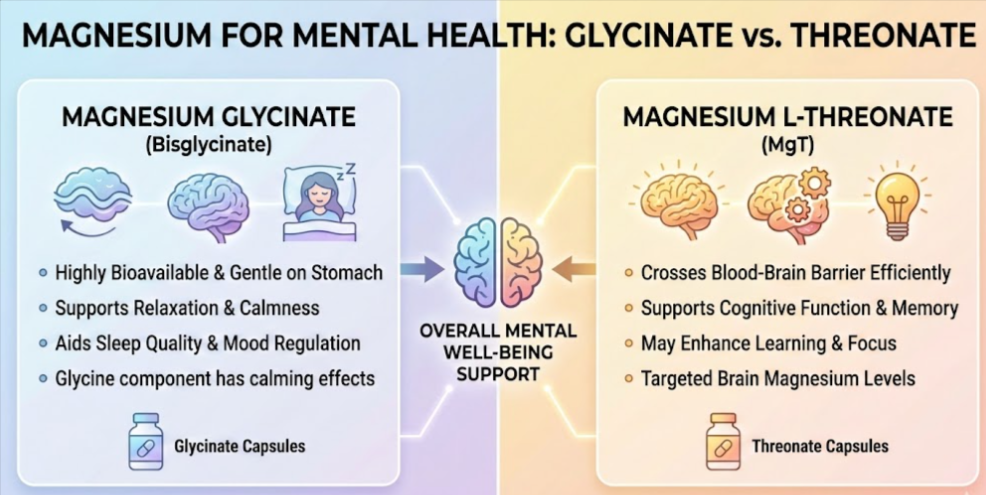
Magnesium L-threonate is sold as the brain form because it raised brain magnesium in rats. In people, the placebo-controlled trials of cognition and sleep are four small, industry-backed studies with mixed results. Magnesium glycinate is a gentle, well-tolerated form with one modest placebo-controlled sleep trial. We found no study comparing the two directly, so tolerability, cost and your prescriber’s advice should decide.
The question of which form to buy carries a hope larger than the mineral: that the right molecule will make an anxious or stuck brain ready to change. The evidence supports a smaller and more useful claim. Form changes how much magnesium you absorb and how your gut reacts. It has not been shown to change what magnesium does inside the human brain, and much of the human evidence that magnesium helps sleep or mood comes from plain oxide, citrate and chloride, the forms supplement marketing calls inferior. Choosing between threonate and glycinate is a practical decision, not a neurological one.
What the two forms are, and what the label numbers mean
Magnesium is a required cofactor for more than 300 enzyme systems. Only about 1 percent of the body’s magnesium sits outside cells, which is one reason a blood test says little about total stores.2 Supplements pair the mineral with a carrier molecule. Magnesium L-threonate pairs it with threonate, a metabolite of vitamin C.3 Magnesium glycinate, usually sold as bisglycinate, pairs each magnesium ion with two molecules of the amino acid glycine.
The carrier sets how much elemental magnesium you get per gram. Magtein, the branded threonate used in two of the trials below, contains about 75 mg of elemental magnesium per gram,4 so a 2 g daily dose supplies roughly 140 to 150 mg. A 250 mg dose of elemental magnesium as bisglycinate comes with about 1.5 g of glycine.5 Magnesium oxide is about 60 percent magnesium by weight, which is why one small oxide tablet can carry a large number on the label.6
For reference, the National Academies set the adult Recommended Dietary Allowance at 420 mg a day for men and 320 mg for women aged 31 to 50. They set the tolerable upper intake level at 350 mg a day of magnesium from supplements and medicines, not food, because the first sign of too much non-food magnesium is diarrhea.2 European regulators use a lower ceiling of 250 mg for supplemental magnesium from readily dissociating salts.7 These are reference values, not a recommendation to take any amount.
Low intake is common, but it is not the same as deficiency. In 2005 and 2006, about 48 percent of Americans got less magnesium from food than the required amount.8
Absorption: real differences, smaller than the marketing
A 2003 randomized trial at the University of Reading gave 46 healthy adults 300 mg a day of magnesium as an amino-acid chelate, citrate or oxide for 60 days. Both organic forms beat oxide on urinary magnesium, citrate produced the highest blood and saliva levels, and oxide did no better than placebo.11 Glycinate’s own key study is a 1994 crossover trial in 12 patients who had lost part of the small intestine to surgery. Overall, absorption from glycinate and oxide was the same, 23.5 versus 22.8 percent. Glycinate did better only in the four patients who absorbed oxide worst, and everyone tolerated it better. The authors suggested that some glycinate is absorbed intact through a dipeptide pathway.12 That is where the peptide-transporter story comes from, and it rests on a dozen patients.
The finished product can matter as much as the salt. In a Belgian test of 15 commercial products, dissolution varied widely, and in 30 volunteers a tablet mixing oxide with glycerophosphate clearly outperformed plain oxide.6 A 2021 systematic review of 14 comparison studies found organic forms generally more bioavailable than inorganic ones, with absorption depending on dose, and concluded that any of them can maintain normal levels in healthy people without a prior deficit.13
The three placebo-controlled sleep trials pooled in a 2021 meta-analysis used magnesium oxide and citrate,14 and the best-known depression trial used magnesium chloride.15 Whatever modest effects magnesium has on sleep and mood, much of the evidence for them comes from the cheap forms.
Threonate: strong in rats, thin in people
What the animal studies showed
The case for threonate comes from Guosong Liu’s laboratory. In a 2010 Neuron paper, with MIT as the lead institution, his group reported that magnesium L-threonate raised brain magnesium in rats and improved learning, working memory, and short- and long-term memory, along with denser synaptic contacts in the hippocampus.16 A later paper summarizes that work as a 7 to 15 percent rise in cerebrospinal fluid magnesium over 24 days, which the other magnesium compounds tested did not produce.3 A 2011 study found that threonate helped rats retain fear extinction, the learning that a once-dangerous cue is now safe, without erasing or strengthening the original fear memory. The changes appeared in the prefrontal cortex but not in the amygdala.17 In cultured neurons, threonate itself raised magnesium inside the cells, an effect the authors traced to glucose transporters.18 A 2014 paper reported less plaque and preserved memory in a mouse model of Alzheimer’s disease.19
The underlying biology is real. Magnesium ions block the NMDA receptor’s channel at rest, and the block lifts when the neuron is depolarized, so the receptor passes current mainly when a cell is already active. Two groups described this voltage-dependent block in 1984.20, 21 The open question is whether a supplement changes that system in a living human brain, where the blood-brain barrier holds cerebrospinal fluid magnesium in a narrow range. Liu’s group notes, citing older human data, that raising blood magnesium by up to 300 percent changes cerebrospinal fluid magnesium by less than 19 percent.22
Three cautions apply. The four animal and cell studies above all came from one research group, whose leader reported co-founding Magceutics, a company developing treatments for age-related memory decline, and filing a U.S. patent application on magnesium L-threonate.17
What the human trials showed
The 2016 trial enrolled 51 adults aged 50 to 70 with cognitive impairment and analyzed 44. After 12 weeks on 1.5 to 2 g a day, the threonate group improved more on a composite of four cognitive tests. The widely repeated line that threonate “reversed brain age by nine years” comes from this study: the authors converted scores on one timed test, Trail Making B, into an estimated brain age and reported a 9.4-year improvement. The same paper says strong placebo effects made it impossible to determine any effect on sleep or anxiety. Neurocentria, the company where the lead author worked, funded the study and helped design it.22
A 2022 trial in 109 healthy Chinese adults found better scores on a standard memory test after 30 days. The product combined threonate with phosphatidylserine and vitamins C, D and B6 and was supplied by Magceutics, with funding from Wu-xi Magtein Bioscience, so the result cannot be pinned on threonate.3 A 2024 sleep trial gave 80 adults 1 g a day for 21 days. Ring-measured deep and REM sleep scores favored threonate, but on the Insomnia Severity Index both groups improved and the difference between them was not significant. AIDP commissioned and funded it, three of its six authors were paid by AIDP, and a 2025 correction states that the trial was registered only retrospectively.4 The most recent, a trial of 100 adults with poor sleep published in 2026, found advantages on an overall cognition score (p = 0.043) and reaction time after six weeks of 2 g a day, but no difference on a reasoning test or in any sleep measure from the wearable ring, and mixed results on self-rated sleep. Threotech, which supplied the product, funded the study and helped design it;24 the company describes itself as the exclusive global supplier and patent licensee for Magtein.25 An open-label pilot in 15 adults with ADHD had no placebo group.26 Outside cognition and sleep, a 2023 trial funded by public research grants in China gave 109 women threonate or placebo for 12 weeks after breast cancer surgery. It found no benefit for persistent pain and no group differences on anxiety, depression, sleep or cognitive screening scores.27
Read together, that is a plausible signal for modest cognitive effects from a short list of company-backed trials, set against one independent trial that found nothing on mood or sleep. It is not evidence of “structural brain change” in humans. We found no trial of threonate for PTSD, depression or an anxiety disorder, and none testing it as an add-on to psychotherapy.
Glycinate, and what magnesium in general can and cannot do
Glycinate’s main selling point is that it is easy on the gut, which rests more on clinical experience and the 1994 tolerance finding than on large trials.12 Its first placebo-controlled sleep trial, by its authors’ account, appeared in 2025. In 155 German adults with self-reported poor sleep, 250 mg a day of magnesium as bisglycinate for four weeks lowered Insomnia Severity Index scores by 3.9 points, against 2.3 for placebo (p = 0.049). The authors called the effect small (Cohen’s d = 0.2). There was no difference in perceived stress, mood or a brief depression and anxiety screen, and an exploratory analysis suggested larger benefits in people who ate less magnesium to begin with. The trial was funded by Leibniz University Hannover.5 The fair summary: glycinate is a reasonable thing to try for sleep once a prescriber has okayed it, with a small expected effect.
The glycine half of the story is also smaller than advertised. In a 2007 study of volunteers with unsatisfying sleep, 3 g of glycine at bedtime improved subjective sleep quality and shortened the time to fall asleep.28 In rats, oral glycine lowered core body temperature by increasing blood flow to the skin, and the authors traced the effect to NMDA receptors in the suprachiasmatic nucleus; blocking glycine’s own inhibitory receptor did not stop the change in skin blood flow.29 So the earlier claim that glycinate adds “GABAergic calming” was wrong twice over: glycine is not GABA, and in rats its sleep-linked cooling ran through NMDA receptors rather than glycine’s own inhibitory receptor. A 250 mg dose of magnesium as bisglycinate delivers about half the glycine used in the human study.5
Across forms, the magnesium literature is modest. A 2021 meta-analysis of three trials in 151 older adults found that people fell asleep about 17 minutes sooner on magnesium, with low to very low quality evidence.14 A 2017 systematic review of 18 studies called the evidence for anxiety suggestive in people already prone to it, and of poor quality.30 For depression, a 2018 meta-analysis found that magnesium looked impressive in uncontrolled studies (g = −1.60) and small and not statistically significant in placebo-controlled ones (g = −0.21).31 A 2023 meta-analysis of seven placebo-controlled trials with 325 adults with depression found a larger benefit and called for bigger, better trials.32 The best-known positive trial was open-label, used magnesium chloride and compared it with no treatment rather than a placebo.15
Some popular uses do not hold up. For the idiopathic night-time leg cramps common in older adults, a 2020 Cochrane review found no meaningful reduction in cramp frequency or intensity with magnesium compared with placebo.33 T
ADHD, autism, qEEG and other claims we removed
A 1997 Polish study of 116 children with ADHD reported low magnesium in 95 percent by at least one of three measures, most often in hair (77.6 percent) and least often in blood serum (33.6 percent).36 A 2019 meta-analysis of seven studies found serum magnesium about 0.1 mmol/L lower on average in ADHD, with very high heterogeneity between studies (I² = 96 percent).37 That is an association worth studying. It is not evidence that magnesium treats ADHD, and the one threonate study in ADHD had no placebo group.26
The autism section cited 1980s French studies of vitamin B6 with magnesium as confirmation; a Cochrane review of the randomized trials found three small studies and could make no recommendation.38 The qEEG section’s claim that well-nourished clients learn neurofeedback faster was an impression, not a measurement.
Safety, stacking and who should ask first
Magnesium from food has not been shown to cause harm, and healthy kidneys clear an excess well. Problems come from non-food magnesium, especially in people with reduced kidney function, where too much from supplements or antacids can cause hypermagnesemia, with neurological and cardiac symptoms at high blood levels.2 Anyone with kidney disease should talk with their physician before taking a magnesium product.
Magnesium also binds some drugs in the gut. FDA labeling warns that magnesium-containing antacids can cut the absorption of the antibiotic ciprofloxacin by as much as 90 percent, that antacids containing magnesium impair absorption of tetracyclines such as doxycycline, and that products containing multivalent cations interfere with the osteoporosis drug alendronate.39, 40, 41 If you take any of these, ask your pharmacist how to time magnesium around them.
The European safety opinion on threonate excluded pregnant and breastfeeding women,7 and the U.S. upper limit of 350 mg applies from age nine; younger children have lower limits.2 Supplements in pregnancy or for children belong in a conversation with an obstetric provider or pediatrician.
What this looks like in therapy
Clients often arrive with a supplement list, and we treat it as information. What someone hopes each product will do tells us a good deal: whether they want sleep, a quieter body, a sharper mind, or proof that the problem is chemical rather than personal. We do not prescribe or dose supplements; when a client wants to try magnesium, we send them to their prescriber or pharmacist with the whole list.
The rat finding on fear extinction shows how to read this research. Extinction is learning. The animals still had to go through extinction training; threonate, at most, helped them keep what they learned. In people, comparable learning happens in exposure work, in trauma-focused therapies such as EMDR, and in the slower experience of being safe with another person. How traumatic memories are stored and updated is its own subject, covered in how trauma is stored in different kinds of memory. Threonate has not been shown to speed that work in humans.
For sleep, magnesium belongs alongside the basics, not in place of them: a consistent wake time, less caffeine late in the day, and an evaluation if insomnia persists rather than another bottle. We compare other options in our review of natural remedies for insomnia, and other supplements sold with brain-health language in posts on magnolia bark for anxiety and NAD+ for mental health. The pattern is similar across them: plausible mechanisms, small trials, and claims that run ahead of both.
If anxiety, poor sleep or a sense of being stuck is what sent you searching for magnesium forms, that deserves more attention than a label comparison. Our clinicians in Hoover work with anxiety and panic, including the body symptoms that often send people to the supplement aisle, and coordinate with prescribers when medications or supplements are involved. You can contact us to ask about an appointment.
References
- Hardy Nutritionals. (n.d.). Open a health professional account. Retrieved November 8, 2026, from https://www.hardynutritionals.com/myaccount/referral_code
- Institute of Medicine. (1997). Dietary reference intakes for calcium, phosphorus, magnesium, vitamin D, and fluoride. National Academy Press. https://doi.org/10.17226/5776
- Zhang, C., Hu, Q., Li, S., Dai, F., Qian, W., Hewlings, S., Yan, T., & Wang, Y. (2022). A Magtein®, magnesium L-threonate, -based formula improves brain cognitive functions in healthy Chinese adults. Nutrients, 14(24), 5235. https://doi.org/10.3390/nu14245235
- Hausenblas, H. A., Lynch, T., Hooper, S., Shrestha, A., Rosendale, D., & Gu, J. (2024). Magnesium-L-threonate improves sleep quality and daytime functioning in adults with self-reported sleep problems: A randomized controlled trial. Sleep Medicine: X, 8, 100121. https://doi.org/10.1016/j.sleepx.2024.100121 (corrigendum on retrospective registration and competing interests: https://doi.org/10.1016/j.sleepx.2025.100141)
- Schuster, J., Cycelskij, I., Lopresti, A., & Hahn, A. (2025). Magnesium bisglycinate supplementation in healthy adults reporting poor sleep: A randomized, placebo-controlled trial. Nature and Science of Sleep, 17, 2027–2040. https://doi.org/10.2147/NSS.S524348
- Blancquaert, L., Vervaet, C., & Derave, W. (2019). Predicting and testing bioavailability of magnesium supplements. Nutrients, 11(7), 1663. https://doi.org/10.3390/nu11071663
- EFSA Panel on Nutrition, Novel Foods and Food Allergens, Turck, D., Bohn, T., Castenmiller, J., De Henauw, S., Hirsch-Ernst, K. I., Maciuk, A., Mangelsdorf, I., McArdle, H. J., Naska, A., Pentieva, K., Siani, A., Thies, F., Tsabouri, S., Vinceti, M., Aguilera-Gómez, M., Cubadda, F., Frenzel, T., Heinonen, M., … Knutsen, H. K. (2024). Safety of magnesium L-threonate as a novel food pursuant to Regulation (EU) 2015/2283 and bioavailability of magnesium from this source in the context of Directive 2002/46/EC. EFSA Journal, 22(3), e8656. https://doi.org/10.2903/j.efsa.2024.8656
- Rosanoff, A., Weaver, C. M., & Rude, R. K. (2012). Suboptimal magnesium status in the United States: Are the health consequences underestimated? Nutrition Reviews, 70(3), 153–164. https://doi.org/10.1111/j.1753-4887.2011.00465.x
- Lindberg, J. S., Zobitz, M. M., Poindexter, J. R., & Pak, C. Y. (1990). Magnesium bioavailability from magnesium citrate and magnesium oxide. Journal of the American College of Nutrition, 9(1), 48–55. https://doi.org/10.1080/07315724.1990.10720349
- Firoz, M., & Graber, M. (2001). Bioavailability of US commercial magnesium preparations. Magnesium Research, 14(4), 257–262. https://pubmed.ncbi.nlm.nih.gov/11794633/
- Walker, A. F., Marakis, G., Christie, S., & Byng, M. (2003). Mg citrate found more bioavailable than other Mg preparations in a randomised, double-blind study. Magnesium Research, 16(3), 183–191. https://pubmed.ncbi.nlm.nih.gov/14596323/
- Schuette, S. A., Lashner, B. A., & Janghorbani, M. (1994). Bioavailability of magnesium diglycinate vs magnesium oxide in patients with ileal resection. Journal of Parenteral and Enteral Nutrition, 18(5), 430–435. https://doi.org/10.1177/0148607194018005430
- Pardo, M. R., Garicano Vilar, E., San Mauro Martín, I., & Camina Martín, M. A. (2021). Bioavailability of magnesium food supplements: A systematic review. Nutrition, 89, 111294. https://doi.org/10.1016/j.nut.2021.111294
- Mah, J., & Pitre, T. (2021). Oral magnesium supplementation for insomnia in older adults: A systematic review & meta-analysis. BMC Complementary Medicine and Therapies, 21(1), 125. https://doi.org/10.1186/s12906-021-03297-z
- Tarleton, E. K., Littenberg, B., MacLean, C. D., Kennedy, A. G., & Daley, C. (2017). Role of magnesium supplementation in the treatment of depression: A randomized clinical trial. PLOS ONE, 12(6), e0180067. https://doi.org/10.1371/journal.pone.0180067
- Slutsky, I., Abumaria, N., Wu, L.-J., Huang, C., Zhang, L., Li, B., Zhao, X., Govindarajan, A., Zhao, M.-G., Zhuo, M., Tonegawa, S., & Liu, G. (2010). Enhancement of learning and memory by elevating brain magnesium. Neuron, 65(2), 165–177. https://doi.org/10.1016/j.neuron.2009.12.026
- Abumaria, N., Yin, B., Zhang, L., Li, X.-Y., Chen, T., Descalzi, G., Zhao, L., Ahn, M., Luo, L., Ran, C., Zhuo, M., & Liu, G. (2011). Effects of elevation of brain magnesium on fear conditioning, fear extinction, and synaptic plasticity in the infralimbic prefrontal cortex and lateral amygdala. Journal of Neuroscience, 31(42), 14871–14881. https://doi.org/10.1523/JNEUROSCI.3782-11.2011
- Sun, Q., Weinger, J. G., Mao, F., & Liu, G. (2016). Regulation of structural and functional synapse density by L-threonate through modulation of intraneuronal magnesium concentration. Neuropharmacology, 108, 426–439. https://doi.org/10.1016/j.neuropharm.2016.05.006
- Li, W., Yu, J., Liu, Y., Huang, X., Abumaria, N., Zhu, Y., Huang, X., Xiong, W., Ren, C., Liu, X.-G., Chui, D., & Liu, G. (2014). Elevation of brain magnesium prevents synaptic loss and reverses cognitive deficits in Alzheimer’s disease mouse model. Molecular Brain, 7, 65. https://doi.org/10.1186/s13041-014-0065-y
- Nowak, L., Bregestovski, P., Ascher, P., Herbet, A., & Prochiantz, A. (1984). Magnesium gates glutamate-activated channels in mouse central neurones. Nature, 307(5950), 462–465. https://doi.org/10.1038/307462a0
- Mayer, M. L., Westbrook, G. L., & Guthrie, P. B. (1984). Voltage-dependent block by Mg2+ of NMDA responses in spinal cord neurones. Nature, 309(5965), 261–263. https://doi.org/10.1038/309261a0
- Liu, G., Weinger, J. G., Lu, Z.-L., Xue, F., & Sadeghpour, S. (2016). Efficacy and safety of MMFS-01, a synapse density enhancer, for treating cognitive impairment in older adults: A randomized, double-blind, placebo-controlled trial. Journal of Alzheimer’s Disease, 49(4), 971–990. https://doi.org/10.3233/JAD-150538
- Author-initiated retraction: Li et al., Elevation of brain magnesium prevents and reverses cognitive deficits and synaptic loss in Alzheimer’s disease mouse model. (2014). Journal of Neuroscience, 34(16), 5733. https://doi.org/10.1523/JNEUROSCI.1265-14.2014
- Lopresti, A. L., & Smith, S. J. (2026). The effects of magnesium L-threonate (Magtein®) on cognitive performance and sleep quality in adults: A randomised, double-blind, placebo-controlled trial. Frontiers in Nutrition, 12, 1729164. https://doi.org/10.3389/fnut.2025.1729164 (correction to the statistical-methods wording: https://doi.org/10.3389/fnut.2026.2010644)
- ThreoTech LLC. (n.d.). About us. Magtein. Retrieved November 8, 2026, from https://magtein.com/about-us/
- Surman, C., Vaudreuil, C., Boland, H., Rhodewalt, L., DiSalvo, M., & Biederman, J. (2021). L-threonic acid magnesium salt supplementation in ADHD: An open-label pilot study. Journal of Dietary Supplements, 18(2), 119–131. https://doi.org/10.1080/19390211.2020.1731044
- Ni, Y., Deng, F., Yu, S., Zhang, J., Zhang, X., Huang, D., & Zhou, H. (2023). A randomized, double-blind, placebo-controlled trial to evaluate the therapeutic effect of magnesium-L-threonate supplementation for persistent pain after breast cancer surgery. Breast Cancer: Targets and Therapy, 15, 495–504. https://doi.org/10.2147/BCTT.S413435
- Yamadera, W., Inagawa, K., Chiba, S., Bannai, M., Takahashi, M., & Nakayama, K. (2007). Glycine ingestion improves subjective sleep quality in human volunteers, correlating with polysomnographic changes. Sleep and Biological Rhythms, 5(2), 126–131. https://doi.org/10.1111/j.1479-8425.2007.00262.x
- Kawai, N., Sakai, N., Okuro, M., Karakawa, S., Tsuneyoshi, Y., Kawasaki, N., Takeda, T., Bannai, M., & Nishino, S. (2015). The sleep-promoting and hypothermic effects of glycine are mediated by NMDA receptors in the suprachiasmatic nucleus. Neuropsychopharmacology, 40(6), 1405–1416. https://doi.org/10.1038/npp.2014.326
- Boyle, N. B., Lawton, C., & Dye, L. (2017). The effects of magnesium supplementation on subjective anxiety and stress: A systematic review. Nutrients, 9(5), 429. https://doi.org/10.3390/nu9050429
- Phelan, D., Molero, P., Martínez-González, M. A., & Molendijk, M. (2018). Magnesium and mood disorders: Systematic review and meta-analysis. BJPsych Open, 4(4), 167–179. https://doi.org/10.1192/bjo.2018.22
- Moabedi, M., Aliakbari, M., Erfanian, S., & Milajerdi, A. (2023). Magnesium supplementation beneficially affects depression in adults with depressive disorder: A systematic review and meta-analysis of randomized clinical trials. Frontiers in Psychiatry, 14, 1333261. https://doi.org/10.3389/fpsyt.2023.1333261
- Garrison, S. R., Korownyk, C. S., Kolber, M. R., Allan, G. M., Musini, V. M., Sekhon, R. K., & Dugré, N. (2020). Magnesium for skeletal muscle cramps. Cochrane Database of Systematic Reviews, 2020(9), CD009402. https://doi.org/10.1002/14651858.CD009402.pub3
- Mori, S., Tomita, T., Fujimura, K., Asano, H., Ogawa, T., Yamasaki, T., Kondo, T., Kono, T., Tozawa, K., Oshima, T., Fukui, H., Kimura, T., Watari, J., & Miwa, H. (2019). A randomized double-blind placebo-controlled trial on the effect of magnesium oxide in patients with chronic constipation. Journal of Neurogastroenterology and Motility, 25(4), 563–575. https://doi.org/10.5056/jnm18194
- Recess. (n.d.). FAQ. Retrieved November 8, 2026, from https://takearecess.com/faq
- Kozielec, T., & Starobrat-Hermelin, B. (1997). Assessment of magnesium levels in children with attention deficit hyperactivity disorder (ADHD). Magnesium Research, 10(2), 143–148. https://pubmed.ncbi.nlm.nih.gov/9368235/
- Effatpanah, M., Rezaei, M., Effatpanah, H., Effatpanah, Z., Varkaneh, H. K., Mousavi, S. M., Fatahi, S., Rinaldi, G., & Hashemi, R. (2019). Magnesium status and attention deficit hyperactivity disorder (ADHD): A meta-analysis. Psychiatry Research, 274, 228–234. https://doi.org/10.1016/j.psychres.2019.02.043
- Nye, C., & Brice, A. (2005). Combined vitamin B6-magnesium treatment in autism spectrum disorder. Cochrane Database of Systematic Reviews, 2005(4), CD003497. https://doi.org/10.1002/14651858.CD003497.pub2
- Umasuto, LLC. (2025). Ciprofloxacin tablets: Prescribing information. DailyMed, U.S. National Library of Medicine. https://dailymed.nlm.nih.gov/dailymed/drugInfo.cfm?setid=0c355077-7361-41d0-9e82-eb31beaf5daa
- NuCare Pharmaceuticals, Inc. (2026). Doxycycline hyclate tablets: Prescribing information. DailyMed, U.S. National Library of Medicine. https://dailymed.nlm.nih.gov/dailymed/drugInfo.cfm?setid=0106a3d3-db4d-f6ee-e063-6294a90a25e9
- Organon LLC. (2026). Fosamax Plus D (alendronate sodium and cholecalciferol) tablets: Prescribing information. DailyMed, U.S. National Library of Medicine. https://dailymed.nlm.nih.gov/dailymed/drugInfo.cfm?setid=10307e7e-9a84-4aa1-8c5c-4b209cffe4d1
- Kew, B. M., Doogue, M. P., McNeill, R., Zhang, M., Rucklidge, J. J., Frampton, C. M., Mulder, R. T., & Beaglehole, B. (2025). Investigation of a broad-spectrum micronutrient formulation as a possible precipitant of pharmacokinetic micronutrient–drug interactions. British Journal of Clinical Pharmacology, 91(7), 1987–1995. https://doi.org/10.1002/bcp.70014


















0 Comments