
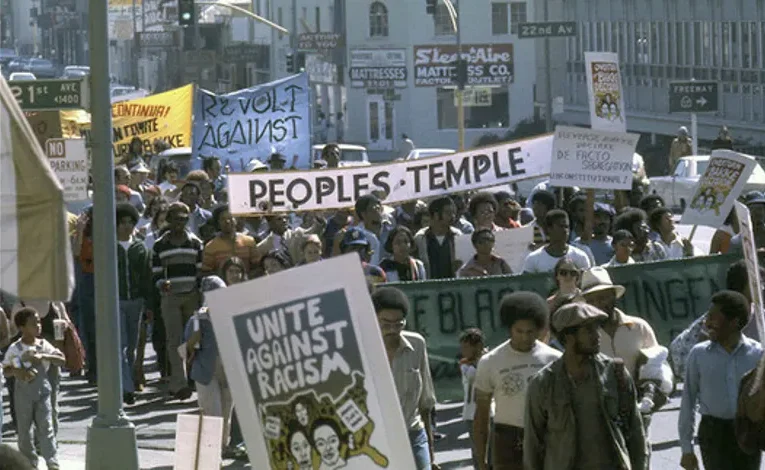
Jonestown was the Guyana settlement of Peoples Temple, the church Jim Jones founded in Indianapolis in the 1950s. On November 18, 1978, more than 900 residents, about a third of them children, died there from cyanide poisoning. Its cult psychology matters because Jones used ordinary tools of coercive control, such as isolation, fear, confession and dependency, to turn a community built on hope into a trap.
Key takeaways
- Peoples Temple combined Pentecostal worship, socialist politics, faith healing and utopian community, held together by loyalty to Jim Jones rather than by doctrine.
- Jones used isolation, fear, confession, staged miracles and suicide drills, the same mechanisms Robert Jay Lifton described as thought reform.
- On November 18, 1978, more than 900 people died at Jonestown, about a third of them children, and 918 died in all that day.
- The Temple drew heavily on Black churchgoers, older people and working-class families, not mainly on alienated young people.
- The tactics of Jonestown match the coercive control seen in abusive relationships, and recovery often needs work with shame and body-held fear.
What was the Jonestown cult?
Peoples Temple began as an integrated Pentecostal-style congregation in Indiana, moved to California in 1965 and built a large following in San Francisco and Los Angeles in the 1970s. In 1977 most of its members relocated to the Peoples Temple Agricultural Project in northwest Guyana, which the world came to know as Jonestown.1
The deaths of November 1978 were a mix of murder and suicide. Children were given poison first, armed guards stood at the edge of the pavilion, and some adults clearly went to their deaths unwillingly. Religious studies scholar Rebecca Moore, whose two sisters died at Jonestown, has argued that the event cannot be understood if we look only at Jones and ignore the people who joined, worked and believed.23
Jonestown’s ending is extreme, but the methods that produced it were not new. In most cults, little of what is good is original, and little of what is original is good. Studying Peoples Temple shows how high-control groups work, the same mechanisms traced in our piece on the psychology of cults and mind control, and how people can resist them.
What did Peoples Temple borrow from other movements?
Peoples Temple stitched together practices and beliefs from religious, therapeutic and political movements that already had meaning for its audience. Each piece carried positive associations. The combination was held together less by theological coherence than by loyalty to Jones himself.4
Pentecostal Christianity
Jones began as a preacher in the holiness and Pentecostal style of the American Midwest. His services featured emotional worship, gospel music, testimony and faith healing. In the late 1950s he visited Father Divine’s Peace Mission in Philadelphia and copied much of its model: a racially integrated congregation, communal kitchens and a leader treated as divine. The Temple affiliated with the mainstream Disciples of Christ denomination, which gave it respectability.1
Communism and the social gospel
Jones preached what he called apostolic socialism. In public he spoke the language of the social gospel, racial equality and care for the poor. In private, and increasingly from the pulpit, he called himself a communist, mocked the Bible and told followers that the God they should worship was socialism itself, embodied in him. The Temple adopted the vocabulary of revolution, and in Guyana Jones looked to the Soviet Union as a possible refuge.46
Faith healing and therapeutic self-help
Jones presented himself as a faith healer who could cure cancer, arthritis and blindness. He mixed this with the pop psychology of his era: catharsis, confrontation and the promise that the group could remake a person. Healing services and later confrontation meetings borrowed the emotional intensity of both revival tents and encounter groups.1
Utopianism
The promise of an egalitarian community was central to the Temple’s appeal. Jonestown itself was pitched as a “Promised Land” where Black and white families could live free from American racism, a version of the communal and back-to-the-land experiments of the 1960s and 1970s. Sociologist John R. Hall reads the Temple as an apocalyptic sect that tried to build a sanctuary outside a world it saw as doomed.5 Our essay on political cults and cults of personality follows the same pull of a simple, total answer.
Who was Jim Jones?
James Warren Jones was born on May 13, 1931, in Crete, Indiana, and grew up in the small town of Lynn. His father, James Thurman Jones, was a disabled First World War veteran; his mother, Lynetta, worked long hours to support the family. The household was poor during the Depression and young Jim was often left to himself. A neighbour took him to church, and he sampled several local congregations.16
Biographers describe a lonely boy drawn to religion, death and power. Childhood acquaintances recalled him preaching to other children and holding funerals for dead animals. Jeff Guinn traces how his sense of being an outsider fed both genuine empathy for the poor and a hunger to be at the centre of attention.6
His early working life was unsteady. He married Marceline Baldwin, a nurse, in 1949, served briefly as a student pastor at a Methodist church in Indianapolis, and raised money for his first independent church by selling pet monkeys door to door. He and Marceline adopted children of several races and called them their “rainbow family,” which made the Joneses a visible symbol of integration in segregated Indiana.1
Jones’s real talent was oratory. He could move a room from laughter to rage to tears, and he read individuals well enough to make each listener feel personally seen. That gift for attunement is what made him dangerous. Writers have proposed many explanations for leaders like him, from narcissistic personality to neurological ideas such as the one discussed in Gastaut-Geschwind syndrome and cult leaders. Psychoanalysts Richard Ulman and D. Wilfred Abse described Jones as a narcissistic leader whose followers idealised him and merged their own self-worth with his.11
In his last years Jones descended into paranoia and drug dependence. Former members describe slurred late-night speeches over the Jonestown loudspeakers, and his autopsy found pentobarbital in his tissues. He died of a gunshot wound to the head on November 18, 1978.18
What control tactics did Jim Jones use?
Jones relied on control tactics found in many high-control groups and added some of his own. Psychiatrist Robert Jay Lifton’s eight criteria of “thought reform,” drawn from his study of Chinese re-education programmes, fit Peoples Temple closely: milieu control, mystical manipulation, the demand for purity, the cult of confession, sacred science, loading the language, doctrine over person and the dispensing of existence.12
Common tactics
- Love bombing: newcomers received warmth, meals, help with housing and a place in a family that felt more caring than the one they came from.
- Isolation: members were urged to cut ties with relatives who doubted Jones, to give their property to the Temple and finally to move to a jungle settlement reachable only by boat or small plane.
- Fear induction: Jones warned of the CIA, the Ku Klux Klan, nuclear war and fascist takeover, and told members that defectors were traitors who would be hunted.
- Information control: mail was read, phone calls were monitored, and in Jonestown Jones read the “news” aloud himself, edited to fit his story.
- Confession and self-incrimination: members wrote letters confessing sins, sometimes invented ones, and signed blank sheets of paper or false statements that could be used against them if they left.7
Tactics specific to Peoples Temple
- Staged healings: aides planted in the audience “passed” growths that former members later said were chicken parts, and Jones used these displays to build a reputation for miracles.1
- Suicide drills: as early as 1973 Jones had members of his inner planning group drink wine he said was poisoned, as a test of loyalty. In Jonestown these “White Nights” became rehearsals for mass death, which made the final night feel like one more drill until it was not.79
- Exploiting racial guilt and fear: Jones told white members that they carried the sins of American racism and could atone only through total service, and he told Black members that the United States would soon put them in concentration camps.2
- Political manoeuvring: the Temple could deliver busloads of volunteers and voters, and it courted California politicians. In 1976 San Francisco mayor George Moscone appointed Jones to the city’s Housing Authority Commission, which he went on to chair. Public endorsements from officials made it harder for critics to be heard.1
Sociologist Benjamin Zablocki offers a useful lens: what cult researchers call brainwashing can be understood as the steady raising of the cost of leaving. By the time members reached Guyana, their money, their families, their reputations and their passports were in the Temple’s hands.15
Peoples Temple timeline
The Temple’s history runs roughly 25 years, from a storefront church to a settlement of nearly 1,000 people.
- 1955: Jones founds the Wings of Deliverance church in Indianapolis, soon renamed Peoples Temple.
- 1960 to 1961: the Temple affiliates with the Disciples of Christ, and Jones is named director of the Indianapolis Human Rights Commission.
- 1965: Jones moves a core of followers to Redwood Valley in Mendocino County, northern California. Members open licensed care homes for elderly and disabled residents, which also fund the Temple.
- Early 1970s: the Temple expands into San Francisco and Los Angeles, and membership climbs into the thousands.
- 1973: eight young members defect and the first loyalty tests with “poisoned” wine take place.
- 1974: the Temple leases land from the government of Guyana, and a pioneer crew begins clearing jungle for the agricultural project.
- 1976: Jones is appointed to the San Francisco Housing Authority Commission.
- 1977: after an exposé by Marshall Kilduff and Phil Tracy in New West magazine, Jones and most members move to Guyana. In September Jones stages a “siege,” telling residents they are under attack.
- 1978: on November 17 and 18 Congressman Leo Ryan visits with journalists and members of the Concerned Relatives group. Temple gunmen kill Ryan, three journalists and a defector at the Port Kaituma airstrip. That evening more than 900 people die at Jonestown, and four more die at the Temple house in Georgetown, for a total of 918.18
Why did Peoples Temple appeal in the 1960s and 1970s?
Peoples Temple grew during the social and political ferment of the 1960s and 1970s, when many Americans had lost faith in established institutions. Jones spoke to the unfinished business of the Civil Rights Movement, the economic fears of the 1973 to 1975 recession and a widespread longing for community.5
Who joined matters. Sociologist James T. Richardson pointed out that Peoples Temple did not fit the picture of a youth cult. Unlike many new religious movements of the period, it drew heavily on Black churchgoers, older people and working-class families, alongside a smaller group of young, educated white idealists, and it was more political than most.10 About two-thirds of those who died at Jonestown were African American.2
At a psychological level, Jones offered something to each group. White members were offered a way to be cleansed of social sin and to give their lives a purpose. Black members, many of them from the Great Migration and from churches that had sustained them through segregation, were offered protection, dignity and a community that seemed to take their oppression seriously. Communal living relieved the isolation and anomie of a turbulent period. Erich Fromm’s argument in Escape from Freedom, that people under strain will hand their freedom to an authority who promises certainty, describes the trade well; see our overview of Erich Fromm and depth psychology.
Jones also fits Max Weber’s description of charismatic authority, power that rests on followers’ belief in a leader’s extraordinary gifts rather than on rules or tradition. Weber noted that such authority is unstable and must keep proving itself, which helps explain Jones’s escalating miracles and crises. More on Weber’s types of authority appears in our piece on Max Weber.
How does Jonestown compare with other cults?
Peoples Temple shared a great deal with other groups of its time. The Children of God, founded by David Berg in California in 1968, the Unification Church of Sun Myung Moon, founded in Korea in 1954 and highly visible in the United States in the 1970s, and the Manson Family all had authoritarian leaders, isolated members, stoked paranoia and demanded extreme commitment.
Later groups repeated the pattern. The Branch Davidians at Waco, the Order of the Solar Temple and Aum Shinrikyo each combined apocalyptic belief with violence. Catherine Wessinger, comparing these cases, argues that groups become violent when an internal sense that the ultimate goal is failing meets outside pressure from critics, families or the state.9 Control can also wear secular clothes, as in the Sullivanian Institute, a psychotherapy community in New York, and it can grow from a panic rather than a leader, as in the Satanic Panic.
Common manipulation tactics across these groups include:
- Authoritarianism: the leader is the sole source of truth.
- Isolation: members are cut off from family and the outside world.
- Us versus them: the group is a besieged elect.
- Fear and paranoia: outside threats are exaggerated and leavers are persecuted.
- Love bombing: lavish affection for new recruits.
- Shame and guilt: secrets members reveal are used to control them.
- Denunciation: members inform on one another for disloyalty.
- Impossible standards: goals of perfection that no one can meet, which keep members dependent on the leader’s approval.
Margaret Singer, a clinical psychologist who interviewed hundreds of former members, described these as the working parts of a coordinated programme of influence, and noted that intelligent, idealistic people are often the ones recruited.13
How did people leave Peoples Temple?
Most people who left Peoples Temple did so on their own, often at great personal cost. Defectors such as Deborah Layton, who escaped Guyana in May 1978 and gave a sworn statement warning of mass suicide plans, had to leave behind relatives and risk the Temple’s retaliation.7 Families of members formed the Concerned Relatives group in 1977 to press for investigations, and their campaign led to Leo Ryan’s visit.5
The era also produced deprogramming, a practice popularised by Ted Patrick in the early 1970s and aimed mainly at groups recruiting young adults. Families hired deprogrammers to remove a relative, often by force, and hold them while the deprogrammer argued them out of the group. Common elements included:
- physically separating the follower from the group
- showing the leader’s failed prophecies and inconsistencies
- revealing the deception behind supposed miracles
- exposing the leader’s hypocrisy and abuses of power
- rebuilding critical thinking
- reconnecting the person with family and the life they had before
Deprogramming was controversial because it often involved abduction and confinement, and several deprogrammers were sued or prosecuted. It gave way to voluntary exit counselling, which uses the same content without coercion. Most former members of high-control groups, with support and time, rebuild their lives, though many carry shame, grief and distrust for years.13
What does Jonestown teach about everyday manipulation?
The tactics of Peoples Temple are not limited to cults. Milder forms show up in political movements, high-pressure sales, workplaces and some religious communities, and above all in abusive relationships. Sociologist Evan Stark’s concept of coercive control describes partners who isolate, intimidate, degrade and micro-regulate daily life, the same pattern Jones applied to a whole community.14 Our posts on the patterns of narcissistic abuse and on cults, propaganda and lies follow the same thread.
Common signs of undue influence include:
- encouraging isolation from family and friends
- demanding unquestioning obedience to a leader
- black-and-white, us-versus-them thinking
- instilling fear and paranoia about outsiders
- invasive demands for personal information or confessions
- extreme pressure to commit money and time
Awareness helps, but knowing the list is rarely enough on its own, because these tactics work through belonging and fear rather than through argument. Keeping connections outside the group, noticing inconsistencies, and taking seriously the bodily sense that something is wrong are all protective. So is remembering that the people of Peoples Temple were not fools: most joined for good reasons, and the group then used those reasons against them.3
How can therapy help after a high-control group?
People come to therapy after leaving a church, a cult-like group, a controlling family or a coercive relationship with similar problems: chronic shame, difficulty trusting their own perceptions, hypervigilance, grief for a lost community and sometimes a spiritual life that now feels poisoned. Psychiatrist Judith Herman described how prolonged captivity, in cults as well as abusive homes, produces complex trauma rather than a single wound. Our post on childhood religious trauma covers how this shows up for people raised inside such groups.
At Taproot we start by restoring the client’s own authority, the very thing a high-control group removes. Much of the damage is stored as body states, such as the jolt of fear at a raised voice or the collapse of shame after a mistake, so we often work below the level of argument. Brainspotting therapy for trauma lets a person process fear and shame bound to specific memories without having to retell every detail. IFS therapy helps with the inner split many survivors feel, between a part still loyal to the group and a part that is furious or grieving, so both can be heard instead of one silencing the other.
Depth psychology adds one more thing. A group like Peoples Temple captures real longings for justice, family and transcendence. Therapy does not ask a person to give those up. It helps them find forms of meaning and belonging that do not require handing their judgement to someone else.
Jonestown shows how ordinary needs and ordinary tactics can combine into catastrophe, and how much courage it takes to walk away. If you are recovering from a controlling group or relationship, you can contact Taproot Therapy Collective to talk with a therapist who understands this kind of harm.
Frequently asked questions
How many people died at Jonestown?
On November 18, 1978, more than 900 members of Peoples Temple died at Jonestown in Guyana, roughly a third of them children. Counting Congressman Leo Ryan and four others shot at the Port Kaituma airstrip and four deaths at the Temple house in Georgetown, the total that day was 918. Most died from cyanide mixed into a fruit drink.
Was Jonestown a mass suicide or a mass murder?
Jonestown was both. Children and infants were poisoned first by adults, armed guards surrounded the pavilion, and some residents were injected or resisted. Many adults did drink willingly after years of suicide drills. Scholars such as Rebecca Moore describe the deaths as murder for many victims and coerced suicide for others, shaped by Jim Jones’s long campaign of control.
Why did people join Peoples Temple?
People joined Peoples Temple for real reasons: an integrated church, care for the poor and elderly, a stand against racism and a close community. Jim Jones’s preaching offered meaning, protection and belonging. The control came gradually, after people had given money, time and relationships, which made leaving more and more costly.
What does the phrase drinking the Kool-Aid come from?
The phrase comes from Jonestown, where cyanide was mixed into a grape drink. Investigators found packets of Flavor Aid, a cheaper competitor, at the site, though Kool-Aid may also have been present. The phrase is now used to mock blind loyalty, which many relatives of the dead find painful because so many victims were children or did not die by choice.
What is coercive control and how does it relate to cults?
Coercive control is sociologist Evan Stark’s term for a pattern of isolation, intimidation, degradation and regulation of daily life used to dominate a partner. High-control groups like Peoples Temple use the same pattern on a whole community. Recognising it helps survivors of cults and of abusive relationships see that their entrapment was engineered, not a personal failing.
Related reading
- The Theories and Ideas of Rollo May
- The Interpersonal Theory of Psychiatry: Harry Stack Sullivan’s Vision of the Social Self
- Yoga Therapy and Trauma-Informed Yoga: Healing Mind and Body Through Mindful Practice
- Donna Haraway : Cyborg Feminism and Technoscience
- Marshall McLuhan: The Medium is the Message
- Claude Shannon and Warren Weaver: Architects of Information Theory
References
- Reiterman, T., & Jacobs, J. (1982). Raven: The untold story of the Rev. Jim Jones and his people. Dutton.
- Moore, R. (2009). Understanding Jonestown and Peoples Temple. Praeger.
- Moore, R. (2000). Is the canon on Jonestown closed? Nova Religio, 4(1), 7-27. https://doi.org/10.1525/nr.2000.4.1.7
- Chidester, D. (1988). Salvation and suicide: An interpretation of Jim Jones, the Peoples Temple, and Jonestown. Indiana University Press.
- Hall, J. R. (1987). Gone from the promised land: Jonestown in American cultural history. Transaction Publishers.
- Guinn, J. (2017). The road to Jonestown: Jim Jones and Peoples Temple. Simon & Schuster.
- Layton, D. (1998). Seductive poison: A Jonestown survivor’s story of life and death in the Peoples Temple. Anchor Books.
- Scheeres, J. (2011). A thousand lives: The untold story of hope, deception, and survival at Jonestown. Free Press.
- Wessinger, C. (2000). How the millennium comes violently: From Jonestown to Heaven’s Gate. Seven Bridges Press.
- Richardson, J. T. (1980). People’s Temple and Jonestown: A corrective comparison and critique. Journal for the Scientific Study of Religion, 19(3), 239-255. https://doi.org/10.2307/1385862
- Ulman, R. B., & Abse, D. W. (1983). The group psychology of mass madness: Jonestown. Political Psychology, 4(4), 637-661. https://doi.org/10.2307/3791059
- Lifton, R. J. (1961). Thought reform and the psychology of totalism: A study of “brainwashing” in China. W. W. Norton.
- Singer, M. T., & Lalich, J. (1995). Cults in our midst. Jossey-Bass.
- Stark, E. (2007). Coercive control: How men entrap women in personal life. Oxford University Press.
- Zablocki, B. (1998). Exit cost analysis: A new approach to the scientific study of brainwashing. Nova Religio, 1(2), 216-249. https://doi.org/10.1525/nr.1998.1.2.216













0 Comments