
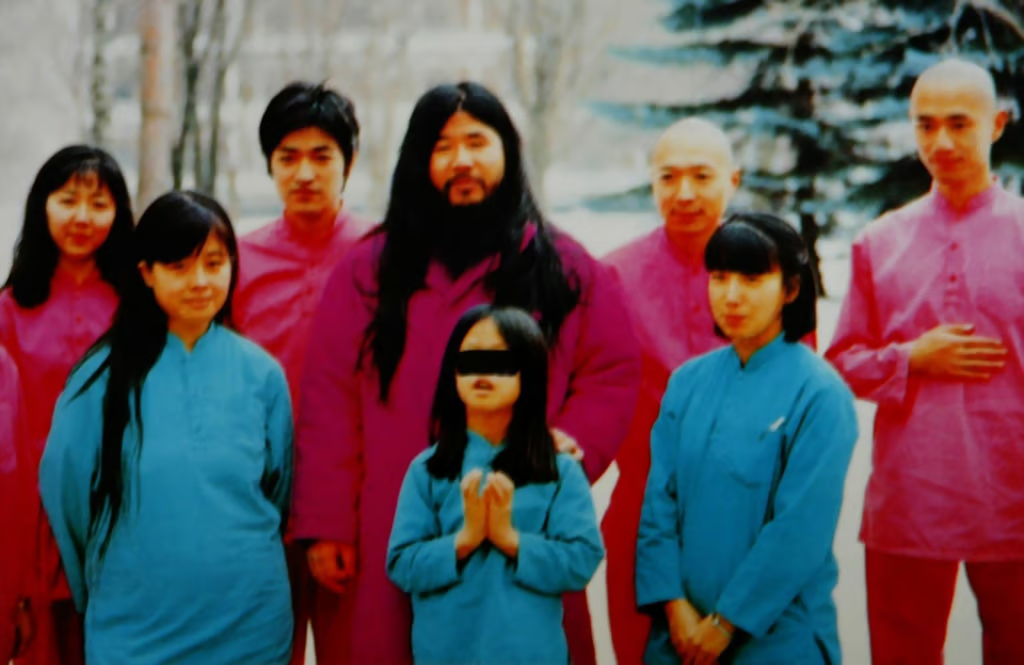
Aum Shinrikyo was a Japanese new religious movement founded in 1984 by Shoko Asahara that grew from a small yoga class into an armed doomsday group. On 20 March 1995 its members released sarin on the Tokyo subway, killing 13 people and injuring thousands. Its story shows how a charismatic guru, borrowed doctrine and total control can turn idealistic seekers into killers.
Key takeaways
- Aum Shinrikyo began in 1984 as a Tokyo yoga circle led by Shoko Asahara and grew into an armed doomsday group with thousands of members.
- Asahara built Aum’s doctrine from borrowed Buddhist, Hindu, Christian and New Age ideas, and twisted the Tibetan practice of poa into a justification for murder.
- The 20 March 1995 sarin attack on the Tokyo subway killed 13 people, injured more than 5,800, and left many survivors with lasting trauma symptoms.
- Aum recruited educated, idealistic young people, showing that coercive control works through the need for meaning and belonging rather than through stupidity.
- People leaving high-control groups often carry trauma, shame and divided loyalties that respond to parts work and brain-based trauma therapy.
What was the Aum Shinrikyo cult?
The name means roughly “Aum Supreme Truth.” “Aum” is the Sanskrit sacred syllable Om, and “Shinrikyo” is Japanese for “teaching of the supreme truth.” The group began in Tokyo in 1984 as Aum Shinsen no Kai, a yoga and meditation circle, and took the name Aum Shinrikyo in 1987. By the mid-1990s it claimed around 10,000 members in Japan and tens of thousands more in Russia, owned compounds near Mount Fuji and ran businesses that ranged from computer shops to noodle restaurants.3
Most members were not drifters. Aum recruited heavily among young, educated Japanese, including graduates in physics, chemistry and medicine. That fact is what made the group so disturbing to the psychiatrist Robert Jay Lifton, who interviewed former members for Destroying the World to Save It (1999). His question was not why foolish people join cults but how intelligent, morally serious people could come to see mass murder as an act of compassion.1 The same question runs through our wider writing on the psychology of cults and mind control.
Where did Aum’s beliefs come from?
Stealing from other systems
Aum Shinrikyo did not invent a worldview from scratch. Like many high-control groups, it appropriated and repackaged beliefs and practices from older religions, philosophies and the sciences. Asahara stitched together Tibetan and Theravada Buddhism, Hindu yoga and the worship of Shiva, Christian apocalyptic prophecy, the predictions of Nostradamus and New Age ideas about psychic power. Each borrowed piece carried some of the authority of its source and lent it to him.5
The group’s central practice, ascetic training through yoga, breathing and meditation, came from Hindu and Buddhist traditions. Asahara taught a form of kundalini yoga and promised that awakening this energy would give practitioners supernatural abilities. He styled himself a guru in the line of the Buddha and later of Jesus Christ, claiming final enlightenment after a 1986 trip to the Himalayas.1
Apocalypse and pseudo-science
Aum taught that a world war, Armageddon, was coming and that only Aum’s spiritually trained members would survive to build a new world. The idea echoes Christian end-times prophecy, and Asahara drew openly on the Book of Revelation. He mixed it with pseudo-scientific claims: modern technology, materialism and pollution were poisoning humanity, enemies were attacking Aum with gas, and only his techniques could purify body and mind.1
The twisting of poa
At the core of Aum’s ethics was poa, the Japanese rendering of the Tibetan Buddhist practice phowa, the transference of consciousness to a higher realm at the moment of death. In Tibetan practice it is a meditation done for the dying. Asahara reinterpreted it to mean that killing a sinner was a kindness, because it stopped the victim accumulating further bad karma and sent his soul upward. Lifton argues that this doctrine turned murder into an act of salvation in the minds of those who carried it out.1 In this way a tradition built on non-violence was bent into a license to kill. The result was a patchwork ideology that seemed deep and ahead of its time to recruits, yet had little substance of its own.
Who was Shoko Asahara?
Shoko Asahara was born Chizuo Matsumoto on 2 March 1955 in Kumamoto Prefecture, the son of a poor tatami maker. Infantile glaucoma left him blind in one eye and with limited sight in the other, and he was sent to a school for the blind. Kaplan and Marshall report that his partial sight gave him an advantage over fully blind classmates, and that he used it to dominate them.3 He later worked as an acupuncturist and sold herbal remedies, and in 1982 he was arrested and fined for selling unlicensed medicines.
Asahara had no formal religious training, but he was a forceful speaker with a sharp sense of what his listeners wanted. In 1985 an occult magazine published a photograph said to show him levitating, and he claimed powers such as mind-reading and seeing the future. Followers were taught to see him as a living Buddha and, after his book Declaring Myself the Christ (1992), as a Christ figure and the Lamb of God.1
Control inside Aum
Like other cult leaders, Asahara demanded absolute obedience. Renunciant members, the shukke, gave the group their property and cut contact with their families. Training involved sleep deprivation, restricted diets, long hours of chanting and, at times, drugs including LSD. Aum also marketed a technological gadget: the “Perfect Salvation Initiation” headgear, a cap wired with electrodes that delivered small electric currents. It did not monitor followers’ brainwaves. It was sold as a way to transmit Asahara’s own brainwaves into their heads.3
Clinicians reading these accounts often notice the pairing of grandiosity with fragility. Heinz Kohut’s self psychology of narcissism describes a grandiose self that needs constant mirroring to hold together. Lifton read Asahara in similar terms: a guru whose sense of himself depended on followers enacting his visions, and who grew more paranoid and violent as legal and media pressure mounted in the early 1990s.1 Some writers look for neurological explanations of such leaders, as in our post on Gastaut-Geschwind syndrome and cult leaders, but the documented record of Asahara is above all a record of a need for control.
Aum Shinrikyo rise and fall timeline
- 1984: Asahara founds Aum Shinsen no Kai, a yoga and meditation group, in Tokyo.
- 1987: The group is renamed Aum Shinrikyo and begins to expand, with branches abroad.
- 1988 to 1989: A member, Terayuki Majima, dies during harsh training in 1988 and his body is secretly burned. In February 1989 a member who wanted to leave, Shuji Taguchi, is strangled.3
- August 1989: The Tokyo metropolitan government grants Aum legal status as a religious corporation, which brings tax benefits and protection from scrutiny.
- November 1989: Lawyer Tsutsumi Sakamoto, who was helping parents trying to get their children out of Aum, is murdered in Yokohama with his wife and their infant son. Their bodies are not found until 1995.
- February 1990: Asahara and 24 followers run for the House of Representatives under the Shinrito (Supreme Truth Party) banner. All lose badly. Asahara’s preaching about an approaching Armageddon intensifies, and the group makes failed attempts to produce biological weapons.1
- 1992: Asahara publishes Declaring Myself the Christ. Aum expands into Russia.
- 1993 to 1994: Aum builds a plant to produce sarin at its Kamikuishiki compound.
- 27 June 1994: Members release sarin in a residential area of Matsumoto, aiming at judges hearing a case against Aum. Eight people die.
- 20 March 1995: Five members puncture bags of liquid sarin on five trains on three subway lines that converge on Kasumigaseki, the seat of government. Thirteen people die and more than 5,800 are injured. A fourteenth victim, left severely disabled, died in 2020. The attack was meant in part to disrupt a police raid that Aum knew was coming.18
- 16 May 1995: Asahara is found hiding in a compartment at the Kamikuishiki compound and arrested. Investigations tie Aum to the Matsumoto attack and the Sakamoto murders.
- 1996 to 2006: Asahara’s trial opens in April 1996. On 27 February 2004 the Tokyo District Court sentences him to death, and the sentence becomes final in 2006. Twelve other members also receive death sentences.
- 2000: Remaining members reorganize as Aleph, under surveillance by Japan’s Public Security Intelligence Agency. In 2007 a former spokesman, Fumihiro Joyu, leads a breakaway group, Hikari no Wa.
- July 2018: Asahara and six others are hanged on 6 July, and the remaining six on 26 July, for the subway attack and other murders.
Why did Aum appeal to young people in 1980s Japan?
Aum’s rise is often explained by the anxieties of its time, though not the ones usually assumed. The late 1980s were the peak of Japan’s “bubble economy,” a period of soaring land and stock prices, not of decline. The bubble burst in 1990 and 1991, just as Aum turned toward violence. For many young people the problem was abundance without meaning: an exam-driven school system, a rigid corporate track and a culture of consumption that seemed empty. Ruth Benedict’s old account of Japanese shame and duty in The Chrysanthemum and the Sword hints at the weight of those social expectations.
In this climate some young people felt alienated, aimless and distrustful of mainstream institutions. Aum offered an alternative spiritual community that rejected materialism and promised transcendence. Ian Reader, a scholar of Japanese religion, shows that Aum belonged to a wave of “new new religions” that drew educated urban youth with promises of personal spiritual experience and world-saving mission.5
Psychologically, Aum gave members a way to answer feelings of powerlessness by merging into something larger. Erich Fromm described this move in Escape from Freedom, and our post on Erich Fromm and depth psychology traces how a frightened self gives itself up to an authority in exchange for certainty. By dedicating themselves totally to Asahara, members found the meaning, purpose and importance they lacked in ordinary life.
Apocalyptic ideas were also everywhere in Japanese popular culture. Goto Ben’s 1973 book on Nostradamus’s prophecies sold in the millions, and manga and anime returned again and again to nuclear catastrophe. Asahara’s prophecies of a third world war tapped into these preoccupations and gave followers the thrill of secret knowledge. Terror management theory suggests why: reminders of death push people to cling harder to a worldview that promises them survival and significance.
What did Murakami’s Underground reveal?
The novelist Haruki Murakami spent a year interviewing survivors of the subway attack and relatives of the dead. The result, Underground (1997), was followed by The Place That Was Promised (1998), interviews with Aum members and former members; the English edition combines both.2 Murakami let ordinary commuters describe the morning in their own words: the smell on the train, the dimming vision, the people who helped and the long aftermath of headaches, fatigue and fear.
Murakami’s argument was that Aum’s story was not entirely foreign to mainstream Japan. He suggested that the cult offered a ready-made narrative to people who could not find one in the wider society, and that ordinary Japanese had handed over their own sense of self to corporations and institutions in a similar way. The members he interviewed were often earnest, lonely idealists.2
Medical research confirms how long the harm lasted. A report on 640 patients treated at St. Luke’s International Hospital on the day of the attack documented the scale of acute poisoning.8 Five years later, 11 of 34 victims assessed with structured interviews met criteria for current or lifetime PTSD.9 A study of 747 survivors followed from 2000 to 2009 found posttraumatic stress responses in about 35 percent, with no decline over the decade, and eye symptoms in 60 to 80 percent.10
What happened to Aum members after 1995?
After the attack, Japanese police raided Aum facilities across the country. Courts stripped the group of its religious corporation status in 1995 and declared it bankrupt in 1996, so its assets could go to victims. There was no state deprogramming program. Members were arrested, questioned and released, and many simply left. Japan passed a law in 1999 that placed the successor groups under ongoing surveillance.4
Leaving was hard. Some members had spent up to a decade submitting to Asahara’s authority, to the point that basic decisions felt impossible without instruction. Lifton found former members who still felt Asahara’s presence in their minds years after leaving, and who described a split between a self that recognized the crimes and a self that remained attached to the guru.1 Anxiety, depression, shame and trauma symptoms were common, and many also carried moral injury, the wound of having served something that betrayed their deepest values.
With time, many rebuilt their lives. For some, learning the full extent of Asahara’s deceptions and crimes was the push they needed. Others found that work, renewed contact with family and new friendships slowly loosened the group’s hold. A core of believers persisted. Successor groups had about 1,650 members in Japan in 2018, by government estimates, and Aleph still reveres Asahara as its spiritual leader. Some remain convinced he was framed.
How does Aum compare with other cults?
Aum belongs to a small set of groups whose apocalyptic belief ended in mass death. The Peoples Temple at Jonestown in 1978, the Branch Davidians at Waco in 1993 and the Order of the Solar Temple in 1994 and 1995 all turned violence inward, on members. Aum, like the Manson Family, turned it outward on strangers. Lifton’s point was that Aum went furthest of all, acquiring weapons of mass destruction in order to “force the end” its leader had prophesied.1 Scholars of religion and violence now treat Aum as a standard case of how apocalyptic belief, a closed community and a leader’s sense of persecution can combine.11
High-control dynamics are not limited to religious groups. The Sullivanian Institute in New York was built inside a psychotherapy practice. And the Satanic Panic of the 1980s showed how a whole culture can be gripped by a conspiracy story of hidden evil, the same kind of story Asahara told about the enemies plotting against Aum.
How can you recognize abuse and coercive control?
Aum used control tactics that also turn up in abusive relationships, extreme political movements and high-pressure religious and business groups. Lifton’s 1961 study of Chinese thought reform described eight features of a “totalist” environment, including control of communication, “loading the language” with thought-stopping jargon and the “dispensing of existence,” the belief that outsiders have no right to live.6 Aum displayed every one. Steven Hassan’s BITE model sorts the same tactics into control of behavior, information, thought and emotion.7 Signs to watch for include:
- Social isolation and an “us versus them” mentality
- Absolute, authoritarian leadership that cannot be questioned
- Required demonstrations of loyalty, such as handing over money or property
- Control of members’ daily lives, sleep, food and relationships
- Guilt, shame or withdrawn affection used to shape behavior
- Special insider language that reinforces a feeling of superiority
- Extreme promises that seem too good to be true
In personal relationships, red flags include a partner who restricts outside contact, demands control of money or constantly criticizes to undermine self-esteem. Abusers also deflect accountability with tactics such as DARVO, recognizing abuse tactics that reverse victim and offender. In politics, leaders who demonize opponents, insist on total faith and obedience or promote apocalyptic thinking are using cult-like methods, as our post on avoiding political cults and cults of personality explains. In high-pressure business settings, be wary of constant upselling in insider jargon and hints that “success” depends on buying the next level.
Everyone is somewhat open to this kind of influence, because people are social animals who want meaning and belonging. Careful thinking helps: test extraordinary claims, notice when emotion is being used against you and keep relationships outside any single group. The educated recruits of Aum show that intelligence alone does not protect anyone. Connection to people who will tell you the truth does.
How does therapy help people leaving high-control groups?
People who leave a cult, a coercive relationship or a controlling church often arrive in therapy with a confusing mix of symptoms: panic, numbness, intense shame, difficulty making ordinary choices and grief for a community they also fear. In our experience at Taproot, these are trauma responses, not signs of weakness. The nervous system learned to survive inside a closed world, and it keeps running that program after the door opens.
We often work with this through IFS therapy and other parts work. A former member may have a part that still feels loyal to the leader and a part that is horrified by what happened, much like the split Lifton described in Aum’s ex-members. Parts work lets both be heard without forcing a choice before the person is ready. For the frozen fear and body memories that coercion leaves behind, Brainspotting therapy for trauma lets the brain process experiences that talking alone does not reach. Jungian and existential work then helps a person build meaning of their own, so that the hunger that drew them into a group is met rather than shamed.
Aum Shinrikyo is a warning about what happens when a longing for transcendence is captured by one man’s need for power. That longing is human and worth honoring. At Taproot we help people recover their own judgment, their own body and their own sense of the sacred after high-control groups and abusive relationships, and you can reach us when you are ready to begin.
Frequently asked questions
What did Aum Shinrikyo believe?
Aum Shinrikyo taught that Armageddon was coming and that only members trained in Shoko Asahara’s yoga and meditation would survive. Its doctrine mixed Tibetan Buddhism, Hindu worship of Shiva, Christian end-times prophecy and Nostradamus. Asahara presented himself as an enlightened guru and later as Christ, and he reinterpreted the Buddhist practice of poa to claim that killing sinners helped their souls.
How many people died in the Tokyo subway sarin attack?
The Aum Shinrikyo attack on 20 March 1995 killed 13 people and injured more than 5,800 commuters and subway workers. A fourteenth victim, left severely disabled by sarin poisoning, died in 2020. Five members released liquid sarin on five trains on three lines that met at Kasumigaseki, the government district of Tokyo.
Does Aum Shinrikyo still exist?
Aum Shinrikyo itself lost its legal status in 1995 and was declared bankrupt in 1996, but successor groups remain. Aleph formed in 2000 and Hikari no Wa split from it in 2007 under Fumihiro Joyu. Japanese authorities estimated about 1,650 members across the successor groups in 2018, and they remain under government surveillance.
What happened to Shoko Asahara?
Shoko Asahara, born Chizuo Matsumoto in 1955, was arrested at Aum Shinrikyo’s compound near Mount Fuji on 16 May 1995. The Tokyo District Court sentenced him to death in February 2004 for the subway attack and other murders. He was hanged on 6 July 2018 with six followers, and six more condemned members were executed later that month.
Why did educated people join Aum Shinrikyo?
Many Aum Shinrikyo recruits were young graduates in science and medicine who felt that Japan’s exam system, corporate careers and consumer culture offered no meaning. Aum promised real spiritual experience, a mission to save the world and a close community. Robert Jay Lifton and Haruki Murakami both found that members were often earnest idealists drawn by that promise.
Related reading
- The Metamorphosis of the Therapeutic Hour: Why Generation Z Demands a New Psychology
- Bruce Perry: From Branch Davidian Waco to “What Happened to You?” – Three Decades Translating Neuroscience into Healing for Maltreated Children
- Richard Schwartz: From Failed Bulimia Study to Discovering the Internal Family System
- Claude Shannon and Warren Weaver: Architects of Information Theory
- The Rise and Evolution of New Urbanism: A Cultural, Technological, and Political Perspective
- David Grand: From EMDR Trainer to Brainspotting Pioneer Through a Champion Skater’s Frozen Gaze
References
- Lifton, R. J. (1999). Destroying the world to save it: Aum Shinrikyo, apocalyptic violence, and the new global terrorism. Metropolitan Books.
- Murakami, H. (2000). Underground: The Tokyo gas attack and the Japanese psyche (A. Birnbaum & P. Gabriel, Trans.). Harvill Press. (Original work published 1997)
- Kaplan, D. E., & Marshall, A. (1996). The cult at the end of the world: The terrifying story of the Aum doomsday cult, from the subways of Tokyo to the nuclear arsenals of Russia. Crown Publishers.
- Metraux, D. A. (2000). Aum Shinrikyo’s impact on Japanese society. Edwin Mellen Press.
- Reader, I. (2000). Religious violence in contemporary Japan: The case of Aum Shinrikyo. University of Hawaii Press. https://doi.org/10.1515/9780824847135
- Lifton, R. J. (1961). Thought reform and the psychology of totalism: A study of “brainwashing” in China. W. W. Norton.
- Hassan, S. (2015). Combating cult mind control: The #1 best-selling guide to protection, rescue, and recovery from destructive cults (25th anniversary ed.). Freedom of Mind Press.
- Okumura, T., Takasu, N., Ishimatsu, S., Miyanoki, S., Mitsuhashi, A., Kumada, K., Tanaka, K., & Hinohara, S. (1996). Report on 640 victims of the Tokyo subway sarin attack. Annals of Emergency Medicine, 28(2), 129-135. https://doi.org/10.1016/s0196-0644(96)70052-5
- Ohtani, T., Iwanami, A., Kasai, K., Yamasue, H., Kato, T., Sasaki, T., & Kato, N. (2004). Post-traumatic stress disorder symptoms in victims of Tokyo subway attack: A 5-year follow-up study. Psychiatry and Clinical Neurosciences, 58(6), 624-629. https://doi.org/10.1111/j.1440-1819.2004.01313.x
- Sugiyama, A., Matsuoka, T., Sakamune, K., Akita, T., Makita, R., Kimura, S., Kuroiwa, Y., Nagao, M., & Tanaka, J. (2020). The Tokyo subway sarin attack has long-term effects on survivors: A 10-year study started 5 years after the terrorist incident. PLOS ONE, 15(6), e0234967. https://doi.org/10.1371/journal.pone.0234967
- Juergensmeyer, M., Kitts, M., & Jerryson, M. (Eds.). (2013). The Oxford handbook of religion and violence. Oxford University Press.

















0 Comments