
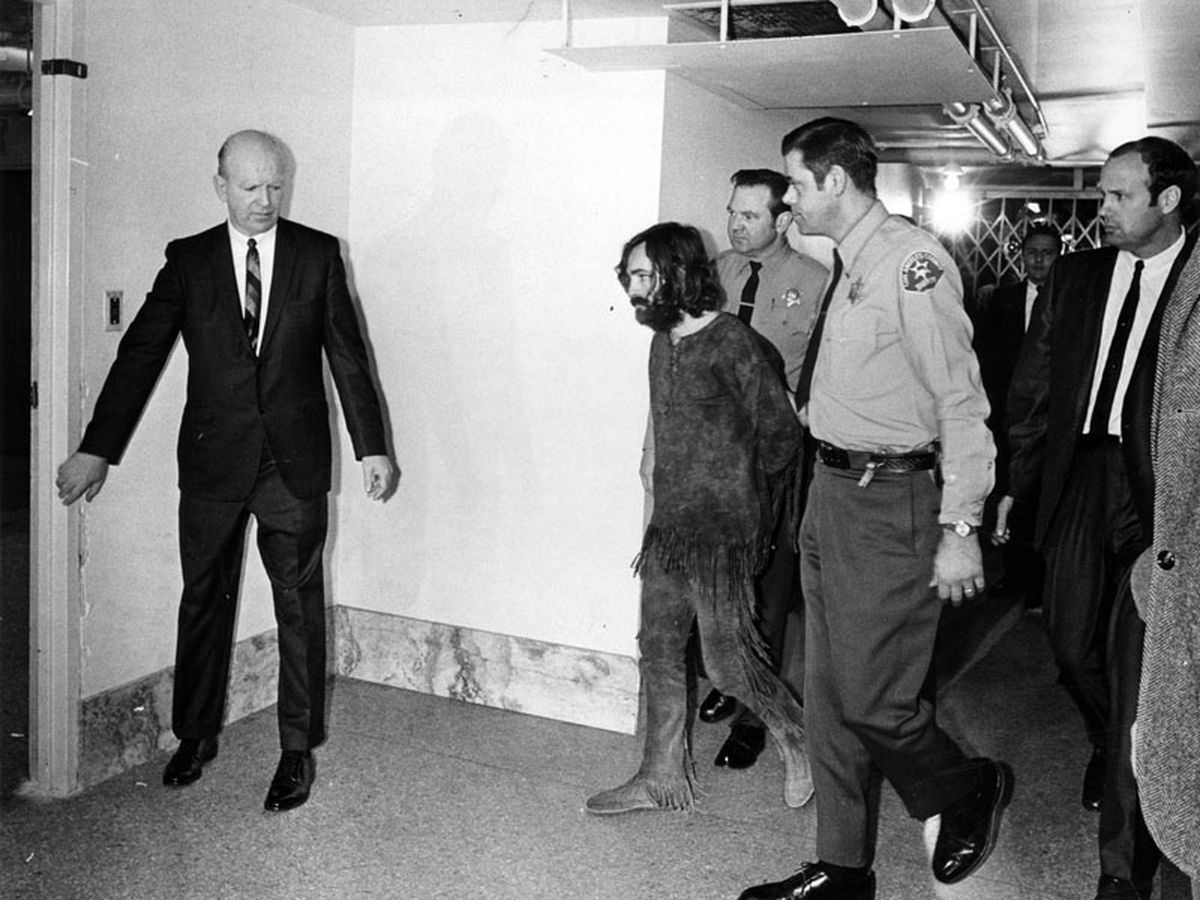
The Manson Family was a small commune of mostly young women that Charles Manson gathered in California between 1967 and 1969. Its cult psychology shows how a manipulative leader can use love, drugs, isolation and an apocalyptic story to turn ordinary seekers into people who would kill on his word, and why leaving such a group leaves lasting traumatic wounds.
Key takeaways
- Charles Manson built the Family’s doctrine from borrowed pieces: Dale Carnegie, Scientology, Process Church imagery, racist race-war fantasy and his reading of the Beatles’ White Album.
- He controlled followers through love-bombing, group LSD sessions, directed sex, shared property and isolation at Spahn and Barker ranches, the mechanisms Robert Jay Lifton called thought reform.
- The trial began in June 1970, guilty verdicts came in January 1971, and the death sentences were commuted in 1972 after People v. Anderson.
- Tom O’Neill’s Chaos raises questions about CIA and FBI ties to Manson but, by its author’s own account, does not prove he was an informant.
- Leaving a coercive group often brings guilt, fear, depression and moral injury, and therapy that works with parts, the body and meaning helps survivors rebuild a self of their own.
Where did Manson’s beliefs come from?
Most cult doctrines are assembled from borrowed parts. Manson built his out of whatever he had picked up in prison, in the Haight-Ashbury and on the radio, and he rearranged it to make himself the centre. Knowing where the pieces came from helps explain why the whole felt so convincing to the people inside it.
The first pieces came from prison. In federal custody in the 1950s Manson studied Dale Carnegie’s How to Win Friends and Influence People, and biographer Jeff Guinn treats Carnegie’s techniques of flattery, attentive listening and letting the other person feel the idea is their own as the backbone of his recruiting style.2 At McNeil Island penitentiary in the early 1960s he took up Scientology, borrowing its language of auditing, clearing away past conditioning and reaching a higher state of being.1
Prosecutor Vincent Bugliosi also saw echoes of the Process Church of the Final Judgment, a group founded in London in the 1960s that revered Christ alongside Jehovah, Lucifer and Satan. Manson’s habit of presenting himself as both Christ and the devil fits that pattern, though direct contact between Manson and the Process was never established.1
The racial part of the doctrine had no scripture behind it. It was crude white supremacy of the kind 19th-century race science, physiognomy included, had once dressed up as knowledge. Manson taught that Black Americans would rise up and win a race war, then prove unable to govern and hand power to the Family, who would wait out the war in a hidden city beneath Death Valley.1
The prophecy itself came from the Beatles. After the White Album was released in November 1968, Manson told his followers that songs such as “Helter Skelter”, “Piggies”, “Blackbird” and “Revolution 9” were coded messages addressed to them, and he read the Book of Revelation, chapter 9, as a description of the four Beatles and of himself. “Helter Skelter” became his name for the coming war.1 By cherry-picking and twisting these sources, he gave a group of drifting young people a story in which they were chosen, persecuted and about to be vindicated.
Who was Charles Manson?
Charles Milles Manson was born on 12 November 1934 in Cincinnati, Ohio, to Kathleen Maddox, an unmarried 16-year-old. His early years were spent with relatives while his mother drifted and served a prison sentence for robbery, and from the age of 12 he moved through reform schools including the Gibault School for Boys in Indiana and the National Training School for Boys in Washington, D.C.2 By the time he was 32 he had spent more than half his life in institutions, for car theft, cheque forgery and pimping.
Criminologists Andrew Atchison and Kathleen Heide read his life through labeling theory, general strain theory and social learning theory: a boy repeatedly defined as a criminal, cut off from legitimate routes to status, and schooled in manipulation by the older inmates who raised him.5 Prison taught him to read people quickly, to spot loneliness and resentment, and to offer exactly the acceptance a person was starving for.
What Manson wanted most was recognition. He wrote songs and believed he would be a star. Through Dennis Wilson of the Beach Boys, who let the Family live in his Sunset Boulevard house in 1968, he met music producer Terry Melcher. The Beach Boys reworked Manson’s “Cease to Exist” into “Never Learn Not to Love” without crediting him, and Melcher declined to sign him in 1969. Guinn argues that this rejection fed the rage that followed, a reading many students of the case share.2 A grandiosity this fragile, where any slight becomes intolerable, is what Heinz Kohut’s self psychology describes as narcissistic rage, and it is why some writers ask whether conditions such as Gastaut-Geschwind syndrome in cult leaders play a part.
How did Manson control his followers?
Manson’s methods match what researchers of the psychology of cults describe in group after group. Recruits were first love-bombed: welcomed, praised, fed and made to feel uniquely understood. Former member Dianne Lake, who joined at 14, describes how warmth and belonging came first and control came later.4
Control then deepened through group LSD sessions in which Manson spoke while followers were highly suggestible, group sex he directed, the sharing of all money and possessions, long nights of talk with little sleep, and the move to remote ranches. Spahn Ranch in the San Fernando Valley, from 1968, and later Barker Ranch in Death Valley cut members off from family and from any outside voice that could contradict him.14
Psychiatrist Robert Jay Lifton’s 1961 study of thought reform gives names to these mechanisms. Among his eight criteria are milieu control (managing all information that reaches the person), mystical manipulation (staged events that seem to prove the leader’s powers), the demand for purity and the “dispensing of existence”, the belief that outsiders do not fully count as people.6 That last criterion is the step that made murder thinkable. Followers were also taught to “cease to exist” as separate selves, to kill the ego, which left them with no inner position from which to refuse.
Timeline of the Manson Family’s rise and fall
- March 1967: Manson is released from Terminal Island prison and goes to Berkeley and the Haight-Ashbury in San Francisco, where he gathers his first followers, beginning with Mary Brunner.
- 1968: The group travels to Los Angeles, lives for a time at Dennis Wilson’s house, and settles at Spahn Ranch. Manson pursues a music career through his industry contacts.
- November 1968: The White Album is released and becomes the centre of the Helter Skelter prophecy.
- July 1969: Family member Bobby Beausoleil kills music teacher Gary Hinman.
- 8 to 10 August 1969: On Manson’s orders, Charles “Tex” Watson, Susan Atkins and Patricia Krenwinkel kill actress Sharon Tate, who was eight and a half months pregnant, and four others at 10050 Cielo Drive, with Linda Kasabian as lookout and driver. The next night Watson, Krenwinkel and Leslie Van Houten kill Leno and Rosemary LaBianca.
- October 1969: Police raid Barker Ranch over stolen vehicles and the burning of a park service earthmover, arresting Manson and others. In November, Atkins’s jailhouse boasting points detectives to the Family.
- December 1969: A Los Angeles grand jury indicts Manson, Watson, Atkins, Krenwinkel, Van Houten and Kasabian for murder and conspiracy.
- June 1970: The trial of Manson, Atkins, Krenwinkel and Van Houten begins, with intense media coverage. Kasabian, granted immunity, is the main prosecution witness. Watson is tried separately in 1971.
- January and March 1971: All four are found guilty on 25 January and sentenced to death on 29 March.
- 1972: The death sentences are commuted to life in prison after the California Supreme Court strikes down the state’s death penalty in People v. Anderson.
- November 2017: Manson dies in custody, aged 83.
Why did the Manson Family emerge in the 1960s?
The Family grew out of an America in upheaval: the counterculture, the civil rights movement and the urban riots that followed it, opposition to the Vietnam War, and a hunger for alternative spirituality and new ways of living. Thousands of teenagers and young adults arrived in the Haight-Ashbury in 1967 with no money, little family support and a strong wish to belong to something.3
Manson offered them belonging and purpose in a world that seemed to be coming apart. He also fed on the decade’s apocalyptic mood. Fear of race war was already in the air after Watts in 1965 and Detroit in 1967, and he turned that fear into a promise: the war was coming, and they would be the chosen survivors.1
The Family was the counterculture’s shadow. In Jung’s sense, the shadow is what a person or a culture refuses to see in itself, and the hippie ideals of peace, love and expanded consciousness had little room for power, cruelty and exploitation. Manson used the movement’s own words, free love, dropping out and ego death, to justify violence, control and sexual exploitation. Rollo May, writing in Power and Innocence in 1972, argued that violence grows out of powerlessness and a desperate need for significance, which describes Manson and his followers closely. The murders ended the dream of the Summer of Love for many Americans and forced a reckoning with the era’s excesses and contradictions.
Was Manson connected to the CIA or FBI?
The Manson case has drawn conspiracy theories since the 1970s. Some links were imagined, others reflect real features of the period. The most serious version comes from journalist Tom O’Neill, whose 2019 book Chaos, written with Dan Piepenbring, grew out of 20 years of research.3
O’Neill asks why Manson, a federal parolee, was repeatedly arrested in 1968 and 1969 and released. He points to Operation CHAOS, the CIA’s domestic surveillance of the antiwar movement and the New Left from 1967 to 1974, and to the FBI’s COINTELPRO campaign against groups such as the Black Panthers. He traces Manson’s time in the Haight to a world that included his parole officer Roger Smith and psychiatrist Louis Jolyon West, who had worked on the CIA’s MKUltra mind-control research and ran a study house for hippies in the Haight in 1967.3 O’Neill states plainly that he could not prove Manson was an informant or a government experiment. The theory survives because the revelations of the 1970s showed that the government did spy on and disrupt the left, which gave real grounds for mistrust of authority.
The prosecution’s own account carried a political charge too. Bugliosi argued that the killing of Gary Hinman, with “political piggy” written in blood on the wall and a Black Panther paw print beside it, was meant to make the police blame Black militants and so start Helter Skelter.1 Guinn and O’Neill both suggest that more ordinary motives, such as drug debts and an attempt to free Beausoleil by staging copycat killings, also played a part.23 Documentaries such as Adam Curtis’s films show why such stories hold us: they put a felt truth about hidden power into narrative form.
Manson and “Paul is Dead”
The “Paul is Dead” legend held that Paul McCartney had died in 1966 and been replaced by a lookalike. It spread in October 1969, after a caller to a Detroit radio station described clues hidden in Beatles records, two months after the murders and before the Family was publicly suspected. The two stories were not connected, but they shared a method: both treated the White Album as a secret text, mining lyrics, artwork and even backwards recordings for hidden messages. That habit of reading private meaning into public media is a hallmark of cult thinking.
The Manson Family in true crime
The Family has been a fixture of true crime ever since. Bugliosi and Curt Gentry’s Helter Skelter (1974) became one of the best-selling true crime books in American history, and a CBS television film of the same name followed in 1976. The second season of Netflix’s Mindhunter (2019) dramatized an FBI interview with Manson, and Quentin Tarantino’s Once Upon a Time in Hollywood (2019) imagined an alternative ending to the night at Cielo Drive. The case keeps returning because it holds the darker undercurrents of American culture in one story.
How did members leave the Manson Family?
After the arrests, many members began to question their loyalty. Linda Kasabian, who drove the car on both nights but did not kill, was granted immunity and spent weeks on the witness stand describing the murders. Barbara Hoyt testified for the prosecution after Family members tried to stop her in September 1970 by feeding her a hamburger laced with a heavy dose of LSD in Honolulu. Dianne Lake, who had been with the group since she was 14, also testified, and later described the slow work of rebuilding a sense of self.14
Others stayed under his sway for years. During the trial Atkins, Krenwinkel and Van Houten shaved their heads and carved X marks into their foreheads in imitation of Manson. Van Houten and Krenwinkel only gradually came to terms with what they had done, and both later described Manson as an abuser who had captured them. Atkins and Watson became born-again Christians in prison. Atkins died in custody in 2009, Krenwinkel has spent more than fifty years in prison, and Van Houten was paroled in July 2023.
None of them went through “deprogramming” in the 1970s sense, the forced removal and confrontation of cult members popularized by Ted Patrick. Their exit happened through prison, testimony and decades of reflection. Contemporary exit counselling, such as the approach Steven Hassan developed after leaving the Unification Church, is voluntary and works through information and relationship rather than force.9
Recovery is long and difficult. A panel of 38 experts in a 2018 study identified 20 kinds of psychological and social disturbance in survivors of abusive groups, with emotional difficulties such as guilt, fear and depression rated the most frequent and intense, followed by problems with relationships and social integration.12 For the women of the Manson Family, the weight of complicity added what clinicians now call moral injury: the shame of having acted against one’s own conscience.
What does the Manson case teach about coercive control?
Abusive partners, authoritarian leaders and extremist groups use many of the tactics Manson used: love-bombing, isolation, control over money, sleep and sex, and an “us versus them” view of the world. Sociologist Evan Stark calls this pattern in intimate relationships coercive control, a campaign of isolation, degradation and regulation of daily life that can trap a person even when physical violence is rare.8 The same patterns appear in narcissistic abuse and in political cults and cults of personality.
Janja Lalich’s idea of “bounded choice” explains why members do not simply walk away. Inside a closed system, every choice a member makes feels free, but the system has already removed the options that would lead out of it.7 Seeing this helps us recognise and resist such methods in our own lives: setting boundaries in relationships, examining the claims of charismatic leaders, and keeping contact with loved ones who may be drawn in. Interviews with 31 former cult members found that family support and a link to someone outside the group were among the most important protective factors for leaving.13
Other cults and conspiracy panics
The Manson Family belongs to a wider history of closed groups and the fears they provoke. Each of these shows a different side of the same dynamics:
- The Sullivanian Institute, a New York psychotherapy community that controlled its members’ relationships and children.
- The Satanic Panic, in which fear of cults became a moral panic of its own.
- Jonestown and the Peoples Temple.
- The Branch Davidians at Waco.
- The Order of the Solar Temple.
- Aum Shinrikyo in Japan.
How does therapy help after cult involvement?
Psychiatrist Judith Herman listed religious cults among the settings of prolonged captivity that produce complex trauma, alongside prisons and abusive homes.11 People who leave high-control groups, or controlling relationships that work the same way, often arrive in therapy with anxiety, numbness, intrusive guilt, distrust of their own judgment and a loss of meaning. Some grew up inside such groups and carry childhood religious trauma that no one around them named. Lalich and Madeleine Tobias wrote Take Back Your Life for exactly this stage of recovery.10
At Taproot we approach this work on several levels. Parts work, including IFS therapy, helps a person meet the part of them that still feels loyal to the leader or the group with curiosity rather than shame, and to separate it from the parts that want to live freely. Brain-based and somatic methods such as Brainspotting work with the body’s stored fear, freeze and hypervigilance, which often persist long after the mind has accepted that the group was harmful.
Existential work addresses the question many ex-members face: what to believe in after the story that organised their whole life has collapsed. Recovery means building a sense of self that belongs to the person rather than to a leader. If you are untangling a group or a relationship that took over your life, you can contact Taproot Therapy Collective to talk with a therapist who understands how coercive control works.
Frequently asked questions
What did Charles Manson believe Helter Skelter meant?
Charles Manson used Helter Skelter, the title of a Beatles song on the 1968 White Album, as his name for a coming race war. He taught that Black Americans would win it, fail to govern and hand power to the Manson Family, who would survive in a hidden city under Death Valley. Prosecutor Vincent Bugliosi argued the murders were meant to trigger it.
Why did people join the Manson Family?
Most people who joined the Manson Family were young, short of money and cut off from their families in the Haight-Ashbury or Los Angeles of 1967 and 1968. Manson offered acceptance, a home, music and a sense of being chosen. Control came later, through LSD, sex, shared property, isolation on remote ranches and an apocalyptic story only he could interpret.
Was Charles Manson a CIA informant?
No one has shown that Charles Manson worked for the CIA or FBI. Journalist Tom O’Neill’s 2019 book Chaos points to his lenient parole treatment, the CIA’s Operation CHAOS and MKUltra researcher Louis Jolyon West, but O’Neill himself says he could not prove a connection. The idea persists because government spying on the 1960s left was real.
What happened to the women of the Manson Family?
Susan Atkins, Patricia Krenwinkel and Leslie Van Houten were convicted in January 1971 and sentenced to death, later commuted to life. Atkins died in prison in 2009, Van Houten was paroled in July 2023, and Krenwinkel has spent more than fifty years in prison. Linda Kasabian testified for the prosecution under immunity.
How do people recover after leaving a cult like the Manson Family?
People leaving a cult such as the Manson Family often face guilt, fear, depression, distrust of their own judgment and trouble rebuilding relationships. Recovery usually involves understanding the manipulation, reconnecting with family and outside friends, and trauma therapy that addresses the body’s fear responses, loyal parts of the self and the loss of meaning.
Related reading
- African American Resilience and Creative Expression: Combating Generational Trauma and Reconnecting with Cultural Roots
- Rise and Fall of the Empire and The Ego: Ancient Rome as a Therapy Case Study
- Richard Schwartz: From Failed Bulimia Study to Discovering the Internal Family System
- Lacanian Psychoanalysis: A Comprehensive Overview
- Francine Shapiro: From Cancer Diagnosis to Revolutionary Trauma Treatment Through Eye Movements
- The Rise and Fall of Eric Berne’s Transactional Analysis:
References
- Bugliosi, V., & Gentry, C. (1974). Helter skelter: The true story of the Manson murders. W. W. Norton.
- Guinn, J. (2013). Manson: The life and times of Charles Manson. Simon & Schuster.
- O’Neill, T., & Piepenbring, D. (2019). Chaos: Charles Manson, the CIA, and the secret history of the sixties. Little, Brown and Company.
- Lake, D., & Herman, D. (2017). Member of the family: My story of Charles Manson, life inside his cult, and the darkness that ended the sixties. William Morrow.
- Atchison, A. J., & Heide, K. M. (2011). Charles Manson and the Family: The application of sociological theories to multiple murder. International Journal of Offender Therapy and Comparative Criminology, 55(5), 771-798. https://doi.org/10.1177/0306624X10371794
- Lifton, R. J. (1961). Thought reform and the psychology of totalism: A study of “brainwashing” in China. W. W. Norton.
- Lalich, J. (2004). Bounded choice: True believers and charismatic cults. University of California Press. https://doi.org/10.1525/california/9780520231948.001.0001
- Stark, E. (2007). Coercive control: How men entrap women in personal life. Oxford University Press. https://doi.org/10.1093/oso/9780195154276.001.0001
- Hassan, S. (1988). Combating cult mind control. Park Street Press.
- Lalich, J., & Tobias, M. (2006). Take back your life: Recovering from cults and abusive relationships. Bay Tree Publishing.
- Herman, J. L. (1992). Trauma and recovery. Basic Books.
- Saldaña Tops, O., Antelo, E., Rodríguez-Carballeira, Á., & Almendros Rodríguez, C. (2018). Taxonomy of psychological and social disturbances in survivors of group psychological abuse. Journal of Aggression, Maltreatment & Trauma, 27(9), 1003-1021. https://doi.org/10.1080/10926771.2017.1405315
- Rousselet, M., Duretete, O., Hardouin, J. B., & Grall-Bronnec, M. (2017). Cult membership: What factors contribute to joining or leaving? Psychiatry Research, 257, 27-33. https://doi.org/10.1016/j.psychres.2017.07.018









0 Comments