
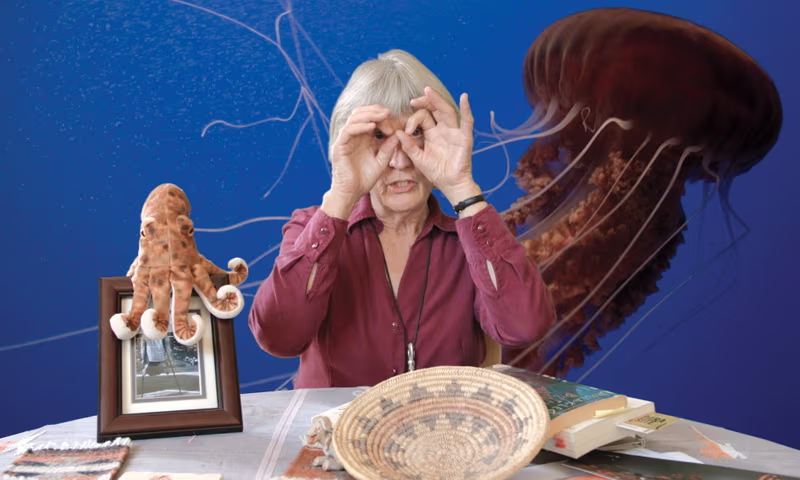
Donna Haraway’s “A Cyborg Manifesto,” first published in Socialist Review in 1985, argues that late twentieth-century science and work had already blurred the lines between human and animal, organism and machine, and physical and non-physical. She used the cyborg, a hybrid of machine and organism, as an ironic political myth for a feminism built on chosen affinity rather than on a shared female nature or a lost origin.
The psychological payoff is narrower and more useful than the slogan that we have all merged with our phones. Haraway aimed the cyborg at origin stories, and she named psychoanalysis as one of the places those stories live. My argument is that therapy should take up her challenge. The goal of treatment is not to recover a pure self that existed before the devices, the diagnosis, the transition, the injury or the family. It is closer to what Haraway called regeneration rather than rebirth: a working, accountable relationship among all the parts a person actually has, including the made and the borrowed ones.
What “A Cyborg Manifesto” argues
Haraway started the essay in 1983, after Socialist Review asked American socialist feminists to think about the movement’s future in the early Reagan years. The magazine’s East Coast collective saw the draft as “a naive embrace of technology.” The Berkeley collective published it anyway, in 1985, as “A Manifesto for Cyborgs: Science, Technology, and Socialist Feminism in the 1980s.”1, 2 Most readers know the revised version, “A Cyborg Manifesto: Science, Technology, and Socialist-Feminism in the Late Twentieth Century,” from her 1991 collection Simians, Cyborgs, and Women.3
The definition comes early: “A cyborg is a cybernetic organism, a hybrid of machine and organism, a creature of social reality as well as a creature of fiction.”3 She names three boundaries that have already failed: human and animal, organism and machine, physical and non-physical. Late twentieth-century machines, she wrote, “have made thoroughly ambiguous the difference between natural and artificial, mind and body.” Her own summary line: “Our machines are disturbingly lively, and we ourselves frighteningly inert.”
So “we are cyborgs” is a claim about social relations, not about implants. Haraway borrowed Rachel Grossman’s image of “women in the integrated circuit” for women’s lives restructured by “the social relations of science and technology.”3 She charted the shift from the old hierarchies of white capitalist patriarchy to what she called the “informatics of domination,” and several rows of her chart read like a history of psychology: hygiene becomes stress management, mind becomes artificial intelligence, depth and integrity become surface and boundary, Freud becomes Lacan. Communications science and modern biology, she argued, share one move, “the translation of the world into a problem of coding,” the world that Claude Shannon and Warren Weaver’s information theory did much to build.
Her politics follow. The category “women” had fractured along lines of race, class and sexuality, so she proposed coalition through “affinity, not identity,” drawing on Chela Sandoval’s “oppositional consciousness” and Audre Lorde’s Zami.3 She turned down two rival comforts. One was the technophobic left, from Herbert Marcuse’s One-Dimensional Man to Carolyn Merchant’s The Death of Nature, which she said “insisted on the necessary domination of technics.” The other was the organic body of radical feminism. Borrowing the title of Adrienne Rich’s 1978 collection, she called “the feminist dream of a common language” a “totalizing and imperialist one.”3
None of this is a hymn to machines. Cyborgs, she wrote, are “the illegitimate offspring of militarism and patriarchal capitalism, not to mention state socialism. But illegitimate offspring are often exceedingly unfaithful to their origins.” The essay ends on its most quoted line: “I would rather be a cyborg than a goddess.”3
Who Donna Haraway is
Donna Jeanne Haraway was born on September 6, 1944, in Denver, Colorado, the daughter of a Denver Post sportswriter. She majored in zoology at Colorado College, spent a Fulbright year in Paris studying evolutionary philosophy and theology at the Fondation Teilhard de Chardin, and earned a PhD in biology at Yale in 1972. Her dissertation, on how metaphor shaped experiments in developmental biology, became her first book, Crystals, Fabrics, and Fields (1976).4, 5 She taught women’s studies and the history of science at the University of Hawaiʻi and Johns Hopkins, then moved in 1980 to the University of California, Santa Cruz, where she is professor emerita in the History of Consciousness and Feminist Studies departments. Her honors include the Ludwik Fleck Prize in 1999, the J. D. Bernal Award in 2000 and the Erasmus Prize in 2025.4, 5
Situated knowledges and the god trick
Her second famous essay, “Situated Knowledges: The Science Question in Feminism and the Privilege of Partial Perspective,” appeared in Feminist Studies in 1988. It attacks two opposite errors. One is the scientific pose she called “the god-trick of seeing everything from nowhere.” The other is relativism, the same trick run backward: “Relativism and totalization are both ‘god-tricks’ promising vision from everywhere and nowhere equally and fully.”6, 7
Her alternative is an objectivity that admits where it stands. “The only way to find a larger vision is to be somewhere in particular,” she wrote, and the knower she describes is partial by nature: “The knowing self is partial in all its guises, never finished, whole, simply there and original; it is always constructed and stitched together imperfectly, and therefore able to join with another, to see together without claiming to be another.”7 This is not anything-goes; “not just any partial perspective will do.” The task is to be answerable for one’s position and to build agreement across positions without pretending the differences vanish.7, 8
From primates to dogs to the Chthulucene
Primate Visions (1989) examined the stories twentieth-century primatology told about sex, race and human origins.9 By 2003 her central figure had changed species: The Companion Species Manifesto: Dogs, People, and Significant Otherness tells a story of coevolution between people and dogs and asks how to live with “significant otherness” rather than erase it.4, 10 When Species Meet (2008) extended the argument.11 Staying with the Trouble (2016) rejects the name Anthropocene and proposes “Chthulucene” for an age in which human and nonhuman lives are bound together on a damaged planet.12, 13
Where the cyborg meets psychology
The word itself came out of a psychiatric hospital. Manfred Clynes and Nathan Kline coined “cyborg” in 1960 and used it in “Cyborgs and Space,” an article in Astronautics, for a self-regulating human-machine system that could help a body survive in space.14, 15 Kline, a psychiatrist known for early work on reserpine and on iproniazid for depression, directed the research center at Rockland State Hospital in New York, where Clynes was chief research scientist.15, 16
Haraway’s history of science also ran through American psychology. Primate Visions includes a chapter on Robert Yerkes, the 1917 president of the American Psychological Association and architect of the Army Alpha and Beta intelligence tests, and another titled “Metaphors into Hardware: Harry Harlow and the Technology of Love.”9, 17 Harlow’s 1958 address “The Nature of Love” reported that infant rhesus monkeys clung to a cloth surrogate mother and visited a wire one mainly to feed, findings that supported John Bowlby’s emphasis on early care.18, 19 Her title states the angle: love built into apparatus.
The sharper connection is one she made herself. The manifesto says the Western origin story “depends on the myth of original unity, fullness, bliss and terror, represented by the phallic mother from whom all humans must separate,” and that separating is “the task of individual development and of history, the twin potent myths inscribed most powerfully for us in psychoanalysis and Marxism.” The cyborg “has no truck with bisexuality, pre-oedipal symbiosis, unalienated labour, or other seductions to organic wholeness through a final appropriation of all the powers of the parts into a higher unity.”3 She credited the original-unity argument to Hilary Klein and cited Zoë Sofoulis’s unpublished manuscript on Lacan, Melanie Klein and nuclear culture. See our overview of Lacanian psychoanalysis.
That puts her at odds with the Jungian depth therapy this practice draws on. Jung framed individuation as the integration of a personality and a life, over time, into a working whole.20 The cyborg is “wary of holism, but needy for connection.”3 The manifesto never mentions Jung or archetypes, and the disagreement is more useful than a forced resemblance. It leaves a Jungian with a fair question: can a person become whole without a story about an original wholeness that was lost?
Some of her rhetoric has found experimental echoes, though her question was rhetorical, not experimental. “Why should our bodies end at the skin,” she asked, “or include at best other beings encapsulated by skin?”3 In 1998 Matthew Botvinick and Jonathan Cohen reported the rubber hand illusion: when a visible rubber hand and a person’s hidden hand are stroked in time, many people start to feel the rubber hand as their own.21, 22 Tool use appears to stretch the brain’s body map to the tip of the tool, and a 2022 systematic review of prosthetics research proposed defining embodiment as ownership plus agency.23, 24 Andy Clark and David Chalmers argued that a notebook can do the work of memory for someone who relies on it, and Clark later called humans Natural-Born Cyborgs.25, 26
The evidence on everyday devices is mixed, which suits Haraway’s refusal of both hype and “a demonology of technology.” Offloading memory to phones and notes is ordinary and often sensible.27 A 2011 Science paper on “Google effects on memory” reported that hard trivia questions primed thoughts of computers, but that experiment failed in a large 2018 replication project and found no conclusive support in a 2020 replication built closer to the original.28, 29, 30 Across three large adolescent datasets, digital technology use explained at most 0.4 percent of the variation in well-being; Jean Twenge, Jonathan Haidt and colleagues argue that this understates the harm, and the dispute is open.31, 32 The same question, asked about writing rather than phones, runs through our piece on Walter Ong’s orality and literacy.
What this looks like in therapy
Haraway did not write about clinical work and offers no treatment model. She offers questions that come up in therapy constantly.
Where people locate the “real me.” Many people place their true self before something: before the phone, the medication, the diagnosis, the divorce, the transition, the injury. Grief for what changed is real and deserves room. But the cyborg “would not recognize the Garden of Eden; it is not made of mud and cannot dream of returning to dust.”3 Often the earlier self was not purer, only less examined. The work shifts from recovering an original to taking responsibility for the person who exists now, including the parts other people installed.
Regeneration, not rebirth. Haraway closed the manifesto with salamanders, whose regrown limbs restore function but can show “twinning or other odd topographical productions at the site of former injury.” Her conclusion: “We require regeneration, not rebirth.”3 Trauma therapy is rarely a return to factory settings. A person can regain function and still carry a changed shape, and much of that change is felt in the body, which is why somatic therapy works with sensation and movement as well as story.
All of our parts. The manifesto asks for “reconstructing the boundaries of daily life, in partial connection with others, in communication with all of our parts.”3 That sits close to parts-based therapy, with one real tension. Internal Family Systems posits a core Self that remains undamaged by trauma, exactly the kind of uninjured origin Haraway distrusts.33 A clinician can use parts language without settling that question. The research base for IFS is still early; one of its few randomized trials, a proof-of-concept study in rheumatoid arthritis, found gains in pain and depressive symptoms but no lasting change in anxiety or disease activity.34
Bodies with devices. Insulin pumps, hearing aids, prostheses, CPAP machines and phones are part of how many people live. The clinical question is less whether a device is natural than whether the person experiences it as theirs and under their control.24 With phones, a curious question works better than a verdict on screen time: what does this do for you, and what does it help you avoid? Our piece on why Generation Z demands a new psychology looks at clients who have never known life without networked devices.
Affinity, not identity. Haraway’s doctoral student Sandy Stone wrote “The Empire Strikes Back: A Posttranssexual Manifesto” under the influence of early drafts of the cyborg essay, and it has been called the text from which transgender studies emerged.35, 36 For clients whose gender, sexuality or heritage does not fit inherited categories, her frame shifts attention from finding the one true category to the relationships a person chooses. That is the spirit of LGBTQIA and trans-affirming therapy.
The therapist’s situated view. Situated knowledge applies to the clinician first. In a meta-analysis of 15 studies, clients’ ratings of their therapist’s multicultural competence correlated with outcomes at r = 0.38, while therapists’ ratings of themselves did not (r = 0.06).37 A 2013 paper found that clients who saw their therapist as culturally humble reported a stronger working alliance, which helped explain their improvement.38 Haraway’s knower, “able to join with another, to see together without claiming to be another,” is close to a working definition of empathy that does not collapse into fusion.
Misreadings and fair criticisms
The most common misreading treats the manifesto as techno-optimism; Wired‘s 1997 piece “You Are Cyborg” read it mostly as a story about people fused with machines, and Haraway has acknowledged that few readers take up all of its parts.1 The second is a post-gender utopia. She did call the cyborg “a creature in a post-gender world,” but has since distanced the essay from post-genderism as a dream of life beyond masculinity and femininity.1, 3 In a 2006 interview with Nicholas Gane she revisited the three boundary breakdowns and tied them to her work on companion species.39
Judy Wajcman judged her stronger at evocative figures of a new feminist subject than at practical guidance for politics.1, 40 Alison Kafer and the disability activist Jillian Weise argue that the essay uses disabled bodies as illustrations without analyzing disability, and its passing remark that “paraplegics and other severely handicapped people” may have “the most intense experiences of complex hybridization” makes their point.1, 41 N. Katherine Hayles argued that the cyborg, still a single body with local agency, “is not networked enough” for an age of programmable media.42
For therapy, the disability critique matters most. People who live with pumps, implants and prostheses did not volunteer to be a metaphor, and a clinician who finds the cyborg exciting should let the client decide what the device means.
If a changed body, a new device, a diagnosis or an identity that no longer fits an old story is part of what you are carrying, it can help to think it through with someone who takes both the loss and the new shape seriously. You can contact Taproot Therapy Collective to ask whether working with one of our therapists would fit.
References
- Wikipedia contributors. (2026, November 2). A Cyborg Manifesto. In Wikipedia, the free encyclopedia. Retrieved November 8, 2026, from https://en.wikipedia.org/w/index.php?title=A_Cyborg_Manifesto&oldid=1383296477
- Haraway, D. (1985). A manifesto for cyborgs: Science, technology, and socialist feminism in the 1980s. Socialist Review, 15(2), issue 80.
- Haraway, D. J. (1991). A cyborg manifesto: Science, technology, and socialist-feminism in the late twentieth century. In Simians, cyborgs, and women: The reinvention of nature (pp. 149–181). Routledge.
- Wikipedia contributors. (2026, October 10). Donna Haraway. In Wikipedia, the free encyclopedia. Retrieved November 8, 2026, from https://en.wikipedia.org/w/index.php?title=Donna_Haraway&oldid=1379593697
- Praemium Erasmianum Foundation. (2025). Donna Haraway: Laureate Erasmus Prize 2025. https://erasmusprijs.org/en/laureates/donna-haraway/
- Haraway, D. (1988). Situated knowledges: The science question in feminism and the privilege of partial perspective. Feminist Studies, 14(3), 575–599. https://doi.org/10.2307/3178066
- Trächtler, J. (2024). The world as witty agent—Donna Haraway on the object of knowledge. Frontiers in Psychology, 15, Article 1389575. https://doi.org/10.3389/fpsyg.2024.1389575
- Grasswick, H. (2026). Feminist social epistemology. In Stanford Encyclopedia of Philosophy (substantive revision of October 16, 2026). Stanford University. https://plato.stanford.edu/entries/feminist-social-epistemology/
- Haraway, D. J. (1989). Primate visions: Gender, race, and nature in the world of modern science. Routledge.
- Haraway, D. J. (2003). The companion species manifesto: Dogs, people, and significant otherness. Prickly Paradigm Press.
- Haraway, D. J. (2008). When species meet. University of Minnesota Press.
- Haraway, D. J. (2016). Staying with the trouble: Making kin in the Chthulucene. Duke University Press. https://doi.org/10.1215/9780822373780
- Wikipedia contributors. (2026, November 8). Staying with the Trouble. In Wikipedia, the free encyclopedia. Retrieved November 8, 2026, from https://en.wikipedia.org/w/index.php?title=Staying_with_the_Trouble&oldid=1384444131
- Clynes, M. E., & Kline, N. S. (1960, September). Cyborgs and space. Astronautics, 26–27, 74–76.
- Wikipedia contributors. (2026, October 5). Nathan S. Kline. In Wikipedia, the free encyclopedia. Retrieved November 8, 2026, from https://en.wikipedia.org/w/index.php?title=Nathan_S._Kline&oldid=1378641637
- Wikipedia contributors. (2026, November 8). Manfred Clynes. In Wikipedia, the free encyclopedia. Retrieved November 8, 2026, from https://en.wikipedia.org/w/index.php?title=Manfred_Clynes&oldid=1384383471
- Wikipedia contributors. (2026, August 29). Robert Yerkes. In Wikipedia, the free encyclopedia. Retrieved November 8, 2026, from https://en.wikipedia.org/w/index.php?title=Robert_Yerkes&oldid=1371991411
- Harlow, H. F. (1958). The nature of love. American Psychologist, 13(12), 673–685. https://doi.org/10.1037/h0047884
- Wikipedia contributors. (2026, November 6). Harry Harlow. In Wikipedia, the free encyclopedia. Retrieved November 8, 2026, from https://en.wikipedia.org/w/index.php?title=Harry_Harlow&oldid=1384042653
- Wikipedia contributors. (2026, June 23). Individuation. In Wikipedia, the free encyclopedia. Retrieved November 8, 2026, from https://en.wikipedia.org/w/index.php?title=Individuation&oldid=1360691228
- Botvinick, M., & Cohen, J. (1998). Rubber hands “feel” touch that eyes see. Nature, 391(6669), 756. https://doi.org/10.1038/35784
- Wikipedia contributors. (2026, October 12). Body transfer illusion. In Wikipedia, the free encyclopedia. Retrieved November 8, 2026, from https://en.wikipedia.org/w/index.php?title=Body_transfer_illusion&oldid=1379851653
- Maravita, A., & Iriki, A. (2004). Tools for the body (schema). Trends in Cognitive Sciences, 8(2), 79–86. https://doi.org/10.1016/j.tics.2003.12.008
- Zbinden, J., Lendaro, E., & Ortiz-Catalan, M. (2022). Prosthetic embodiment: Systematic review on definitions, measures, and experimental paradigms. Journal of NeuroEngineering and Rehabilitation, 19, Article 37. https://doi.org/10.1186/s12984-022-01006-6
- Clark, A., & Chalmers, D. (1998). The extended mind. Analysis, 58(1), 7–19. https://doi.org/10.1093/analys/58.1.7
- Clark, A. (2003). Natural-born cyborgs: Minds, technologies, and the future of human intelligence. Oxford University Press.
- Risko, E. F., & Gilbert, S. J. (2016). Cognitive offloading. Trends in Cognitive Sciences, 20(9), 676–688. https://doi.org/10.1016/j.tics.2016.07.002
- Sparrow, B., Liu, J., & Wegner, D. M. (2011). Google effects on memory: Cognitive consequences of having information at our fingertips. Science, 333(6043), 776–778. https://doi.org/10.1126/science.1207745
- Camerer, C. F., Dreber, A., Holzmeister, F., Ho, T.-H., Huber, J., Johannesson, M., Kirchler, M., Nave, G., Nosek, B. A., Pfeiffer, T., Altmejd, A., Buttrick, N., Chan, T., Chen, Y., Forsell, E., Gampa, A., Heikensten, E., Hummer, L., Imai, T., … Wu, H. (2018). Evaluating the replicability of social science experiments in Nature and Science between 2010 and 2015. Nature Human Behaviour, 2(9), 637–644. https://doi.org/10.1038/s41562-018-0399-z
- Hesselmann, G. (2020). No conclusive evidence that difficult general knowledge questions cause a “Google Stroop effect”: A replication study. PeerJ, 8, e10325. https://doi.org/10.7717/peerj.10325
- Orben, A., & Przybylski, A. K. (2019). The association between adolescent well-being and digital technology use. Nature Human Behaviour, 3(2), 173–182. https://doi.org/10.1038/s41562-018-0506-1
- Twenge, J. M., Haidt, J., Joiner, T. E., & Campbell, W. K. (2020). Underestimating digital media harm. Nature Human Behaviour, 4(4), 346–348. https://doi.org/10.1038/s41562-020-0839-4
- Wikipedia contributors. (2026, October 16). Internal Family Systems Model. In Wikipedia, the free encyclopedia. Retrieved November 8, 2026, from https://en.wikipedia.org/w/index.php?title=Internal_Family_Systems_Model&oldid=1380504984
- Shadick, N. A., Sowell, N. F., Frits, M. L., Hoffman, S. M., Hartz, S. A., Booth, F. D., Sweezy, M., Rogers, P. R., Dubin, R. L., Atkinson, J. C., Friedman, A. L., Augusto, F., Iannaccone, C. K., Fossel, A. H., Quinn, G., Cui, J., Losina, E., & Schwartz, R. C. (2013). A randomized controlled trial of an internal family systems-based psychotherapeutic intervention on outcomes in rheumatoid arthritis: A proof-of-concept study. The Journal of Rheumatology, 40(11), 1831–1841. https://doi.org/10.3899/jrheum.121465
- Wikipedia contributors. (2026, October 16). Sandy Stone (artist). In Wikipedia, the free encyclopedia. Retrieved November 8, 2026, from https://en.wikipedia.org/w/index.php?title=Sandy_Stone_(artist)&oldid=1380537454
- Stone, S. (1992). The empire strikes back: A posttranssexual manifesto. Camera Obscura, 10(2), 150–176. https://doi.org/10.1215/02705346-10-2_29-150
- Soto, A., Smith, T. B., Griner, D., Domenech Rodríguez, M., & Bernal, G. (2018). Cultural adaptations and therapist multicultural competence: Two meta-analytic reviews. Journal of Clinical Psychology, 74(11), 1907–1923. https://doi.org/10.1002/jclp.22679
- Hook, J. N., Davis, D. E., Owen, J., Worthington, E. L., Jr., & Utsey, S. O. (2013). Cultural humility: Measuring openness to culturally diverse clients. Journal of Counseling Psychology, 60(3), 353–366. https://doi.org/10.1037/a0032595
- Gane, N. (2006). When we have never been human, what is to be done? Interview with Donna Haraway. Theory, Culture & Society, 23(7–8), 135–158. https://doi.org/10.1177/0263276406069228
- Wajcman, J. (2004). TechnoFeminism. Polity Press.
- Kafer, A. (2013). Feminist, queer, crip. Indiana University Press.
- Hayles, N. K. (2006). Unfinished work: From cyborg to cognisphere. Theory, Culture & Society, 23(7–8), 159–166. https://doi.org/10.1177/0263276406069229











0 Comments