
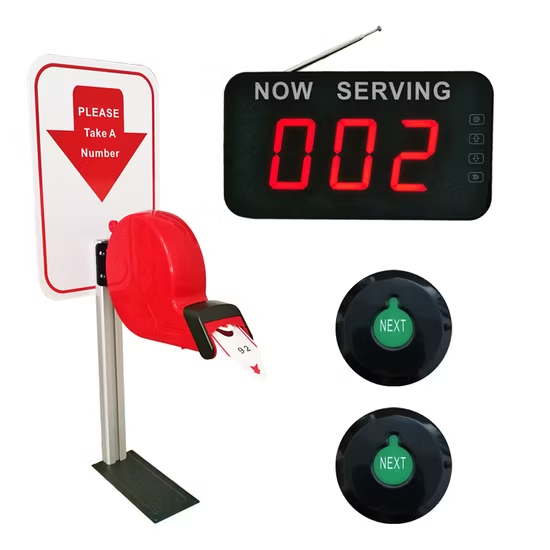
The experience of waiting defies objective time measurement in ways that continue to baffle researchers. A five-minute wait at the DMV feels eternal, while a 45-minute queue for Space Mountain flies by. This isn’t just about fun versus bureaucracy; the psychology runs deeper and stranger than anyone expected.
The Occupied Time Illusion
MIT operations researcher Richard Larson discovered that occupied time feels 36% shorter than unoccupied time, which explains why Disney provides entertainment in queues. But here’s where it gets weird: fake progress makes waits feel shorter even when people know it’s fake. Elevators that display floor numbers moving quickly between floors (even though the elevator speed hasn’t changed) receive fewer complaints. The Houston airport famously reduced wait time complaints not by speeding up baggage delivery, but by making passengers walk farther to baggage claim.
Initial theories suggested simple distraction, but brain imaging reveals something more complex. The anterior insular cortex, which processes time perception, shows different activation patterns during occupied versus unoccupied waiting. Yet this doesn’t explain why some distractions work while others make time feel longer. Reading makes waits feel shorter, but doing math problems makes them feel longer, even though both occupy the mind equally.
The Serpentine Mystery
Single serpentine lines (one line feeding multiple servers) move faster than parallel lines mathematically, but they also feel faster psychologically, even when they’re actually slower. Researchers at Duke University proposed it’s about fairness perception: nobody who arrived after you gets served before you. But studies in cultures that don’t value fairness as highly show the same effect.
The uncertainty reduction hypothesis seemed promising. People prefer knowing their wait time, even if it’s long. Houston’s therapy clinics that display wait times report higher satisfaction than those without displays, even with longer actual waits. But here’s the paradox: extremely precise wait times (“your wait is 23 minutes”) increase anxiety compared to rounded times (“about 20 minutes”), yet people trust them more.
The Progress Paradox
Disney discovered that showing wait times 20% longer than actual waits creates happiness when people board rides “early.” This “exceeding expectations” theory made sense until researchers found the effect reverses for waits under 10 minutes. Short waits feel longer when overestimated. The threshold varies by context in unpredictable ways.
Even stranger is the goal gradient effect. People walk faster as they approach their destination, and perceived time speeds up near the end of waits. But adding visible progress (like those moving-dot progress bars) sometimes makes waits feel longer, particularly when progress is non-linear. The same progress bar that reduces perceived duration for file downloads increases it for video streaming.
Cultural Time Mysteries
Americans experience waiting differently than Germans, who experience it differently than Brazilians, but not in ways cultural values predict. High-context cultures (Japan, Arab nations) supposedly have more patience, yet Japanese customers show less wait tolerance than Americans in service settings. The Birmingham therapy community notes that waiting room dynamics vary dramatically between cultural groups in ways that standard cultural dimensions don’t explain.
The social buffering hypothesis proposed that waiting with others makes time pass faster. Sometimes true: theme park lines feel shorter in groups. Sometimes false: waiting rooms feel longer when crowded. The presence of strangers slows time perception in elevators but speeds it in subway stations. No unified theory explains these contradictions.
The Retroactive Rewriting of Time
Perhaps most mysteriously, our evaluation of wait times changes retroactively based on outcomes. A long wait followed by excellent service gets remembered as shorter than it was. A short wait followed by poor service gets remembered as longer. This isn’t simple rosy retrospection; brain scans show the hippocampus literally rewrites temporal memories based on emotional outcomes.
Behavioral economists from Wharton found that people prefer experiences that end well over objectively better experiences that end poorly. But wait time memory doesn’t follow peak-end rules consistently. Sometimes the middle of the wait matters most, sometimes the beginning, with no predictable pattern.
The mystery deepens: people who are told their wait will be pleasant experience shorter subjective waits, even when the wait is identical. The expectation somehow changes time perception at a fundamental level. Neuroscientists can see this happening in the supramarginal gyrus, but can’t explain the mechanism.
Tags:













0 Comments