The Universe 25 Experiment and the Psychological Stress of Modern Civilization

by | Oct 15, 2024 | 0 comments

What Was The Universe 25 Experiment?
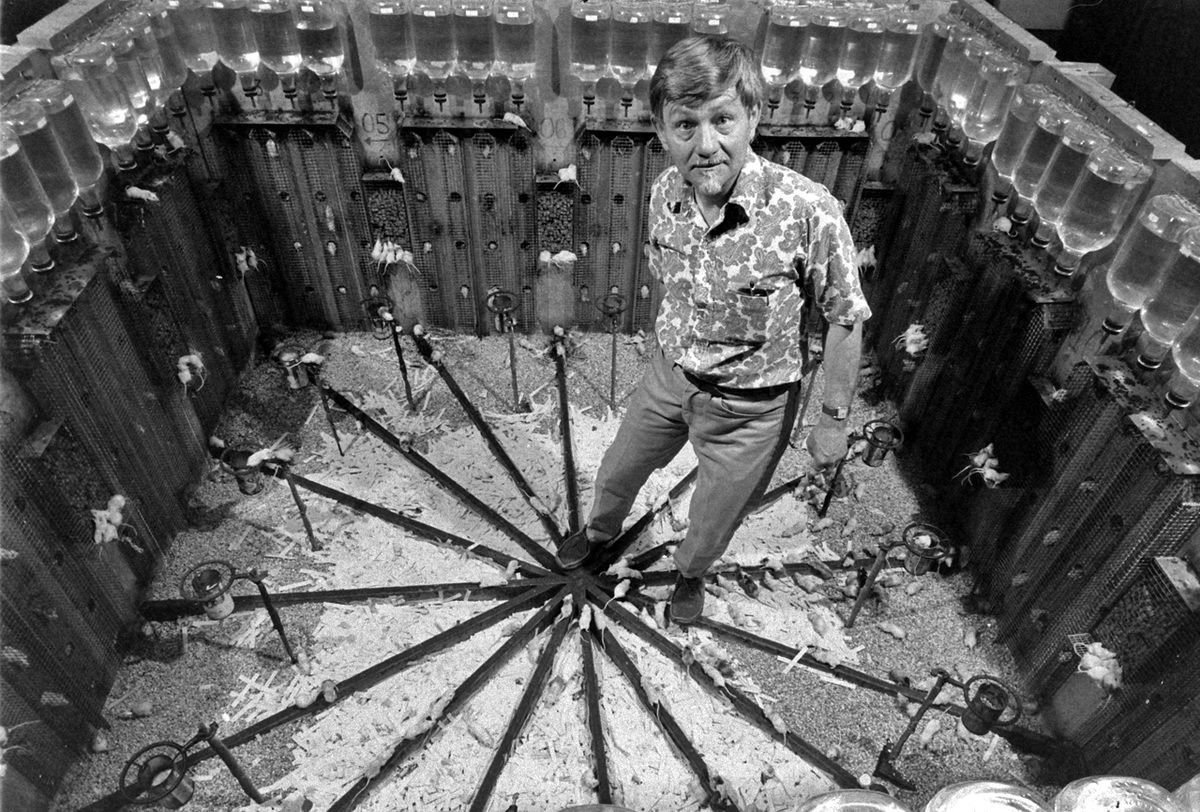
In the 1970s, ethologist John B. Calhoun conducted a famous experiment called Universe 25. In the study, a colony of mice was placed in a utopian enclosure called a “mouse paradise” with unlimited access to food, water, and nesting materials. The colony rapidly expanded but then exhibited increasingly dysfunctional and abnormal behaviors as overcrowding intensified. Many withdrew from social interaction, some became aggressive, mothers neglected their young, and eventually the colony collapsed.

This experiment has been viewed by many as a troubling allegory for modern human society. Anthropologists, evolutionary psychologists, Jungians, and psychoanalytic thinkers have drawn parallels between the breakdown of natural social structures and behavior seen in Universe 25 and the “double binds” and psychological stresses created by modern post-industrial civilizations.

Evolutionary Psychology Perspective

Evolutionary psychologists posit that much of human behavior and our underlying neural architecture evolved to adapt to the social conditions of our ancestral hunter-gatherer kin groups. By contrast, the conditions of high-density urban living, relative social isolation, consumerist culture, breakdown of extended family, and departure from traditional community roles seen in developed societies today are evolutionarily novel. This mismatch between the modern environment and the conditions we are optimized for leads to increased stress and mal-adaptations.

Jungian Perspective

Carl Jung and his followers saw neuroses, psychosis, and psychological suffering as signs of a “sick society” that has lost contact with myth, ritual, and the cycles of nature. They argue modern civilization has severed our link to the collective unconscious, the archetypal realm, and the natural progression through stages of life. Jung viewed schizophrenia as a kind of shamanistic state – an attempt by the psyche to self-heal and rebalance what society has fragmented.

But modernity, focused on the scientific, materialist worldview, has lost the capacity to integrate these states. It can no longer hear the compensatory messages from the unconscious indicating how out of balance we have become. Jungians see our consumer culture as a misguided attempt to fill our archetypal and spiritual voids with hollow goods and promises of immortality through products, status, and perpetual youth. By disconnecting us from nature’s cycles of aging and death and mythic rites of passage, it leaves us developmentally stuck and confused.

Psychoanalytic Perspective

Psychoanalysts like Sigmund Freud also examined the psychological toll of civilization. In works like Civilization and Its Discontents, Freud argued that civilization requires the suppression of individual instinctual drives, particularly aggression and sexuality, so that complex societies can function. This comes at a great cost—neurosis, discontent, and widespread psychological pain. The superego or conscience strictly regulates the innate libidinous drives of the id so people can cooperate at a mass scale. But these thwarted instincts still leak out in the form of anxiety, depression, aggression, perversions, and antisocial behaviors.

Warnings for the Future

The fate of the Universe 25 mouse colony should serve as a grave warning for the future of human civilization if we continue down our current trajectory. As population pressures increase and we drift ever further from the social networks, environments, and ways of being that we are evolutionarily and psychologically adapted for, we will likely see rising rates of mental illness, loneliness, violence, and societal discord.

We ignore the archetypal and psychological needs of human beings at our peril. To forge a healthier future, we must find ways to build meaning, community, and connection to nature and our own inner worlds into the framework of modern technological society. We need avenues to express and channel our innate drives and instincts rather than simply repress them.

If we fail to heed these warning signs from the psyche, we risk a large-scale psychological and social breakdown akin to the fate of Universe 25. It is imperative that we transform our civilizational “mouse utopia” into one that is more aligned with our fundamental nature—before it is too late.

Digital, Media, and Cultural Theorists and Philosophers 

Bernays and The Psychology of Advertising

John B Calhoun and Universe 25

The Siituationalists

Guy Debord

Vilem Flusser

Jean Baudrillard

Erich Fromm

Lev Manovich

Marshal McLuhan

Claude Shannon and Warren Weaver
Marcel Mauss

The Left and Right Hand Path in Cultural Psychology

Donna Haraway

Neil Postman

Explore the Other Articles by Categories on Our Blog 

What are the most common images in dreams?

What are the most common images in dreams?

Dreams keep their place in therapy because they are the purest projective material available. Nobody wrote them, nobody edited them, and the person who produced them was not trying to make an impression. In a way, dreams are our own personal mythology. Patients bring...

Mircea Eliade’s Insights into the Sacred

Mircea Eliade’s Insights into the Sacred

Mircea Eliade's Insights into the Sacred “A religious symbol conveys its message even if it is no longer consciously understood in every part. For a symbol speaks to the whole human being and not only to the intelligence.” ― Mircea Eliade, The Sacred and the Profane:...

Why are Trauma Patients Afraid of Space

Why are Trauma Patients Afraid of Space

Our phobias are often metaphors for our most unconscious parts of self. In the 2013 movie Gravity, Sandra Bullock plays an astronaut marooned in space. At every moment she is seconds from spinning into the hopeless oblivion of deep space. Bullock’s character must use...

Richard Tarnas: Cultural History Through Astrology

Richard Tarnas: Cultural History Through Astrology

The Historian of the Western Soul In 1991, Richard Tarnas published a book that became standard reading in universities worldwide: The Passion of the Western Mind. It was a brilliant, sweeping history of Western thought from Plato to Hegel to Jung. But in 2006, he...

3 Ways Your Shadow Shows Up as Animals in Myths and Dreams

3 Ways Your Shadow Shows Up as Animals in Myths and Dreams

Carl Jung thought that dreams were the way that we use the past to try and conceptualize what the future will be like. When we are on the edge of a big often unavoidable change in our life we begin to dig into our unconscious mind to try to predict the future. Our...

The Neuroscience and Phenomenology of Brainspotting

The Neuroscience and Phenomenology of Brainspotting

 An In-Depth Exploration of What Brainspotting Does in the Brain Brainspotting is a relatively new psychotherapy approach that combines elements of psychodynamic, somatic, and mindfulness-based therapies to facilitate deep emotional healing and trauma resolution [1]....

Why We Recommend Hardy Nutritionals: A Clinical Perspective on the Research That Changed How We Think About Treatment Resistance

Why We Recommend Hardy Nutritionals: A Clinical Perspective on the Research That Changed How We Think About Treatment Resistance

Why Taproot Therapy Collective recommends Hardy Nutritionals Daily Essential Nutrients for treatment-resistant mood disorders, ADHD, and emotional dysregulation. Discovered not through advertising but through patients whose bipolar disorder and other conditions finally responded. Over 40 peer-reviewed studies support the NutraTek chelation technology. Use code TAPROOT at gethardy.com for 15% off for life.

Who Is Victor Lamme?

Who Is Victor Lamme?

The Neuroscientist Who Found Consciousness in the Feedback Loops of the Brain When you look at a face, what happens in your brain? The answer turns out to be surprisingly complex. First, visual information streams forward from your eyes through your visual cortex,...

What the Ancient Mysteries Knew About Healing Trauma

What the Ancient Mysteries Knew About Healing Trauma

The Eleusinian, Mithraic, and Dionysian mysteries weren’t religious observances. They were orchestrated psychodramas designed to shatter the ego and rebuild the self. Modern trauma therapy has inadvertently reconstructed their methods.

Naomi Quenk’s Work on the Inferior Function

Naomi Quenk’s Work on the Inferior Function

You've had the experience. You're usually calm, but suddenly you're screaming at your partner over dishes. You're normally logical, but you're sobbing uncontrollably about something that "shouldn't" matter. You're typically easygoing, but you've become rigidly fixated...

Understanding How the Different Types of Therapy Fit Together

Understanding How the Different Types of Therapy Fit Together

You've tried therapy before. Maybe it helped a little. Maybe you spent months talking about your childhood without anything changing. Maybe you learned coping skills that worked until they didn't. Maybe the therapist was nice but you left each session feeling like...

Somatic Reset Techniques You Can do At Home

Somatic Reset Techniques You Can do At Home

Written by the clinical team at Taproot Therapy Collective, a Birmingham psychotherapy practice specializing in somatic and trauma-focused modalities. Our clinicians are trained in body-based approaches including Brainspotting, EMDR, and somatic trauma resolution....

0 Comments

Submit a Comment

Your email address will not be published. Required fields are marked *