


We marry our shadow because early attraction runs partly on projection. Jung’s shadow holds the qualities a person learned to disown, and a partner who lives those qualities openly can feel like fate. Jung said it plainly: the more unconscious we are, “the less is marriage a free choice.”1 The trait that pulls two people together is often the one they later fight about.
The claim here is narrower than the slogan. People do not usually marry their opposite. Across more than a hundred measured traits, partners tend to resemble each other.2 What we marry is one or two capacities we were taught to give away, plus a relational script we learned at home. A marriage becomes livable when each partner takes those capacities back and grows them, instead of assigning the other person to carry them for life.
What “marrying your shadow” actually means
The shadow is the part of the personality the ego refuses to see. In Aion (1951) Jung called it “a moral problem that challenges the whole ego-personality, for no one can become conscious of the shadow without considerable moral effort.”3 Most of it is unflattering: the temper or greed a person condemns in others. But Jung also noted “rather rare cases where the positive qualities of the personality are repressed,” and in his 1921 definitions he wrote that people project not only painful contents but “positive values which for some reason are uncongenial to the subject.” His example was “the consequences of self-depreciation.”34 Later writers call this the golden shadow: the confidence or play you admire in someone else because you never let yourself have it.
Projection is the mechanism. Jung insisted it is not chosen: “it is not the conscious subject but the unconscious which does the projecting. Hence one meets with projections, one does not make them.” It replaces a real relationship with an illusory one. “Projections change the world into the replica of one’s own unknown face.”3
Why a partner in particular? Jung answers later in Aion: “The shadow can be realized only through a relation to a partner, and anima and animus only through a relation to a partner of the opposite sex, because only in such a relation do their projections become operative.”3 Strictly, Jung held that the shadow is always of the same sex as the person and traced the most stubborn projections to the anima and animus, the contrasexual images.3 “Marrying your shadow” is popular shorthand that folds both together, and the clinical point does not depend on Jung’s gendered scheme: the capacities you disowned tend to turn up, vivid and magnetic, in the person you love.
Why attraction runs on projection
Jung’s most direct treatment is “Marriage as a Psychological Relationship,” written for Count Hermann Keyserling’s The Book of Marriage (English edition 1926). A young person of marrying age, he argued, “acts almost entirely from unconscious motives,” while feeling very conscious. That is why falling in love feels fated: “The greater the extent of unconsciousness, the less is marriage a free choice, a fact that shows itself subjectively in the sense of the driving power of fate so clearly felt when one is in love.”1 The sense that this person is destined is unconscious material finding a hook.
He also located the hook in the family. A conscious love for the parents, he wrote, “favours the choice of a mate similar to the father or mother,” while an unconscious tie distorts the choice. And “all of the life that could have been lived by the parents, but in which they were thwarted,” is handed to the children, who are pushed to live out what the parents left unlived.1 The child raised to be the steady, responsible one may disown spontaneity, then fall hard for a partner who has plenty of it. The family script decides which qualities get exiled before anyone is old enough to date.
The fantasy of completion through another person is far older than Jung. In Plato’s Symposium, Aristophanes tells of humans split in half by Zeus, each half “longing to grow into one” with its partner: “the desire and pursuit of the whole is called love.” Diotima, as Socrates reports her, answers that lovers are “seeking neither for the half of themselves, nor for the whole, unless the half or the whole be also a good.”5 Diotima’s correction is close to Jung’s: what the lover wants is a good he has not yet made his own.
Modern research supports a version of this. In a study of dating and married couples, Sandra Murray and colleagues found that people’s impressions of their partners “were more a mirror of their self-images and ideals than a reflection of their partners’ self-reported attributes.” Yet this idealization predicted greater satisfaction, not less.6 Some projection is part of how love works. In laboratory studies, when people were told they had an unflattering trait and then asked not to think about it, they became more likely to see that trait in someone else.7 A review of the social psychology of defenses found projection real in ordinary people, though possibly as a by-product of defense rather than the defense itself.8
Not your opposite: what the research on partners shows
“Opposites attract” is the popular version of the shadow story, and it is mostly wrong. The largest set of meta-analyses on partner similarity published as of 2023 covered 22 traits and added 133 traits measured in up to 79,074 UK Biobank couples. Of the 118 UK Biobank correlations that survived correction for multiple testing, 115 were positive and three negative. The strongest “opposite” pairing was morning people with evening people, at r = −.18. Personality traits showed the weakest resemblance, but still toward similarity.2
A meta-analysis of 313 attraction studies adds a twist: actual similarity predicted attraction among strangers and new acquaintances, but in existing relationships only perceived similarity did.9 A study of 291 newlywed couples found substantial similarity in attitudes and little in personality, and where spouses’ personalities did match, especially on attachment, marriages were happier.10
So the shadow is not a whole opposite person. It is narrower: one capacity such as anger, play, ambition or tenderness, carried by a partner who otherwise resembles you.
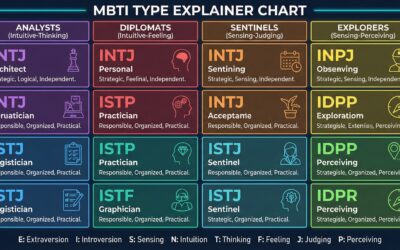
Typology needs a correction here. Jung’s term was the inferior function, not an “inferior type”: the function “that remains in arrear in the process of differentiation,” left undeveloped because a person leans on the strongest function for success.4 The Myers-Briggs Type Indicator turned Jung’s theory into a questionnaire, but research does not support its central premise of distinct types. Its four scales behave as continuous dimensions that overlap with four of the Big Five traits.1112 John Beebe’s eight-function model, which links each of eight function-attitudes to an archetypal role, is a useful map for reflection.13 But no model of type has been shown to predict who you will fall for. The inferior function is a good question to ask yourself, not a dating algorithm.
How the gift becomes the fight
Diane Felmlee put numbers on the darker half of the story. She asked 301 college students what first attracted them to their most recent former partner and what they later liked least. In 29.2 percent of the breakups, a disliked quality appeared to be the other face of an original attraction. Qualities such as “exciting” and “different” were especially likely to turn this way.14 In a follow-up, these “fatal attractions” were more likely when the appealing quality was seen as dissimilar from one’s own, unique or extreme, and less likely when it was seen as similar.15 The quality that most feels like what I am missing is the one most likely to turn on me.
Jung expected this turn and treated it as necessary. When a marriage reaches its middle years and one partner becomes divided within, “the causes of it are ordinarily projected upon the married partner. Thus there grows up a critical atmosphere, the indispensable precondition to becoming conscious.”1 In the same essay he described a “container” and a “contained” partner and a cycle in which “the more the contained one clings, the more does the container feel forced out of the relationship.”1 Couples researchers study a close cousin of this cycle as the demand/withdraw pattern. A meta-analysis of 74 studies covering 14,255 participants found it moderately associated with worse relationship and personal outcomes, and more strongly in distressed or clinical samples.16
Hal and Sidra Stone, the founders of Voice Dialogue, called a similar loop a “bonding pattern,” in which partners default to parent and child roles. The caretaker in one bonds with the other’s unspoken needs, and the other grows more rational and distant, until “John can’t feel his feelings and Mary can’t use her brains.” They noted that a negative bonding pattern very often follows a positive one, which is why the turn feels like betrayal.17 Each partner now fights, in the other, what they disowned in themselves. If you tend to merge and lose yourself in a relationship, the post on codependent patterns and healthy interdependence takes that side further.
Attachment research explains why the old script feels like home. Hazan and Shaver’s 1987 studies treated romantic love as an attachment process and linked adult attachment styles to reported experiences with parents.18 A later meta-analysis found attachment security only moderately stable from infancy to age 19, so the early pattern is a default, not a sentence.19 One study of adopted women found that their husbands’ faces resembled their adoptive fathers’, more so when the father had been emotionally supportive. It is a single study, but it fits Jung’s remark about conscious love for a parent.20 More on this in the post on attachment styles in adult relationships.
Taking the projection back
Jung did not think insight alone dissolves a projection. When the cause of an emotion seems to lie “beyond all possibility of doubt, in the other person,” recognizing it as one’s own is “a moral achievement beyond the ordinary.” A person “must be convinced that he throws a very long shadow before he is willing to withdraw his emotionally-toned projections from their object.”3 His colleague Marie-Louise von Franz later gave the whole process a book, published in English in 1980 as Projection and Re-Collection in Jungian Psychology.21 Re-collection is the point: you gather back what you scattered into other people.
Taking a projection back starts with a few honest questions:
- What specifically drew me to this person, and which of those qualities do I judge, fear or forbid in myself?
- What trait of theirs provokes the strongest reaction in me, admiring or contemptuous, and when did I first feel this way about someone?
- What did my family reward, and what did it punish or ignore?
- What would a modest, healthy dose of this quality look like in my own life?
The last question carries the work, because withdrawing a projection does not mean becoming your partner. The cautious spouse does not need to become reckless; she needs enough boldness of her own that she stops resenting his. The expressive partner does not need to become rigid; he needs enough structure of his own that her steadiness stops feeling like a cage.
Voice Dialogue, which the Stones developed in the early 1970s after Hal Stone’s training at the C. G. Jung Institute of Los Angeles, gives this a working vocabulary. In their model, “primary selves” are the parts we identify with when we say “I,” and “disowned selves” are pushed down by the primary system but “do not disappear completely” and keep shaping behavior. Their aim is an Aware Ego process that can “hold the tension of opposites” rather than obey one self and project the other.2223 Its research base is small and mostly qualitative, not controlled trials.24 It belongs to the same family as the parts-based therapies used at our practice.
None of this means you should stop projecting. Murray’s findings suggest some idealization helps couples, and the Jungian analyst Robert A. Johnson built a whole book, We (1983), on the Tristan and Iseult legend, reading Western romantic love through it and closing with a chapter titled “Of Human Love.”625 The aim is to know which part of the beloved is the person and which part is your own unlived life. Obsessive longing for someone out of reach is a related but different problem, covered in the post on love versus limerence.
What this looks like in therapy
Nobody arrives in therapy saying “I married my shadow.” They say they keep choosing the same kind of person, or that the quality they loved at first now drives them up the wall. In individual depth work, a therapist tracks the strongest reactions to the partner, admiring or contemptuous, and asks what they say about the client’s exiled capacities. Dreams help too; because Jung held that the shadow is always of the same sex as the subject, it tends to appear in dreams as a same-sex figure.3 Parts work slows the process down: the part that disowned anger usually had a job, often protecting a child from a parent who could not tolerate it, and it gets respect before it is asked to step aside.
In couple work, each partner learns to describe the cycle, rather than the other person, as the problem, and to name what they hand to the other to carry. The parts of each partner that never make it into the room are often the disowned ones. The evidence for couple therapy is reasonably strong: a 2020 meta-analysis of 58 studies with 2,092 couples found large gains in relationship satisfaction for treated couples, while waitlisted couples did not improve significantly.26 In a trial with 134 seriously distressed married couples, integrative and traditional behavioral couple therapy ended with similar clinically significant change: 71 and 59 percent of couples, respectively, reliably improved or recovered.27 The integrative version was built to add emotional acceptance of real differences between partners to the older model’s change techniques.28 These are trials of structured couple therapies, not of Jungian shadow work, for which no comparable trials turned up in the research for this article.
The shadow frame is about ordinary projection between two people who are both basically safe. It should never be used to explain away control, threats or violence as “just your shadow.” If fear is part of the relationship, the first task is safety, and the post on the lasting impact of narcissistic abuse is a better starting point than this one.
If this pattern sounds familiar, our Jungian depth therapy in Hoover is built around exactly this kind of question. You can also contact us to ask which of our therapists is the best fit.
References
- Jung, C. G. (1948). Marriage as a psychological relationship. In Contributions to analytical psychology (H. G. Baynes & C. F. Baynes, Trans.; pp. 189–203). Routledge & Kegan Paul. (Original translation published 1928) https://archive.org/details/dli.ernet.532881
- Horwitz, T. B., Balbona, J. V., Paulich, K. N., & Keller, M. C. (2023). Evidence of correlations between human partners based on systematic reviews and meta-analyses of 22 traits and UK Biobank analysis of 133 traits. Nature Human Behaviour, 7(9), 1568–1583. https://doi.org/10.1038/s41562-023-01672-z
- Jung, C. G. (1968). Aion: Researches into the phenomenology of the self (R. F. C. Hull, Trans.; 2nd ed., Collected Works Vol. 9, Part 2). Princeton University Press. (Original work published 1951) https://archive.org/details/collectedworksof92cgju
- Jung, C. G. (1933). Psychological types, or the psychology of individuation (H. G. Baynes, Trans.). Harcourt, Brace and Company; Kegan Paul, Trench, Trubner. (Original work published 1921) https://archive.org/details/psychologicaltyp00jung_1
- Plato. (1999). Symposium (B. Jowett, Trans.). Project Gutenberg. (Original work written c. 385–370 BCE) https://www.gutenberg.org/ebooks/1600
- Murray, S. L., Holmes, J. G., & Griffin, D. W. (1996). The benefits of positive illusions: Idealization and the construction of satisfaction in close relationships. Journal of Personality and Social Psychology, 70(1), 79–98. https://doi.org/10.1037/0022-3514.70.1.79
- Newman, L. S., Duff, K. J., & Baumeister, R. F. (1997). A new look at defensive projection: Thought suppression, accessibility, and biased person perception. Journal of Personality and Social Psychology, 72(5), 980–1001. https://doi.org/10.1037/0022-3514.72.5.980
- Baumeister, R. F., Dale, K., & Sommer, K. L. (1998). Freudian defense mechanisms and empirical findings in modern social psychology: Reaction formation, projection, displacement, undoing, isolation, sublimation, and denial. Journal of Personality, 66(6), 1081–1124. https://doi.org/10.1111/1467-6494.00043
- Montoya, R. M., Horton, R. S., & Kirchner, J. (2008). Is actual similarity necessary for attraction? A meta-analysis of actual and perceived similarity. Journal of Social and Personal Relationships, 25(6), 889–922. https://doi.org/10.1177/0265407508096700
- Luo, S., & Klohnen, E. C. (2005). Assortative mating and marital quality in newlyweds: A couple-centered approach. Journal of Personality and Social Psychology, 88(2), 304–326. https://doi.org/10.1037/0022-3514.88.2.304
- McCrae, R. R., & Costa, P. T., Jr. (1989). Reinterpreting the Myers-Briggs Type Indicator from the perspective of the five-factor model of personality. Journal of Personality, 57(1), 17–40. https://doi.org/10.1111/j.1467-6494.1989.tb00759.x
- Pittenger, D. J. (2005). Cautionary comments regarding the Myers-Briggs Type Indicator. Consulting Psychology Journal: Practice and Research, 57(3), 210–221. https://doi.org/10.1037/1065-9293.57.3.210
- Beebe, J. (2016). Energies and patterns in psychological type: The reservoir of consciousness. Routledge. https://doi.org/10.4324/9781315685946
- Felmlee, D. H. (1995). Fatal attractions: Affection and disaffection in intimate relationships. Journal of Social and Personal Relationships, 12(2), 295–311. https://doi.org/10.1177/0265407595122009
- Felmlee, D. H. (1998). “Be careful what you wish for…”: A quantitative and qualitative investigation of “fatal attractions.” Personal Relationships, 5(3), 235–253. https://doi.org/10.1111/j.1475-6811.1998.tb00170.x
- Schrodt, P., Witt, P. L., & Shimkowski, J. R. (2014). A meta-analytical review of the demand/withdraw pattern of interaction and its associations with individual, relational, and communicative outcomes. Communication Monographs, 81(1), 28–58. https://doi.org/10.1080/03637751.2013.813632
- Stone, H., & Stone, S. (n.d.). What are “bonding patterns”? and What is a “negative bonding pattern”? Voice Dialogue International FAQ. Retrieved November 8, 2026, from https://voicedialogueinternational.com/FAQ/What_are_bonding_patterns.htm
- Hazan, C., & Shaver, P. (1987). Romantic love conceptualized as an attachment process. Journal of Personality and Social Psychology, 52(3), 511–524. https://doi.org/10.1037/0022-3514.52.3.511
- Fraley, R. C. (2002). Attachment stability from infancy to adulthood: Meta-analysis and dynamic modeling of developmental mechanisms. Personality and Social Psychology Review, 6(2), 123–151. https://doi.org/10.1207/S15327957PSPR0602_03
- Bereczkei, T., Gyuris, P., & Weisfeld, G. E. (2004). Sexual imprinting in human mate choice. Proceedings of the Royal Society of London. Series B: Biological Sciences, 271(1544), 1129–1134. https://doi.org/10.1098/rspb.2003.2672
- von Franz, M.-L. (1980). Projection and re-collection in Jungian psychology: Reflections of the soul (W. H. Kennedy, Trans.). Open Court.
- Stone, H., & Stone, S. (n.d.). What are primary selves and disowned selves? and What is the role of the Aware Ego? Voice Dialogue International FAQ. Retrieved November 8, 2026, from https://voicedialogueinternational.com/FAQ/What_are_primary_selves_and_disowned_selves.htm and https://voicedialogueinternational.com/FAQ/What_is_the_role_of_the_Aware_Ego.htm
- Voice Dialogue International. (n.d.). Hal Stone, Ph.D. Retrieved November 8, 2026, from https://voicedialogueinternational.com/index-Hal_Stone.htm
- Chua, N., Serpell, L., Burnett-Stuart, S., & Pugh, M. (2022). Interviewing anorexia: How do individuals given a diagnosis of anorexia nervosa experience Voice Dialogue with their eating disorder voice? A qualitative analysis. Clinical Psychology & Psychotherapy, 29(2), 600–610. https://doi.org/10.1002/cpp.2652
- Johnson, R. A. (1983). We: Understanding the psychology of romantic love. Harper & Row.
- Roddy, M. K., Walsh, L. M., Rothman, K., Hatch, S. G., & Doss, B. D. (2020). Meta-analysis of couple therapy: Effects across outcomes, designs, timeframes, and other moderators. Journal of Consulting and Clinical Psychology, 88(7), 583–596. https://doi.org/10.1037/ccp0000514
- Christensen, A., Atkins, D. C., Berns, S., Wheeler, J., Baucom, D. H., & Simpson, L. E. (2004). Traditional versus integrative behavioral couple therapy for significantly and chronically distressed married couples. Journal of Consulting and Clinical Psychology, 72(2), 176–191. https://doi.org/10.1037/0022-006X.72.2.176
- Jacobson, N. S., Christensen, A., Prince, S. E., Cordova, J., & Eldridge, K. (2000). Integrative behavioral couple therapy: An acceptance-based, promising new treatment for couple discord. Journal of Consulting and Clinical Psychology, 68(2), 351–355. https://doi.org/10.1037/0022-006X.68.2.351














0 Comments