

Limerence is an involuntary, obsessive state of romantic longing for another person, named by psychologist Dorothy Tennov in 1979. It differs from love because it feeds on uncertainty and idealization rather than knowing the other person. Psychologically it matters because it hijacks mood, attention and the body, and because what it projects onto the beloved often belongs to the one who longs.
Key takeaways
- Limerence, named by psychologist Dorothy Tennov in 1979, is involuntary romantic obsession marked by intrusive thoughts, longing for reciprocation, idealization and mood that depends on the other person.
- Brain imaging shows intense romantic love activates dopamine reward regions, and rejection activates areas linked to craving, which is why limerence behaves like an addiction.
- Uncertainty feeds limerence: intermittent warmth works like a variable reinforcement schedule, and anxious or disorganized attachment makes people more vulnerable to it.
- Jungian psychology reads limerence as projection of the anima, animus or golden shadow, so recovery involves taking back qualities placed in the other person and living them oneself.
- Therapy for limerence combines reduced contact and structure with nervous system work such as Brainspotting and EMDR, parts work and Jungian depth work on projection.
You cannot stop thinking about them. Not for an hour, not for ten minutes. Your mind returns to them the way a tongue returns to a broken tooth: compulsively, involuntarily, almost against your will.
When they text, your heart races. When they do not, you spiral, checking your phone and replaying every interaction for signs of what they might be feeling. A casual compliment sends you into euphoria. A delayed reply plunges you into despair. Your mood now depends on the behavior of someone who may have no idea how much space they occupy in your life.
You know this is not healthy. You know, intellectually, that you are losing yourself. But the knowing does not help. The feelings override everything else, and when you try to stop, you cannot. If that describes your experience, you may be in the state Tennov called limerence, and understanding what is happening in your brain, your attachment history and your psyche is the first step toward getting your life back.
What is limerence?
Dorothy Tennov (1928 to 2007) was a psychology professor at the University of Bridgeport in Connecticut. Over several years she collected interviews and written questionnaires from hundreds of people about their experience of being in love, and she published the results in Love and Limerence: The Experience of Being in Love (1979).1 She invented a new word because the existing ones (love, infatuation, crush) blurred together very different experiences. She deliberately chose a word with no prior meaning so that readers would not bring old assumptions to it. The person who is the focus of the state she called the “limerent object,” now usually shortened to LO.
Tennov was clear that limerence is not the same as love, though it is easily mistaken for love by the person in it and by everyone watching. Some people in her sample had never experienced it at all and were puzzled by the descriptions; others had lived through it repeatedly. The features she described are recognizable to almost anyone who has been through it.
Intrusive, involuntary thinking about the LO
This is not pleasant daydreaming about someone you like. It is rumination that arrives uninvited and interferes with concentration, sleep and work. Tennov’s respondents described spending most of their waking hours preoccupied with the LO and being unable to redirect their attention despite genuine effort.1 The thoughts often take the form of rehearsed conversations, replayed moments and fantasies of a future scene in which the LO finally declares their feelings.
Acute longing for reciprocation
The limerent person wants the LO to return the feeling, and to return it with the same intensity. Physical availability is not enough; the longing is for proof of mutual emotional devotion. It is experienced as a need rather than a want, and it has a desperate quality that ordinary attraction lacks.
Mood that depends on the LO
Emotional state becomes contingent on how the LO seems to feel. A smile, a touch or a warm message produces what Tennov called buoyancy, a sense of walking on air. Perceived coldness or distance produces crushing despair. These swings can happen several times in one day, and they are driven less by what the LO actually does than by how the limerent person reads it.
Idealization of the LO
The limerent person does not see the LO clearly. Tennov borrowed the word “crystallization” from the novelist Stendhal to describe how the mind dwells on the LO’s admirable qualities and explains away or ignores the rest.1 The idealization is remarkably resistant to contradictory evidence: a flaw that would end ordinary attraction is reframed as charming or as proof of hidden depth.
Physical symptoms
Limerence is felt in the body. Tennov’s respondents reported a racing heart, trembling, flushing, loss of appetite, insomnia, and an aching in the chest when uncertainty was strongest. Many described a nervous energy that felt like anxiety and excitement at once, along with fear of rejection and painful shyness in the LO’s presence.
Uncertainty as fuel
Tennov observed that limerence intensifies through adversity. If the LO clearly reciprocates, limerence often settles over time into a calmer bond. If the LO clearly rejects, it usually fades, though often slowly. But when the LO’s feelings stay ambiguous, warm one day and distant the next, limerence grows. That pattern is a form of intermittent reinforcement, and it is the reason limerence can keep a person hooked for months or years.
How is limerence different from love?
Limerence feels like love. To the person inside it, it can feel like the deepest love they have ever known, precisely because it is so intense. But intensity and depth are not the same thing. A fire that burns hot and fast is not the same as a hearth.
Healthy romantic love tends to involve the following:
- Seeing the other person realistically, including their flaws, and loving them anyway.
- Feeling enlarged rather than diminished by the relationship.
- Keeping your own identity, interests and friendships.
- Caring about the other person’s wellbeing for its own sake, not as a way of regulating your own emotions.
- Growing calmer and more secure over time as the attachment deepens.
Limerence tends to involve a different set of experiences:
- Relating to a fantasy rather than to the real person.
- Feeling consumed, obsessed and often anxious or destabilized.
- Losing yourself: neglecting other relationships, responsibilities and parts of your identity.
- Focusing mainly on getting something from the LO, such as attention, validation or reciprocation.
- Growing more desperate and dysregulated over time while reciprocation stays uncertain.
The deepest difference is this. Love is a connection with another person. Limerence is about what the other person represents: what they symbolize, what their attention would mean, what their love would prove about your worth. In limerence the LO is less a person than a screen onto which you project your deepest needs and longings. That idea of projection is where the neuroscience and the depth psychology of limerence meet.
Why does limerence feel like an addiction?
If limerence feels like an addiction, there is a reason. In 2005 Arthur Aron, Helen Fisher and colleagues scanned seventeen people who had recently fallen intensely in love while they looked at a photograph of their beloved. The strongest activations were in the right ventral tegmental area and the caudate nucleus, dopamine-rich regions of the brain’s reward and motivation system.2 The researchers concluded that early-stage intense romantic love behaves less like a specific emotion and more like a goal-directed motivational state, a drive to win a particular person.
A follow-up study looked at fifteen people who had recently been rejected by a partner but were still in love. Viewing the rejecter’s photograph activated the ventral tegmental area and also the nucleus accumbens and orbitofrontal and prefrontal regions that are associated with craving in cocaine addiction.3 In 2016 Fisher and colleagues pulled this work together and argued that intense romantic love works like a natural addiction, one that can be positive when love is returned and painful and compulsive when it is not.4 At the level of basic reward processing, the brain does not sort rewards into good and bad. It registers that a stimulus is highly salient and keeps pursuing it.
The neurochemistry of early attraction
Dopamine is not the only player. In 1999 the Italian psychiatrist Donatella Marazziti and colleagues measured the serotonin transporter on blood platelets in twenty people who had fallen in love within the previous six months. Their transporter levels were significantly lower than those of controls and similar to levels in untreated patients with obsessive-compulsive disorder, and they returned to normal when the same people were retested a year or more later.5 The study measured a marker in blood, not serotonin in the brain, but it offers a plausible biological link between early love and obsessive thinking. A later study by Marazziti and Canale found raised cortisol, the stress hormone, in both men and women in the early phase of falling in love.6 Fisher has also proposed that norepinephrine, which sharpens arousal and attention, contributes to the sleeplessness and focused energy of new love.4
Put together, this profile matches the limerent experience: hyper-focused attention, nervous energy, a body that behaves as if under stress, emotional volatility, and difficulty thinking about anything else.
Why unpredictability makes it worse
The reward system responds most strongly to rewards that are uncertain. In the 1950s Charles Ferster and B. F. Skinner catalogued how different schedules of reinforcement shape behavior. Behavior rewarded on an intermittent, unpredictable schedule, especially a variable-ratio schedule in which the payoff comes after an unpredictable number of tries, was the hardest to extinguish.7 Slot machines run on this principle. So does limerence. When the LO is sometimes warm and sometimes cold, each moment of warmth lands like a jackpot and each silence becomes craving.
This is why limerence is so hard to end through willpower alone. You are not fighting a preference or a habit. You are fighting a reward system that has locked onto a target with the tenacity it would bring to a life-sustaining resource. Once the brain has classified the LO as essential, it generates craving, seeking and acute distress when deprived, much as it would with any addiction.
Which attachment patterns make limerence more likely?
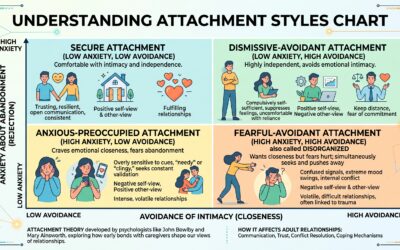
Not everyone experiences limerence with the same intensity or frequency. Research on adult attachment and long clinical experience both suggest that certain attachment patterns create vulnerability. In 1987 Cindy Hazan and Phillip Shaver applied attachment theory to adult romance. Adults who described themselves as anxious or ambivalent in relationships reported love experiences marked by obsessive preoccupation, a strong desire for reciprocation and union, emotional highs and lows, and intense jealousy.8 That list reads almost like Tennov’s description of limerence.
Anxious attachment
Anxious attachment is particularly associated with limerence. People with this pattern usually learned early that caregivers were inconsistently available, responsive at some times and absent or preoccupied at others. The child learns that closeness is uncertain and must be monitored and worked for. In adulthood this shows up as preoccupation with a partner’s availability, sensitivity to any sign of withdrawal, and difficulty self-soothing when the partner is distant. The same nervous-system vigilance appears in children raised by unpredictable parents, a pattern Taproot describes in its piece on eggshell parenting.
The anxiously attached person is primed for limerence because uncertainty does more than cause distress: it switches the whole attachment system on at full intensity. The question “do they love me?” feels familiar, even necessary. A secure, steady partner may feel boring or seem to lack chemistry, simply because that partner does not trigger the anxious arousal the person has learned to read as love.
Disorganized and fearful-avoidant attachment
Disorganized attachment, which in adult research is often linked with the fearful-avoidant style, can also predispose a person to limerence, particularly its most painful forms. A child with a disorganized pattern experienced the caregiver as both the source of comfort and the source of fear, an impossible bind. As adults, such people may be drawn to relationships that recreate the bind: wanting closeness desperately while fearing it, and attracted to people who are only intermittently available, because total availability would trigger fear and total unavailability would trigger despair.
Understanding your attachment pattern, and the early experiences that shaped it, is often essential to understanding why limerence has such a grip. The LO is not only activating your reward system. They may be activating your whole attachment system, including the wounded parts that formed in childhood. This is where inner child work becomes relevant: the intensity of limerence often draws its power from unmet childhood needs that are being projected onto the LO.
What does Jungian psychology say about limerence?
Depth psychology offers another lens on limerence, one that complements the neuroscience rather than contradicting it. From a Jungian perspective, limerence involves a massive projection of the anima or animus onto the LO. Carl Jung used these terms for the contrasexual figure in the unconscious: the inner feminine image in a man (anima) and the inner masculine image in a woman (animus). Many contemporary Jungians treat them more broadly as the inner image of the soul or the other, regardless of gender.
How projection works
Projection, in Jung’s sense, is not a choice. It happens automatically when unconscious content has not yet been recognized as part of oneself, so it appears to belong to someone outside. In Aion (1951; English translation 1959) Jung described how the anima and animus are first met in projection onto real people, and how projection isolates a person from the people around them, replacing a real relationship with an illusory one.9 Jung argued that we carry inner images of the beloved shaped partly by personal experience, parents and early relationships, and partly by collective, archetypal patterns. When we meet someone who fits the image, we fall in love, but much of what we feel is recognition of our own projected content. We are falling in love with our own gold, reflected back to us in another person’s face.
The American Jungian analyst Robert A. Johnson developed this argument at length in We: Understanding the Psychology of Romantic Love (1983).10 Reading the medieval legend of Tristan and Iseult, Johnson argued that Western romantic love asks a human partner to carry the weight of the soul, something closer to a religious longing than to a relationship with an ordinary person. When that projection falls away, as it always eventually does, people conclude that love has died, when what has actually ended is the projection. Johnson contrasted this with what he called human love, the ordinary, daily care for a real person. His view, discussed more fully in Taproot’s piece on Robert A. Johnson, maps closely onto Tennov’s distinction between limerence and love.
This explains why limerence involves such intense idealization. The limerent person is not seeing the LO; they are seeing their own anima or animus. All the qualities they long for, wholeness, specialness, aliveness, the capacity to love and be loved, seem to live in the other person. If only the LO would love them back, they would be complete.
The problem is that projection is unconscious and distorting. The LO is a real person with their own qualities, limits and inner life, and the limerent person cannot see it. They see the symbol, not the person. Because the projected content belongs to the limerent person’s own psyche, no outside person can ever fulfill it. At bottom, the longing is for something within themselves that they have not yet developed or integrated.
The shadow side of the Lover archetype
This is what the Lover archetype looks like in its shadow form. In King, Warrior, Magician, Lover (1990), Robert Moore and Douglas Gillette described the Lover’s shadow as having two poles. The Addicted Lover is swallowed by sensation and longing, unable to hold boundaries, endlessly restless; the Impotent Lover is flat, cut off from feeling and depressed.11 Limerence lives at the addicted pole: not connection and intimacy but possession and consumption, the wish to merge with another person so completely that boundaries dissolve. The shadow Lover does not relate; it devours. And when that pattern takes over, the result is the desperate, self-losing quality of limerence, with the impotent pole often waiting on the other side when the obsession collapses.
The shadow and the golden shadow
Jung’s concept of the shadow is relevant too. The shadow is everything about ourselves that we have not accepted into conscious identity. It includes not only what we consider bad but also positive capacities we were taught to suppress. Often, the qualities we project onto the LO are qualities we have disowned. Perhaps you see in them a confidence you do not allow yourself to express, a freedom you have suppressed, or a capacity for passion you learned to distrust. The limerence is not really about them. It is about parts of yourself that want to be lived and are trying to come into consciousness through the vehicle of an obsessive attraction.
What are the stages of limerence?
Limerence usually develops through recognizable phases. Popular writing often compresses them into three: infatuation, crystallization and deterioration. That three-part scheme is a later simplification rather than Tennov’s own formula, but it describes the course many people recognize.
Infatuation
Initial attraction intensifies. The person begins to occupy more and more mental space. There is excitement, energy and a sense of possibility. At this point limerence may be indistinguishable from an ordinary crush or the early stage of falling in love, and the experience is more pleasant than painful.
Crystallization
This is full limerence. The term comes from Stendhal’s treatise De l’amour (On Love, 1822). Stendhal described how a bare branch left in the depths of the Salzburg salt mines is drawn out months later covered in glittering crystals, so that the original twig can no longer be seen; the lover’s mind, he said, does the same to the beloved, finding new perfections everywhere. Stendhal himself laid out a sequence of seven steps, from admiration and hope to a first crystallization, a period of doubt, and a second, stronger crystallization that doubt sets off. That detail matters: Stendhal had already noticed that doubt intensifies love rather than ending it, the same observation Tennov made about uncertainty.1
In this phase obsessive thinking dominates. The LO is idealized and their flaws vanish or turn into virtues. Mood swings intensify. The limerent person may begin checking behaviors: monitoring social media, engineering “accidental” encounters, analyzing every message for hidden meaning. Life increasingly revolves around the LO.
Deterioration
If limerence does not resolve into a relationship, where it may mature into attachment, or end through clear rejection, it deteriorates. The constant uncertainty becomes exhausting. The highs get harder to reach and the lows get deeper and longer. The limerent person may recognize that what they are living through is not healthy and still feel unable to stop. Depression, anxiety and despair often mark this phase, and some people stay stuck here for months or years.
Knowing which phase you are in helps shape the approach to healing. Early limerence is easier to interrupt. Long-running limerence, especially when it rests on old attachment wounds, usually needs more sustained work.
Why is limerence so hard to end?
People in limerence often ask, “Why can’t I just stop?” The question assumes that limerence is a choice, or at least that it should respond to a rational decision. But limerence runs through systems that do not answer to conscious will. Several factors make it especially resistant to change.
The reward system keeps seeking. As long as any possibility of reciprocation remains, reward circuitry keeps generating craving and seeking. This is why “no contact” is so often recommended: not as punishment, but because continued contact, including watching someone’s social media, keeps the reward loop active.
The attachment system is involved. For people with anxious or disorganized attachment, limerence activates the whole attachment system, early wounds included. Letting go can feel like abandoning a child or facing annihilation, because at the level of the attachment system that is what it represents.
The projection contains real psychological gold. What you see in the LO is not entirely fantasy. It often points to real capacities in yourself that want development. The psyche does not want to give up those potentials, even when it is reaching them through an unhealthy channel.
Limerence supplies meaning and intensity. For some people, limerence fills a void. It gives life purpose, drama and significance. Without it they fear flatness, emptiness and boredom, and the prospect of ordinary life without the highs and lows can feel like a kind of death.
Withdrawal is genuinely painful. When you have been running on limerent neurochemistry, removing the stimulus brings real withdrawal: low mood, anxiety, restlessness, poor concentration and physical discomfort. Fisher’s rejection study captured this state directly, with craving and distress showing up in the same brain regions that drive the pursuit.3 The brain adapted to one chemical environment and protests when it changes.
How do therapists treat limerence?
Ending limerence is not simply a matter of willpower or insight, though both help. It means working with the underlying patterns on several levels at once: behavior, thought, emotion, the body and the deeper psyche.
Behavioral strategies
No contact, or a radical reduction in contact, is often needed to begin breaking the cycle. Each interaction reactivates the reward system, and even “harmless” social media checking keeps the loop running. The separation does not have to be permanent, but a period of complete or near-complete distance gives the nervous system a chance to recalibrate.
Behavioral activation means deliberately doing things that offer other sources of reward, meaning and engagement. Exercise is especially useful because it works on some of the same dopamine and stress systems involved in limerence. Creative projects, time with friends and family, and learning something new all help the brain build other routes to reward.
Ritual and structure help contain obsessive thinking. Some people set aside a designated time each day to think about the LO and gently postpone rumination outside that window. Over weeks, this tends to loosen the grip of intrusive thoughts, because the mind learns that the thoughts can wait.
Working with thoughts and stories
Limerence is not purely a problem of thinking, but thought patterns matter. Reality testing means deliberately noticing the LO’s flaws and limits, and the ways the relationship has not actually served you. This is not about demonizing the person; it is about seeing a human being instead of a fantasy.
Examining underlying beliefs often reveals deeper convictions: “I’ll never find anyone else.” “Their love would prove I’m worthwhile.” “I can’t be happy without them.” These beliefs usually carry the voice of an earlier time, and they loosen most when they are traced back to where they were learned, which is easier with a therapist than alone.
Narrative reframing means consciously building a different story about what is happening. Instead of “I’m in love with someone who doesn’t love me back,” perhaps “I’m learning something important about my own patterns and needs.” Instead of “I’ll never get over them,” perhaps “This is a hard transition that I’m moving through.” Qualitative research with people who had lived through limerence found that many came to understand it in exactly this way, as a painful passage toward a more authentic sense of self.15
Working with the nervous system
Because limerence involves deep nervous system dysregulation, approaches that work directly with the body and brain are often essential. Insight alone rarely reaches the parts of the brain where craving and attachment panic live.
Brainspotting, developed by David Grand in 2003, rests on his observation that where a person looks affects how they feel. The therapist helps the client find an eye position that connects with the activation they feel when thinking of the LO and then holds attention there while the body processes what arises.14 Grand describes this as reaching the subcortical, emotional brain beneath conscious narrative, which is why it suits material like attachment wounds that talking alone does not touch. Taproot’s piece on the neurological experience of Brainspotting describes this process in more detail.
EMDR (eye movement desensitization and reprocessing) helps people process early attachment experiences and painful memories that feed the intensity of a limerent response. When limerence is fueled by childhood wounds, working through those memories often reduces the charge of the current attraction.
Somatic approaches build awareness of the body sensations that come with limerence: the craving, the anxious buzz, the ache in the chest. Learning to stay present with those sensations rather than acting on them or dissociating from them builds the capacity to tolerate the discomfort of withdrawal. Grounding techniques provide in-the-moment tools for the hardest moments, when you want to reach out, check their profile, or act on the obsession in ways you will regret.
Depth psychological work
Lasting freedom from limerence usually requires integrating the projections: taking back the gold you have placed in the other person and developing it in yourself.
Parts-based therapy is particularly useful here. In Richard Schwartz’s Internal Family Systems model, the mind is made up of parts: exiles carry old pain, managers try to keep that pain from surfacing, and firefighters react impulsively when it breaks through.13 Limerence often involves young exiled parts that carry early attachment wounds and firefighter parts that use the obsession to avoid feeling those wounds directly. Getting to know these parts, understanding their protective intent, and helping them trust that the system can handle difficult emotions can change the inner landscape that produces limerence.
The Jungian approach involves withdrawing projections consciously: recognizing that the qualities you see in the LO belong in part to you and beginning to develop them directly. What does the LO represent? What qualities do they embody that you have disowned? How might you cultivate those qualities without needing another person to carry them for you? Dreams, active imagination and close attention to what the LO stirs in you are the usual material of this work.
Donald Kalsched’s work on archetypal defenses deepens this picture. In The Inner World of Trauma (1996) Kalsched described a self-care system that the psyche builds after early trauma: a protective inner figure that shields the vulnerable core of the personality but, in doing so, keeps the person from fully living.12 Limerence can be understood as one form of that defense, a way of keeping the self from fully occupying its own life by orienting endlessly toward an outside object. The work involves gradually making it safe enough for the self to come home to itself.
What is limerence trying to tell you?
Limerence is not only a problem to be solved. It is also a messenger. It arrives carrying information about unmet needs, developmental arrests and unlived life. When you find yourself in it, these questions are worth sitting with:
- What does this person represent to me?
- What qualities do I see in them that I have disowned in myself?
- What void in my life is this obsession filling?
- If this longing were fully satisfied, what would it give me that I do not have now?
- What early experiences primed me for this kind of attachment?
- What parts of me have been waiting for someone else’s love before they can finally live?
These questions do not have quick answers. They are the material of deep therapeutic work, the kind of inquiry that can change not just one episode of limerence but the pattern that keeps producing it.
The goal is not to stop feeling attraction or longing; those are part of being human. The goal is to feel attraction without losing yourself in it, to long for connection without making it the condition of your worth, and to love another person as a subject rather than using them as a surface for your unfinished business.
When should you see a therapist for limerence?
Consider working with a therapist if any of the following apply:
- The limerence has lasted for months and is not easing on its own.
- Your daily functioning is significantly impaired, and work, relationships or self-care are suffering.
- You are engaging in behavior you know is harmful, such as following the person, repeated unwanted contact or online surveillance.
- You are experiencing severe depression or thoughts of suicide connected with the limerence. If you are in immediate danger, call or text 988 in the United States.
- You have gone through several episodes of limerence over your life and want to understand and change the pattern.
- You recognize that childhood attachment wounds are involved and want to heal at that level.
- Earlier attempts to end the limerence by willpower alone have not worked.
Limerence exists on a spectrum. Milder episodes may resolve with self-awareness and time. Severe or repeated episodes, especially those rooted in early trauma and attachment disruption, usually need professional support to heal fully.
At Taproot Therapy Collective, we work with people caught in limerence and other forms of relationship distress using approaches that address both the nervous system and the deeper psychological patterns underneath. Our work includes Brainspotting, EMDR and parts-based therapy, along with Jungian depth work, and its aim is to help you understand why limerence holds such power in your life and to find real freedom from it. We see clients in person in Hoover, near Birmingham, and offer teletherapy throughout Alabama, including Montgomery and Tuscaloosa.
Can you recover from limerence?
Limerence can feel like a life sentence. Inside it, you cannot imagine being free of the obsession, and often cannot imagine wanting to be. The thought of letting go feels like losing something essential.
But people do recover. Marazziti’s participants showed their biological markers returning to normal as the first phase of love passed.5 The reward system settles when it is no longer fed. The projections get withdrawn. The underlying wounds heal. What seemed like the most important thing in the world becomes, looking back, one chapter in a longer story: painful, but one that taught you something essential about yourself.
The gold you saw in them? It is still there, but now you know where it lives. Jungians call this the golden shadow: the admirable qualities we cannot yet claim and so find first in someone else. It lives in you. It always did.
Learning to recognize this, to develop within yourself what you sought in another, is the real work that limerence invites. It is not easy work, but it does more than end one episode of obsessive attachment. It changes who you are, how you relate, and what you are able to receive and give in love. If you are ready to start that work, you can reach out to Taproot and we will help you find a therapist who fits.
Frequently asked questions
What are the signs of limerence?
The main signs of limerence are intrusive thoughts about one person, a desperate need for them to return your feelings, mood swings that track their every signal, idealizing them despite evidence, physical symptoms like a racing heart or insomnia, and feelings that grow stronger when their interest is uncertain. Dorothy Tennov described these features in her 1979 book Love and Limerence.
How long does limerence last?
Limerence can last from a few weeks to many years. It usually fades when the feelings are clearly returned and settle into attachment, or when there is clear rejection and little contact. It lasts longest when the other person stays ambiguous, because intermittent signs of interest keep the reward system firing and the attachment system on alert.
Is limerence a mental illness?
Limerence is not a diagnosis in the DSM or ICD. It is a recognized pattern of romantic obsession that Dorothy Tennov described in 1979. It becomes a clinical concern when it disrupts work, sleep or relationships, drives harmful behavior such as surveillance, or connects with depression, anxiety, obsessive thinking or old attachment trauma.
Can limerence turn into real love?
Limerence can turn into lasting love when the feelings are mutual and the couple comes to know each other as real people. As the uncertainty ends, the idealization softens and a calmer attachment can grow. Robert A. Johnson called this the shift from projected romantic love to human love, the everyday care of an actual person.
Why do I get limerence for people who are unavailable?
Unavailable people produce limerence because unpredictable attention is the strongest reinforcer the brain knows. For people with anxious or disorganized attachment, an unavailable partner also recreates the inconsistency of early caregiving, which feels familiar. In Jungian terms, an unavailable person is an easy screen for projection, since reality rarely interrupts the fantasy.
Related reading
- Enmeshment: When Closeness Becomes a Cage
- Trauma Dumping vs. Healthy Sharing: Understanding the Difference
- Adult ADHD, ADHD Screener, AuDHD, ADHD and Autism, Neurodiversity, Psychotherapy, Mental Health, Executive Function, ADHD Symptoms, Self-Assessment
- How do Archetypes Show Up in Relationships
- Karl Friston and Carl Jung: The Unnoticed Rehabilitation
- The Evolution of Addiction Recovery: How Jungian Psychology is Creating Deeper, More Sustainable Healingaft
References
- Tennov, D. (1979). Love and limerence: The experience of being in love. Stein and Day.
- Aron, A., Fisher, H., Mashek, D. J., Strong, G., Li, H., & Brown, L. L. (2005). Reward, motivation, and emotion systems associated with early-stage intense romantic love. Journal of Neurophysiology, 94(1), 327-337. https://doi.org/10.1152/jn.00838.2004
- Fisher, H. E., Brown, L. L., Aron, A., Strong, G., & Mashek, D. (2010). Reward, addiction, and emotion regulation systems associated with rejection in love. Journal of Neurophysiology, 104(1), 51-60. https://doi.org/10.1152/jn.00784.2009
- Fisher, H. E., Xu, X., Aron, A., & Brown, L. L. (2016). Intense, passionate, romantic love: A natural addiction? How the fields that investigate romance and substance abuse can inform each other. Frontiers in Psychology, 7, 687. https://doi.org/10.3389/fpsyg.2016.00687
- Marazziti, D., Akiskal, H. S., Rossi, A., & Cassano, G. B. (1999). Alteration of the platelet serotonin transporter in romantic love. Psychological Medicine, 29(3), 741-745. https://doi.org/10.1017/s0033291798007946
- Marazziti, D., & Canale, D. (2004). Hormonal changes when falling in love. Psychoneuroendocrinology, 29(7), 931-936. https://doi.org/10.1016/j.psyneuen.2003.08.006
- Ferster, C. B., & Skinner, B. F. (1957). Schedules of reinforcement. Appleton-Century-Crofts.
- Hazan, C., & Shaver, P. (1987). Romantic love conceptualized as an attachment process. Journal of Personality and Social Psychology, 52(3), 511-524. https://doi.org/10.1037/0022-3514.52.3.511
- Jung, C. G. (1959). Aion: Researches into the phenomenology of the self (R. F. C. Hull, Trans.; Collected Works Vol. 9, Pt. 2). Princeton University Press. (Original work published 1951)
- Johnson, R. A. (1983). We: Understanding the psychology of romantic love. Harper & Row.
- Moore, R., & Gillette, D. (1990). King, warrior, magician, lover: Rediscovering the archetypes of the mature masculine. HarperSanFrancisco.
- Kalsched, D. (1996). The inner world of trauma: Archetypal defenses of the personal spirit. Routledge.
- Schwartz, R. C., & Sweezy, M. (2020). Internal family systems therapy (2nd ed.). Guilford Press.
- Grand, D. (2013). Brainspotting: The revolutionary new therapy for rapid and effective change. Sounds True.
- Willmott, L., & Bentley, E. (2015). Exploring the lived-experience of limerence: A journey toward authenticity. The Qualitative Report. https://doi.org/10.46743/2160-3715/2015.1420



















0 Comments