Demystifying Jung

by | May 19, 2022 | 3 comments

Demystifying Jung

Jung was a complicated man. He was broad minded to the point that he dabbled in parapsychology and ESP. Jung outlined a type of new psychology but was hesitant to spell out what the implications or boundaries of this new psychology should be. Jung’s ambivalence towards standardizing his psychology shows across the varied fields in which it has become practiced. The study of archetypal images latent within the humanity’s collective unconscious has become known as “depth psychology”. This study has been applied to many fields, namely sociology, anthropology, creative writing and comparative religion.

he broad strokes of Jungian psychology as a clinical style is that it is more growth oriented than the majority of other modalities. The goal of most psychotherapy models is the rapid reduction of symptoms. The focus of Jungian psychology is self discovery and personal growth across the life cycle. Jungian clinicians put more emphasis on helping patients discover what they want than on trying to help patients get what they say they want. Jungian clinicians put a large emphasis in expressing the self through creativity and on growth as a person.

Bibliography:

Jung, C.G. Collected Works of C.G. Jung. Edited by William McGuire and R.F.C. Hull, Princeton University Press, 1953-1979.

Jung, C.G. The Red Book. Edited by Sonu Shamdasani, W.W. Norton & Company, 2009.

Edinger, Edward F. Ego and Archetype. Shambhala, 1992.

Hollis, James. The Eden Project: In Search of the Magical Other. Inner City Books, 1998.

Von Franz, Marie-Louise. Archetypal Dimensions of the Psyche. Shambhala, 1997.

Further Reading:

Hillman, James. Re-Visioning Psychology. Harper & Row, 1975.

Neumann, Erich. The Great Mother: An Analysis of the Archetype. Princeton University Press, 1972.

Stevens, Anthony. Archetype Revisited: An Updated Natural History of the Self. Brunner-Routledge, 2002.

Samuels, Andrew. Jung and the Post-Jungians. Routledge, 1985.

Beebe, John. Integrity in Depth. Central Recovery Press, 2015.

Stein, Murray, editor. Jungian Psychoanalysis: Working in the Spirit of C.G. Jung. Open Court, 2010.

Singer, June. Boundaries of the Soul: The Practice of Jung’s Psychology. Anchor, 1994.

Hall, James A. Jungian Dream Interpretation: A Handbook of Theory and Practice. Inner City Books, 1983.

Jaffe, Aniela. Memories, Dreams, Reflections. Vintage, 1989.

Corbett, Lionel, editor. Film and the Jungian Imagination. Spring Journal Books, 2018.

Callan, Richard. Jung and Yoga: The Psyche-Body Connection. Inner City Books, 2018.

Explore the Other Articles by Categories on Our Blog 

Hardy Micronutrition is clinically proven to IMPROVE FOCUS and reduce the effects of autism, anxiety, ADHD, and depression in adults and children without drugsWatch Interview With HardyVisit GetHardy.com and use offer code TAPROOT for 15% off

What the Ancient Mysteries Knew About Healing Trauma

What the Ancient Mysteries Knew About Healing Trauma

The Eleusinian, Mithraic, and Dionysian mysteries weren’t religious observances. They were orchestrated psychodramas designed to shatter the ego and rebuild the self. Modern trauma therapy has inadvertently reconstructed their methods.

Naomi Quenk’s Work on the Inferior Function

Naomi Quenk’s Work on the Inferior Function

You've had the experience. You're usually calm, but suddenly you're screaming at your partner over dishes. You're normally logical, but you're sobbing uncontrollably about something that "shouldn't" matter. You're typically easygoing, but you've become rigidly fixated...

Understanding How the Different Types of Therapy Fit Together

Understanding How the Different Types of Therapy Fit Together

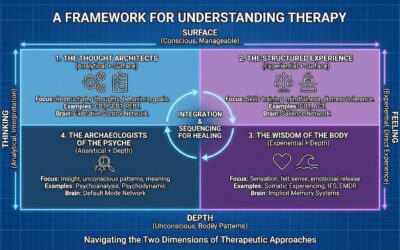
You've tried therapy before. Maybe it helped a little. Maybe you spent months talking about your childhood without anything changing. Maybe you learned coping skills that worked until they didn't. Maybe the therapist was nice but you left each session feeling like...

David Bohm: The Physicist Who Saw Mind in Matter

David Bohm: The Physicist Who Saw Mind in Matter

The Heretic of Copenhagen David Bohm (1917-1992) committed what many physicists considered an unforgivable sin: he took quantum mechanics seriously as a description of reality, not just a calculation tool. While the Copenhagen interpretation (Bohr, Heisenberg)...

Who Is Johnjoe McFadden?

Who Is Johnjoe McFadden?

Explore Johnjoe McFadden’s CEMI field theory, which proposes that consciousness arises from the brain’s electromagnetic field, solving the binding problem and explaining free will.

Active Imagination vs. Meditation: What’s the Difference?

Active Imagination vs. Meditation: What’s the Difference?

If you have ever tried to meditate and found yourself frustrated by a mind that refuses to go blank, you are not alone. The modern wellness industry heavily promotes mindfulness and "quieting the mind" as the gold standard for mental health. But for many...

Marion Woodman: The Body as the Shadow

Marion Woodman: The Body as the Shadow

Marion Woodman revolutionized the treatment of addiction and eating disorders by connecting Jungian psychology to the body. Explore her concepts of ‘Addiction to Perfection’ and Conscious Femininity.

The Golden Bough and the Voices of the Gods: A Critical Re-evaluation of James George Frazer and Julian Jaynes in the Light of Modern Cognitive Science

The Golden Bough and the Voices of the Gods: A Critical Re-evaluation of James George Frazer and Julian Jaynes in the Light of Modern Cognitive Science

A comprehensive critical analysis of James George Frazer’s The Golden Bough and Julian Jaynes’s Bicameral Mind theory, examining how these “magnificent failures” of anthropology and psychology—while rejected by modern scholarship—accurately described the permanent structures of magical thinking, sympathetic association, and the phenomenology of consciousness. Explores validation through cognitive science (Paul Rozin), depth psychology (Freud, Jung, Peterson), and modern anthropology (René Girard, Harvey Whitehouse).

3 Comments

  1. Mark

    Thanks for your blog, nice to read. Do not stop.

    Reply
    • Joel Blackstock

      Thank you for the kind words.

    • Joel Blackstock

      There is also a podcast now in addition to the blog.

Submit a Comment

Your email address will not be published. Required fields are marked *