

How a modality dismissed as “pseudoscience” by academic critics became the treatment of choice for thousands of trauma clinicians—and what this schism reveals about the broken relationship between research and practice.
The Fracture Between the Ivory Tower and the Therapy Room
Something remarkable is happening in the world of trauma therapy, and the academic establishment would prefer you not notice. While the American Psychological Association maintains its carefully curated list of “evidence-based” treatments, while the National Institute of Mental Health continues funding the same cognitive-behavioral paradigms it has championed for decades, a grassroots revolution is spreading through clinical practice with a velocity that defies institutional control. Practitioners are abandoning the modalities they learned in graduate school and flocking to something their professors never mentioned, something the treatment guidelines explicitly exclude, something that sounds—as one pioneering clinician admitted—”crazy” when you first hear about it.
That something is Brainspotting, a somatic psychotherapy developed in 2003 by Dr. David Grand that has become arguably the fastest-growing trauma treatment methodology in the world. The premise is deceptively simple: where you look affects how you feel. By locating specific eye positions that correlate with stored traumatic material, Brainspotting bypasses the verbal, cognitive layers of the brain and accesses subcortical regions where trauma is neurologically encoded. It sounds strange. It looks even stranger—a client staring at a pointer while processing memories without saying a word. And according to the academic gatekeepers who control what counts as “evidence-based,” it is at best unproven and at worst dangerous pseudoscience.
Yet the clinical reality tells a radically different story. In Birmingham, Alabama, a single practitioner who trained in Brainspotting six years ago—despite deep skepticism that “it wouldn’t work”—has watched the modality spread through the professional community until more than sixty certified providers now practice in a tight cluster of ZIP codes. This is not happening because of university endorsements or insurance mandates. It is happening because clinicians are experiencing results with treatment-resistant clients that their cognitive-behavioral training never prepared them for, and they are telling their colleagues, and their colleagues are trying it for themselves, and those colleagues are telling their colleagues. The revolution is spreading through direct experience, through what researchers would dismissively call “anecdote”—but what practitioners recognize as the lived truth of therapeutic efficacy.
This article is an investigation into the hostility that Brainspotting faces from the psychological establishment. It is not a defense of the modality against legitimate scientific skepticism—skepticism is healthy and necessary. Rather, it is an examination of how that skepticism has curdled into something less scientifically principled: a systematic exclusion that has more to do with economic gatekeeping, epistemological rigidity, and professional turf protection than with genuine concern for patient welfare. The story of Brainspotting’s reception reveals profound dysfunction in how psychological science validates (or refuses to validate) therapeutic innovation. And it matters urgently, because the patients caught in this crossfire are people suffering from trauma who deserve access to treatments that work—regardless of whether those treatments fit neatly into the academic establishment’s preferred paradigm.
Discovery in the Visual Field: How a Wobble Changed Everything
To understand why Brainspotting provokes such resistance, you must first understand what it is and how it emerged. The origin story has the quality of a scientific accident—the kind of serendipitous observation that characterizes many breakthroughs but that academic protocols are specifically designed to prevent.
In 2003, David Grand was already an established figure in the trauma therapy world, a trained practitioner of EMDR (Eye Movement Desensitization and Reprocessing) with years of clinical experience. He was working with a high-level figure skater who suffered from a persistent performance block—despite extensive therapy, she could not land her triple loop. During a standard EMDR session, Grand was moving his fingers back and forth across her visual field as the protocol requires, when he noticed something subtle: every time her eyes passed a specific point, they wobbled. There was a reflexive hitch, a moment of visual instability that the standard protocol would have simply moved past.
Grand did something that violated his training: he stopped moving. He held his fingers still at that exact point and let the skater’s eyes lock there. What followed was explosive. Traumatic material—memories of falls, injuries, failures, fears—erupted into consciousness and processed with unusual speed and intensity. The session was unlike anything he had facilitated before. The next day, the skater landed her triple loop effortlessly, as though the block had never existed.
What Grand had discovered, he came to believe, was a portal. The specific eye position correlated with a specific neural network holding the traumatic material. By stabilizing the gaze at that “Brainspot,” he had allowed the brain to access and process what standard protocols skipped past. Over subsequent years, Grand developed this observation into a comprehensive methodology, training thousands of practitioners worldwide in a technique that diverges fundamentally from the cognitive paradigm that dominates academic psychology.
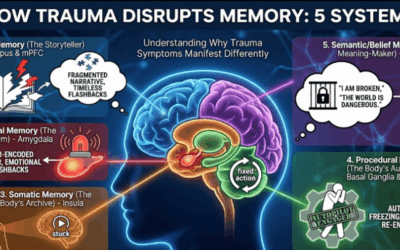
The theoretical framework Grand developed draws on neuroanatomy that is well-established but rarely emphasized in mainstream therapeutic training. The key structure is the superior colliculus, a region of the midbrain that controls eye movement and orientation. When we experience threat, our eyes orient toward or away from danger as part of the survival response. In traumatic experiences where the threat overwhelms our capacity to respond, this orienting reflex may be interrupted or frozen. The memory becomes neurologically “stuck,” encoded not in the narrative-processing regions of the cortex but in the subcortical structures that handle survival—regions that do not process language and cannot be reached by talk therapy’s verbal interventions.
Brainspotting proposes that specific eye positions serve as access points to these subcortical capsules. By locating the relevant position—often identified through reflexive cues like eye wobbles, blinks, facial twitches, or changes in breathing—and maintaining focused attention there, the brain is given an opportunity to complete the interrupted processing. The client does not need to narrate their trauma, analyze their cognitions, or consciously restructure their beliefs. They simply maintain the gaze while the nervous system does what it could not do at the time of the original event: process and release.
This is what practitioners mean when they describe Brainspotting as a “bottom-up” therapy. Unlike Cognitive Behavioral Therapy, which works from the top down—changing thoughts to change feelings—Brainspotting works from the bottom up, releasing physiological states that have been locked in the body and allowing cognitive and emotional changes to follow naturally. It is a distinction that has profound implications for treatment, and profound implications for why the academic establishment finds the modality so threatening.
From One Practitioner to Sixty: The Alabama Phenomenon
The trajectory of Brainspotting adoption in Alabama offers a natural experiment in how therapeutic innovations spread—or fail to spread—through the clinical community. It is a story that illuminates both the power of practice-based evidence and the irrelevance of academic endorsement when a treatment genuinely works.
The practitioner who brought Brainspotting to the Birmingham area did not begin as a believer. Trained in traditional modalities, steeped in the cognitive-behavioral paradigm that dominates graduate education, they initially viewed the premise with deep skepticism. The idea that a fixed gaze position could unlock deep-seated trauma sounded, in their own words, “crazy.” This is not the reaction of a credulous convert; it is the appropriate immune response of a clinician trained to privilege evidence over enthusiasm, skepticism over hype.
The conversion came through experience—specifically, through the experiential component of Brainspotting training itself. Unlike purely didactic trainings that teach technique through lecture and demonstration, Brainspotting training requires practitioners to undergo the process as clients. They must locate their own Brainspots, process their own material, experience their own subcortical releases. For the Alabama pioneer, this training was transformative in a way that intellectual learning had never been. Issues that years of personal therapy had failed to resolve shifted during the training experience. The skeptic became a practitioner not through persuasion but through direct somatic evidence.
Even after training, however, the fear persisted. Would it work with actual clients? Would the clinical reality match the training experience? The practitioner began integrating Brainspotting into their practice with the anxiety that accompanies any new methodology—the professional vulnerability of trying something your colleagues might dismiss, the personal vulnerability of potentially failing clients who are trusting you with their healing.
Eight years later, the results have spoken with unmistakable clarity. Clients with treatment-resistant PTSD, complex developmental trauma, and dissociative presentations have recovered at rates that defied the practitioner’s previous benchmarks. Not every client, not every session—Brainspotting is not magic—but with a consistency and depth that talk therapy alone had never achieved. The clinical evidence accumulated, one case at a time, in the only laboratory that ultimately matters: the therapy room.
The challenge then became spreading what had been learned. In a region characterized by traditional medical and therapeutic values, suggesting that “looking at a pointer” could heal sexual abuse or combat trauma risked professional ridicule. Academic supervisors discouraged the approach. Insurance companies had never heard of it. The APA treatment guidelines not only failed to recommend it but excluded it from consideration entirely.
The solution was elegantly simple: free demonstrations. Rather than trying to convince skeptical colleagues through citations and arguments, the practitioner invited them to experience Brainspotting directly. Twenty minutes of personal processing accomplished what hours of explanation could not. When a skeptical clinician experiences a profound physiological shift—when they feel their own nervous system release material they had not consciously known they were carrying—the intellectual defense collapses. You cannot argue with your own body.
The viral mechanics followed predictably from there. Clinicians who experienced the demonstrations sought training. Trained clinicians began offering their own demonstrations to colleagues. Clients who found relief became word-of-mouth ambassadors, requesting Brainspotting by name and driving market demand. Within four and a half years, the number of certified Brainspotting providers in the Birmingham cluster grew from one to more than sixty—a sixty-fold increase occurring without institutional support, without insurance mandates, without a single nod from the academic establishment.
This density is extraordinary. In major metropolitan areas with robust mental health infrastructure, finding a specialized somatic trauma therapist can still be difficult. In this Alabama cluster, Brainspotting has achieved saturation approaching a new standard of care, at least among a network of trauma-focused practitioners. The market test has been passed with remarkable clarity. Clients are voting with their feet and their wallets. Practitioners are voting with their continuing education choices and their career investments. The ground truth has spoken, regardless of what the ivory tower refuses to hear.
The Epistemological Gatekeeping: How “Evidence-Based” Became a Weapon
To understand why Brainspotting faces such systematic exclusion, one must understand how the concept of “evidence-based practice” has evolved from a reasonable principle into an exclusionary weapon. The phrase itself carries moral weight—who could oppose basing practice on evidence? But the devil is in the definition, and the definition has been captured by interests that benefit from keeping therapeutic innovation tightly controlled.
The gold standard of psychological evidence, borrowed from pharmaceutical research, is the Randomized Controlled Trial. In an RCT, subjects are randomly assigned to treatment or control conditions, the treatment is standardized so that every participant receives essentially the same intervention, outcomes are measured with validated instruments, and the results are analyzed for statistical significance. This methodology has genuine virtues: it controls for placebo effects, it minimizes researcher bias, it produces data that can be compared across studies. For pharmaceutical interventions, where the “treatment” is a molecule with predictable properties, the RCT is brilliantly suited to its purpose.
For psychotherapy, the fit is considerably worse. The “treatment” in therapy is not a molecule but a relationship—a dynamic, responsive, infinitely variable interaction between two human beings. Standardizing this relationship into a manualized protocol (Step 1: say this; Step 2: do this; Step 3: evaluate this) may be necessary for RCT methodology, but it strips the therapy of the very qualities that make it effective. The warmth, attunement, and moment-to-moment responsiveness that characterize masterful clinical work become noise to be controlled rather than signal to be enhanced.
Brainspotting is particularly ill-suited to this Procrustean bed because its methodology explicitly embraces what it calls the “uncertainty principle.” Rather than following a rigid protocol, the Brainspotting therapist is trained to “follow the tail of the comet”—to track the client’s internal process wherever it leads, without imposing direction or interpretation. This fluidity is clinically powerful precisely because it honors the unique, non-linear healing trajectory of each individual nervous system. Two clients with similar presenting problems may have profoundly different sessions because their brains organize and access traumatic material differently.
From the perspective of RCT methodology, this fluidity is heresy. A treatment that varies based on therapist attunement and client presentation is “uncontrolled” by definition. There is no standardized protocol to test. There is no way to ensure that what happens in the treatment condition of one study matches what happens in another. The therapy is inherently resistant to the very methodology that the establishment has declared the only valid source of evidence.
The consequence is a catch-22 that effectively bars innovative therapies from legitimacy. To be included in the APA’s Clinical Practice Guidelines, a treatment must have multiple RCTs that can be aggregated into systematic reviews. To conduct multiple RCTs, a treatment must have millions of dollars in research funding. To secure millions of dollars in research funding, a treatment must already have establishment credibility and institutional backing. Brainspotting, having emerged from private practice rather than academic research, having spread through practitioner networks rather than university curricula, having developed outside the established channels of scientific legitimacy, lacks the infrastructure to compete in this funding environment.
The result is not that Brainspotting has been evaluated and found wanting. The result is that Brainspotting has been excluded from evaluation altogether. In the APA’s 2017 guidelines for PTSD treatment, and again in the 2024 update, the methodology for inclusion was explicitly designed to filter out treatments without extensive RCT literature before any evaluation of efficacy occurred. Brainspotting was not rejected based on negative evidence—there is no negative evidence, no controlled trials showing that it fails to work. It was simply never considered. The guidelines include a note acknowledging that exclusion “does not necessarily mean that it doesn’t work” but rather that insufficient research meeting their criteria exists. This bureaucratic neutrality masks a hostile outcome: by excluding Brainspotting from the guidelines, the APA discourages insurance coverage, discourages university teaching, discourages VA adoption. The treatment is not banned, but it is systematically disadvantaged by the institutions that control access to care.
The Economics of Validation: Who Gets to Prove What Works
Behind the epistemological gatekeeping lies a more fundamental problem: the political economy of mental health research. Science is not free. The gold standard of the RCT is a luxury product that only certain entities can afford, and this economic reality shapes which therapies get validated and which are left in the cold.
Conducting a large-scale, multi-site RCT that meets establishment standards costs between two and five million dollars per study. You need research coordinators, clinical assessors blinded to treatment condition, standardized training for therapists, validated outcome measures, statistical consultants, institutional review board approval, participant recruitment and retention, and the administrative overhead that accompanies any major research undertaking. You typically need multiple studies to generate the systematic reviews that the guidelines require. The total cost to achieve “evidence-based” status through legitimate channels approaches ten million dollars or more.
Pharmaceutical companies have this money and spend it freely because there is a product to sell at the end—a patented molecule that will generate billions in revenue if approved. The research investment is a cost of doing business that the market will recoup many times over. The National Institute of Mental Health has this money, but its grant review boards are populated by established researchers who have built their careers on existing paradigms. The academics who review grant applications have invested decades in cognitive-behavioral approaches; funding a study that might demonstrate the superiority of an alternative is not in their professional interest. The structure of peer review tends toward conservatism, toward funding what is already known to work, toward the incremental refinement of existing approaches rather than the validation of genuinely novel ones.
Brainspotting exists outside this funding ecosystem. It is a technique, not a product. You cannot patent the visual field. There is no molecule to sell, no device to market, no revenue stream to justify research investment. David Grand and his training organization can fund small studies—and they have—but they cannot compete with pharmaceutical companies for research dollars. The training revenue that sustains Brainspotting’s growth goes into training infrastructure, not multi-million-dollar trials.
This creates a systematic bias in what gets validated. Therapies with corporate backing get studied, get published, get included in guidelines, get taught in universities, get covered by insurance. Therapies without corporate backing—no matter how effective in clinical practice—languish in the “insufficient evidence” category where the establishment has placed them. The system is not designed to find out what works; it is designed to validate products that someone is willing to pay to validate. Innovation that emerges from practice rather than from industry or academia is structurally disadvantaged from the start.
The irony is that SAMHSA and other federal agencies have explicitly called for practice-based evidence to complement the evidence-based practice paradigm. The recognition exists at the policy level that RCTs are not the only valid source of knowledge, that clinical experience matters, that what works in the controlled environment of a research study may not work in the complex reality of community practice and vice versa. But this recognition has not translated into genuine structural change. The guidelines still privilege RCTs. The insurance companies still defer to the guidelines. The academic training programs still teach what the guidelines recommend. The economy of validation remains captured by interests that benefit from the status quo.
The Allegiance Effect and the CBT Industrial Complex
Within this economy, one paradigm has achieved near-monopoly status: Cognitive Behavioral Therapy. Over four decades, CBT has accumulated more federal research funding, more published studies, more textbook chapters, and more graduate training hours than any other therapeutic approach. This dominance is self-reinforcing in ways that bear close examination.
The researchers who sit on NIMH grant review boards are predominantly CBT-trained. They have built their careers on cognitive-behavioral research, published their most-cited papers on cognitive-behavioral topics, trained their doctoral students in cognitive-behavioral methods. When a grant application proposes testing a somatic therapy like Brainspotting, it lands on desks occupied by people whose professional identities are invested in the cognitive paradigm. The conflict of interest is not financial but ideological—and none the less real for that.
Research on the “allegiance effect” has demonstrated that a researcher’s belief in the therapy being tested is a substantial predictor of outcome. When CBT researchers test CBT, it tends to work. When they test alternative approaches, the outcomes are often less favorable—and the reasons for this are not entirely mysterious. A researcher skeptical of somatic therapy may design a study with inadequate training in the tested modality, with therapists who do not fully believe in what they are doing, with protocols that strip the approach of its essential elements. The resulting “failure” is then taken as evidence that the alternative does not work, when in reality it demonstrates only that poorly implemented therapy produces poor outcomes.
Brainspotting and other somatic approaches enter this arena as underdogs with no political capital. They challenge the very premise of the cognitive monopoly—the assumption that changing thoughts is the primary mechanism of therapeutic change. For practitioners trained in CBT, this challenge is not merely intellectual but existential. If somatic processing matters more than cognitive restructuring, if the body stores trauma in ways that talk therapy cannot reach, if decades of cognitive-behavioral training have prepared clinicians for only part of the therapeutic task, what does that mean for careers built on the supremacy of cognition?
The defensive hostility is understandable, even as it is scientifically unjustified. Established paradigms do not surrender gracefully. The physicists who rejected continental drift, the medical establishment that resisted germ theory, the astronomers who clung to geocentrism—each was protecting not just an intellectual position but a professional identity. The resistance to Brainspotting partakes of this same dynamic. It is not simply that the evidence is insufficient; it is that the implications of the evidence are threatening.
What the Research Actually Shows
Despite the structural barriers to research funding, Brainspotting is not without empirical support. The claim that there is “no evidence” for the modality is simply false—a reflection of the establishment’s decision not to look rather than an accurate description of what exists.
A 2017 comparative study involving 76 clients found that three 60-minute sessions of Brainspotting were as effective as EMDR in reducing PTSD symptoms, with effects sustained at six-month follow-up. This is a direct comparison with an established, evidence-based treatment, and Brainspotting performed equivalently. A study published in the International Journal of Environmental Research and Public Health found statistically significant reductions in distress and improvements in heart rate variability during Brainspotting sessions—physiological changes that cannot be attributed to placebo expectancy. Treatment programs working with survivors of mass casualty events, including the Sandy Hook school shooting, have documented Brainspotting’s effectiveness in reducing acute trauma symptoms in residential settings.
These studies are not large enough to satisfy the establishment’s appetite for systematic reviews. They do not meet the arbitrary thresholds that the guidelines have established. But they are not nothing. They represent genuine scientific investigation using valid methodologies, and they consistently point in the same direction: Brainspotting produces measurable, beneficial effects on trauma symptoms and physiological markers of distress. The appropriate scientific response to this preliminary evidence is not dismissal but curiosity—not exclusion but further investigation. The establishment’s response, however, has been to maintain its barriers and wait for data that the funding structure is designed to prevent from ever being generated.
Meanwhile, the practice-based evidence continues to accumulate. Every one of the sixty-plus providers in the Birmingham cluster represents a natural experiment in clinical efficacy. If Brainspotting were placebo, if it provided only the non-specific benefits of therapeutic attention, we would expect adoption to plateau as practitioners encountered the limits of the approach. Instead, adoption has accelerated over eight years. Practitioners who integrated Brainspotting into their work have not abandoned it as the novelty wore off; they have become evangelists, offering demonstrations to colleagues, referring clients to trained providers, investing in advanced training. This is the market test of therapeutic efficacy, and Brainspotting is passing it with remarkable consistency.
The academic establishment’s refusal to recognize this market evidence is a failure of scientific curiosity. The sixty providers in a single Alabama cluster are data. The eight years of sustained adoption are data. The clients who recover from treatment-resistant trauma are data. The practitioners who report outcomes exceeding their previous benchmarks are data. To insist that none of this counts because it was not generated in a laboratory is to mistake the methodology for the goal. The goal is to find out what helps suffering people. The methodology is a means to that end, not an end in itself.
The Somatic Turn and the Challenge to Cognitive Supremacy
Brainspotting’s rise is part of a broader shift in therapeutic practice—a “somatic turn” that is challenging the cognitive paradigm’s dominance and recentering the body in the understanding of psychological distress. This shift is supported by neuroscience, by clinical observation, and by the lived experience of trauma survivors, even as it remains marginalized by the academic establishment.
The pioneering work of Bessel van der Kolk, whose book “The Body Keeps the Score” has reached millions of readers, has brought public attention to what clinicians have long observed: trauma is not primarily a cognitive phenomenon. It is stored in the body, in the survival systems of the brainstem and limbic system, in patterns of muscular tension and autonomic dysregulation. The flashbacks, the hypervigilance, the emotional flooding that characterize PTSD are not failures of cognition that can be corrected by better thinking. They are eruptions of subcortical material that operates below and prior to conscious thought.
Peter Levine’s Somatic Experiencing, Pat Ogden’s Sensorimotor Psychotherapy, and David Grand’s Brainspotting all represent different approaches to the same fundamental insight: effective trauma treatment must address the body, not just the mind. These approaches diverge in their specific techniques but share a commitment to “bottom-up” processing—to working with physiological states directly rather than trying to change them through cognitive intervention alone. They represent a paradigm shift of the first order, a reconceptualization of what psychotherapy is and how healing happens.
The academic resistance to this shift is not merely about Brainspotting; it is about defending a paradigm that has organized careers, institutions, and funding streams for decades. If the somatic approaches are right—if cognitive restructuring is often insufficient for trauma, if the body must be addressed directly, if the talking cure has profound limitations—then the cognitive-behavioral edifice that dominates academic psychology is built on incomplete foundations. This is not a comfortable implication for those who have invested their professional lives in that edifice.
But the clinical reality is increasingly difficult to deny. Trauma specialists are flocking to somatic trainings not because they enjoy being marginalized by the establishment but because they are seeing results with their clients. The International Society for Traumatic Stress Studies has begun to acknowledge somatic approaches in its treatment guidelines, even if the APA remains resistant. The National Center for PTSD has expanded its research portfolio beyond purely cognitive interventions. The ground is shifting, even if the institutional response lags behind.
An Invitation to the Skeptic
For the clinician reading this with appropriate skepticism—with the same skepticism that the Alabama pioneer felt when first hearing about Brainspotting—the story offers not a demand for belief but an invitation to inquiry. Skepticism is healthy. Caution about unvalidated treatments is professionally responsible. The point is not to abandon critical thinking but to examine whether the current barriers to validation serve scientific truth or merely institutional convenience.
Consider the epistemology underlying your skepticism. If you require RCT evidence before trying a new approach, recognize that this requirement systematically excludes innovations that cannot access the funding necessary for large-scale trials. Consider whether the absence of evidence, in a system designed to prevent evidence from being generated, is the same as evidence of absence. Consider whether the treatments you currently use met the standards you are applying to Brainspotting at the time you adopted them, or whether you adopted them because they were taught in your training program by professors who had adopted them from their professors.
Consider the phenomenology of your clinical experience. Have you worked with trauma clients for whom cognitive interventions seemed to slide off the surface? Clients who could articulate perfectly rational beliefs about their safety while their bodies remained locked in survival mode? Clients who understood cognitively that the trauma was over but whose nervous systems had not received the message? These are the clients for whom somatic approaches exist—not as replacements for cognitive work, but as complements that address dimensions of suffering that cognition alone cannot reach.
Consider the evidence that exists, even if it does not meet the arbitrary thresholds of the guidelines. Read the published studies. Examine the outcome data from clinical settings. Talk to colleagues who have integrated Brainspotting into their work and ask about their experience. If you find the reports compelling enough to warrant further investigation, seek training that includes the experiential component—not to be converted, but to gather data from the only laboratory where therapeutic efficacy is ultimately determined: your own nervous system and your own clinical practice.
The Alabama pioneer who thought it “sounded crazy” is now surrounded by sixty colleagues who made the same journey from skepticism to practice. They are not credulous believers who abandoned scientific standards. They are professionals who tested a hypothesis against clinical reality and found that reality supported the hypothesis. The experiment is replicable. The invitation stands.
The Crisis in Psychological Science
The hostility toward Brainspotting is ultimately a symptom of a larger crisis in psychological science—a crisis of relevance, of methodology, of the relationship between research and practice. The replication crisis that has shaken psychology in the past decade revealed that much of what was published in prestigious journals could not be reproduced. The ongoing critique of statistical significance has revealed that p-values are routinely misinterpreted and misused. The acknowledgment that most published findings are false, in the memorable phrase of John Ioannidis, has undermined confidence in the very research infrastructure that the establishment uses to exclude innovations like Brainspotting.
Meanwhile, the mental health crisis deepens. Rates of anxiety, depression, and trauma-related disorders continue to climb. Access to effective treatment remains limited by provider shortages, insurance barriers, and geographic distribution. The treatments that the guidelines recommend often require more sessions than insurance will cover, more verbal processing capacity than some clients possess, more stability than highly dysregulated clients can achieve. There is an urgent, practical need for therapeutic innovations that work—and a systematic tendency in the establishment to obstruct rather than facilitate those innovations.
The resolution of this crisis will not come from within the establishment. It will come from practitioners who insist on using what works, from clients who demand access to effective treatment, from training organizations that spread innovations through direct experience rather than institutional endorsement, from a gradual shift in the ground truth of clinical practice that eventually forces the institutions to follow. The revolution is already underway. Brainspotting’s growth despite academic hostility demonstrates that the gatekeeping can be circumvented, that the barriers to validation do not prevent adoption, that clinicians will ultimately choose effectiveness over credentials.
The establishment can continue to declare that treatments like Brainspotting have “insufficient evidence.” What it cannot do is prevent those treatments from working. And as long as they work—as long as clinicians see results and clients find relief—the gap between the ivory tower and the therapy room will continue to widen. Eventually, the map will have to accommodate the territory. The question is how much suffering will occur while the cartographers resist redrawing their lines.
Measuring the Ocean With a Ruler
The hostility of psychological academia toward Brainspotting is a multifaceted phenomenon. It is the immune response of an established order against a disruptive innovator. It is the defense of the “thinking brain” paradigm against the challenge of the “feeling body.” It is the byproduct of a funding system that demands millions of dollars to prove what clients feel in minutes. It is the entrenchment of a professional class whose identity is bound up with a therapeutic approach that the somatic turn is rendering incomplete.
But the tide is turning. The ivory tower is being surrounded by the ground truth. When sixty licensed professionals in a single Alabama cluster shift their practice to a modality that the guidelines exclude, the establishment can no longer claim that no evidence exists. They are simply ignoring the evidence of the field—the evidence that accumulates every day in therapy rooms where clients recover from trauma that cognitive interventions could not reach, where practitioners witness effects that their graduate training never prepared them for, where the body’s wisdom proves more therapeutic than the mind’s analysis.
To the academic critics, the grant reviewers, the guideline writers, the message from the Brainspotting community is clear: your map is not our territory. You are measuring the ocean with a ruler. The phenomena you cannot measure do not cease to exist because your instruments cannot detect them. The healing you cannot explain does not cease to occur because your theories cannot account for it.
And to the skeptics—the clinicians who, like the Alabama pioneer, think it “sounds crazy”—the invitation remains open. Read the studies, yes. Scrutinize the neuroscience, absolutely. Maintain your professional caution, of course. But do not stop there. If you have doubts, try it. Experience the process yourself. Gather data from the inside. How could you say with any scientific certainty that it does not work until you have tested the hypothesis in the only laboratory that matters?
The revolution is not waiting for permission. It is already here, spreading through clinical practice with the velocity of demonstrated efficacy. The academic establishment can join, can adapt, can expand its epistemological frameworks to accommodate what practitioners are learning. Or it can continue to resist, to exclude, to insist on methodologies that serve institutional interests rather than patient welfare. The choice will define whether academic psychology remains relevant to the clinical enterprise it claims to guide—or whether it becomes an increasingly irrelevant spectator to the transformation of mental health care that is already underway.
This article draws on published research from peer-reviewed journals, clinical outcome data from practice settings, and the documented experience of practitioners who have integrated Brainspotting into their work. For more information about Brainspotting training and research, visit Brainspotting.com. For information about trauma treatment guidelines and evidence-based practice, consult the American Psychological Association, the International Society for Traumatic Stress Studies, and the National Center for PTSD. For information about related somatic approaches, see EMDR International Association and Somatic Experiencing International.






















0 Comments