
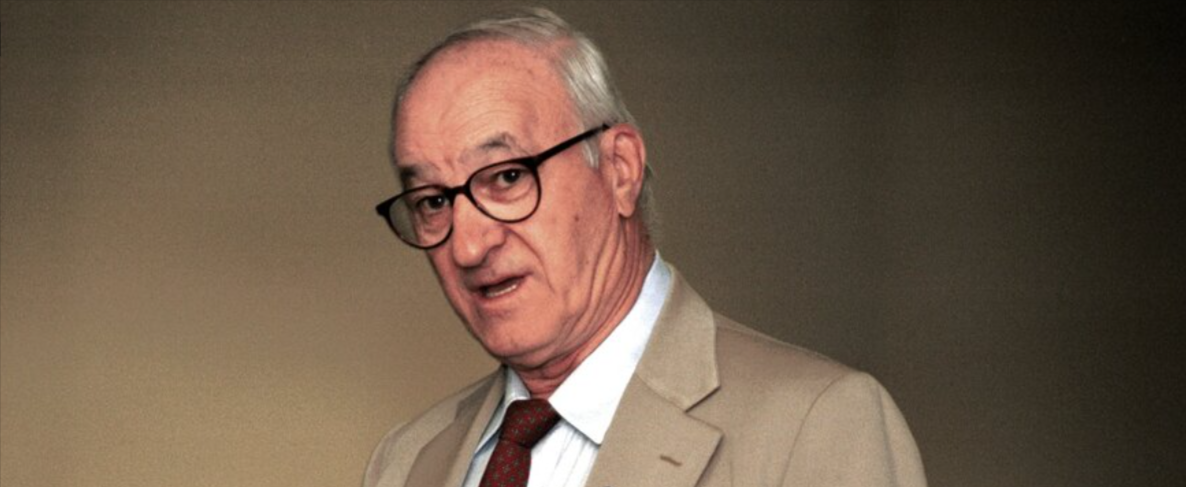
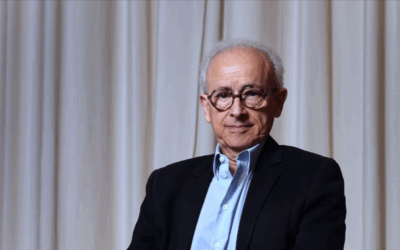
Albert Bandura (1925 to 2021) was a Canadian-American psychologist at Stanford University who showed that people learn by watching others, not only by being rewarded or punished themselves. His Bobo doll experiments made that point visible, and his theory of self-efficacy, our belief that we can do what a situation asks of us, explains why knowing what to do so often fails to change what we do.
Key takeaways
- Albert Bandura’s 1961 Bobo doll study showed that preschool children copy an adult’s specific aggressive acts and words without any reward or instruction.
- His 1965 study separated learning from performance: children who saw a model punished had still learned the behaviour and reproduced it once offered an incentive.
- Self-efficacy, introduced in 1977, is a person’s belief that they can carry out what a situation requires, built mainly through mastery, modelling, persuasion and bodily states.
- Bandura’s view that the body’s arousal shapes efficacy beliefs links his theory to somatic and brain-based trauma therapy, where clients experience coping in the body.
Who was Albert Bandura?
Bandura was born on December 4, 1925, in Mundare, a farming hamlet in Alberta, Canada, about fifty miles east of Edmonton. The district had been settled largely by Eastern European immigrants, and his parents were among them: his father, Joseph, came from Poland and his mother, Justyna, from Ukraine. Albert was the youngest of six children and the only son. His father first laid track for the trans-Canada railway and then cleared and worked a homestead farm. The family had little money, but neither parent had much schooling and both pushed their children to get more.
Mundare had one school, and it was short of both teachers and textbooks. A small staff covered the entire high school curriculum, so students often had to teach themselves. Bandura later described this as an education in self-direction: when a subject was not taught, he and his classmates worked through it together. He also spent a summer after high school in the Yukon working on the Alaska Highway alongside men who had drifted to the far north, an experience he said gave him an early, close view of human oddity and resilience. It is easy to see those years in his later interest in agency, the human capacity to direct one’s own learning and life.
How did Bandura become a psychologist?
Bandura enrolled at the University of British Columbia in Vancouver intending to study the biological sciences. His route into psychology was an accident of timing. He commuted with students in engineering and premedicine who had early morning classes, and he needed something to fill his own early slot. The course that fit was introductory psychology. He was hooked, finished his degree in three years, and graduated in 1949 with the Bolocan Award in psychology.
He went on to the University of Iowa, then one of the strongest centres of learning theory in North America. Iowa’s psychology department carried the influence of Clark Hull’s drive-reduction theory through Kenneth Spence, who chaired the department, but Bandura trained as a clinical psychologist under Arthur Benton. His 1952 doctoral dissertation studied the psychological processes behind the white space response on the Rorschach inkblot test. During these years he read Neal Miller and John Dollard’s Social Learning and Imitation (1941), which treated imitation as a learned habit. Bandura came to think that account was too narrow, because it required the learner to act and be rewarded before anything was learned.
At Iowa he met Virginia Varns, an instructor in the university’s nursing school. They married in 1952 and had two daughters, Carol and Mary. Virginia was his partner for almost sixty years until her death in 2011. After a postdoctoral clinical internship at the Wichita Guidance Center in Kansas, Bandura joined the psychology faculty at Stanford University in 1953. He stayed there for the rest of his career, became a full professor in 1964, and in 1974 was named the David Starr Jordan Professor of Social Science in Psychology.
What did Bandura and Richard Walters find about aggression?
At Stanford, Bandura was drawn into the work of Robert Sears on how families shape children’s behaviour. With Richard Walters, his first doctoral student, he studied adolescent boys whose aggression had brought them to the attention of schools and courts, comparing them with boys who were not aggressive. Adolescent Aggression (1959) reported that the aggressive boys tended to have parents who modelled hostile attitudes and who encouraged aggression outside the home even while punishing it at home.1
The finding mattered because the dominant accounts of aggression at the time located its source inside the person. In Freudian theory it was the expression of a drive; in the Yale frustration-aggression hypothesis it was the inevitable product of a blocked goal. Bandura and Walters argued instead that children acquire aggressive styles the way they acquire any other behaviour: by watching the people around them, noticing what those people get away with, and trying it themselves. Their second book, Social Learning and Personality Development (1963), widened the argument to personality as a whole.2
What happened in the Bobo doll experiment?
The research that made Bandura famous began in 1961. With Dorothea Ross and Sheila Ross, he tested whether children would copy an adult’s aggression even when nobody rewarded them for doing so.3 The participants were 72 children, 36 boys and 36 girls, aged roughly three to six, from the Stanford University Nursery School.
Each child sat in a corner of a playroom with a picture and sticker activity while an adult played in another corner. The room held tinker toys, a mallet and a five-foot inflatable Bobo doll, a clown figure weighted at the base so that it bounced back upright when knocked over. There were three groups:
- Aggressive model. After a minute, the adult turned on the doll: sat on it and punched it in the nose, struck it on the head with the mallet, tossed it in the air and kicked it around the room, while saying things like “Sock him in the nose,” “Hit him down,” “Kick him” and “Pow.”
- Non-aggressive model. The adult assembled the tinker toys quietly for the whole session and ignored the doll.
- No model. A control group saw no adult at all.
The researchers also varied whether the model was the same sex as the child. Afterwards each child was taken to a second room of attractive toys and, after a short time, told that those toys were being kept for other children. This mild frustration was designed to raise the chance of aggression in every group equally. The child was then taken to a third room with a Bobo doll, a mallet and other toys, and watched for twenty minutes through a one-way mirror.
Children who had watched the aggressive model were far more aggressive than the other two groups, and much of what they did was a direct copy: the same blows with the mallet, the same sitting on the doll, and the same words. Boys imitated physical aggression more than girls did, and a male model was copied more readily than a female one. The children had received no instruction and no reward. They had learned by watching.
What did the later Bobo doll studies show?
A 1963 follow-up asked whether a screen would do the same job as a live adult. Children saw the aggressive sequence performed live, on film, or by an adult dressed as a cartoon cat on a fake television set. All three groups were much more aggressive than controls, and filmed models were at least as influential as live ones.4
In 1965 Bandura showed children a film of a man, called Rocky in the film, attacking the doll. In one version Rocky was rewarded with sweets and praise, in another he was scolded and spanked, and in a third nothing followed. Children who saw him punished copied him least. Then the experimenter offered every child juice and stickers for each of Rocky’s actions they could reproduce, and the gap between the groups largely disappeared.5 The children who had seen punishment had learned the behaviour just as well; they had simply chosen not to perform it. This distinction between learning and performance became central to Bandura’s theory. It also meant that the effects of what a child observes can stay hidden until circumstances call them out.
Media violence and later debates
The Bobo studies arrived as television was entering almost every American home, and their implication was hard to miss: if filmed models teach as well as live ones, then screen violence could be teaching children specific ways to hurt people. The question has never gone away, and today’s arguments about the psychology of video games repeat many of the same points. Bodies such as the American Academy of Pediatrics still draw on this line of research in their guidance about children’s media.
What is social learning theory?
From these studies Bandura built social learning theory, set out in Social Learning Theory (1977).8 Its starting claim is that most human learning happens in a social setting, through watching other people, watching what happens to them, and forming expectations about what will happen to us if we act the same way. That was a sharp break with B. F. Skinner’s operant conditioning, in which behaviour is shaped by its own consequences, and with the classical conditioning of Ivan Pavlov. Bandura kept the behaviourists’ insistence on observation and experiment but brought thought back into the account: expectations, memory, self-evaluation and planning.
In Social Foundations of Thought and Action (1986) he renamed the framework social cognitive theory, to make clear that what happens in the mind is part of the explanation, not a side effect.10 The same book introduced triadic reciprocal determinism: personal factors (beliefs, emotions, biology), behaviour and environment all act on one another. People are shaped by their surroundings, but they also choose and change their surroundings, and their own actions feed back into how they see themselves.
The four processes of observational learning
Bandura identified four processes that must work for observational learning to happen:8
- Attention. The observer has to notice the model. We attend most to models who are distinctive, attractive, powerful or similar to ourselves, and our own state, such as arousal or interest, affects what we see.
- Retention. What was seen must be stored, in images or in words, so it can be used later. Rehearsing it in the mind strengthens the memory.
- Reproduction. The observer must be able to turn the memory into action, which depends on physical and mental capacity and on practice.
- Motivation. The observer must have a reason to act. That reason can come from direct reward, from seeing the model rewarded (vicarious reinforcement), or from the observer’s own standards and self-approval.
What is self-efficacy?
Bandura’s work on self-efficacy grew out of a clinical problem. In the late 1960s he treated people with severe snake phobias using guided mastery, also called participant modelling: the therapist demonstrated each step of handling a snake, then helped the person do it, breaking the task into small steps and gradually withdrawing support. Compared with systematic desensitization and with watching a film of others handling snakes, guided participation removed the phobic avoidance in nearly every participant.7 What interested Bandura was that people’s confidence in their own ability to cope predicted their later behaviour better than their past behaviour did.
In a 1977 paper in Psychological Review he named that confidence self-efficacy: a person’s belief in their capability to organise and carry out the actions a particular situation requires.9 Self-efficacy is specific to a task, so someone can feel highly capable at work and helpless in a family argument. It concerns perceived ability rather than actual skill, and those perceptions shape what people attempt, how much effort they spend, how long they persist when things go badly, and how much stress they feel along the way. Bandura separated it from outcome expectations: you can believe that a certain behaviour would lead to a good result and still doubt that you are able to do it.
The idea is often compared with Julian Rotter’s locus of control, which concerns whether outcomes depend on one’s actions or on outside forces, and with Martin Seligman’s learned helplessness, the collapse of effort after repeated experiences that action changes nothing. Self-efficacy asks a different question: not whether action matters, but whether I can perform the action at all.
The four sources of self-efficacy
Bandura described four sources of efficacy beliefs, in order of strength:911
- Mastery experiences. Actually succeeding at the task is the most powerful source. Success that comes through effort and persistence builds the sturdiest belief; easy success can leave people discouraged by the first setback.
- Vicarious experience. Watching someone similar succeed suggests “if they can, I can,” and watching them fail after real effort can lower our own expectations.
- Verbal persuasion. Encouragement from others helps, especially from people we trust, but its effect is weaker and fades if experience contradicts it.
- Physiological and emotional states. People read their own bodies for information. A racing heart, shaking hands or exhaustion are taken as signs of incapacity; a calm body is taken as a sign of readiness. Changing those states, or how a person interprets them, changes efficacy.
Where has self-efficacy theory been applied?
Self-efficacy became one of the most studied ideas in psychology. Bandura gathered the research in Self-Efficacy: The Exercise of Control (1997), which covers health, education, sport, work, clinical problems and political life.11
Health psychology
Efficacy beliefs predict who succeeds at stopping smoking, keeping up exercise, managing weight and living with chronic illness such as diabetes, arthritis and chronic pain. A person with diabetes may know exactly what diet and monitoring their condition requires and still not do it because they doubt they can keep it up. Health programmes built on social cognitive theory therefore aim at efficacy directly, through graded practice, peer models and coaching, rather than giving information alone.
Education
Teachers model not only skills but ways of approaching problems, handling mistakes and persisting. Academic self-efficacy, a student’s belief that they can master a subject, predicts which courses students choose, how long they stay with a hard problem and whether they recover from a bad grade. Teachers’ own sense of efficacy predicts how long they persist with struggling students.
Work and organisations
Employee self-efficacy is linked with job performance, adaptation to change and the transfer of training to the real job, and leadership development programmes routinely include mastery and modelling exercises. The less visible side of workplace psychology, such as the unspoken rules and modelled behaviour that shape executive leadership, follows the same pattern: people copy what the powerful do more than what they say.
Cognitive and behavioural therapies
Bandura’s 1969 Principles of Behavior Modification applied social learning to clinical work and made modelling a standard behaviour therapy technique.6 When cognitive therapies arrived in the 1970s, through figures such as Aaron Beck and Albert Ellis, his emphasis on beliefs gave them a learning-theory rationale. Clinicians in many traditions, including experiential and somatic therapists, now attend not only to whether a client has a skill but to whether the client believes they can use it. Video modelling, in which a person watches recorded demonstrations of a skill, is also widely used with autistic children and adults learning social and daily living skills.
What are collective efficacy and moral disengagement?
Bandura extended self-efficacy to groups. Collective efficacy is a group’s shared belief in its combined ability to reach its goals: a team, a school faculty, a neighbourhood or a nation. Bandura argued that collective efficacy shapes what a group attempts, how hard it works together and how it responds to failure, and that many social problems, from neighbourhood safety to public health, need shared confidence as well as individual skill.11 His later writing on social cognitive theory described three modes of agency: personal agency, proxy agency (acting through others who have the resources or power) and collective agency.
His other major late theme was moral disengagement, the set of mental moves that let ordinary people do harm and still think of themselves as good.12 Bandura listed eight mechanisms: moral justification, euphemistic labelling, advantageous comparison, displacement of responsibility, diffusion of responsibility, disregard or distortion of consequences, dehumanization, and attribution of blame to the victim. He applied the framework to military atrocities, terrorism, capital punishment, corporate wrongdoing, the gun industry and environmental harm. Diffusion of responsibility in particular echoes Max Weber’s analysis of bureaucracy, where each person handles one small part of a task and no one feels the weight of the whole. For people on the receiving end of such systems, the result is often what clinicians call moral injury.
How does Bandura’s work apply in therapy?
Bandura was a learning theorist, but his central observations still describe much of what happens in trauma and depth work, and they help explain why insight alone so rarely changes a life.
Families teach by example
The Bobo doll findings are a laboratory version of what clinicians see in family histories. Children absorb how their parents handle anger, fear, closeness and shame long before they can put any of it into words, and the learning-performance distinction explains why those patterns can lie dormant for years and then appear, unchosen, in a person’s own marriage or parenting. Seeing a pattern as something learned rather than something one simply is can loosen its grip. Parts-based therapists often find that a protective part of a client is copying a parent’s strategy, and the work in generational cycles and parts-based therapy builds on that recognition.
Knowing is not the same as believing you can
Self-efficacy theory explains a familiar frustration: clients who know exactly what they would like to do and still cannot do it. The obstacle is often not missing information but a deep conviction of incapacity, usually learned in situations where the person really was powerless. Developmental trauma in particular can leave a person with an identity organised around helplessness or shame, a process described in Laurence Heller’s work on developmental trauma and identity. Earlier depth psychologists had their own words for the same capacity: Otto Rank wrote about will, and existential therapists speak of the courage to act.
The body as a source of efficacy
Bandura’s fourth source, physiological and emotional states, is where his theory meets somatic trauma therapy most directly. A trauma survivor whose heart pounds and whose legs go weak in a crowded room reads those signals as proof of incapacity, and the belief and the body reinforce each other. Benight and Bandura proposed that coping self-efficacy, the belief that one can manage the demands that follow a traumatic event, is a central factor in recovery after disasters, assault, combat and terrorism.13 Brain-based and somatic approaches work at this level. In Brainspotting, a client processes activation while staying in contact with a regulated body and an attuned therapist, so the nervous system learns from experience that it can feel the old fear and come through it. Peter Levine describes trauma resolution as completing defensive responses that were cut off, which is a bodily mastery experience in Bandura’s sense.
Modelling in the therapy room and in groups
Therapists model all the time, whether they intend to or not: how they tolerate silence, respond to anger, admit a mistake or stay steady in the face of a client’s distress. For a client with social anxiety, watching a therapist handle an awkward moment calmly can teach more than any explanation. Groups multiply the effect. Irvin Yalom listed imitative behaviour and the instillation of hope among the therapeutic factors of group therapy, and both rest on watching peers cope; his existential approach to group work draws on them. Research on modelling found that coping models, who show fear and struggle before succeeding, often help observers more than flawless mastery models, because observers see themselves in the struggle.14
Structuring early success
Because mastery is the strongest source of efficacy, good treatment is paced so that a client meets real but manageable challenges and succeeds at them. In trauma work that means building enough stability and resourcing before approaching the hardest material, so that each session ends with the experience of having faced something and remained intact.
What can Bandura teach about personal change?
Bandura’s research translates into practical guidance for anyone trying to change a habit or learn a skill. Start with challenges you can reasonably expect to meet, then raise the difficulty as you succeed, because early wins build the beliefs that carry later effort. Look for models who have done what you want to do, especially people similar to you in background or circumstance, since their success is the most convincing evidence that your goal is within reach.
Pay attention to how you explain what happens. If you succeed and put it down to luck, your efficacy will not grow. If you fail and decide it proves a permanent inner flaw, your efficacy will shrink. Bandura emphasised that people read their own performances and draw conclusions from them, so learning to credit your own part in success, and to treat failure as information about strategy or effort rather than about your worth, protects the belief that keeps you trying. Notice the body as well: fatigue and anxiety lower efficacy judgements, so attempting hard things when you are rested and regulated gives you a truer reading of what you can do.
Honours, final years and death
Bandura was elected president of the American Psychological Association in 1974. He was elected a fellow of the American Academy of Arts and Sciences in 1980 and a member of the Institute of Medicine (now the National Academy of Medicine) in 1989, and he received many honorary degrees. President Barack Obama awarded him the National Medal of Science, as one of the 2015 laureates, at a White House ceremony in 2016. A 2002 survey in the Review of General Psychology ranked him fourth among the most eminent psychologists of the twentieth century, behind B. F. Skinner, Jean Piaget and Sigmund Freud.15
He became professor emeritus in 2010 but kept writing into his nineties, on moral disengagement, collective efficacy and how social cognitive theory could be used for global problems. His modelling theory guided serial radio and television dramas, starting with Miguel Sabido’s telenovelas in Mexico in the 1970s, designed to model literacy, family planning and women’s rights to large audiences, and late in life he wrote on enlisting young people in action on climate change. Bandura died of congestive heart failure on July 26, 2021, at his home in Stanford, California, at the age of 95. Virginia had died ten years earlier; he was survived by his daughters, Carol and Mary, and their families.
Timeline of Bandura’s life
- 1925: Born December 4 in Mundare, Alberta, to Joseph and Justyna Bandura.
- 1949: Graduates from the University of British Columbia with the Bolocan Award in psychology.
- 1951: Master’s degree in psychology, University of Iowa.
- 1952: PhD in clinical psychology, University of Iowa; marries Virginia Varns.
- 1953: Joins the Stanford faculty after an internship at the Wichita Guidance Center.
- 1959: Adolescent Aggression, with Richard Walters.
- 1961: First Bobo doll study, with Dorothea and Sheila Ross.
- 1963: Social Learning and Personality Development, with Walters; study of film-mediated aggression.
- 1964: Full professor at Stanford.
- 1965: Study of vicarious reinforcement and the learning-performance distinction.
- 1969: Principles of Behavior Modification.
- 1974: President of the American Psychological Association; named David Starr Jordan Professor.
- 1977: Social Learning Theory; self-efficacy paper in Psychological Review.
- 1986: Social Foundations of Thought and Action: A Social Cognitive Theory.
- 1997: Self-Efficacy: The Exercise of Control.
- 2010: Becomes professor emeritus.
- 2011: Death of Virginia Bandura.
- 2016: Moral Disengagement; receives the National Medal of Science from President Obama.
- 2021: Dies July 26 at his home in Stanford, California.
Bandura’s major books
- Adolescent Aggression (1959), with Richard Walters: a study of aggressive adolescent boys and their families, tracing aggression to parental modelling and child-rearing rather than to inner drives.1
- Social Learning and Personality Development (1963), with Walters: the first statement of social learning as an account of personality.2
- Principles of Behavior Modification (1969): a clinical handbook applying modelling and social learning to behaviour change.6
- Social Learning Theory (1977): a short, readable statement of the theory and its evidence.8
- Social Foundations of Thought and Action: A Social Cognitive Theory (1986): his largest theoretical work, introducing social cognitive theory and reciprocal determinism.10
- Self-Efficacy: The Exercise of Control (1997): the full account of self-efficacy and its applications.11
- Moral Disengagement: How People Do Harm and Live with Themselves (2016): his analysis of the mechanisms that let people commit harm while keeping a good opinion of themselves.12
Why does Bandura still matter?
Bandura moved psychology away from the strict behaviourism of John Watson and Skinner by showing that learning happens through observation and that beliefs about oneself steer behaviour. His Bobo doll studies remain the standard demonstration that children copy what they see, and they still frame public argument about media violence. Self-efficacy is used across health, education, work and clinical practice, and collective efficacy and moral disengagement have given researchers a vocabulary for how groups act together and how institutions do harm.
For therapists, his most useful legacy may be the simplest: people change when they have the experience of being able to do something they believed they could not do. Bandura found that experience in guided mastery of a feared snake. Depth and somatic therapists find it when a client feels an old terror in the body and stays present through it, or speaks to a parent’s voice inside them and finds that it no longer rules them.
At Taproot Therapy Collective we see this every week: the shift comes when a client moves from knowing about a pattern to feeling, in the body, that they can meet it differently. Our somatic therapy in Birmingham and brain-based trauma work are built around that kind of lived mastery. If you would like to talk about starting, you can contact Taproot Therapy Collective.
Frequently asked questions
What did the Bobo doll experiment prove?
Albert Bandura’s Bobo doll experiment of 1961 showed that children aged roughly three to six who watched an adult hit and kick an inflatable clown doll later attacked the doll themselves, often copying the exact blows and phrases. They had received no reward or instruction, which showed that aggression and other behaviour can be learned simply by observing a model.
What is self-efficacy in simple terms?
Self-efficacy is Albert Bandura’s term for your belief that you are able to do what a particular task or situation demands. It is specific to the task and concerns perceived ability, not actual skill. People with higher self-efficacy attempt more, try harder, persist longer through setbacks and feel less stress while doing so.
What are the four sources of self-efficacy?
Bandura named four sources. Mastery experiences, actually succeeding at the task, are the strongest. Vicarious experience comes from watching similar people succeed. Verbal persuasion is encouragement from others. Physiological and emotional states are signals from the body, such as a racing heart or calm breathing, that people read as evidence of whether they can cope.
What is the difference between social learning theory and social cognitive theory?
They are the same body of work by Albert Bandura at two stages. Social learning theory, set out in 1977, explained how people learn by observing models. In 1986 Bandura renamed it social cognitive theory to stress thought, expectation and self-regulation, and added reciprocal determinism, the idea that personal factors, behaviour and environment all influence one another.
How is Bandura’s work used in trauma therapy?
Trauma often leaves people convinced they cannot cope, and Bandura showed that such beliefs steer behaviour. Benight and Bandura linked coping self-efficacy to recovery after trauma. Therapists use modelling, paced mastery experiences and work with bodily states, the source Bandura called physiological arousal, so that a client feels in the body that they can face what once overwhelmed them.
Related reading
- Unlocking the Power of Ericksonian Hypnosis: Crafting Personalized Guided Meditations
- The Theories and Ideas of Rollo May
- How Trauma Disrupts Memory: A Guide to How Trauma is Stored Differently in Different Types of Memory
- Exploring the Relevance of Albert Camus’ Ideas for Psychotherapy
- Lessons on Acceptance from Irvin Yalom’s Existential Psychotherapy
- Lionel Corbett: Exploring the Psyche, Spirituality, and the Sacred
References
- Bandura, A., & Walters, R. H. (1959). Adolescent aggression: A study of the influence of child-training practices and family interrelationships. Ronald Press.
- Bandura, A., & Walters, R. H. (1963). Social learning and personality development. Holt, Rinehart and Winston.
- Bandura, A., Ross, D., & Ross, S. A. (1961). Transmission of aggression through imitation of aggressive models. Journal of Abnormal and Social Psychology, 63(3), 575–582. https://doi.org/10.1037/h0045925
- Bandura, A., Ross, D., & Ross, S. A. (1963). Imitation of film-mediated aggressive models. Journal of Abnormal and Social Psychology, 66(1), 3–11. https://doi.org/10.1037/h0048687
- Bandura, A. (1965). Influence of models’ reinforcement contingencies on the acquisition of imitative responses. Journal of Personality and Social Psychology, 1(6), 589–595. https://doi.org/10.1037/h0022070
- Bandura, A. (1969). Principles of behavior modification. Holt, Rinehart and Winston.
- Bandura, A., Blanchard, E. B., & Ritter, B. (1969). Relative efficacy of desensitization and modeling approaches for inducing behavioral, affective, and attitudinal changes. Journal of Personality and Social Psychology, 13(3), 173–199. https://doi.org/10.1037/h0028276
- Bandura, A. (1977). Social learning theory. Prentice-Hall.
- Bandura, A. (1977). Self-efficacy: Toward a unifying theory of behavioral change. Psychological Review, 84(2), 191–215. https://doi.org/10.1037/0033-295X.84.2.191
- Bandura, A. (1986). Social foundations of thought and action: A social cognitive theory. Prentice-Hall.
- Bandura, A. (1997). Self-efficacy: The exercise of control. W. H. Freeman.
- Bandura, A. (2016). Moral disengagement: How people do harm and live with themselves. Worth Publishers.
- Benight, C. C., & Bandura, A. (2004). Social cognitive theory of posttraumatic recovery: The role of perceived self-efficacy. Behaviour Research and Therapy, 42(10), 1129–1148. https://doi.org/10.1016/j.brat.2003.08.008
- Meichenbaum, D. H. (1971). Examination of model characteristics in reducing avoidance behavior. Journal of Personality and Social Psychology, 17(3), 298–307. https://doi.org/10.1037/h0030593
- Haggbloom, S. J., Warnick, R., Warnick, J. E., Jones, V. K., Yarbrough, G. L., Russell, T. M., Borecky, C. M., McGahhey, R., Powell, J. L., III, Beavers, J., & Monte, E. (2002). The 100 most eminent psychologists of the 20th century. Review of General Psychology, 6(2), 139–152. https://doi.org/10.1037/1089-2680.6.2.139













0 Comments