

In 1952, a psychologist at the Institute of Psychiatry in London published a short review article with a flat title and a live charge inside it. Hans Eysenck was a behaviorist, a statistician by temperament, and a man constitutionally incapable of deference. “The Effects of Psychotherapy: An Evaluation” surveyed the existing outcome literature and announced that the accumulated data failed to support the claim that psychotherapy helped anyone recover from neurotic disorders at all.
The numbers he reported did the damage. Patients receiving custodial care alone, meaning general medical or hospital attention with no formal psychotherapy, showed a 72 percent spontaneous recovery rate. Patients in eclectic therapy improved at 64 percent. Patients in intensive psychoanalysis improved at 44 percent. On Eysenck’s reading, treatment was at best inert and possibly worse than nothing, and he suggested, with characteristic provocation, that prospective clients ought to be told these figures before consenting to therapy on ethical grounds.
He was wrong, and it took decades to prove it. When McNeilly and Howard eventually reanalyzed Eysenck’s own data sets, they found that eight sessions of psychotherapy produced a 50 percent improvement rate against a 2 percent spontaneous remission rate over the same time window, and that fifteen sessions delivered the equivalent of two years of unassisted symptom remission. The original analysis was riddled with methodological and statistical flaws. By then it did not matter. The accusation had already reorganized the profession. Thousands of outcome studies were launched specifically to answer it, insurers and health systems began asking about medical cost offset, and clinicians discovered that theoretical pedigree was no longer an acceptable substitute for evidence. If a behavioral exposure protocol resolved a phobia in weeks while free association required years, the ethical pressure to relieve suffering started to outweigh the mandate to stay doctrinally pure.
Eysenck intended to bury psychotherapy. What he actually did was fertilize the ground in which eclecticism grew.
The Age of the Schools
To understand why eclecticism needed defending at all, you have to understand what the field looked like at midcentury. Clinical psychology and psychiatry were organized into rival schools, each claiming exclusive explanatory power over the human mind. Psychoanalysis located pathology in unconscious conflict, defense mechanisms, and early childhood experience. Behaviorism located it in conditioning histories and environmental contingencies, and treated the inner life as unmeasurable and therefore irrelevant. Humanistic therapy located health in self-actualization, empathy, and the phenomenological experience of the client.
These were not merely different emphases. They rested on incompatible assumptions about human nature, the origins of distress, and the mechanisms of change, and the field treated them as incommensurable. The result was the mono-theorist: a clinician trained in one doctrine, loyal to one lineage, and prepared to reject the valid contributions of rival schools on ideological grounds alone. In that climate, “eclectic” functioned as a mild insult. It suggested a practitioner without convictions, a dabbler who had never committed to a real position.
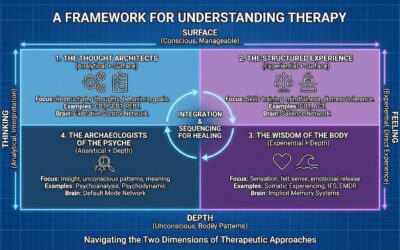
The accumulating outcome data made that posture untenable. Psychological difficulties turned out to be multi-determined and rarely one-dimensional, and no single modality proved universally effective for every patient in every circumstance. Two related movements grew out of that realization: eclectic psychotherapy, which is pragmatic and technique-first, and psychotherapy integration, which is theoretical and synthesis-first. The story of how the field learned to tell them apart, and how eclecticism went from clinical guesswork to actuarial science, is one of the more genuinely impressive maturation arcs in the history of the discipline.
Three Words That Are Not Synonyms
The vocabulary matters here, because the early decades of multi-school practice were haunted by a failure mode with its own name. Syncretism is the haphazard, unprincipled merging of techniques from different traditions without any understanding of their mechanisms or any decision rule governing their use. A syncretic therapist borrows an intervention because it sounds interesting, lurches between incompatible stances, and confuses or harms the client in the process. Early eclecticism was justly criticized for exactly this, and the criticism forced the field to formalize its terms.
The institutional turning point came in 1983 with the founding of the Society for the Exploration of Psychotherapy Integration, which gave the movement a home, a journal, and a set of boundaries. Figures like John Norcross, Marvin Goldfried, and George Stricker drew the central distinction: eclecticism is divergent and technique-driven, while integration is convergent and theory-driven. The eclectic therapist selects an intervention because outcome data or accumulated clinical experience says it works, and feels no obligation to reconcile that technique with a unified philosophy of mind. The integrationist wants to know not only what works but why, and labors to blend the underlying theories into a single coherent framework.
Within that broad distinction, the literature identifies four routes. Technical eclecticism selects the best available techniques for a specific patient and problem on empirical grounds, explicitly without adopting the theories that spawned them, which demands an enormous repertoire and a working knowledge of which interventions serve which populations. Theoretical integration attempts the grand unification, blending two or more divergent theories into a synthesized framework distinct from its parents, a project as ambitious and as stubbornly difficult as reconciling quantum mechanics with general relativity, because the parent theories contradict each other at the level of first premises. Assimilative integration keeps the clinician anchored in one host theory while deliberately importing tools from elsewhere, so a psychodynamic therapist might assign cognitive-behavioral homework but will interpret the patient’s resistance to completing it through a dynamic lens, never really leaving home. The common factors approach strips away proprietary language altogether and asks what all effective therapies share. Goldfried identified five universal principles of change that cut across orientations: fostering hope and motivation, building the therapeutic alliance, increasing awareness and insight, facilitating corrective emotional experiences, and encouraging ongoing reality testing.
Each route carries a different professional psychology. Assimilative integration is the safest anchor for the clinician’s identity. Technical eclecticism places the heaviest burden of continuing education. And it is technical eclecticism, disciplined by data, that produced the landmark systems the rest of this history follows.
Frederick Thorne and the Data-First Clinician
The first serious attempt to systematize eclectic practice predates Eysenck’s grenade by two years. Frederick C. Thorne was a physician and clinical psychologist, the founder and editor of the Journal of Clinical Psychology, and in 1950 he published Principles of Personality Counseling: An Eclectic Viewpoint, arguing against the entire prevailing structure of the field. Thorne drew on the holistic and purposive psychologies of Alfred Adler, Prescott Lecky’s work on self-consistency, D.O. Hebb’s behavioral neuroscience, and G.S. Marston’s writing on the integrative role of consciousness, and from that mix he built a claim that sounds obvious now and was heretical then: the clinician should gather the facts first and then find the theory that fits them, rather than force-fitting observations into a favored framework.
His 1955 follow-up, Principles of Psychological Examining, made comprehensive assessment the non-negotiable foundation of all treatment. Thorne argued that the proper object of diagnosis is the total personality, that psychological functioning is organized in hierarchical levels running from sensation and perception up through learning, memory, and motivation, and that disruption at a lower level predictably interferes with everything above it. Skip the examination, he insisted, and the therapy is doomed before it begins.
Thorne had his blind spots. His books purported to survey all known methods but read, as contemporary reviewers noted, like a lucid and unapologetic defense of directive therapy. Against Carl Rogers and the rising non-directive movement, Thorne wanted the clinician active, evaluative, and authoritative, and his critics detected underneath the system a basic distrust of the client’s own resources. The criticism has weight. But the conceptual step he took still stands: he separated principled multi-method practice from guesswork, and he did it before the field knew it needed the distinction.
Arnold Lazarus and the Architecture of Multimodal Therapy
If Thorne proposed the idea, Arnold Lazarus built the machine. Lazarus, a South African-born psychologist who spent much of his career at Rutgers, began as one of the purest behaviorists alive. He is credited with the first use of the term “behavior therapy” in the scientific literature, in 1958. What moved him was his own follow-up data. When Lazarus tracked his behavioral patients over time, he found a troubling pattern: people who responded beautifully to narrow-band behavioral treatment relapsed at unacceptable rates. Durability, it turned out, was a function of breadth. When significant dimensions of a patient’s life went unaddressed, the untreated territory acted as an anchor and dragged the patient back down.
His answer, developed through the 1970s and 1980s, was Multimodal Therapy, still the most systematic operationalization of technical eclecticism the field has produced. Lazarus started from an unglamorous anthropological observation: human beings are biological organisms who act, feel, sense, imagine, think, and relate to one another. Psychological problems are therefore multilayered by nature and demand broad-spectrum assessment. The famous acronym, BASIC I.D., walks through the seven modalities: behavior, meaning observable actions and habits; affect, the range and intensity of emotional life; sensation, the body’s tension, pain, and panic signatures; imagery, including intrusive pictures, nightmares, and the client’s self-image; cognition, the beliefs and internal dialogue driving distress; interpersonal functioning, the way the client manages conflict, intimacy, and dependence; and drugs, Lazarus’s shorthand for the entire biological substrate of medication, sleep, diet, exercise, and physical health. He treated biology as the physiological base of the whole structure and interpersonal life as its apex, the most complex layer, shaping everything beneath it.
The system was eclectic in technique but not chaotic in theory. Lazarus explicitly rejected theoretical eclecticism as a recipe for confusion and anchored everything in social learning theory: classical conditioning, operant conditioning, and vicarious modeling, augmented by individual expectancies, language, and selective attention. The assessment ran through structured instruments, chiefly the Multimodal Life History Inventory and the Structural Profile Inventory, a validated 35-item questionnaire that graphs a client’s relative reliance on each modality. The SPI turned out to be quietly brilliant in couples work. A great deal of marital friction is simply two structural profiles grinding against each other, one partner living in affect while the other lives in cognition, and the multimodal therapist’s job becomes teaching each to translate into the other’s native register.
Two signature strategies made the system clinically surgical. Tracking maps the firing order of a client’s modalities during a symptomatic episode. Panic is the cleanest example. One patient’s attack runs sensation to cognition to affect: a racing heart, then the thought of a heart attack, then terror. Another patient’s runs cognition to affect to sensation: a deadline, then anxiety, then nausea. The same diagnosis, two different machines, two different points of intervention. Bridging handles resistance without confrontation. When a client is defended in a clinically important modality, the therapist begins in the client’s preferred one and walks the conversation across. The intellectualizing client who resists feeling gets met first in the architecture of the problem, in logic and analysis, and only gradually steered toward the avoided emotional territory. The therapy adapts to the contours of the patient rather than demanding the reverse.
Lazarus was candid about the limits. Clients in acute delusional states, severe agitation, or pervasive disorganization generally cannot engage the layered assessment the model requires. But within its range, Multimodal Therapy demonstrated that a vast toolkit could be organized rather than merely accumulated.
Larry Beutler and the Actuarial Turn
By the close of the century, the question had sharpened again. Lazarus had mapped the interior of the patient. Larry Beutler, a psychotherapy researcher who spent decades running meta-analyses at the University of California, Santa Barbara, set out to map the match between patient and treatment. The result, Systematic Treatment Selection, marks a third epoch in this history. The first epoch searched for common healing factors. The second tailored techniques to problems. The third, Beutler’s, prescribes treatments based on cross-cutting, transdiagnostic patient characteristics, and it replaced the old generalized question, does psychotherapy work, with a far more useful one: what specific treatment, delivered by what kind of therapist, works for this individual with this problem.
Beutler’s central finding is uncomfortable for anyone attached to the diagnostic manual: certain stable, non-diagnostic patient traits predict outcome better than the DSM diagnosis does. Two of them carry most of the weight.
The first is coping style, the trait-like manner in which a person responds to threat and change, running along an internalizing-externalizing continuum. Internalizers turn distress inward, into rumination, somatic symptoms, anxiety, and self-reproach. Externalizers act out, avoid, move impulsively, and locate blame in the environment and in other people. Beutler’s meta-analytic work showed that coping style interacts strongly with the theoretical focus of the treatment. A 2011 meta-analysis of twelve studies covering 1,291 patients found a medium effect, d = 0.55, favoring the match between coping style and treatment focus, and an updated analysis of eighteen studies pushed the effect to d = 0.60. The clinical rule that falls out of the data is blunt. Externalizers do better in symptom-focused treatment: behavioral activation, skills training, structured cognitive work. Internalizers do better in insight-focused treatment: psychodynamic exploration, narrative and humanistic reflection. Running insight therapy on a highly externalizing patient is not just inefficient, it is empirically contraindicated, because the reflective capacity the treatment assumes is not yet there. Running purely symptom-focused treatment on an internalizer leaves the inner-blaming narrative that generates the symptoms untouched.
The second trait is reactance, the magnitude of a person’s oppositional response to perceived threats to their freedom, especially direct demands for change from an authority. High-reactance clients have always been associated with poor outcomes, weak engagement, and premature termination, and the traditional therapeutic response made it worse. When a patient pushes back, the natural human move, and the trained move in most directive traditions, is to push harder. Early research on countertransference, including Cutler’s work on how poorly therapists report their own behavior during conflict, showed how easily clinicians escalate these power struggles without knowing they are doing it. Beutler’s updated meta-analysis of thirteen studies covering 1,208 patients found that matching therapist directiveness to patient reactance produces one of the largest effects in the entire psychotherapy literature, d = 0.79 to 0.82. High-reactance patients improve when met with nondirective, reflective, supportive treatment, with acceptance instead of control. Low-reactance patients actively want structure and do better with directive, authoritative guidance.
The finding exposes a systemic training deficit. Faced with resistance, therapists reliably mistake the contraindicated response for the correct one. The eclectic practitioner trained in Systematic Treatment Selection reads the reactance, drops the demand, and shifts to a supportive stance, defusing the struggle and preserving the alliance. The capacity to make that pivot quickly and accurately is close to the definition of advanced, evidence-based eclecticism.
Berthold Gersons and the Protocolized Endpoint
The final stage of this evolution turned eclecticism itself into a manual. Brief Eclectic Psychotherapy for PTSD, developed by the Dutch psychiatrist Berthold Gersons in Amsterdam, is prescriptive eclecticism at its apex: a strictly structured sixteen-session protocol that deliberately splices cognitive-behavioral exposure with psychodynamic meaning-making to treat single-incident trauma. Randomized controlled trials have found it equal to Prolonged Exposure and EMDR in reducing PTSD symptoms, and it is considered the treatment of choice when a patient needs more than symptom reduction, when the trauma has broken the patient’s picture of the world and something has to be done about the meaning of that.
Even the session limit is doing theoretical work. Sixteen sessions of 45 to 60 minutes prevents drift, guards against the regressive dependency severely traumatized patients often develop toward their clinicians, and builds a container that forces focus. The sequence inside the container is precise. Session one is joint psychoeducation, and it requires the presence of the patient’s partner or a close support figure, an opening move that treats the interpersonal wreckage of trauma as part of the clinical picture from the first hour. The therapist reframes the symptoms not as madness but as a survival mechanism firing in the wrong context, an automatic anxiety response built for acute danger and now misapplied to ordinary life.
Sessions two through six bring imaginal exposure, with the patient recounting the event in present tense as if it were happening now, preceded by a brief relaxation and breathing exercise, because traumatized patients often fear their own emotions more than their memories. Here the protocol quietly departs from orthodox CBT. The goal of exposure in this model is not habituation to fear but catharsis, the release of the suppressed grief, helplessness, and sorrow the event left behind. Alongside the exposure, patients bring mementos to session, photographs, newspaper clippings, the jewelry of the dead, objects chosen to bypass cognitive defenses and reach visceral memory. And they take on a strange, exacting piece of homework: a daily letter, capped at thirty minutes to prevent dysregulation outside the consulting room, written to the person or institution the patient holds accountable. The letter is never sent. It exists to give aggression a channel, to shrink powerlessness, and to move anger out of the body and onto the page.
Session seven evaluates progress. Sessions eight through fifteen enter what the protocol calls the domain of meaning, where the freed-up psychic energy turns to the question of what the trauma did to the patient’s worldview and identity. The therapist works psychodynamically here, setting the event into the longer life narrative, alongside childhood experience and old coping patterns, with an explicit and unsentimental aim: the patient relinquishes the old, naive self who existed before the event and accepts a new identity as a sadder but wiser person. This is the protocol’s definition of post-traumatic growth, and it refuses the fantasy of restoration.
Session sixteen closes with the farewell ritual. The patient, again with the partner present, formally says goodbye to the traumatic period of their life, often by burning or burying the anger letters or finding a new purpose for the mementos. The ritual permits one final, shared experience of sadness in the presence of the people who matter, and it draws a line: the trauma now belongs to the past, and ordinary life resumes on the other side of it. It is exposure therapy and grief rite in a single hour, which is the whole eclectic argument compressed into a gesture.
What the Arc Teaches
Run the timeline end to end and the shape becomes clear. A field organized into warring orthodoxies is publicly humiliated by a flawed statistical attack it cannot initially answer. The humiliation forces it to measure. Measurement dissolves the schools’ claims to monopoly. Thorne argues for facts before theory. The taxonomists separate disciplined eclecticism from syncretic mess. Lazarus organizes the toolkit across the whole architecture of a person. Beutler proves, with some of the largest effect sizes in the literature, that matching treatment focus to coping style and therapist stance to reactance beats loyalty to any single doctrine. Gersons demonstrates that behavioral exposure, somatic regulation, and psychodynamic meaning-making can be sequenced into a single validated protocol that does what none of its parent traditions could do alone.
This lineage is not academic history for anyone practicing integrative trauma treatment today. Every clinician who moves between exposure work and meaning work, who reads the body before the narrative, who chooses a directive or nondirective stance based on the person in the chair rather than the certificate on the wall, is working downstream of this arc, whether the tools in question are EMDR, brainspotting, somatic approaches, or anything else in the modern repertoire. The organizing theory of good treatment turned out not to be a theory at all. It is the patient.
The schools did not lose the argument to one another. They lost it to the patient, and the profession is better for the defeat.



















0 Comments