
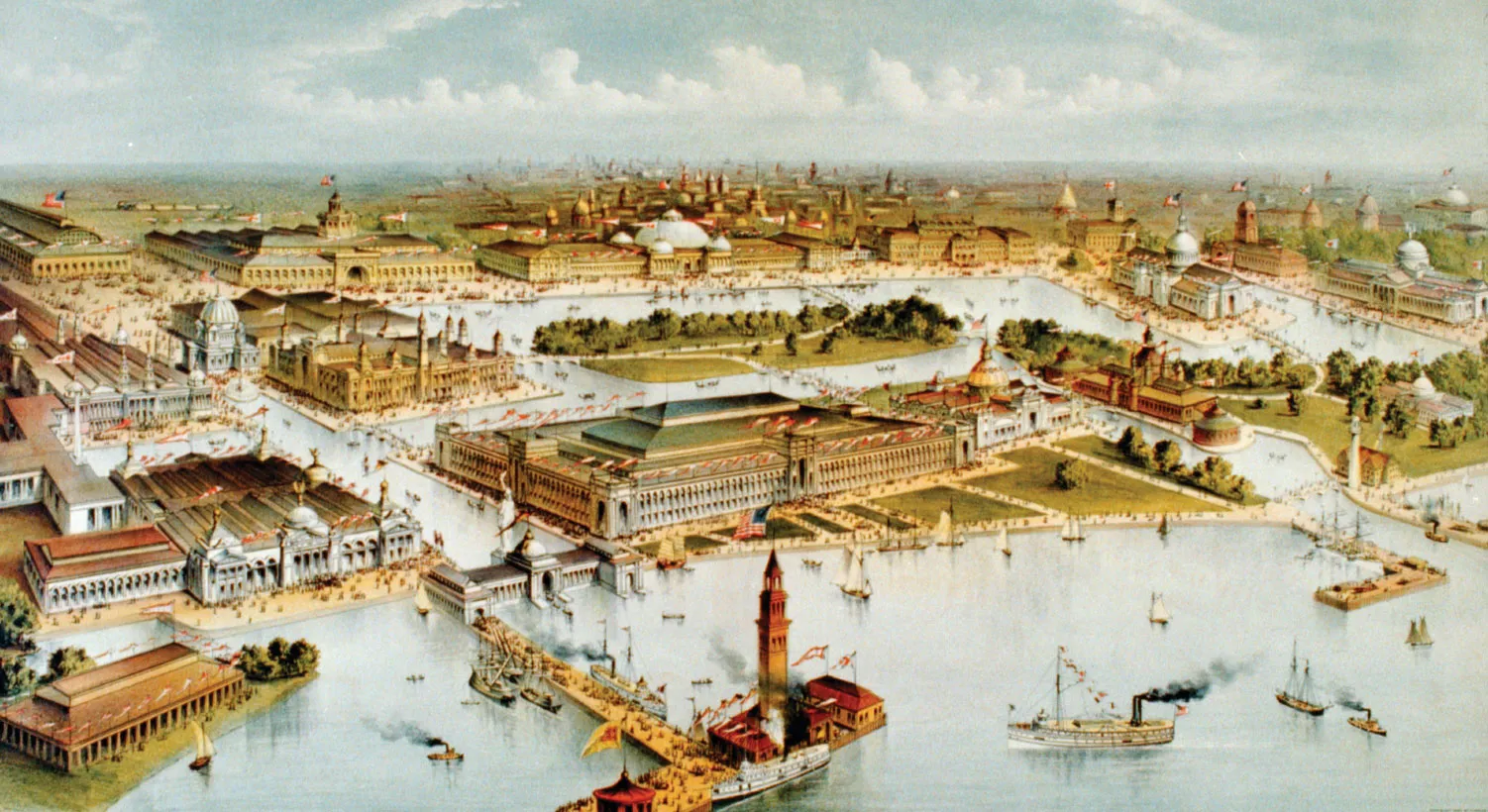
The City Beautiful Movement was an American planning reform, strongest from the 1893 Chicago World’s Fair to about 1920, that tried to cure the disorder of industrial cities with grand civic centers, tree-lined parkways, parks and classical public buildings. Its leaders believed that beauty and order in the streets would produce calmer, prouder and more civic-minded citizens, a psychological claim about how places shape people.
Key takeaways
- The City Beautiful Movement, launched by Chicago’s 1893 White City, held that beautiful, ordered cities would produce healthier and more civic-minded citizens.
- Daniel Burnham, the Olmsted firm, Charles Mulford Robinson, Edward Bennett and George Kessler turned that belief into civic centers, parkways and comprehensive plans.
- Birmingham, Alabama commissioned Warren Manning’s 1919 city plan and the Olmsted Brothers’ 1925 park report, and its civic buildings grew up around today’s Linn Park.
- Read through Jung, the movement’s grand plans resemble a collective mandala, an image of a whole and ordered center, with poverty and disorder as its shadow.
What was the City Beautiful Movement?
The phrase “City Beautiful” became common around 1900 through the journalism of Charles Mulford Robinson and the campaigns of civic improvement societies, and it named a loose coalition rather than a single school.2 Architects, landscape architects, women’s clubs, business associations and reform-minded mayors joined it. What united them was a conviction that the American city had grown too fast, too ugly and too fragmented, and that a planned, beautiful city would also be a healthier and more moral one.
The historian William H. Wilson, whose 1989 study remains the standard account, argued that the movement was never only about decoration. Its supporters wanted cleaner streets, more parks, coordinated public buildings and a sense of shared ownership of the city. Beauty was the means; civic virtue and social peace were the goal.1 That is the psychological heart of the movement: a bet that the built environment works on the people who live inside it.
What conditions produced the City Beautiful Movement?
Several pressures converged in the 1890s. Each one gave planners a problem to solve and gave civic leaders a reason to pay for solutions. Read together, they explain why the movement spread so quickly from Chicago to Washington, Cleveland, Denver, Kansas City and dozens of smaller cities.3
Rapid urbanization
American cities grew at a pace no one had planned for. Chicago went from about 30,000 residents in 1850 to more than a million by 1890. Crowded tenements, open sewers, smoke, disease and labour violence made the industrial city feel like something out of control. City Beautiful planners answered that feeling of chaos with an image of order.
Progressive Era reforms
The Progressive Era, roughly the 1890s to the 1910s, was a period of activism against corruption, monopoly and urban misery. Reformers pushed for public health codes, playgrounds, honest municipal government and expert administration. City Beautiful planning fitted this mood: it treated the shape of the city as a public responsibility rather than the accidental result of private speculation.
World’s Columbian Exposition of 1893
The World’s Columbian Exposition in Chicago gave the movement its founding image. Daniel Burnham directed construction, Frederick Law Olmsted shaped the grounds of Jackson Park, and architects such as Richard Morris Hunt and McKim, Mead and White designed a Court of Honor of matching neoclassical halls around a great basin.4 The buildings were faced in white “staff,” a plaster and fibre mix, which gave the fair its name: the White City. Millions of visitors walked through a city that was clean, lit by electricity, unified in style and policed into calm. Many went home asking why their own downtowns could not look like that.
Advancements in civil engineering
New tools made large-scale reshaping possible. Steel frames, electric streetcars, municipal water and sewer systems, paved boulevards and electric street lighting let cities reorganize whole districts. The same engineering that produced the grim factory city could be turned to building parkways and civic plazas.
Rise of the middle class
A growing professional and commercial middle class wanted parks, libraries, museums and respectable streets. Women’s clubs and village improvement societies were among the most active local advocates, organizing tree planting, clean-up campaigns and support for civic art long before city councils hired planners.2
Immigration waves
More than twenty million immigrants arrived in the United States between 1880 and 1920, many of them settling in the industrial cities. Native-born elites often worried about assimilation and the loyalty of newcomers. Monumental civic architecture was meant in part to teach a shared American identity through stone: here is your city hall, your library, your common ground.
Industrial wealth
The fortunes made in steel, railroads, meatpacking and finance paid for much of the movement. The Commercial Club of Chicago sponsored the 1909 Plan of Chicago, and wealthy donors funded museums, fountains and park land in city after city.5 Philanthropy brought ambition, and it also gave business leaders a strong voice in how the public city would look.
What did City Beautiful planning look like?
City Beautiful planners introduced a set of recognizable tools. Most of them depended on seeing the city as one designed object instead of a pile of separate lots.
- Comprehensive city planning. The Plan of Chicago treated the whole region, including rail lines, lakefront, harbour, parks and street grid, as a single design problem. It is usually counted as the first comprehensive metropolitan plan in the United States.5
- Civic centers. Public buildings such as courthouses, city halls, libraries and auditoriums were grouped around a mall or plaza so that government would appear as a unified and dignified presence. Cleveland’s 1903 Group Plan is the classic example.
- Parkway systems. Broad, tree-lined boulevards linked parks into networks, giving residents green routes through the city and raising nearby property values.
- City-scale Beaux-Arts architecture. The principles taught at the École des Beaux-Arts in Paris, including symmetry, axial planning and classical orders, were applied to entire districts. The building style is traced in our post on Beaux-Arts architecture.
- Integration of nature. Parks, gardens, waterfronts and fountains were treated as part of the city’s structure rather than leftovers, an idea that anticipates today’s biophilic design.
- Monumental vistas. Long, straight avenues ended at a dome, a column or a public building, so that the eye was led to the city’s symbolic center.
- Public art programs. Sculpture, murals, memorial arches and fountains were commissioned to carry civic meaning, often through allegorical figures of Justice, Commerce or the city itself.6
Charles Mulford Robinson’s Modern Civic Art (1903) gave these tools a theory. He argued that civic beauty was a practical matter, built from street layout, planting, lighting and the placement of public buildings, and that it would raise the self-respect of a city’s people.6
Who were the key figures of the City Beautiful Movement?
Daniel Burnham (1846 to 1912)
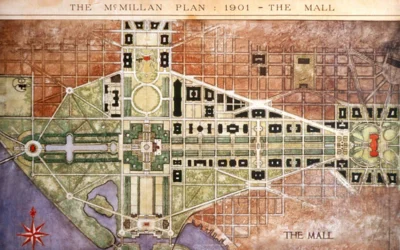
Burnham was the Chicago architect who directed the building of the 1893 fair. He went on to serve on the Senate Park Commission that produced the 1902 McMillan Plan for Washington, to help plan Cleveland’s civic center, and to draft plans for San Francisco (1905) and for Manila and Baguio in the Philippines. With Edward H. Bennett he wrote the Plan of Chicago, published in 1909.4
Frederick Law Olmsted (1822 to 1903)
Olmsted belongs to the generation before the City Beautiful, and his firm carried his ideas into it. With Calvert Vaux he won the 1858 competition for Central Park in New York, and he went on to design Prospect Park in Brooklyn and park systems in Buffalo and Boston. He laid out the grounds of the 1893 fair. His son, Frederick Law Olmsted Jr., served on the McMillan Commission, and the family firm, Olmsted Brothers, produced park plans for cities across the country, including Birmingham.12
Charles Mulford Robinson (1869 to 1917)
Robinson was a Rochester journalist who became the movement’s most widely read writer. The Improvement of Towns and Cities (1901) and Modern Civic Art (1903) turned scattered local campaigns into a national program, and he consulted on plans for many cities. He was later appointed the first professor of civic design at the University of Illinois.6
Arnold W. Brunner (1857 to 1925)
Brunner was a New York architect who joined Burnham and John Carrère on Cleveland’s 1903 Group Plan and designed its federal building and courthouse. He also worked on planning studies for Baltimore, Rochester, Denver and other cities.3
John Nolen (1869 to 1937)
Nolen, trained in landscape architecture at Harvard, brought City Beautiful principles to smaller places. His Replanning Small Cities (1912) collected planning studies of small American cities, and he planned San Diego and many new towns in the following decades.8
Edward H. Bennett (1874 to 1954)
Bennett co-authored the Plan of Chicago with Burnham and then led plans of his own, including Portland, Oregon, Minneapolis and the federal plan for Ottawa and Hull in Canada.5
George E. Kessler (1862 to 1923)
Kessler, born in Germany, designed the park and boulevard system of Kansas City in the 1890s, one of the movement’s most admired achievements, and later planned park and boulevard systems for Dallas, Indianapolis, Memphis and other cities.1
How did the City Beautiful relate to other planning movements?
The City Beautiful sat inside a crowded field of reform ideas. Some fed it, some ran alongside it and some replaced it.
- Garden City Movement. Ebenezer Howard, an English stenographer and reformer, proposed self-contained towns of limited size, ringed by agricultural greenbelts and owned in common, in To-morrow: A Peaceful Path to Real Reform (1898), reissued as Garden Cities of To-morrow (1902).7 Where the City Beautiful remade the existing metropolis, Howard wanted to move people out of it.
- Parks Movement. The nineteenth-century push, led by Olmsted and Vaux, to give crowded cities large public parks as “lungs” for health and recreation. City Beautiful park systems grew directly out of it.
- Progressive Era reforms. The wider campaign for public health, housing codes, playgrounds and clean government gave the movement its moral language.
- Beaux-Arts architecture. The Paris-trained classical style supplied the movement’s visual vocabulary.
- City Efficient Movement. After about 1909, when the first National Conference on City Planning met in Washington, planners increasingly spoke of the “City Practical” or “City Efficient”: zoning, traffic, housing and engineering rather than monuments.8 The shift reflects the turn toward administrative rationality that Max Weber described in the same years.
- Civic Art Movement. Municipal art societies, such as the one founded in New York in 1893, campaigned for public sculpture, murals and well-designed street furniture. J. Horace McFarland of the American Civic Association turned these local efforts into a national crusade.10
- American Renaissance. Historians use this name for the period, roughly 1876 to 1917, when American artists and architects such as Augustus Saint-Gaudens and Charles McKim consciously took up the classical and Renaissance traditions, following earlier revivals like Greek Revival architecture. It also defined itself against the busy mix of Victorian eclecticism.
Did Birmingham, Alabama have a City Beautiful plan?
It did. Birmingham was founded in 1871 and grew so quickly on iron and steel that it was nicknamed the Magic City. Its boosters sent the cast-iron statue of Vulcan to the 1904 St. Louis World’s Fair, itself a descendant of Chicago’s White City, as a symbol of the city’s industrial pride, a story told in our post on the Vulcan statue.
Civic leaders commissioned the Boston landscape architect Warren H. Manning, who had trained in Olmsted’s office, to prepare a plan for the whole city. Warren H. Manning’s City Plan of Birmingham was published in 1919. It proposed parks along ridges and stream valleys, better streets and a civic center grouped around the downtown park.11 The plan was never formally adopted, but its civic center idea largely came true.
In 1924 the city’s Park and Recreation Board hired Olmsted Brothers, and the firm’s report, A System of Parks and Playgrounds for Birmingham, appeared in 1925. It recommended a network of parks following the city’s creeks and ridges, and it advised keeping the downtown park open as the center of a group of civic buildings.12 Around that park, known over the years as Capitol Park and Woodrow Wilson Park and later renamed Linn Park, the Municipal Auditorium (now Boutwell Auditorium) opened in 1924, the central library (now the Linn-Henley Research Library) in 1927, the Jefferson County Courthouse in 1931 and City Hall in 1950. The courthouse shows how the City Beautiful’s classical grouping later absorbed the vertical lines of Art Deco.
Much of the Olmsted park network went unbuilt as the Depression arrived, and Birmingham also lost the streetcar network that tied the city together, a loss explored in our post on Birmingham’s lost streetcar system. The Red Rock Ridge and Valley Trail System, planned in the 2010s, has revived the Olmsted idea of greenways along the creeks.
Where can you see the City Beautiful today?
The movement’s work is still visible in many North American downtowns. Washington’s National Mall took its present form from the 1902 McMillan Plan, which restored Pierre L’Enfant’s axis, removed a railroad station from the Mall and set the sites later used for the Lincoln Memorial. Chicago’s lakefront parks and Michigan Avenue bridge come from the Plan of Chicago. Denver’s Civic Center Park, championed by Mayor Robert Speer, Cleveland’s Mall, Philadelphia’s Benjamin Franklin Parkway and Kansas City’s boulevards are all City Beautiful landscapes.1
Its top-down, monumental method fell out of favour after the First World War. Yet its central claim, that design shapes behaviour and civic feeling, returns in the current interest in placemaking, walkable streets and lively public squares. New Urbanism in particular borrows its civic squares, terminated vistas and respect for public buildings, while insisting on community participation that the earlier movement lacked.
The movement’s commitment to nature also looks prescient. Roger Ulrich’s 1984 study in Science compared surgical patients whose hospital windows faced trees with matched patients who faced a brick wall: those with the tree view had shorter postoperative stays and needed fewer strong pain medications.13 Modern green-space planning tends to emphasise ecological function and access for every neighbourhood, but it rests on the same intuition that City Beautiful park builders acted on.
What were the main criticisms of the City Beautiful Movement?
The movement drew criticism in its own day and afterwards. An informed admirer would name five.
- Elitism. Critics said that monumental beauty served downtown business and the respectable classes more than tenement dwellers who needed housing, sanitation and work.
- Displacement. Clearing land for civic centers and parkways often removed existing neighbourhoods, many of them poor, immigrant or Black.
- Cost. Grand plans were expensive, and money spent on marble could have gone to schools or sewers. Many plans, including Birmingham’s, were only partly built.
- Lack of functionality. The City Practical planners argued that traffic, zoning and housing mattered more than vistas. Daniel Bluestone’s study of Detroit shows how civic ideals collided with the commercial interests that actually drove downtown growth.9
- Environmental determinism. The belief that beautiful surroundings would by themselves produce good citizens was later judged too simple. Jane Jacobs, in The Death and Life of Great American Cities (1961), argued that formal civic centers were often avoided by the very people they were built to uplift.
What did the City Beautiful assert, and what did it fear?
Viewed as a collective self-presentation, the movement made confident claims. It asserted that environmental design could shape behaviour and social outcomes. It projected civic pride, cultural sophistication and faith in progress, and its grand plans announced that the United States had become a world power that deserved capitals to match.1
Underneath, it also showed insecurities. The reliance on European, Paris-trained classicism reflected a long-standing anxiety that American cities lacked the refinement of Old World capitals. The stress on order and cleanliness carried fears of strikes, crime, disease and the moral influence of crowded, mixed immigrant neighbourhoods. In Jung’s terms, the white façades worked like a persona, the face a person shows the world, while the slums and the factories held what the persona left out: the city’s shadow.
The sheer scale of City Beautiful projects can also be read as compensation. Cities that had grown in a chaotic, unplanned rush answered that history with an equally large display of control. A person who feels inwardly disordered sometimes builds a rigid outward order; a city can do something similar. Our wider reading of these forces is in the psychology of architecture.
How might a Jungian read the City Beautiful Movement?
Carl Jung described archetypes as inherited patterns of imagination that shape how human beings perceive and organise experience, recurring across myths, dreams and cultures.14 The archetypes named below are an interpretive lens rather than historical findings, but each matches something real in the movement’s own language and design.
- The Great Mother. Parks, playgrounds, fountains and green parkways were meant to nurture and shelter city dwellers, the city as a caring body.
- The Hero. Triumphal arches, monuments and long processional avenues expressed collective aspirations to civic greatness, the drama of the hero archetype written in stone.
- The Sage. Libraries, museums and universities at the heart of civic centers embodied the hope that wisdom could be housed and offered to everyone, the sage archetype given public form.
- The Creator. Comprehensive plans imagined whole cities into being on paper, the impulse of the creator archetype.
- The Ruler. Axial avenues, grouped government buildings and strict design codes imposed order and hierarchy on the urban scene.
Behind all five stands an older image: the ideal city. Jung paid close attention to images of a center surrounded by an ordered enclosure, the mandala, which he saw as a symbol of the Self, the organising center of the whole psyche.14 In Memories, Dreams, Reflections he recounts a 1927 dream of Liverpool in which dark, rainy streets radiated from a square around a round pool, with a sunlit island and a flowering magnolia at its center. He took the dream as a picture of the Self and of the goal of psychological development.15 The City Beautiful plans, with their radiating avenues and civic heart, read like a collective attempt to build that image, to meet a psychological need for order, beauty and meaning in a time of disorienting change. The same idea of sacred enclosure runs through our posts on the temenos in urban planning and on Leon Krier and the architecture of the archetype.
The movement holds both the aspirations and the anxieties of its era. Its grand, top-down method has given way to participatory planning, but its core belief in the power of the built environment to foster civic pride still shapes how cities are designed. The ongoing task of making cities that are beautiful and also fair, sustainable and responsive to the people in them can be traced back to the City Beautiful’s ideals and its contradictions.
What does the City Beautiful mean for therapy?
The City Beautiful planners were making a claim therapists hear every week: surroundings change how a person feels. Clients describe the relief of a walk in a park, the low-level dread of a chaotic home or workplace, the way a certain street or building carries memory. The nervous system registers space before the thinking mind has an opinion about it, which is why somatic therapy pays close attention to what the body does in a room, on a commute or in a childhood neighbourhood.
The movement’s shadow side is just as familiar clinically. Many people build an orderly, impressive outer life to manage inner chaos, the personal equivalent of a white civic façade over crowded back streets. In Jungian therapy we look at that gap without contempt for either side: the persona has real value, and so does the disorder it hides. The work is to let the hidden districts into awareness so that order no longer has to be maintained by force.
At Taproot we often ask clients about the places in their lives: the house they grew up in, the town they left, the spaces where they feel safe or watched. Images of cities, plazas, ruins and gardens also appear often in dreams, and we treat them as pictures of the psyche’s own structure. The question the City Beautiful asked of American cities, what would a whole and livable center look like, is a question people bring into therapy about themselves.
Beauty, order and the inner city
The City Beautiful reformers believed that people rise to meet the places they live in, and that a city could be designed to give its people dignity. Therapy works on a similar faith at a smaller scale: that the psyche has a center worth finding and an order that does not need to be imposed. If that kind of work interests you, you can meet our therapists and begin the conversation.
Frequently asked questions
What was the main goal of the City Beautiful Movement?
The City Beautiful Movement aimed to reform crowded industrial cities through planned beauty: grouped civic buildings, parks, tree-lined boulevards and public art. Its supporters believed that an ordered, beautiful city would raise civic pride, calm social conflict and improve public health, so beauty was treated as a tool of social reform rather than decoration alone.
Who started the City Beautiful Movement?
No single person started the City Beautiful Movement. Daniel Burnham’s direction of the 1893 World’s Columbian Exposition in Chicago gave it a model, Charles Mulford Robinson’s books gave it a theory, and civic improvement societies, women’s clubs and business groups across the United States gave it local support from the 1890s onward.
Why did the City Beautiful Movement decline?
The City Beautiful Movement faded after about 1910 as planners turned to the City Practical: zoning, traffic, housing and engineering. Critics said its monuments were costly, served downtown interests more than the poor, and assumed too simply that beautiful surroundings make good citizens. Many of its parks and civic centers still remain in use.
What are examples of City Beautiful architecture?
Well-known City Beautiful landscapes include the National Mall in Washington shaped by the 1902 McMillan Plan, Chicago’s lakefront parks from the 1909 Plan of Chicago, Cleveland’s Group Plan mall, Denver’s Civic Center Park, Philadelphia’s Benjamin Franklin Parkway and the Kansas City park and boulevard system designed by George Kessler.
Is Linn Park in Birmingham a City Beautiful design?
Linn Park reflects City Beautiful ideas. Warren Manning’s 1919 City Plan of Birmingham proposed a civic center around the downtown park, and Olmsted Brothers’ 1925 report advised keeping it open as the center of civic buildings. The auditorium, central library, Jefferson County Courthouse and City Hall were built around it between 1924 and 1950.
Related reading
- Ludwig Mies van der Rohe: Architect of the Modern Age
- Language as Mirror: How Saxon and Latinate Word Choices Reflect Values and Shape Therapeutic Practice
- The Theories and Ideas of Rollo May
- Adaptive Reuse: Breathing New Life into Existing Structures
- Deindustrialization and the Postmodern Corporate Headquarters: Reimagining the Workplace
- Neo-Modernism: Reviving and Refining Modernist Principles
References
- Wilson, W. H. (1989). The City Beautiful movement. Johns Hopkins University Press.
- Peterson, J. A. (1976). The City Beautiful movement: Forgotten origins and lost meanings. Journal of Urban History, 2(4), 415-434. https://doi.org/10.1177/009614427600200402
- Peterson, J. A. (2003). The birth of city planning in the United States, 1840-1917. Johns Hopkins University Press.
- Hines, T. S. (1974). Burnham of Chicago: Architect and planner. Oxford University Press.
- Burnham, D. H., & Bennett, E. H. (1909). Plan of Chicago. Commercial Club of Chicago.
- Robinson, C. M. (1903). Modern civic art, or the city made beautiful. G. P. Putnam’s Sons.
- Howard, E. (1902). Garden cities of to-morrow. Swan Sonnenschein.
- Scott, M. (1969). American city planning since 1890. University of California Press.
- Bluestone, D. M. (1988). Detroit’s City Beautiful and the problem of commerce. Journal of the Society of Architectural Historians, 47(3), 245-262. https://doi.org/10.2307/990300
- Wilson, W. H. (1981). J. Horace McFarland and the City Beautiful movement. Journal of Urban History, 7(3), 315-334. https://doi.org/10.1177/009614428100700302
- Manning, W. H. (1919). Warren H. Manning’s city plan of Birmingham. Published by subscription.
- Olmsted Brothers. (1925). A system of parks and playgrounds for Birmingham. Park and Recreation Board of Birmingham.
- Ulrich, R. S. (1984). View through a window may influence recovery from surgery. Science, 224(4647), 420-421. https://doi.org/10.1126/science.6143402
- Jung, C. G. (1959). The archetypes and the collective unconscious (R. F. C. Hull, Trans.; Collected Works, Vol. 9, Part 1). Pantheon Books.
- Jung, C. G. (1963). Memories, dreams, reflections (A. Jaffé, Ed.; R. Winston & C. Winston, Trans.). Pantheon Books.








0 Comments