
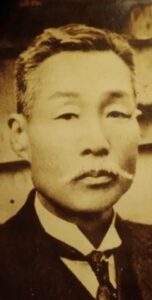
Shoma Morita (1874-1938) was a Japanese psychiatrist who founded Morita therapy in 1919. His central insight was that fighting anxiety, intrusive thoughts and bodily fear keeps them alive, while accepting them “as they are” and acting on what matters lets them settle. That idea, which we would now call a change in metacognition, prefigured mindfulness and acceptance therapies and still marks the limits of what medication can do.
Key takeaways
- Shoma Morita (1874-1938) founded Morita therapy in Tokyo in 1919 to treat shinkeishitsu, a nervous temperament marked by anxiety, obsessions and health fears.
- Morita argued that the effort to control or suppress anxious feeling, not the feeling itself, keeps people trapped in suffering.
- His answer, arugamama, means accepting feelings as they are while doing what the situation and one’s values require.
- Morita’s method prefigured Mindfulness-Based Stress Reduction, DBT’s radical acceptance, ACT’s committed action and Wells’s metacognitive therapy by decades.
- Medication can ease severe symptoms, but changing a person’s relationship to thoughts and feelings is the work of therapy.
Who was Shoma Morita?
Morita, whose given name is also read Masatake, was born in 1874 in Kochi Prefecture on the island of Shikoku. He graduated in medicine from Tokyo Imperial University in 1902 and spent his career teaching psychiatry at the Jikei medical school in Tokyo, where he became professor. He worked at the same moment Freud was building psychoanalysis in Vienna, and he read the Western literature of his day closely, yet he arrived at a very different account of nervous suffering.2
He knew the problem from the inside. As a student Morita suffered from palpitations, headaches and fears about his health of the kind then labelled neurasthenia. In his own retelling, he stopped taking the medicine he had been prescribed and threw himself into study before an examination, and the symptoms he had been nursing faded once his attention was elsewhere. That experience became a template: the symptom loses force when a person stops organising life around it.3
His main statement of the method, Shinkeishitsu no hontai to ryoho, appeared in 1928. It was published in English in 1998 as Morita Therapy and the True Nature of Anxiety-Based Disorders, translated by Akihisa Kondo and edited by Peg LeVine.1 In the United States the anthropologist David Reynolds introduced the approach to readers with Morita Psychotherapy in 1976 and later adapted it as “Constructive Living.”3
What is shinkeishitsu, and what did Morita see in it?
Morita treated patients with what he called shinkeishitsu, a nervous temperament marked by anxiety, obsessive thinking, panic, hypochondriacal worry and social fear. Today these people would receive diagnoses such as generalised anxiety, panic disorder, social anxiety or obsessive-compulsive disorder. Morita noticed that they shared a personality style: sensitive, introspective, perfectionistic and highly motivated to live well.2
His explanation turned the usual logic around. Anxiety, he argued, is the shadow side of a healthy desire to live fully, which he called sei no yokubo. A person who wants very much to succeed will also fear failure. The trouble begins when that person treats a normal sensation, such as a racing heart before a talk, as a dangerous abnormality. Attention narrows onto the sensation, the sensation grows under scrutiny, and the growing sensation draws still more attention. Morita called this loop seishin kogo sayo, often translated as “psychic interaction.”1
He described the resulting state as toraware, being caught or trapped. The person becomes captured by the effort to get rid of feeling, and by the gap between how they think they should feel and how they actually feel. In Morita’s view the attempt to control or suppress difficult emotion was itself the main source of suffering, not the emotion.2
How does Morita therapy work?
The answer Morita gave was arugamama, accepting things as they are. Feelings are treated like weather: they come and go on their own schedule and cannot be commanded. Actions, by contrast, are under a person’s control. So the therapist stops asking the patient to fix feelings and asks the patient to do what the situation requires while the feelings are present.1
The classic inpatient programme had four stages. First came about a week of isolated bed rest with no reading, talking or distraction, so that the patient met anxiety and boredom directly and discovered that both pass and give way to a wish to act. Next came light, quiet work such as gardening or tidying, then heavier and more demanding work, and finally a return to ordinary social life. Throughout, patients kept a diary, and the physician wrote brief comments in the margins that pointed away from symptom talk and toward what the patient had done.2
Later practitioners in Japan and abroad adapted the method for outpatient work, and it is often delivered in weekly sessions today. A randomised trial in Devon, England, offered 8 to 12 sessions of outpatient Morita therapy alongside usual care to adults with major depression, and 94 percent of participants completed the four-month follow-up.7
What can and cannot be treated with medication?
Morita died in 1938, more than a decade before chlorpromazine and the first antidepressants opened the era of modern psychopharmacology. He had watched the treatments of his own time, including sedatives and rest cures for neurasthenia, and concluded that symptom-focused remedies left the underlying trap in place. His reasoning applies with new force to the medicines that came after him.
Psychiatric medications act on neurotransmitter systems involving serotonin, dopamine and norepinephrine, and for many people they lift the weight of severe depression, quiet panic, or steady the swings of bipolar disorder. They help, and for some conditions they are necessary. What they do not do is teach a person how to relate to a thought, a memory or a feeling.
Large reviews point the same way. A network meta-analysis of 101 trials with nearly 12,000 adults found that psychotherapy plus medication produced more response than either alone, and that psychotherapy alone and medication alone performed about equally.8 The medication and the conversation do different work.
There are also experiences that are not illnesses at all. Emotion after a death, existential anxiety about meaning and mortality, the ache of a difficult relationship, and the struggle with identity and purpose are part of being human. Morita would have said they need to be lived through and integrated. Medication may make them bearable for a season. It cannot supply the acceptance and purposeful action that Morita saw as the ground of well-being.
How did Morita anticipate mindfulness and acceptance therapies?
Six decades after Morita founded his method, Jon Kabat-Zinn began the Stress Reduction Clinic at the University of Massachusetts Medical Center in 1979, the programme that became Mindfulness-Based Stress Reduction.4 In 1993 Marsha Linehan published the treatment manual for Dialectical Behavior Therapy, which pairs change with radical acceptance.5 In 1999 Steven Hayes, Kirk Strosahl and Kelly Wilson set out Acceptance and Commitment Therapy.6 Each arrived at principles Morita had organised into a clinical method by 1919.
Morita drew on the Japanese intellectual world he lived in, including Zen Buddhism, though he insisted his method was medicine and not religious training. Readers who know D.T. Suzuki, who carried Zen to the West in the same era, or the paradoxical teaching of the Zen koan, will recognise the family resemblance. Four elements of his therapy became cornerstones of later Western practice.
Somatic awareness
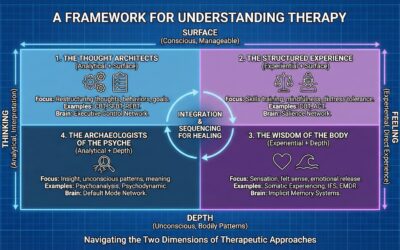
Morita asked patients to let palpitations, tension and dread run their course without trying to stop them. He saw that fighting a bodily sensation amplifies it, the same observation that underlies modern body-based trauma work.
Experiential acceptance
Rather than analysing why a patient felt anxious, Morita treated the feeling as a natural fluctuation, like weather passing through. This is close to what experiential therapists mean when they contrast experiencing with cognitive analysis.
Mindful observation
Morita did not teach sitting meditation, and he warned that anxious introspection feeds the symptom. What he cultivated was a quieter stance: noticing that a feeling is present, naming it as a feeling, and returning attention to the task at hand. The bed-rest stage and the diary both trained this capacity to see a mental event without being ruled by it.
Values-based action
Patients were asked to take up meaningful work while discomfort was present, not after it disappeared. ACT later called this “committed action,” and its emphasis on values and willingness echoes Morita closely.6
Mindfulness-based programmes now have a substantial research base; a meta-analysis of 39 studies found moderate reductions in anxiety and depression.9 Their spread into Western practice confirms what Morita saw early: the Western habit of pathologising and eliminating uncomfortable emotion was part of the problem.
Why does Morita’s idea count as metacognition?
Metacognition means awareness of one’s own thinking. In Morita’s terms, the goal was to see a thought or feeling as an event that comes and goes, not as a command or a verdict. Once a person can see the pattern of fear, scrutiny and more fear, there is room to choose a different response. That capacity for observing consciousness itself is the mechanism Morita relied on.
The British psychologist Adrian Wells later built an entire treatment, metacognitive therapy, on a similar insight: that what keeps anxiety and depression going is less the content of a worry than a person’s beliefs about worry and the strategies used to control it.10 Morita reached that conclusion by clinical observation decades earlier.
This understanding could have reshaped both psychotherapy and psychopharmacology. In the best case, medication would be used as a support that makes enough stability for this kind of awareness to grow, and therapy would focus on the relationship to difficult experience rather than on erasing symptoms.
What is the formulaic trap in modern therapy?
Instead, much of the field moved toward technique. The rise of cognitive-behavioral therapy brought session protocols, worksheets and symptom tracking, and the drive toward standardised treatments often lost sight of the personal, experiential nature of change. Writers at Taproot have argued this case in When Evidence Based Practice Goes Wrong.
From Morita’s angle the problem is specific. Classic cognitive work asks a person to dispute and replace the content of a thought. Morita asked a person to stop arguing with the thought and act. An emphasis on correcting thought content can keep someone in the very struggle that maintains suffering: monitoring the mind and trying to make it say the right thing.
The same pattern shows up in prescribing. A diagnostic model built around symptom reduction can hide the fact that emotional pain often carries meaning. A symptom may be pointing toward a life change that needs to happen or an unacknowledged part of the self that needs attention, and a plan aimed only at removing it can miss the message.
What would a metacognitive approach change?
Morita’s legacy invites a different question about every form of treatment: does it help the person build a new relationship with experience?
For prescribers
Medication becomes a means of creating conditions in which a patient can develop awareness and acceptance, not only a route to remission. The question shifts from “Which symptoms must go?” to “What support does this person need to face what they are living through?”
For therapists
The focus moves beyond technique to presence and attention. Techniques still have their place, in service of helping clients observe their experience with clarity and compassion. The therapist’s own steadiness, the quality explored in the wounded healer tradition, matters as much as any protocol.
For patients
The aim becomes a wise and accepting relationship with the full range of feeling rather than the absence of hard emotions. Success shows up as greater flexibility and the ability to live meaningfully while discomfort comes and goes.
How do we use Morita’s ideas in therapy at Taproot?
At Taproot we see many people whose anxiety, obsessive loops or health fears have grown through exactly the cycle Morita described. A first step is often to name that cycle: the sensation, the alarm about the sensation, and the narrowing of life around it. Naming it lets a client see that the effort to make the feeling stop has become its own problem.
From there the work tends to move in two directions. One is toward the body. In somatic therapy and in Brainspotting, a client is helped to stay with a sensation long enough for the nervous system to complete its own process, which is a close cousin of Morita’s instruction to let feeling run its course. The other is toward meaning and action: what does this person want their life to be for, and what is one thing they can do today with the fear still present? That question links Morita to existential therapy and to the work of Irvin Yalom on acceptance.
Parts work adds a further layer. The anxious, vigilant part that scans the body for danger is usually trying to protect the person. When clients learn to observe that part rather than merge with it, as described in why IFS works, they are practising the same observing stance Morita trained with bed rest and the diary.
The path forward: integration and wisdom
Morita’s work offers a corrective to a treatment culture that measures success by symptom counts. Four points stand out:
- Metacognition is the mechanism of healing. Change comes less from eliminating difficult thoughts and feelings than from changing one’s relationship to them.
- Some experiences should not be medicated away. Grief, existential anxiety and spiritual longing ask to be processed and lived, even when medication helps someone carry them.
- Eastern traditions have much to offer. The arrival of mindfulness, acceptance and somatic awareness in Western psychotherapy returns to ground Morita mapped a century ago, a theme also traced in the life of Alan Watts.
- Therapy remains an art. The process cannot be reduced to a formula or to an algorithm. It requires presence, intuition and respect for each person’s path.
Honoring the fullness of human experience
Morita’s contribution reaches well beyond the specific method that carries his name. He saw that acceptance makes change possible, that the effort to escape feeling often hurts more than the feeling, and that some parts of life have to be lived through rather than removed.
As neuroscience and pharmacology advance, those observations remain true. The goal of mental health care is not a symptom-free life. It is the awareness, acceptance and resilience that let a person meet hard seasons with steadiness. The future lies in integration: the relief medication can give, combined with the change that comes from a new relationship to inner experience. Morita saw this a century ago.
If you recognise yourself in the loop of fighting your own feelings, the therapists at Taproot work with that pattern every week through somatic, existential and depth-oriented therapy. You can reach out to Taproot Therapy Collective to talk about starting.
Frequently asked questions
What is arugamama in Morita therapy?
Arugamama is a Japanese term usually translated as accepting things as they are. In Morita therapy it means allowing anxiety, fear and unpleasant sensations to be present without fighting them, while turning attention to the task or action that matters. Morita saw feelings as uncontrollable and actions as controllable, so the work focuses on doing rather than on fixing how one feels.
What are the four stages of traditional Morita therapy?
Classic inpatient Morita therapy has four stages: about a week of isolated bed rest, then light quiet work, then heavier and more demanding work, and finally preparation for return to ordinary social life. Patients keep a diary throughout, and the therapist comments on what they did rather than on their symptoms. Many clinicians now use an outpatient adaptation delivered in weekly sessions.
Is Morita therapy the same as mindfulness?
Morita therapy is not a meditation practice, and Shoma Morita warned that anxious self-examination feeds symptoms. It shares with mindfulness the stance of noticing a feeling without struggling against it. Morita therapy places more weight on purposeful action and work, which makes it close to Acceptance and Commitment Therapy as well as to Mindfulness-Based Stress Reduction.
What is shinkeishitsu?
Shinkeishitsu is the term Shoma Morita used for a nervous temperament in sensitive, perfectionistic and introspective people. It covered what would now be called generalised anxiety, panic, social anxiety, health anxiety and obsessive thinking. Morita believed these people had a strong desire to live well, and that their fear was the other side of that desire.
Can Morita therapy be used alongside medication?
Yes. Morita therapy addresses a person’s relationship to anxious thoughts and sensations, which medication does not teach. A 2018 trial in England offered outpatient Morita therapy in addition to usual care, which included medication for many participants. Reviews of depression treatment also find that therapy combined with medication helps more people than either one alone.
Related reading
- Eugene Gendlin: A Biographical Timeline
- Did the State of Alabama Just Get Rid of Ketamine Therapy for PTSD?
- The Machine as False God: Lewis Mumford’s Pentagon of Power and the Crisis of Contemporary Psychotherapy
- Can Psychotherapy Survive Staying Seperated from Anthropology and Philosophy?
- What is Energy Psychotherapy?
- On Arrogance and Excellence: Deconstructing the Double Binds of Modern Psychotherapy
References
- Morita, S. (1998). Morita therapy and the true nature of anxiety-based disorders (shinkeishitsu) (A. Kondo, Trans.; P. LeVine, Ed.). State University of New York Press. (Original work published 1928)
- Kitanishi, K., & Mori, A. (1995). Morita therapy: 1919 to 1995. Psychiatry and Clinical Neurosciences, 49(5-6), 245-254. https://doi.org/10.1111/j.1440-1819.1995.tb01896.x
- Reynolds, D. K. (1976). Morita psychotherapy. University of California Press.
- Kabat-Zinn, J. (1990). Full catastrophe living: Using the wisdom of your body and mind to face stress, pain, and illness. Delacorte Press.
- Linehan, M. M. (1993). Cognitive-behavioral treatment of borderline personality disorder. Guilford Press.
- Hayes, S. C., Strosahl, K. D., & Wilson, K. G. (1999). Acceptance and commitment therapy: An experiential approach to behavior change. Guilford Press.
- Sugg, H. V. R., Richards, D. A., & Frost, J. (2018). Morita Therapy for depression (Morita Trial): A pilot randomised controlled trial. BMJ Open, 8(8), e021605. https://doi.org/10.1136/bmjopen-2018-021605
- Cuijpers, P., Noma, H., Karyotaki, E., Vinkers, C. H., Cipriani, A., & Furukawa, T. A. (2020). A network meta-analysis of the effects of psychotherapies, pharmacotherapies and their combination in the treatment of adult depression. World Psychiatry, 19(1), 92-107. https://doi.org/10.1002/wps.20701
- Hofmann, S. G., Sawyer, A. T., Witt, A. A., & Oh, D. (2010). The effect of mindfulness-based therapy on anxiety and depression: A meta-analytic review. Journal of Consulting and Clinical Psychology, 78(2), 169-183. https://doi.org/10.1037/a0018555
- Wells, A. (2009). Metacognitive therapy for anxiety and depression. Guilford Press.
















0 Comments