

When the Unconscious Goes Online
What happens when Jung’s collective unconscious meets the internet? This question, once relegated to speculative philosophy, has become one of the most pressing concerns of our metamodern age. We are witnessing something unprecedented in human history: the externalization of our shared psychological depths into a visible, searchable, and algorithmically curated digital landscape.
The rise of the digital domain has created a new virtual world that is eternal and ethereal and with it has created a philosophical entropy state where more than ever technology has superseded cultural thought and ethics. What Jung once described as the collective unconscious, once deemed parapsychology or too esoteric, is now a conscious reality of creation. We now, accidentally or intentionally, take part in creating a collective unconscious that more than ever has a visible presence and massive direct and indirect effect on our cultural groups as well as having a global unconscious appeal.
This transformation demands a new framework for understanding human consciousness, culture, and communication. That framework is metamodernism, an emerging cultural paradigm that synthesizes the universal aspirations of modernism with the relativism and irony of postmodernism. For therapists, depth psychologists, and anyone seeking to understand the contemporary psyche, grasping this metamodern turn is no longer optional. It is essential.
What is Metamodernism? Beyond the Modern and Postmodern Divide
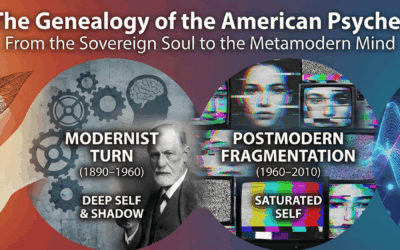
To understand our current predicament, we must first understand where we have been. Modernism, the dominant paradigm of the first half of the 20th century, believed in grand narratives, universal truths, and the steady march of progress. It gave us science, democracy, and the conviction that human reason could solve any problem. But modernism’s confidence was shattered by two world wars, colonialism, and the recognition that its “universal” truths often reflected the particular perspectives of those in power.
Postmodernism emerged as modernism’s corrective. Thinkers like Michel Foucault and Jacques Derrida taught us to deconstruct grand narratives, to see truth as socially constructed, and to embrace irony as a defense against the dangers of absolute certainty. Postmodernism was liberating, but it left us with a problem: if all narratives are equally constructed, what do we believe? If everything is ironic, how do we act with sincerity? Postmodernism offered brilliant critique but little guidance for moving forward.
Enter metamodernism. As cultural theorists Timotheus Vermeulen and Robin van den Akker first articulated in their influential 2010 essay “Notes on Metamodernism,” this new sensibility emerged from the recognition that neither modernism nor postmodernism alone is adequate for navigating the 21st century. Vermeulen and van den Akker describe metamodernism as a “structure of feeling” that oscillates between modernism and postmodernism like a pendulum swinging between opposite poles. They write that metamodernism oscillates between a modern enthusiasm and a postmodern irony, between hope and melancholy, between naivety and knowingness, empathy and apathy, unity and plurality.
This oscillation is not mere indecision. It is a conscious navigation between extremes, a pragmatic idealism that acknowledges the constructedness of reality while still reaching for transcendent truths. The metamodern sensibility can be conceived of as a kind of informed naivety, a pragmatic idealism characteristic of cultural responses to recent global events such as climate change, the 2008 financial crisis, political instability, and the digital revolution.
For a deeper exploration of metamodern theory and its key thinkers, see my articles on Timotheus Vermeulen and Seth Abramson.
The Return of Orality: Digital Culture and the Participatory Voice
One of the most profound transformations of our metamodern age is the resurrection of oral culture within a literate context. To understand this, we must turn to the work of Jesuit philosopher and cultural historian Walter J. Ong, whose seminal book “Orality and Literacy: The Technologizing of the Word” provides the framework we need.
Ong argued that the shift from orality to literacy fundamentally restructured human consciousness and social organization. Whereas oral cultures were characterized by a sense of immediacy, communality, and mythic identification, literate cultures increasingly prioritized abstraction, individuation, and rational analysis. With the advent of writing and especially with the spread of print culture, the performative and participatory dimension of language was progressively marginalized. The fixed, abstract, and decontextualized nature of the written word fostered a new conception of meaning as something objective, universal, and eternal.
But Ong also recognized that electronic media were bringing about a new kind of “secondary orality” that combines the participatory and immersive qualities of premodern oral culture with the technological affordances of modern media. Digital platforms, in particular, have radically expanded the possibilities for ordinary people to create, share, and remix content, blurring the lines between producer and consumer, author and audience.
What we are experiencing now goes beyond what Ong could have imagined. Social media platforms like TikTok, X (formerly Twitter), and Instagram have created a hybrid condition in which the archival affordances of writing coexist with the experiential immediacy of speech. On these platforms, language is less about recording timeless truths than about riffing on the memetic moment. We are witnessing the emergence of digital folklore, as scholars like Trevor J. Blank have documented, where the boundaries between the real and the fictional, the sincere and the ironic, are constantly blurred.
The implications for therapy are profound. Our clients are now embedded in a culture that operates on fundamentally different communicative principles than the print culture that shaped psychoanalysis and most of our therapeutic traditions. Understanding this shift is essential for meeting clients where they are. For more on how philosophy informs therapeutic practice, see my series on Lessons that Philosophy Can Teach Psychology.
Memes as Modern Mythology: The Archetypes of Digital Culture
In oral cultures, language was not a static system of signs but a dynamic medium of performance and participation. Meaning emerged through the embodied, dialogical, and improvisational process of storytelling, where speaker and listener, poet and audience, were bound together in a shared space of co-creation. Think of Homer’s Odyssey, where religion, culture, history, ethical dialogues, and entertainment overlap in the same tale. Different modes of understanding unlock different parts of the tale as they are needed by the culture through oral participation and enhancement.
Memes are the modern equivalent of these participatory myths. They are visual, participatory, and performative like oral culture; decontextualized and endlessly remixable like print culture; and shot through with postmodern irony, absurdism, and meta-reference. But memes are not merely entertainment. They function as shorthand expressions of collective knowledge, humor, and identity, forms of participatory vernacular that rely on shared recognition and implicit cultural fluency.
Internet researchers recurrently encounter kinds of online content and communicational genres that appear as trivial and mundane as they are entangled with the everyday use of new media: online jargons, emoticons, copy-pasted jokes, Internet memes, and many other repertoires of digital folklore. Over the last four decades, these semiotic resources and user practices have been approached from multiple angles: as forms of textual play or poaching, as examples of visual or linguistic creativity, as a material culture resulting from networked communications, as vernacular resources for identity making, and as the folk art of new media.
From a depth psychological perspective, memes are carrying archetypal content. The Hero’s Journey appears in countless viral formats. The Trickster archetype manifests in the trolling and subversion that defines so much online discourse. The Shadow appears in the dark humor and transgressive content that proliferates in anonymous spaces. The collective unconscious, once an abstract psychological concept, has found a palpable form in the digital narratives of the 21st century.
Every blog post that resonates with our deepest aspirations, every meme that encapsulates our shared cultural experiences, every hashtag that rallies us around a common cause: these are the living expressions of Jung’s archetypes. They affirm that the collective unconscious, once an abstract psychological concept, has found a palpable form in the digital narratives of the 21st century.
For more on how mythology informs therapeutic practice, see my explorations of Jungian therapy and depth psychology and the labyrinth in Jungian psychology.
The Dual Register: Speaking Literally and Symbolically at Once
Perhaps the most distinctive feature of metamodern communication is what we might call the dual register: the simultaneous operation of literal and symbolic modes of meaning. We are living through a remarkable transformation in the nature of human communication, one that is reshaping the very foundations of language, culture, and politics as we know them.
In the first mode, we are using language more literally than ever before, with words serving as precise, technical labels for concrete realities. But simultaneously, in the second mode, we are using those same words as mythic signifiers, charged with symbolic and archetypal resonances. This strange dual register is not a “tower of Babel” situation of mutual unintelligibility, but rather a fluid shift between two frequencies of meaning. The result is a kind of metamodern code-switching, where the same phrase can operate as both factual description and symbolic incantation.
This is unprecedented. In the past, we have had oral culture and then later written culture, but never have we had both modes of language sharing the linguistic space at the same time. We have had people speak different languages with different words, but never different languages with the same words. We feel both hyper-connected and hyper-isolated. What we say is seen and examined by more people than we can comprehend, but we feel less understood and less seen than has ever been recorded.
This dual register explains much of the confusion and conflict in contemporary discourse. When someone says “Make America Great Again,” they may be making a literal policy claim about economic conditions, but they are also invoking a mythic narrative about national identity, heroic restoration, and cultural meaning. When critics respond with fact-checks about economic data, they are often missing the symbolic register entirely. Neither side is wrong; they are simply operating in different modes of meaning.
For therapists, understanding this dual register is crucial. Our clients are often struggling with exactly this kind of cognitive dissonance, caught between the literal demands of daily life and the symbolic needs of the soul. The therapeutic space can become a laboratory for learning to navigate both registers consciously. See my article on anticipating the metamodern for more on this cultural transition.
The Politics of Metamodern Meaning: Truth in the Age of Post-Truth
The metamodern linguistic landscape is a contested terrain of political and cultural struggle. In an age of post-truth politics and information warfare, the ability to control the narrative, to shape the symbolic landscape of collective meaning-making, has become a crucial source of power.
Research on political polarization and problematic information has proliferated in recent years. Studies find that distrust of the foundational institutions of democracy, government, media, and experts, by citizens from both sides of the political aisle has led to divisive online discourses and hyper-partisanship. Public confidence in scientists and medical professionals continues to decline sharply. The rise of post-truth politics coincides with polarized political beliefs. A Pew Research Center study of American adults found that those with the most consistent ideological views on the left and right have information streams that are distinct from those of individuals with more mixed political views, and very distinct from each other.
The metamodern condition allows bad faith actors to retreat into ambiguity and avoid accountability. Language is being subjected to contradictory pressures: to fragment and dissolve meaning on the one hand, and to express timeless truths and grand visions on the other. This can lead to profound misunderstandings and conflicts, as people talk past each other without realizing they are inhabiting different linguistic universes.
On one level, the metamodern linguistic turn has opened up new possibilities for grassroots activism and resistance. Movements like Occupy Wall Street and Black Lives Matter have used social media to challenge dominant discourses and mobilize collective action, often in ways that blend sincere moral outrage with ironic meme-making and hashtag wordplay. At the same time, the metamodern linguistic landscape has also given rise to new forms of manipulation and demagoguery.
The solution is not to retreat into either pole. We cannot go back to the naive certainties of modernism, nor can we afford the paralyzing irony of postmodernism. Instead, we need to cultivate what Vermeulen and van den Akker call informed naivety: the ability to hold both skepticism and sincerity, to oscillate consciously between modes rather than being unconsciously captured by either.
For explorations of how these dynamics play out in therapy, see my articles on Jürgen Habermas and dialogical practice and the blindspots in individual and society.
The Digital Collective Unconscious: Jung Meets the Internet
The most radical implication of our metamodern moment is the externalization and visibility of what Jung called the collective unconscious. Jung posited the collective unconscious as a reservoir of shared human archetypes, myths, and experiences that transcend individual subjectivity. This collective unconscious is a reservoir of archetypes and symbols, narrative elements that appear across cultures and epochs, revealing the shared human journey. These archetypes, which Jung identified as primordial images and themes, surface in our myths, art, religions, dreams, and now, vividly, across the digital landscape.
The internet has made this once-invisible realm visible. Social media platforms emerge as modern expressions of the collective unconscious. Shared symbols, memes, and cultural expressions on platforms such as Facebook and Twitter reflect and shape the collective psyche. The digital age transforms the way archetypal narratives are distributed, consumed, and transformed.
But this visibility is not merely passive reflection. We are now active participants in the creation of the collective unconscious. The internet is becoming the town square for the global village of tomorrow, as Bill Gates once put it. We are witnessing a new kind of collective meaning-making that operates at unprecedented speed and scale.
This creates both opportunities and dangers. On the positive side, individuals who once would have been isolated in their struggles can now find communities of shared experience. The therapeutic implications are significant: clients can access peer support, psychoeducation, and diverse perspectives with unprecedented ease.
On the negative side, the same connectivity that enables community also enables contagion. Collective neuroses can spread virally. The shadow side of the collective unconscious, normally hidden, is now on full display. Minds that have awoken to this digital awareness earlier than others have felt, consciously or unconsciously, the potential of these unmapped neural territories on the internet. Many of the negative aspects of the digital viral culture we see now are bad actors attempting to probe for and colonize weak nodes on the network. They search for weak structures and untapped energy in the networked zeitgeist to harness and redirect its potential energy for their own ends.
For more on Jung’s concepts and their contemporary applications, see my articles on the philosophy behind Carl Jung and Gilbert Durand’s anthropology of the imaginary.
The Witness Consciousness: Navigating Between Modes
How do we navigate this metamodern landscape without losing ourselves? The first step is to cultivate what we might call a witness consciousness: a perspective that allows us to step outside of each mode of language, to see their respective purposes and not overly identify with any single one. By maintaining a witnessing awareness, we can use these different linguistic modes selectively and skillfully, as tools for specific ends rather than as totalizing worldviews that subsume our identity.
This requires a kind of metamodern mindfulness, a capacity to observe our own participation in the meaning-making process without being entirely swept away by it. We must learn to recognize when we are speaking in mythic or memetic registers, when we are using language for poetic or political purposes, and to discern the appropriate context and limits of each mode. At the same time, we need to honor the unique gifts and insights that each linguistic realm offers, and to explore their potential synergies and harmonies.
By cultivating this witness consciousness, we paradoxically become more engaged and empowered as meaning-makers. We are no longer merely passive consumers of cultural narratives, but active weavers of the stories that shape our world. We can more intentionally choose which myths to enact, which memes to spread, which poetic possibilities to manifest.
This is the therapeutic task of our age: helping clients develop the capacity to oscillate consciously between modes, to engage both the literal and the symbolic, to maintain connection in a world that feels increasingly fragmented. For practical approaches to this work, see my articles on Gaston Bachelard and psychology through poetics and Jean Gebser and integration through the integral.
The Synthetic Synthesis: Brains Wired Together
One cautiously optimistic interpretation of humanity’s future is that all the minds comprising society are now fusing into a singular larger being that is both terrifying and liberating, and perhaps inevitable. This great synthesizing occurs as the accelerating speed of communication and proliferating modes of interconnection entwine us into a vastly complex, interdependent neural network. It is simultaneously composed of individuals and made up of inseparable, interlinked parts.
When Peak Neuroscience joined forces with Taproot Therapy Collective to offer quantitative electroencephalography (qEEG) brain mapping, I asked the clinical psychologist who runs the clinic numerous questions about the fascinating property of brains to entrain to and mimic external frequencies and thought patterns. This neuroplasticity principle underlies the neurostimulation and neuromodulation treatments we provide at my clinic.
I asked: “What would happen if you could somehow duct tape five or six living brains together while keeping them intact and healthy?” He theorized that the brains would likely start to synchronize their frequencies as they recognized each other’s repetitive patterns. They would then potentially reorganize and build new neural networks among themselves to form a more efficient collective organism. While this scenario is obviously speculative science fiction, it serves as an intriguing metaphor for what we are witnessing with the emergence of metamodernism in society.
This state of being both hyper-individualized and hyper-connected is a novel phenomenon unparalleled in human history. It compels us to radically reimagine our notions of identity and social interaction. In essence, we must learn how to integrate the seemingly paradoxical polarities of self and other, to identify both as the familiar parts of ourselves and as the greater super-organism beyond ourselves that we are a part of.
As society functions like one connected brain, it has more potential but also more potential for more horrifying disorders and neuroses than one brain alone was ever capable of. These distinctions and connections must become more fluid, while still allowing us to retain our individuality within the collective.
For more on the neuroscience of consciousness and connection, see my articles on Antonio Damasio and reuniting mind, body, and emotion and our qEEG brain mapping services.
Indigenous Wisdom for Digital Times: Learning from the Dreamtime
In the search for mythopoetic alternatives to the disembodied digital predicament, we can look to the profound wisdom of indigenous cultures. The Aboriginal Australian concept of the Dreamtime offers particularly rich resources. The Dreamtime is a sacred era in which ancestral totemic spirits sang the world into existence. But it is not just a distant past: it is an eternal realm that interpenetrates ordinary reality and can be accessed through ritual, art, and states of consciousness.
In the Dreamtime stories, individual beings are not separate, isolated entities but rather nodes in a vast web of kinship that encompasses the entire cosmos. Each person has multiple overlapping identities based on their ancestral lineages, totemic affiliations, and the particular Songlines or Dreaming tracks that crisscross their territory. The boundaries between self and other, human and nature, matter and spirit are fluid and permeable.
This indigenous worldview offers a powerful framework for navigating the metamodern situation in which we find ourselves. Just as the Dreaming spirits are both timeless archetypes and localized, embodied expressions, each of us contains the universality of the collective unconscious while manifesting a unique individual consciousness. We are simultaneously dreaming and being dreamed by greater powers.
The Dreamtime also teaches us that crises and disruptions are initiatory thresholds for transformation and renewal, not apocalyptic end points as they are often portrayed in modern narratives. In the same way, the metamodern mind may need to undergo a psychic “burnoff” of outdated belief systems, identities, and social structures in order to unleash the latent creative potential within. This process is not comfortable or painless by any means, but it is an essential ordeal for our collective maturation.
For more on how ancient wisdom traditions inform contemporary therapy, see my articles on Plotinus and Neoplatonic philosophy, Alan Watts as a bridge between East and West, and Christian mysticism in therapy.
The Therapeutic Implications: Meeting Clients in the Metamodern
What does all this mean for clinical practice? Several implications stand out:
First, we must become fluent in both registers. Clients today are often speaking in a hybrid language that blends literal content with symbolic resonance. When a client talks about their social media presence, they may be describing both a practical communication tool and a core aspect of their identity and self-worth. We need to hear both levels.
Second, we must help clients navigate the dual register consciously. Many of the presenting problems we see, anxiety, depression, identity confusion, relational difficulties, are exacerbated by the unconscious oscillation between modes. Helping clients recognize when they are operating in literal versus symbolic registers, and when each is appropriate, can be profoundly liberating.
Third, we must take digital life seriously as a domain of psychological experience. The collective unconscious is now visible and participatory. Our clients’ online lives are not separate from their “real” lives; they are increasingly inseparable dimensions of a single existence. The archetypes they encounter in memes and viral content are as psychologically potent as those in dreams and myths.
Fourth, we must cultivate community in the face of hyper-connection. The paradox of our age is that we are more connected than ever yet feel more isolated than ever. Therapy can serve as a space of genuine presence and depth in a world of surfaces and performances.
Fifth, we must embrace informed naivety ourselves. We cannot guide clients through the metamodern landscape if we are either naively enthusiastic about technology or cynically dismissive of it. We must model the oscillation, holding both hope and skepticism, sincerity and irony, in creative tension.
For resources on integrating these insights into clinical practice, see my articles on the future of therapy and navigating the tensions of our time and Theodore Porter’s critique of quantification.
Conclusion: Toward a Metamodern Depth Psychology
We are all called to be shamans in this time between stories, to make the hazardous descent into the depths of our individual and collective psyche, to retrieve the soul-fragments we have lost, and to re-enchant the world with mythopoetic meaning. This does not mean a regression to pre-modern superstitions, but rather a quantum leap into a new synthesis of archaic and modern, intuitive and rational, spiritual and scientific ways of knowing.
The metamodern linguistic turn is a call to courage, a summons to creativity. We must learn to sit with uncertainty and tension with rapt attention in an age where the immediacy of digital life has made many adults into children who can do none of these things. The willing must step into the unknown, to embrace the mystery and the wonder of this future synthesis.
The stakes could not be higher. If we navigate this transition unconsciously, we risk the worst of both worlds: the ego-inflating grandiosity of modernist narratives projected onto authoritarian figures, combined with the relativistic lack of accountability that postmodernism enables. We have already seen this dangerous synthesis in contemporary politics.
But if we navigate consciously, with witness awareness, informed naivety, and commitment to depth, we have the opportunity to participate in the emergence of something genuinely new: a metamodern consciousness that integrates the best of what has come before while transcending its limitations. This is the work that calls us, as therapists, as cultural participants, as human beings awakening to our unprecedented moment.
The collective unconscious has gone online. It is up to us to ensure that this visibility leads to integration rather than fragmentation, to healing rather than harm, to wisdom rather than mere information. The metamodern age demands nothing less than a revolution in how we understand and engage with the depths of the human psyche.
Further Reading and Resources
For more explorations of metamodernism, depth psychology, and the future of therapy, explore these related articles:
Metamodernism and Post-Secularism:
- Anticipating the Metamodern
- Metamodern as Oral Culture
- Gianni Vattimo and Weak Thought
- Christopher Partridge on Spirituality and Depth Psychology
- John Caputo and the Post-Secular Path
Philosophy for Therapists:
- Martin Heidegger and the Quest for Being
- Jean-Paul Sartre on Existentialism and Freedom
- Peter Sloterdijk as Pioneering Metamodern Philosopher
- Maurice Merleau-Ponty on Embodied Perception
- Edmund Husserl and Phenomenological Foundations
Historical Influences on Depth Psychology:
- Friedrich Schelling’s Conceptualization of Trauma
- Friedrich Nietzsche’s Impact on Psychology
- Immanuel Kant’s Enduring Impact
- Friedrich Hegel’s Dialectical Philosophy
- Ernst Cassirer on Symbolic Forms
Additional Resources:
- Hans-Georg Gadamer on Hermeneutics
- Walter Benjamin on Trauma and Memory
- William James as Father of American Psychology
- Hannah Arendt on the Ethics of Politics
- Plato as the First Depth Psychologist
- Paul Ricoeur on Narrative Identity
- Aristotle’s Divergence from Platonic Idealism
- Socrates’ Influence on Philosophy and Depth Psychology
- Theodor Adorno on Critical Theory
- Gilbert Simondon on Modes of Existence
- Arthur Schopenhauer on Pessimism and Mysticism
- Ludwig Wittgenstein on Language Games
- Henri Bergson on Time and Intuition
- Saul Kripke’s Relevance for Psychotherapy
- Wolfgang von Goethe as Visionary Poet and Thinker
- Søren Kierkegaard’s Ideas for Psychotherapy
- Wilfred Bion on Psychoanalysis and Dreams
- Fredric Jameson on Post-Spirituality and Depth Psychology
- Why Parents Treat Children Differently
References
Blank, T. J. (Ed.). (2009). Folklore and the Internet: Vernacular Expression in a Digital World. Utah State University Press.
Farkas, J., & Schou, J. (2020). Post-Truth, Fake News and Democracy: Mapping the Politics of Falsehood. Routledge.
Howard, R. G. (2008). The vernacular web of participatory media. Critical Studies in Media Communication, 25(5), 490-513.
Jung, C. G. (2014). The Archetypes and the Collective Unconscious. Routledge.
Ong, W. J. (1982). Orality and Literacy: The Technologizing of the Word. Routledge.
Schafer, S. B. (Ed.). (2016). Exploring the Collective Unconscious in the Age of Digital Media. IGI Global.
Shifman, L. (2014). Memes in Digital Culture. MIT Press.
Vermeulen, T., & van den Akker, R. (2010). Notes on metamodernism. Journal of Aesthetics and Culture, 2(1).
Vermeulen, T., van den Akker, R., & Gibbons, A. (Eds.). (2017). Metamodernism: Historicity, Affect and Depth after Postmodernism. Rowman & Littlefield.
Joel Blackstock, LICSW-S, MSW, PIP is a Licensed Clinical Social Work Supervisor (License #4135C-S) and Clinical Director of Taproot Therapy Collective in Hoover, Alabama. He specializes in complex trauma treatment using advanced modalities including Brainspotting, EMDR, Emotional Transformation Therapy (ETT), qEEG brain mapping, and somatic approaches, with a unique integration of Jungian archetypal psychology and depth-oriented frameworks.
Categories: Metamodernism and Deconstruction | Philosophy for Therapists | Psychology of Media and Culture | Psychology of Modernism Post Modernism and the Meta Modern | Jungian Therapy and Depth Psychology

0 Comments