
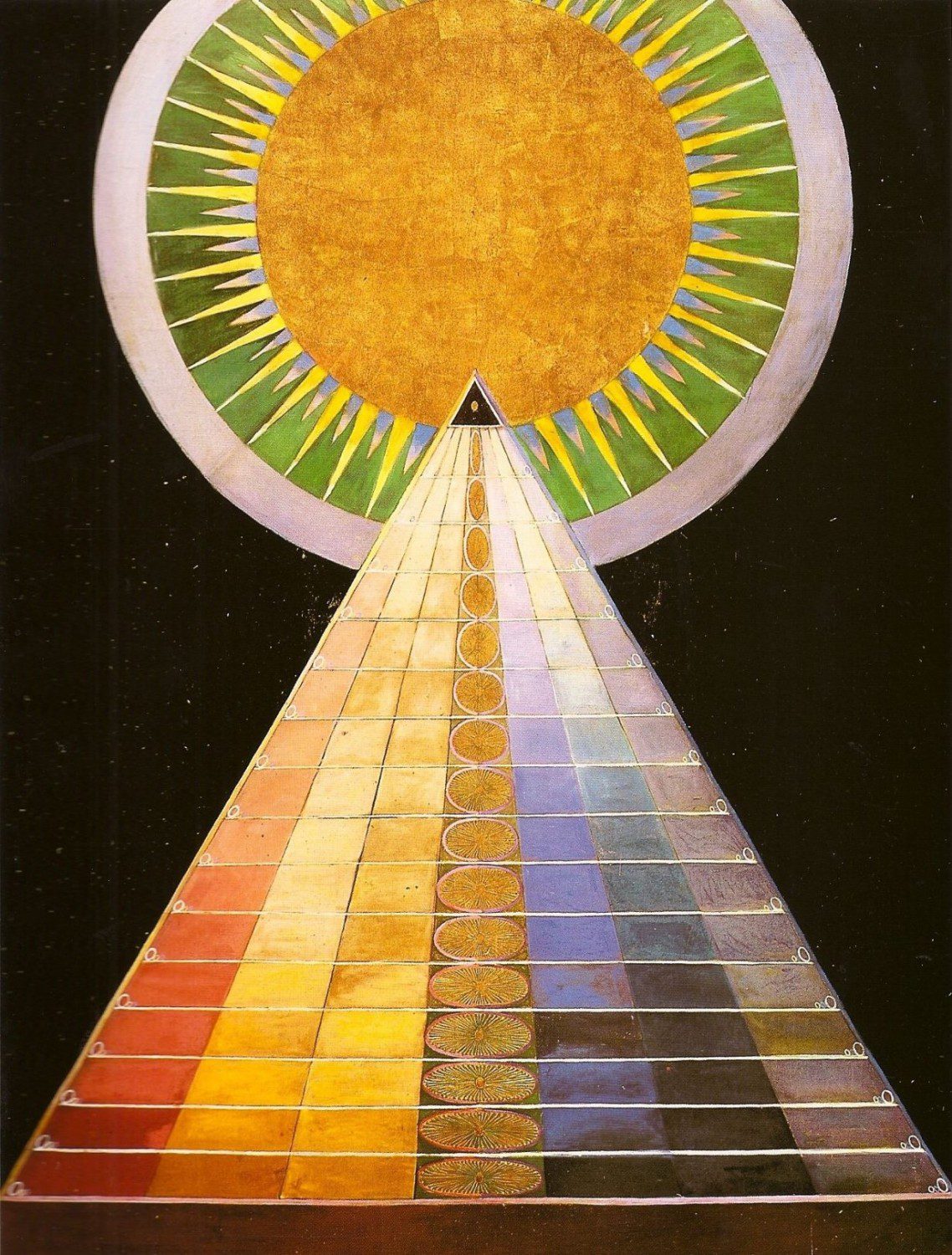
Executive Summary: The Science of the Soul
The Definition: Mysticism is not magic; it is Direct Experience. It is the practice of bypassing the intellectual Ego to access the deeper, non-verbal layers of the psyche. It is the difference between reading a menu and eating the meal.
The Neuroscience: Modern scans show that mystical states (induced by meditation, prayer, or deep trauma therapy) correspond to a quieting of the Default Mode Network (DMN)—the brain’s “storyteller” and seat of the Ego.
The Clinical Link: Effective trauma therapy often mimics the mystical path. To heal deep wounds, we must descend through the layers of Avoidance (Ego) and Trauma (Personal Unconscious) to reach the “Universal Connection” (Self) that holds the capacity for integration.
The Mystical Depths of the Psyche: Exploring the Intersection of Neuroscience, Religion, and Psychotherapy
In the medieval period, pilgrims embarked on perilous journeys to the Holy Land, facing bandits, disease, and the unknown. For those unable to undertake such arduous voyages, the great cathedrals of Europe offered an alternative technology of the soul: The Labyrinth. Often found adorning the floors of cathedrals like Chartres, these intricate stone patterns offered a symbolic pilgrimage.
At first glance, a labyrinth looks like a maze, but there is a crucial distinction. A maze is a puzzle designed to confuse the rational mind with dead ends and wrong turns. It engages the Ego—the part of you that solves problems and fears failure. A labyrinth, however, is unicursal. It has a single, winding path that inevitably leads to the center. There are no choices to make, no puzzles to solve. You simply have to keep walking.
This labyrinth serves as a powerful metaphor for the mystical practices we explore in this article. As we traverse its path, we relinquish the need for rational decision-making. The repetitive action of walking, free from the demands of executive function, facilitates a winding down of the Ego. In this state, we access a different level of consciousness, tuning into the deeper recesses of our mind, heart, and perhaps soul.
In modern therapy, we are essentially walking this labyrinth. We are moving from the noisy surface of the mind to the silent center of the self. This article explores how mysticism is not just a religious concept, but a psychological necessity for deep healing.
Defining Mysticism: Beyond the “Woo-Woo”
Mysticism is often misinterpreted as abstract, obscure, or superstitious thinking. In our hyper-rational culture, calling something “mystical” is often a polite way of calling it “nonsense.” However, in the history of philosophy and psychology, mysticism has a rigorous definition: It is the pursuit of knowledge through direct experience rather than intellectual doctrine.
The core tenant of mysticism is that the Ego—our rigid self-image and conscious, language-based thinking—is a filter. While this filter is necessary for survival (it helps us drive cars and pay taxes), it is an obstacle to understanding the deeper reality of who we are. The mystic argues that you cannot know an apple by reading a book about horticulture; you must bite into the apple. Similarly, you cannot heal trauma by analyzing it; you must process it.
This concept might initially seem threatening to some religious perspectives, as it appears to equate self-knowledge with knowledge of the divine. However, most mystics do not claim that the “Ego-Self” is God. Rather, they propose that our capacity to understand ultimate reality is inherently limited by our own neurosis. Through this lens, our traumas, fears, and rigid defenses become barriers to the light. The mystical journey is one of cleaning the window.
The Neuroscience of Ego Dissolution: The Default Mode Network
For decades, scientists dismissed mystical experiences as hallucinations or delusions. However, the advent of fMRI technology has given us a map of what happens in the brain during these states. The results are startling.
It turns out that the “Ego” has a biological address. It is a network of brain regions known as the Default Mode Network (DMN). The DMN is active when we are daydreaming, worrying about the future, regretting the past, or obsessing over what others think of us. It is the “Narrator” in your head that never shuts up.
When individuals engage in deep prayer, meditation, or psychedelic therapy, the DMN goes quiet. Blood flow is diverted away from the “Narrator” and towards the sensory processing centers of the brain.
* The Subjective Result: The boundary between “Me” and “The World” dissolves. Anxiety about the future vanishes because the part of the brain that constructs “the future” is offline.
* The Clinical Result: Without the Ego’s rigid defenses, traumatic memories that were previously repressed can surface and be reprocessed safely. This is why “mystical” states are often the catalyst for breakthroughs in PTSD treatment.
Mysticism in the Therapeutic Context
At first glance, the connection between mystical practices and modern psychotherapy might not be apparent. As a therapist, I don’t lead my patients in chants, yoga sessions, or prayer circles. Yet, I’ve come to believe that what we might call a “mystical experience” often marks the crucial turning point in therapy—the moment when real change occurs.
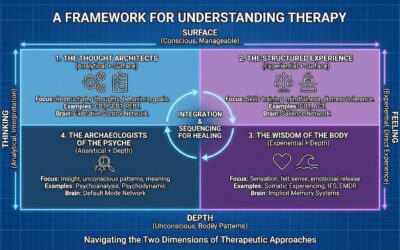
We often assume that change comes from “insight”—from figuring out *why* we do what we do. But how many times have you known exactly why you were self-sabotaging, yet done it anyway? Insight is a function of the Prefrontal Cortex (the Ego). Healing is a function of the Subcortical Brain (the Body).
Meaningful change occurs when the Ego is temporarily suspended or “turned off.” This allows us to reprogram the subcortical brain—the part responsible for emotional reactions and body awareness. Cognitive Behavioral Therapy (CBT) tries to talk the Ego into submission. Depth Psychology and mysticism bypass the Ego entirely to speak directly to the soul.
The 4 Layers of Consciousness: A Map for the Journey
As we delve deeper into the unconscious mind through therapy, we often encounter distinct “layers” of consciousness. This is not a rigid scientific hierarchy, but a phenomenological map of the descent into the self:
- The Avoidance Layer (The Persona):
This is the surface. It contains the lies we tell ourselves to survive. It includes our addictions, our workaholism, and our “rational” explanations for why we are unhappy. It is the Ego fighting to maintain control.
- The Trauma Layer (The Personal Unconscious):
When we pierce the veil of avoidance, we hit the pain. This layer contains childhood wounds, repressed anger, and the “Shadow” elements of our personality. This is the “Dark Night of the Soul.” It is uncomfortable, chaotic, and scary. Most people stop here and turn back.
- The Pre-Cognitive Layer (The Somatic):
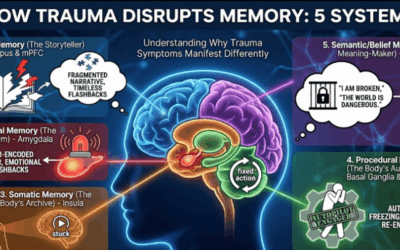
Deeper still, we lose language. Here, we encounter emotions that don’t have words—feelings of “falling,” “burning,” or “suffocating.” These are often somatic memories from pre-verbal infancy. This is where Brainspotting and Somatic Experiencing do their best work.
- The Universal Connection Layer (The Self):
If we can sit with the pain of the previous layers without flinching, we break through to the bottom. Here, patients report a sudden shift. The pain dissolves into a sense of peace, vastness, or love. They feel connected to humanity, nature, or God. In Jungian terms, this is the encounter with the Self. This experience provides the energy and safety needed to heal the wounds above it.
Exoteric vs. Esoteric: Is it Religion or Therapy?
This brings us to the final question: Is this religion, or is it therapy? The answer requires us to distinguish between two types of religion.
- Exoteric Religion is external. It is about dogmas, rules, buildings, and social structures. It provides a container.
- Esoteric Religion (Mysticism) is internal. It is about the direct experience of transformation. It provides the content.
Jungian Psychology acts as a bridge between the two. Carl Jung dedicated his life to studying how the symbols of religion (Christ, Buddha, the Mandela) are actually projections of psychological processes. He didn’t want to explain *away* religion; he wanted to show that the religious impulse is a biological necessity.
In a secular world that has lost its rituals, therapy has become the new cathedral. It is one of the few places left where we are allowed to stop producing, stop pretending, and simply descend into the labyrinth of the self to find out who we really are. Whether you call that destination “Healing,” “The Self,” or “The Divine,” the path is the same.
Explore the Depths of the Psyche
Taproot Therapy Collective Podcast
Mysticism & Neuroscience
Energy Centers in Mystical Traditions
Clinical Applications
Navigating the Labyrinth of Self (DID)
Guided Meditations for Therapists
Bibliography
- Jung, C.G. (1964). Man and His Symbols. Anchor Press.
- Edinger, E. F. (1995). The Mysterium Lectures. Shambhala.
- Underhill, E. (1911). Mysticism: A Study in the Nature and Development of Man’s Spiritual Consciousness. Methuen & Co.
- Van der Kolk, B. (2014). The Body Keeps the Score. Viking.
- Huxley, A. (1945). The Perennial Philosophy. Harper & Brothers.
- Carhart-Harris, R. L., et al. (2014). The entropic brain: a theory of conscious states informed by neuroimaging research with psychedelic drugs. Frontiers in Human Neuroscience.






0 Comments