

Autism and OCD: How Two Conditions Overlap, and How They Differ
Autism and obsessive-compulsive disorder are two distinct conditions, and they co-occur far more often than chance would predict. Because some of what they look like from the outside can resemble each other, the overlap is easy to miss or to mistake for one thing when it is really two. This guide reflects current research on how often they appear together, how to tell anxiety-driven OCD apart from autistic patterns that are actually soothing, and what genuinely helps.
How to read this. This article is educational and is not a diagnosis or a substitute for an assessment with a qualified clinician. Co-occurring autism and OCD is two conditions interacting, not a single official label, and only an evaluation by a professional experienced in both can sort out what is happening for a particular person.
If you are in crisis or thinking about harming yourself, call or text the 988 Suicide and Crisis Lifeline, or call the Crisis Center of Birmingham at 205-323-7777.
How often they occur together
Estimates vary widely depending on who is studied and which criteria are used, but the association is consistent and substantial. A 2024 meta-analysis found OCD in roughly 12 percent of autistic young people, and autism in roughly 10 percent of young people with OCD. Among autistic adults, lifetime estimates of OCD run higher, around 20 percent in some samples, with current-OCD figures closer to 9 percent, and across the literature the range stretches from about 6 to 36 percent. The relationship runs in both directions. A large longitudinal study found that an autism diagnosis roughly doubled the likelihood of also being diagnosed with OCD, and that people with OCD were significantly more likely to later receive an autism diagnosis. The takeaway is not a single number but a clear pattern of elevated, two-way co-occurrence. You can read more about how we think about autism in our work on autism therapy and recognizing autism in adulthood.
Telling them apart: ask what the behavior is for
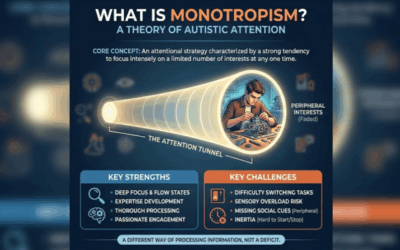
This is the part that matters most, because it changes what should and should not be treated. Repetitive behavior is common to both conditions, but the reason behind it tends to differ. OCD compulsions are driven by anxiety. They are performed to neutralize a distressing intrusive thought, they usually feel unwanted, and the relief they bring is temporary. Many autistic repetitive behaviors and deep interests are the opposite. They are often soothing, regulating, and genuinely enjoyable, pursued because they feel good rather than to ward off dread. Our piece on monotropism describes how absorbing focus can be a feature of autistic experience rather than a symptom to be removed.
The comparison below is a starting question, not a diagnostic test. The same outward behavior can sit in either column, which is exactly why the function, the why behind it, is what counts.
Pointing toward OCD
Driven by anxiety, experienced as unwanted
- The behavior is done to relieve a distressing thought or fear
- It feels compulsory rather than chosen, and often unwelcome
- Relief is brief, and the cycle returns and tends to escalate
- Interrupting it raises anxiety sharply
Pointing toward autistic self-regulation
Driven by interest or comfort, experienced as soothing
- The behavior or interest is calming, organizing, or enjoyable
- It is sought out because it feels good, not to avoid dread
- It supports focus and steadiness rather than eroding them
- Interrupting it is frustrating, but not driven by fear
When the two genuinely co-occur, they can also feed each other. A strong autistic preference for sameness can give OCD's demand for certainty more to grab onto, and sensory sensitivity can become the raw material for contamination or symmetry fears. Each condition can also hide the other, a problem clinicians call diagnostic overshadowing, where everything gets attributed to the more familiar label and the second condition goes untreated. For more on the less visible forms of OCD, see understanding Pure OCD and the unseen struggle of purely obsessional OCD.
Shared wiring, distinct conditions
Brain research finds real overlap. Both autism and OCD involve the cortico-striato-thalamo-cortical loops that link the cortex with deeper structures, and there is some shared involvement of serotonin and dopamine signaling. That overlap is partial, not identical, and the prevailing view treats autism and OCD as distinct but related conditions rather than the same thing wearing two names, though the idea of an obsessive-compulsive spectrum remains debated. Some researchers have described a subgroup whose OCD, in the context of autism, tends to be more severe and more treatment-resistant, which is a useful caution against expecting a quick or uniform response.
Diagnosis, gender, and masking
For years, diagnostic rules discouraged giving someone both labels, so autistic people's OCD often went unnamed. That hierarchy was removed in the DSM-5 in 2013 and the change carries through the DSM-5-TR, which makes more accurate, dual recognition possible. Recognition is still uneven across gender. Autistic girls and women are more likely to internalize distress and to camouflage their traits, which can delay an autism diagnosis and obscure co-occurring OCD well into adulthood. We write about the cost of that masking in unmasking neurodiversity and about non-pathologizing care in neurodivergent-affirming therapy.
What actually helps
For the OCD itself, the evidence points clearly to one approach. Exposure and response prevention, a form of cognitive behavioral therapy in which a person gradually faces what triggers the obsession while resisting the compulsion, is the established first-line treatment for OCD. It works for autistic people too, with a landmark randomized trial supporting adapted CBT for OCD in autistic adults, provided the delivery is adjusted to fit how a person communicates, processes, and experiences sensation. Helpful adaptations include clear and literal language, respecting routines and special interests rather than treating them as targets, building exposures collaboratively, accommodating sensory needs, and allowing more processing time, sometimes shortening or delaying a ritual rather than stopping it all at once. The hard truth in the research is that autistic people often do not receive this evidence-based treatment as early or as often as they should. You can read about our broader approach to OCD treatment.
A crucial principle follows from the function distinction above. Good treatment goes after the distressing, anxiety-driven compulsions, and it protects the interests and self-regulating behaviors that are actually helping a person feel steady. The goal is never to sand down autistic ways of being. It is to loosen OCD's grip while leaving the regulating parts intact.
Alongside that evidence-based core, the body-based and depth-oriented work we do can support the parts of the picture that exposure therapy is not designed to reach. These approaches are not cures for OCD and are not established treatments for the autism and OCD combination specifically, but they can genuinely help with the nervous-system load, the sensory overwhelm, and the trauma that often sit underneath and make everything harder to manage.
Somatic and nervous-system work
Somatic Experiencing can support regulation and lower baseline anxiety, adapted for sensory needs.
Brainspotting
Brainspotting can help process the emotional distress and trauma that often accompany chronic anxiety.
Parts-based work
Parts-based and IFS-informed therapy can ease the internal conflict and self-criticism that OCD tends to amplify.
qEEG and neurofeedback
Brain mapping and neurofeedback can help individualize a plan, best understood as a complement rather than a stand-alone fix.
Sensory needs deserve direct attention in their own right, which we explore in our work on sensory processing. And a full plan often includes a prescriber, since medication can play a role in OCD. Because we do not prescribe, those decisions stay between a person and their physician.
Real strengths, alongside real distress
None of this erases what is genuinely valuable about an autistic mind. Strong pattern recognition, the capacity for deep and sustained focus, a serious commitment to fairness and principle, and acute awareness of one's inner states are real strengths, and we have written about the last of these in why autistic minds are built for justice. Holding both things at once is the honest posture. The strengths are real, the OCD-related distress is also real and treatable, and a person deserves support that respects the first while easing the second.
Looking for support that understands both?
We work with autistic adults and with co-occurring anxiety and OCD in Hoover and across the Birmingham area, offering somatic, trauma-focused, and brain-based therapy, and coordinating with the exposure-based and medical care that a full OCD plan can include. Joel Blackstock, LICSW-S and our team are glad to talk through what would fit.
Reach out to our team See the conditions we treatOn the research. Prevalence figures are drawn from a 2024 systematic review and meta-analysis in Brain Sciences and from adult estimates summarized in the autism and OCD literature. Guidance on adapting exposure and response prevention for autistic people is available from the International OCD Foundation and in a 2025 framework published in Frontiers in Psychiatry, which references the randomized trial of adapted CBT for OCD in autistic adults.













0 Comments