

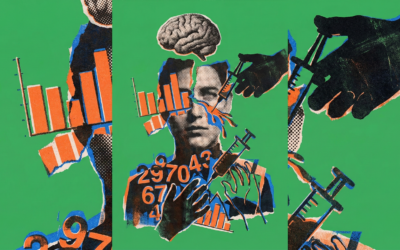
Psychology, as a field, stands at a critical juncture. Over the past few decades, the focus has shifted away from the fundamental nature of human consciousness and towards a more mechanistic, symptom-focused approach to mental health. Manualized therapies, diagnostic checklists, and a preoccupation with “evidence-based” practices have come to dominate the landscape, threatening to reduce the rich tapestry of human experience to a set of computerized algorithms.
As a graduate student, I remember feeling a deep unease with this direction. The idea that therapy should look the same for every person, regardless of their unique history, personality, and inner world, seemed antithetical to the very essence of psychology. If patients were merely seen as malfunctioning machines to be fixed with a standardized set of techniques, then what would stop therapy from eventually being replaced by artificial intelligence altogether?
At the time, this notion seemed like a far-off dystopia. But with the rapid advancement of language models like Chat GPT and the increasing reports of dissatisfied therapy clients turning to AI chatbots for support, that future now feels alarmingly close at hand. While these LLMs can provide helpful psychoeducation and simulate evidence-based techniques, they fundamentally lack the ability to engage with the depth and complexity of human consciousness.
The Pioneers of Consciousness-Centered Psychology
To reclaim the soul of psychology, we must look back to the early pioneers who understood that the study of the mind was, first and foremost, the study of consciousness itself. Figures like Carl Jung, William James, and Edmund Husserl recognized that human experience could not be reduced to a set of behaviors or symptoms, but rather emerged from the complex interplay of perception, emotion, cognition, and unconscious processes.
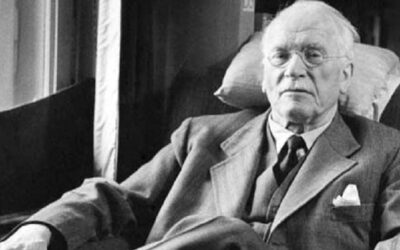
Jung, in particular, used phenomenology as a tool to map the structures of consciousness, exploring how objectivity and subjectivity often clash within the psyche to create inner conflict and turmoil. He recognized that trauma could often disguise itself as intuition, leading individuals to trust gut feelings that were actually rooted in unresolved wounds. By helping patients develop a kind of metacognitive awareness – the ability to observe their thoughts and emotions without being overwhelmed by them – Jung believed that therapy could restore a sense of balance and dynamic flow between different aspects of the mind.
The Essence of Transformative Therapy
This, I believe, is the essence of truly transformative therapy – not the rote application of techniques, but the co-exploration of the patient’s inner world in all its complexity and contradictions. It is about attuning to the subtle relational dynamics that unfold between therapist and client, using the therapeutic relationship itself as a catalyst for insight and change. And it is about helping patients to integrate disparate parts of themselves, to find meaning in their struggles, and to expand their consciousness in ways that enhance their overall engagement with life.
This deeply human process is something that even the most sophisticated AI cannot replicate. It requires the kind of intuitive, embodied attunement that can only emerge between two conscious beings. When therapy is reduced to a set of manualized procedures or computerized self-help exercises, something essential is lost – the opportunity for a genuine encounter between two subjectivities, co-creating a space for transformation and growth.
The Risks of a Consciousness-Blind Psychology
The stakes could not be higher. If psychology continues down the path of reducing human beings to a collection of symptoms or behaviors, seeing therapists as mere technicians administering evidence-based “fixes,” we risk losing touch with the very thing that makes our field meaningful and transformative. We risk alienating patients who are seeking not just symptom relief, but a deeper understanding of themselves and their place in the world. And we risk ceding ground to the machines, allowing artificial intelligence to replace the uniquely human art of psychotherapy.
Moreover, a psychology that is blind to consciousness risks perpetuating oppression and marginalization. When we fail to grapple with the subjective realities of those whose experiences differ from the dominant norms, we can unwittingly impose frames of reference that pathologize difference and reinforce the status quo. A truly liberatory psychology must be grounded in a deep respect for the diversity of human consciousness, recognizing that what is considered “healthy” or “adaptive” is always context-dependent and culturally-bound.
Re-Visioning Psychology and Psychotherapy
What is needed, then, is nothing short of a renaissance in psychology – a radical re-centering of the field around the study of consciousness in all its multifaceted complexity. This will require a shift in both research and training, with a greater emphasis on phenomenology, intersubjectivity, and the first-person exploration of mental states. It will require a willingness to grapple with the messy, non-linear realities of the human psyche, rather than trying to reduce it to a set of tidy variables or mechanisms.
At the level of clinical practice, it will mean training therapists to be expert explorers of consciousness, equipped with the skills to navigate the unique inner worlds of each patient. This will involve a greater emphasis on the therapeutic relationship, on the cultivation of presence and attunement, and on the use of techniques that foster mindfulness, metacognition, and self-awareness. It will also require a greater openness to non-Western and transpersonal approaches that recognize the spiritual and existential dimensions of human suffering and flourishing.
The future of psychology hangs in the balance. Will we continue down the path of reductionism and mechanization, treating patients like defective machines to be fixed with standardized techniques? Or will we embrace a vision of psychology that places consciousness at the center, recognizing the irreducible complexity and subjectivity of human experience?
As the field grapples with these existential questions, let us remember the words of pioneering psychologist Rollo May: “We must be fully committed to the idea that the essence of the human being is consciousness. This is not just an intellectual commitment but one that involves the whole person, feeling and sense of identity as well as thought.” May’s words serve as a clarion call for a psychology that is willing to plumb the depths of the human soul, even as it remains grounded in scientific rigor and empirical inquiry.
In the end, the fate of psychology and psychotherapy will depend on our willingness to reclaim the study of consciousness as our primary mission. Only by honoring the irreducible mystery and complexity of the human mind can we hope to offer a vision of healing and transformation that touches the deepest parts of our being. In a world increasingly dominated by algorithms and artificial intelligence, this task has never been more urgent – or more essential to the future of our species.
Bibliography:
Baron, R. J. (2016). Routledge international handbook of critical psychology. London: Taylor and Francis.
Casale, A., Estrada, E.M., Luke, B., Reich, T. (2015). Counseling Psychology Model Training Values Statement Addressing Diversity. Training and Education in Psychology, 11(1).
Giorgi, A. (2009). The descriptive phenomenological method in psychology: A modified Husserlian approach. Duquesne University Press.
Grof, S. (1985). Beyond the brain: Birth, death, and transcendence in psychotherapy. SUNY Press.
Heidegger, M. (1962). Being and time. Harper & Row.
Hoffer, A. (1994). The Primacy of Consciousness: A New Synthesis. Journal of Humanistic Psychology, 34(2), 6–33.
Jung, C. G., & Hull, R. F. C. (1968). The Archetypes and the collective unconscious. Princeton, NJ: Princeton University Press.
Laing, R.D. (1990). The politics of experience and the bird of paradise. Penguin.
Mahmoudi, H., Khazaei, H.R., Ghiasi, S.S. (2018). Use of phenomenology in counseling. Journal of Family Medicine 10(2), 57-63.
May, R. (1981). Freedom and destiny. New York: Norton.
Rieff, P. (1979). Freud: The mind of the moralist. University of Chicago Press.
Romanyshyn, R. D. (2012). The wounded researcher: Research with soul in mind. New Orleans: Spring Journal Books.
Todd, T. A., & Bohart, A. C. (1999). Foundations of clinical and counseling psychology. Addison-Wesley Longman Publishing Co., Inc.
Varela, F. J., Thompson, E., & Rosch, E. (2016). The embodied mind: Cognitive science and human experience. MIT press.


















0 Comments