

Relational-Cultural Therapy (RCT) is a model of psychotherapy, developed by Jean Baker Miller, Judith Jordan, Irene Stiver, Janet Surrey and Alexandra Kaplan at Wellesley College’s Stone Center, which holds that people grow through and toward connection across the whole lifespan. It treats chronic disconnection and isolation, often produced by cultural power and exclusion, as a main source of psychological suffering, and it heals through mutually empathic relationships.
Key takeaways
- Relational-Cultural Therapy holds that people grow through and toward connection across the lifespan, and that chronic disconnection and isolation drive much psychological suffering.
- RCT grew from a Stone Center theory group at Wellesley College led by Jean Baker Miller, whose Toward a New Psychology of Women appeared in 1976.
- The central relational paradox describes how people hide parts of themselves to keep relationships, which then makes real connection impossible.
- Research on empathy and the therapy relationship, plus RCT outcome studies such as a 91-woman trial of brief RCT, supports the model’s focus on connection.
- RCT therapists practise mutual empathy, repair ruptures openly and pay attention to how culture and power shape a client’s relationships.
What is Relational-Cultural Therapy?
RCT begins from one claim: we are shaped by our relationships, and psychological growth happens inside them rather than in spite of them. Most twentieth-century models of development measured health by separation, autonomy and a firmly bounded self. Miller and her colleagues argued that this picture described an ideal, largely drawn from the lives of privileged men, and then labelled anyone who organised life around relationships as dependent or immature.1
In RCT the goal is not independence but growth-fostering connection: relationships in which both people are moved, both are seen, and both leave with more energy than they came with. The reverse also holds. When a person’s attempts at connection are repeatedly met with indifference, shaming or violence, they learn to hide parts of themselves to stay in relationship at all. RCT names that pattern as the source of much of the suffering that brings people to therapy.2
The model sits within the wider relational movement in psychotherapy, alongside interpersonal psychiatry and contemporary relational psychoanalysis. What sets it apart is the word “cultural”: RCT insists that relationships are never private arrangements between two people, because race, gender, class, sexuality and disability decide whose needs are heard and whose are dismissed.4
What are the core tenets of RCT?
RCT rests on a small set of assumptions about human development. The first is that the wish for connection is a central human need, not a sign of weakness or a failure to individuate. Jordan’s summary of the theory sets out the rest.4
- Relationality. Authentic connection with others is necessary for well-being throughout life, not only in infancy.
- Mutuality. Growth-fostering relationships are reciprocal. Mutuality does not mean sameness of role; it means both people are open to being affected and changed by the other.
- Mutual empathy. Each person experiences the other’s feelings and can see that their own feelings have had an impact. Seeing that you matter to someone is, in this model, a large part of what heals.
- Disconnection. Isolation and marginalization are primary sources of distress. Healing means moving back into connection.
- Cultural context. Relationships are shaped by cultural norms and power. RCT therapists actively consider the impact of oppression and privilege on both the client and the therapy relationship.
- Empowerment. The therapy relationship becomes a new relational experience that builds mutual empowerment and resilience, which the client then carries into other relationships.
The five good things
Miller described what a growth-fostering relationship produces in each person as “five good things”: a sense of zest or energy, greater clarity about oneself and the relationship, a stronger sense of worth, the capacity to act and be productive, and a desire for more connection.2 These give clinician and client a practical test. After a conversation with a partner, parent or therapist, does a person feel more alive and clear, or depleted and confused?
The central relational paradox
Miller and Stiver’s most clinically useful idea is the central relational paradox. When early attempts at connection are met with harm, a person keeps parts of their experience out of relationship in order to hold on to the relationship. The very strategy meant to preserve connection then makes real connection impossible, because the other person is relating to an edited self.2 Taken far enough, this produces what Miller called condemned isolation: a sense of being locked out of human connection and personally to blame for it. RCT writers link this state to shame, which Jordan describes as the felt loss of one’s own empathic responsiveness and a conviction of being unworthy of connection.4
Who developed Relational-Cultural Therapy?
RCT came out of a collaborative group of women clinicians in the Boston area. Beginning in 1977 they met regularly to talk about why the dominant theories did not match what they saw in their women patients. When Wellesley College opened the Stone Center for Developmental Services and Studies in 1981, Miller became its first director, and the group became known as the Stone Center theory group. Its papers circulated as the Stone Center “Works in Progress” series and were gathered in Women’s Growth in Connection (1991).3 The founding scholars wanted a psychology that accurately reflected the relational lives of women and, as the work widened in the 1990s, of other marginalized groups.
- Jean Baker Miller, M.D. (1927-2006). A psychiatrist and psychoanalyst whose book Toward a New Psychology of Women (Beacon Press, 1976) laid the groundwork. Miller argued that qualities assigned to women and devalued by the culture, such as attention to others’ feelings and the wish to foster others’ growth, were strengths a whole society needed. She saw dominant and subordinate groups as locked in a structure that kept both from full development.1
- Irene Pierce Stiver, Ph.D. (1924-2000). A psychologist who directed the psychology department at McLean Hospital. She wrote on dependency, work inhibitions in women and therapeutic impasse, and co-wrote The Healing Connection (1997) with Miller, the fullest statement of mutual empathy and disconnection in clinical practice.2
- Judith V. Jordan, Ph.D. A clinical psychologist who did more than anyone to define mutuality, mutual empathy and relational resilience. Her book Relational-Cultural Therapy (American Psychological Association, 2010; 2nd ed., 2018) is the standard clinical introduction.4
- Janet L. Surrey, Ph.D. A clinical psychologist who developed the idea of the “self-in-relation”, the view that a woman’s sense of self is organised through relationship rather than through separation from it. She continues to write and teach, including on the meeting of relational psychology and Buddhist mindfulness.3
- Alexandra G. Kaplan, Ph.D. A psychologist who worked with the group in its early years. Her papers examined empathy as a two-way process and applied the self-in-relation model to depression in women, arguing that what gets called depression often follows from relational loss and the silencing of one’s own voice.3
The group’s work drew on earlier dissenters within psychoanalysis. Karen Horney had challenged Freud’s account of female psychology in the 1920s and 1930s, and Harry Stack Sullivan had placed interpersonal life at the centre of psychiatry. Later RCT writers such as Maureen Walker, Linda Hartling and Amy Banks extended the model to race, humiliation and the neuroscience of connection.4
In 1995 the Jean Baker Miller Training Institute was founded at the Wellesley Centers for Women as the home of the theory group’s training work. In 2018 it became an independent nonprofit, the International Center for Growth in Connection (ICGC), which now carries the model forward through trainings, intensive institutes, publications and an international community of practitioners.
Is Relational-Cultural Therapy evidence-based?
RCT is a humanistic and relational therapy, and its strongest support comes from a large body of research on the therapy relationship itself. An American Psychological Association task force reviewed meta-analyses of relationship elements and concluded that the psychotherapy relationship makes substantial and consistent contributions to outcome independent of the type of treatment.5 One of those meta-analyses, covering 82 samples and 6,138 clients, found that therapist empathy is a moderately strong predictor of outcome across theoretical orientations and presenting problems.6 RCT is, in effect, a model built to make that empathic relationship the main vehicle of change.
Studies of RCT itself are smaller in number but encouraging. In a study at a community-based women’s mental health centre, 91 women who received brief relational-cultural therapy improved significantly on all eight outcome measures, and their gains held at three- and six-month follow-up.7 A nine-session RCT intervention with incarcerated adolescent girls increased relational empowerment and engagement with others.8 A systematic review by Lenz found that RCT is a useful framework for understanding clients’ experiences and that its central constructs have strong psychometric validation, with measures such as the Relational Health Indices; the outcome literature is still growing.9
Clinicians have applied the model to a range of concerns:
- Depression and anxiety, which RCT understands partly as the cost of chronic disconnection and silencing.
- Trauma and C-PTSD, particularly complex trauma from child abuse, partner violence and sexual assault, where the injury itself was relational.10
- Eating disorders, where secrecy and isolation often keep symptoms in place and relational counseling can work alongside medical and nutritional care.11
- Marginalization and identity, including the effects of racism, heterosexism and other forms of exclusion on a person’s sense of belonging.12
What are the goals of RCT treatment?
The overarching goal is relational resilience, Jordan’s term for the capacity to build and keep growth-fostering connections and to move back into connection after conflict or disconnection. Resilience here is not toughness or self-sufficiency. It is the ability to reach out, to ask for help and to repair.4
- Symptom relief. Reducing distress by addressing the disconnections that sit underneath symptoms.
- Relational awareness. Helping clients identify their relational images, the inner expectations built from past relationships (“if I show need, I will be abandoned”), and notice how these images shape present relationships.
- Authentic connection. Building the capacity for authenticity, vulnerability and empathy, so that a person can bring more of their real experience into relationship.
- Empowerment. Recognising and resisting internalized oppression, including what RCT writers, borrowing from Patricia Hill Collins, call controlling images: cultural stereotypes that tell people who they are allowed to be.
In practice these goals are worked on through what RCT calls strategies of disconnection: the ways a person goes quiet, placates, withdraws or attacks when they feel unsafe. The therapist helps the client notice these moves as they happen, including in the therapy room, and treats each rupture as a chance to practise reconnection.4
What does an RCT therapist actually do?
RCT is less a set of techniques than a way of being present. Its central practice is mutual empathy: the therapist lets the client’s experience register and, with judgment about timing, lets the client see that it has registered. Jordan describes this as authentic responsiveness. The therapist is not a blank screen, and a careful, client-centred disclosure of being moved can show a client that they have impact on another person, perhaps for the first time.4
Ruptures are expected. When a therapist misunderstands or a client pulls away, the RCT therapist names the disconnection and works to repair it rather than interpreting it from a distance. For someone whose early caregivers never repaired anything, a repaired rupture with a therapist can be a new relational experience that slowly revises old relational images. The therapist also attends to power openly: who holds it in the room, how cultural differences between therapist and client are shaping the work, and how the client’s distress may reflect real injustice rather than personal failing.12
The same stance runs through other relational models on the site, such as Functional Analytic Psychotherapy, which also treats the live therapy relationship as the place where change happens, and Interpersonal Reconstructive Therapy, which traces present patterns back to the relationships that taught them.
What other therapy approaches does RCT draw from?
RCT is integrative. It shares ground with, and has influenced, many other therapies, and it belongs to the broad relational turn in psychotherapy since the 1980s.
- Feminist therapy. RCT shares feminist therapy’s focus on sociocultural power and its commitment to empowerment, and Miller’s 1976 book was one of the founding texts of that movement.1
- Psychodynamic therapy. Miller and Stiver were psychoanalytically trained, and RCT keeps the psychodynamic idea that past relationships shape the present and that the therapy relationship is itself a vehicle for change. Its emphasis on empathy has much in common with Heinz Kohut’s self psychology, though RCT stresses that empathy flows both ways.
- Humanistic therapy. RCT aligns with Carl Rogers on empathy, genuineness and authenticity, and its picture of mutuality echoes Martin Buber’s I-Thou relation, in which two people meet as whole persons rather than as roles.
- Trauma-informed therapy. RCT’s focus on safety, connection and empowerment matches the principles of trauma-informed care. Its view runs parallel to Judith Herman, whose Trauma and Recovery (1992) argued that recovery from trauma happens within relationships and cannot happen in isolation.10
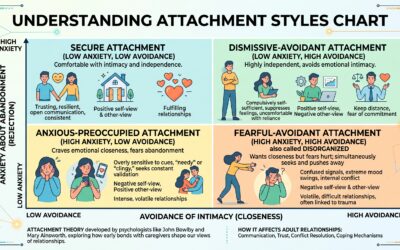
RCT also differs from attachment theory in an instructive way. Attachment research tends to locate a person’s relational style in childhood and describe it as relatively stable. RCT agrees that early relationships leave lasting images, but it puts more weight on the present relational and cultural world, and on the possibility that new relationships at any age can change those images.
How does RCT connect with body-based and brain-based trauma work?
Later RCT writers, especially Amy Banks, connected the model to neuroscience, arguing that the nervous system is built to be regulated in relationship. That view lines up with Stephen Porges’s work on safety and social engagement, and with research on mirror neurons and empathy. When a client feels met by another person, the body often settles before the mind has words for why.
At Taproot we see this every day. Many of the people we work with carry relational injuries that live in the body as much as in memory: a chest that tightens when they need something, a voice that disappears in conflict. We draw on RCT’s attention to mutuality and power while using somatic therapy and Brainspotting, whose principle of dual attunement holds the relational and the neurobiological together. Parts work offers a further parallel, since the hidden parts that RCT’s central relational paradox describes are close to what IFS therapy calls exiles, kept out of relationship to protect the whole person.
Why connection is the medicine
Relational-Cultural Therapy rests on a simple observation: our deepest wounds often come from disconnection, so our most lasting healing comes through connection. By building mutual empathy, authenticity and empowerment, and by taking culture and power seriously, RCT helps people move toward resilience and fuller relationships. That conviction runs through our work at Taproot, and you can contact Taproot Therapy Collective to talk with one of our therapists.
Frequently asked questions
Who founded Relational-Cultural Therapy?
Relational-Cultural Therapy was founded by psychiatrist Jean Baker Miller with psychologists Judith Jordan, Irene Stiver, Janet Surrey and Alexandra Kaplan. The group began meeting in 1977 and became the Stone Center theory group at Wellesley College after the Stone Center opened in 1981 with Miller as its first director.
What is the central relational paradox in RCT?
In Relational-Cultural Therapy the central relational paradox, described by Miller and Stiver, is the bind in which a person keeps parts of their experience out of relationship to avoid rejection or harm. The strategy is meant to protect connection, but it leaves others relating to an edited self, so real connection becomes harder.
What are the five good things in Relational-Cultural Theory?
Jean Baker Miller said a growth-fostering relationship leaves each person with five good things: zest or energy, clarity about oneself and the relationship, a greater sense of worth, the capacity to act productively, and a desire for more connection. RCT therapists use them as a practical test of whether a relationship is helping someone grow.
How is RCT different from attachment theory?
Attachment theory tends to locate relational style in early childhood and describe it as fairly stable. Relational-Cultural Therapy agrees that early relationships leave lasting relational images, but it gives more weight to present relationships and to culture and power, and it holds that new growth-fostering relationships at any age can change those images.
What problems is Relational-Cultural Therapy used for?
Clinicians use Relational-Cultural Therapy for depression, anxiety, relational trauma and C-PTSD, eating disorders, and the effects of racism, heterosexism and other exclusion. A study of 91 women receiving brief RCT found significant improvement on all eight outcome measures, with gains maintained at three and six months.
Related reading
- Unveiling Systemic Constellations: A Comprehensive Guide to Family Healing Through Generational Insights
- Panic-Focused Psychodynamic Psychotherapy (PFPP): An In-Depth Look at this Innovative Treatment for Panic Disorder
- Psychobiological Approach to Couple Therapy (PACT): A Comprehensive Guide to Relationship Healing
- Sensorimotor Art Therapy: Integrating Body, Mind, and Creativity for Holistic Trauma Healing
- Understanding NARM Therapy: A Comprehensive Guide to Healing Developmental Trauma
- Radically Open Dialectical Behavior Therapy (RO-DBT): An Innovative Treatment for Disorders of Overcontrol
References
- Miller, J. B. (1976). Toward a new psychology of women. Beacon Press.
- Miller, J. B., & Stiver, I. P. (1997). The healing connection: How women form relationships in therapy and in life. Beacon Press.
- Jordan, J. V., Kaplan, A. G., Miller, J. B., Stiver, I. P., & Surrey, J. L. (1991). Women’s growth in connection: Writings from the Stone Center. Guilford Press.
- Jordan, J. V. (2018). Relational-cultural therapy (2nd ed.). American Psychological Association. https://doi.org/10.1037/0000063-000
- Norcross, J. C., & Lambert, M. J. (2018). Psychotherapy relationships that work III. Psychotherapy, 55(4), 303-315. https://doi.org/10.1037/pst0000193
- Elliott, R., Bohart, A. C., Watson, J. C., & Murphy, D. (2018). Therapist empathy and client outcome: An updated meta-analysis. Psychotherapy, 55(4), 399-410. https://doi.org/10.1037/pst0000175
- Oakley, M. A., Addison, S. C., Piran, N., Johnston, G. J., Damianakis, M., Curry, J., Dunbar, C., & Weigeldt, A. (2013). Outcome study of brief relational-cultural therapy in a women’s mental health center. Psychotherapy Research, 23(2), 137-151. https://doi.org/10.1080/10503307.2012.745956
- Lenz, A. S., Speciale, M., & Aguilar, J. V. (2012). Relational-cultural therapy intervention with incarcerated adolescents: A single-case effectiveness design. Counseling Outcome Research and Evaluation, 3(1), 17-29. https://doi.org/10.1177/2150137811435233
- Lenz, A. S. (2016). Relational-cultural theory: Fostering the growth of a paradigm through empirical research. Journal of Counseling & Development, 94(4), 415-428. https://doi.org/10.1002/jcad.12100
- Kress, V. E., Haiyasoso, M., Zoldan, C. A., Headley, J. A., & Trepal, H. (2018). The use of relational-cultural theory in counseling clients who have traumatic stress disorders. Journal of Counseling & Development, 96(1), 106-114. https://doi.org/10.1002/jcad.12182
- Trepal, H. C., Boie, I., & Kress, V. E. (2012). A relational cultural approach to working with clients with eating disorders. Journal of Counseling & Development, 90(3), 346-356. https://doi.org/10.1002/j.1556-6676.2012.00043.x
- Comstock, D. L., Hammer, T. R., Strentzsch, J., Cannon, K., Parsons, J., & Salazar, G., II. (2008). Relational-cultural theory: A framework for bridging relational, multicultural, and social justice competencies. Journal of Counseling & Development, 86(3), 279-287. https://doi.org/10.1002/j.1556-6678.2008.tb00510.x
















0 Comments