

The NeuroAffective Relational Model (NARM) is a therapy for developmental trauma created by psychologist Laurence Heller. It holds that early failures of connection, attunement, trust, autonomy and love leave adults with a dysregulated nervous system and a distorted sense of who they are, often marked by shame. NARM works on both at once, through body awareness and present-moment inquiry, without reliving the past.
Key takeaways
- NARM, the NeuroAffective Relational Model, is Laurence Heller’s therapy for developmental trauma, introduced to a wide audience in Healing Developmental Trauma (2012) with Aline LaPierre.
- NARM organizes early injury around five core needs: connection, attunement, trust, autonomy and love-sexuality, each with its own adaptive survival style.
- Heller built NARM by adding psychodynamic and relational work on identity to the nervous system tools of Somatic Experiencing, because developmental trauma distorts identity as well as physiology.
- NARM works in the present moment, avoids catharsis and reliving, and treats symptoms as adaptations rather than pathology.
- The 2022 Practical Guide by Heller and Brad Kammer sets out four pillars: clarifying the contract, exploratory questions, reinforcing agency and reflecting psychobiological shifts.
What is NARM therapy?
NARM is a relational, body-informed psychotherapy for the effects of chronic early stress: neglect, misattunement, emotional unavailability, abuse and the quieter forms of relational injury that rarely count as “trauma” in ordinary speech. Heller and the psychologist Aline LaPierre introduced the model to a wide readership in Healing Developmental Trauma: How Early Trauma Affects Self-Regulation, Self-Image, and the Capacity for Relationship, published by North Atlantic Books in September 2012.1
The book’s central claim is that most emotional problems trace back to five biologically based organizing needs: connection, attunement, trust, autonomy and love-sexuality. When one of these needs is consistently unmet in childhood, the child adapts. Those adaptations protect the child, but they persist into adulthood as patterns of identity and physiology that limit what Heller calls aliveness, the felt sense of being connected to oneself and others.1
NARM combines two directions of work. Top-down work addresses identity: beliefs such as “I am too much” or “my needs are a burden.” Bottom-up work addresses the nervous system: the bracing, collapse, numbness and agitation that the body keeps producing long after the original circumstances are gone. Heller’s argument is that each feeds the other, so neither alone is enough.3
Is NARM therapy evidence-based?
NARM rests on three bodies of research that are each large and well replicated. Attachment research shows that early caregiving shapes how children regulate emotion and relate to others. The Adverse Childhood Experiences study of more than 9,000 adults found a graded relationship between the number of childhood adversities a person reported and later risk of heart disease, lung disease, depression, suicide attempts and substance use.9 And developmental neurobiology, especially the work of Allan Schore on right-brain affect regulation, describes how a caregiver’s attunement literally organizes an infant’s stress physiology.6
NARM translates those findings into a clinical method. Studies of NARM itself have begun to appear in peer-reviewed journals, and the most developed of them so far concern the therapists who practise it and how the work affects their own resilience. Most of what clinicians know about how NARM works with clients comes from the published teaching transcripts in Heller’s books and from the experience of practitioners.2
Who developed NARM therapy?
NARM was developed by Laurence Heller, PhD, a psychologist who spent more than three decades in private practice before becoming known chiefly as a trainer and author. He founded the Gestalt Institute of Denver and later served as senior faculty for the Somatic Experiencing Training Institute.3
Laurence Heller’s training and influences
Heller’s early grounding was in Gestalt therapy, the here-and-now, experiential method associated with Fritz Perls. Gestalt taught him to attend to what a client is experiencing in the room rather than to the story about it. He has also described training in several psychodynamic approaches, in attachment theory, and, early on, in bioenergetics and other somatic psychologies.3
Bioenergetics, Alexander Lowen’s development of Wilhelm Reich’s ideas, mapped recurring “character structures” that showed up in posture, breathing and muscular holding. Readers who know Reich’s character styles will recognize the lineage in NARM’s survival styles, which also link a developmental stage to a pattern held in both body and identity. NARM’s version drops the diagnostic, sometimes judgmental tone of the older typologies.
The third strand is Somatic Experiencing, the body-based shock-trauma method developed by Peter Levine. Heller taught in Levine’s training program and co-wrote Crash Course, a self-help guide to recovering from car accident trauma, with the attachment-focused trauma therapist Diane Poole Heller.3
The birth of NARM
Heller has explained the step that led to NARM in plain terms. Somatic Experiencing, he said, “works incredibly well with shock trauma,” but when developmental trauma is involved, clients also carry a “distortion of identity” on top of deep dysregulation of the autonomic nervous system.3 A car crash happens to a person who already has a self. Chronic early neglect shapes the self that later meets everything else.
NARM was his answer: keep the nervous-system tools of Somatic Experiencing, and add psychodynamic and relational work on identity. He named the loop between the two the distress cycle, a continuous feedback in which shame-based beliefs keep the body braced and a braced body keeps confirming the beliefs.3
What are the core principles of NARM?
Several working principles run through Heller’s books and teaching.12
- Early experience shapes the adult nervous system. Relationships in the first years of life set the baseline for how a person regulates arousal and how safe closeness feels.
- Self-regulation is a capacity that can grow. NARM treats regulation as something built in relationship, first with caregivers and later with a therapist, rather than a skill to be drilled.
- Top-down and bottom-up together. Insight into identity and attention to bodily state are worked on in the same session, often in the same minute.
- The present moment is the field of work. History matters, but the work happens in how old patterns show up now.
- Attunement and connection heal. The therapist’s moment-to-moment attunement to the client is a main instrument of change.
- Symptoms are adaptations. NARM is explicitly non-pathologizing: what looks like a disorder is read as a survival strategy that once made sense.
- Five adaptive survival styles. Each corresponds to one of the five core needs and describes how a person organized around its absence.
What are the five NARM survival styles?
The survival styles are the most recognizable part of NARM. Each one names a core need, the adaptation a child makes when that need is not met, and the adult identity that results. Heller and LaPierre stress that everyone has some of each, that the styles describe strategies rather than types of people, and that each contains a strength alongside its cost.1
Connection
The earliest style forms when there is trauma before or around birth or in the first months of life.3 The child’s solution is to withdraw from contact and from the body. Adults with this style often live in their heads, feel they do not quite belong, and find closeness both longed for and frightening. Heller gives examples such as very early surgery or a mother who was severely depressed or physically ill and so could not be present.
Attunement
When an infant’s needs for nourishment and responsiveness are met inconsistently, the child learns to turn attention outward. Adults with this style are often finely tuned to what others need and have trouble knowing, or asking for, what they need themselves. Heller notes the paradox that these people are highly attuned to others while unattuned to themselves.3
Trust
The trust style develops where a child cannot safely let down and lean on the adults. Often the child is rewarded for a special role that serves a parent: the parent’s confidant, a pawn between fighting or divorcing parents, or the repository of a parent’s ambitions, as with the classic stage mother or sports father. The child gains a certain gratification and loses the freedom to be authentic. The adult pattern can look like competence and strength on the surface, with an expectation of betrayal underneath.3
Autonomy
When a child’s independence and “no” are met with pressure or withdrawal of love, the child learns to comply outwardly and resist inwardly. Adults with this style tend to placate, avoid open conflict and feel quietly resentful of expectations, a pattern Heller describes directly.3
Love-sexuality
The latest style develops when a child’s warmth and emerging sexuality meet rejection or are tied to performance. The adult often splits the heart from sexuality and leans on perfectionism, achievement and appearance to earn love.1
How does NARM understand trauma, the unconscious and identity?
Trauma in NARM
NARM distinguishes shock trauma, such as an accident, an assault or a disaster, from developmental trauma, which is cumulative and relational. Developmental trauma is a disruption in the ordinary process of growing up: the child’s needs for connection, attunement, trust, autonomy and love were not adequately met, over and over. Bessel van der Kolk made a similar argument when he proposed “developmental trauma disorder” in 2005 as a diagnosis for children whose difficulties arise from chronic interpersonal trauma rather than a single event.8 Heller is careful about scope: he has said that “very few of us escape childhood without some developmental trauma” if misattunement is counted alongside neglect and abuse.3
The unconscious in NARM
NARM accepts that much of what drives a person is outside awareness, as psychodynamic therapy does. It looks for unconscious material less in dreams or slips than in the body and the relationship: a breath held when a certain topic comes up, a smile that appears whenever anger does, a pull to take care of the therapist. These are observable in the session and can be explored there.2
Identity and self in NARM
NARM separates a core self, the person’s capacity for connection and aliveness, from the adaptive identities built around survival. Heller speaks of shame-based and pride-based identifications: the shame-based belief (“I am unlovable”) and the pride-based compensation that defends against it (“I don’t need anyone”).3 The aim is not to replace one story with a better one but to loosen identification with both, so the person can experience themselves directly. The link between shame and the body is explored further in our post on the neurobiology of shame.
What techniques does a NARM therapist use?
NARM is not a sequence of exercises. Its methods are ways of paying attention, organized in the 2022 Practical Guide into a therapeutic model of four pillars plus several supporting tools.2
1. The four pillars
Heller and Brad Kammer lay out four pillars: clarifying the therapeutic contract, asking exploratory questions, reinforcing agency, and reflecting psychobiological shifts.2 The contract is an ongoing clarification of what the client wants from the work. Exploratory questions invite curiosity about how the client is organizing experience right now. Reinforcing agency helps the client notice their own part in how a pattern continues, which is also where their power to change it lies. Reflecting shifts means naming, out loud, the moments when breath, posture or feeling changes, so the client can register them.
2. Somatic mindfulness
Clients are guided to notice sensations, emotions and thoughts as they arise. Heller calls this somatic mindfulness and uses it to help a client “always keep one foot in the here and now.”3 It overlaps with general mindfulness practice, but its focus is the body during relational material.
3. Somatic tracking
While a client talks about something charged, the therapist follows changes in the body and invites the client to follow them too. Tracking ties the story to the physiology, which is where the top-down and bottom-up strands meet.
4. Titration
Titration, borrowed from Somatic Experiencing, means approaching difficult material in small doses so the nervous system is not flooded.4 A little activation is experienced, allowed to settle, and only then is more approached.
5. Pendulation
Pendulation, also from Levine’s work, is the natural movement between activation and settling. The therapist helps a client move between a hard feeling and a place of relative ease, such as a part of the body that feels steady, so the system learns it can come back.413
6. Inquiry
NARM inquiry asks questions such as “What happens inside as you say that?” or “What do you notice when you imagine saying no?” The questions are designed to increase self-awareness rather than to steer toward an answer the therapist already has.2
7. Resource building
Resources are anything internal or external that supports regulation: a memory of a kind grandparent, a sense of the ground under one’s feet, a friend, a skill. Strengthening them gives a client somewhere to return to during harder work.
8. Working with survival styles
The therapist helps the client recognize how the connection, attunement, trust, autonomy and love-sexuality styles show up in daily life, and what each one protected. In the 2022 book this becomes the NARM Personality Spectrum Model, which places each style on a continuum from more to less constricting.2
9. Relational work
The relationship in the room is used as a live example of the client’s relational patterns. If a client with an attunement style starts managing the therapist’s feelings, that becomes something to explore together, gently. The Practical Guide sets this out as the NARM Relational Model, alongside an Emotional Completion Model for working with feelings that were never allowed to finish.2
10. Nervous system regulation and integration
Throughout, the therapist helps the client move out of hyperarousal or shutdown into a range where reflection is possible, the zone often called the window of tolerance. NARM explicitly avoids abreaction. Heller contrasts it with the cathartic Gestalt of the 1970s, when therapists had clients beat pillows, and jokes with trainees that “there’s no pillow abuse in NARM.”3 The goal is to contain and deepen feeling, weaving cognitive understanding and bodily awareness into one experience.
What are the goals and stages of NARM treatment?
The overall goal of NARM is to help people heal developmental trauma and reconnect with a core self and its aliveness. In practice that breaks down into several aims:
- Increasing self-awareness and somatic mindfulness
- Developing a greater capacity for self-regulation
- Resolving shame and chronic self-judgment
- Improving the capacity for secure, mutual relationships
- Reconnecting with authentic needs, desires and a sense of agency
NARM does not prescribe fixed stages, because the work follows the client. A typical arc still looks like this:
- Stabilization and resource building: establishing safety in the relationship and enough regulation to explore.
- Exploring survival styles: recognizing the client’s dominant strategies and the beliefs and body patterns that go with them.
- Working through core issues: meeting the unmet needs, grief and anger underneath, in titrated doses.
- Integration and growth: letting new experiences of connection and agency become part of the client’s sense of self.
- Consolidation and ending: reinforcing gains and preparing for the end of therapy, which is itself relational work.
Where is NARM practised, and who is it for?
NARM is mostly practised in outpatient settings: private practice, group practices, community clinics and trauma programs. It is used in individual and group therapy and has been taught to people in many helping professions. It suits adults with complex trauma, attachment injuries, chronic anxiety or depression, persistent shame, or relationship difficulties that keep repeating, the cluster often described as complex PTSD.
Because the model addresses identity and regulation rather than a single diagnosis, clinicians bring NARM thinking to a range of problems where developmental trauma is often underneath:
- Addiction and substance use, where the substance often regulates what relationships could not; Heller is a senior fellow of Meadows Behavioral Healthcare, a residential trauma and addiction treatment provider
- Eating disorders, which frequently involve control and body-based shame
- Recovery from domestic and relational violence
- Work with veterans and first responders whose combat or service trauma lands on earlier wounds
- Chronic pain and stress-related physical symptoms, consistent with the ACE findings on adult health9
Many practitioners also fold NARM into another primary approach. Heller has noted that therapists trained in EMDR have found ways to integrate NARM into their EMDR work.3
What makes NARM different from other trauma therapies?
- Somatic and psychological work are integrated. Many therapies add a body technique to talk therapy. NARM treats identity and physiology as one system, linked by the distress cycle.
- Developmental trauma is the main focus. Most trauma protocols were built around single incidents. NARM was built for the cumulative injuries of childhood.
- The present, not the past, is the field of work. NARM does not ask clients to relive events. It asks how old adaptations are shaping experience now.
- It is non-pathologizing. Symptoms are read as intelligent adaptations, which tends to reduce shame from the first session.
- A detailed map of survival styles. The five styles give therapist and client a shared, non-blaming language for complex relational patterns.
- Structure with flexibility. The four pillars give a clear framework while leaving the content to the client.
How does NARM compare with other psychotherapy models?
- Somatic Experiencing: NARM keeps Somatic Experiencing‘s bottom-up tools, such as titration and pendulation, but adds sustained work on identity and relationship for developmental trauma.34
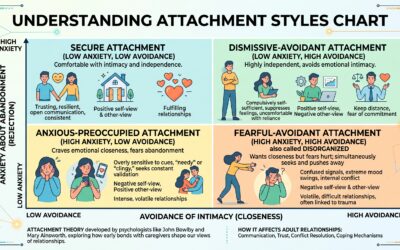
- Attachment-based therapies: NARM shares John Bowlby’s attachment theory as a foundation and adds somatic interventions and a present-moment focus.
- Internal Family Systems: Both IFS and NARM work with protective adaptations without blaming them. IFS personifies them as parts; NARM frames them as survival styles rooted in developmental needs and nervous system states.
- Sensorimotor Psychotherapy: Pat Ogden‘s model also joins cognitive and somatic work.7 NARM is more specifically organized around developmental needs and survival styles.
- Psychodynamic therapies: NARM shares the interest in early life and unconscious process, and places more weight on the body and on present-moment experience. Accelerated Experiential Dynamic Psychotherapy (AEDP) is a close cousin in its focus on felt emotion and relational safety.
- Mindfulness-based approaches: NARM uses present-moment awareness, but always inside a relationship and a developmental map.
- Polyvagal theory: NARM draws on Stephen Porges‘s account of how the autonomic nervous system responds to safety and threat to explain why connection itself regulates.5
What cultural forces shaped NARM?
- Growing recognition of trauma’s reach. The ACE study in 1998 showed how common childhood adversity is and how far its effects extend into adult health, which created demand for models built for chronic early trauma.9
- The rise of affective neuroscience. Work by Schore, Porges and others in the 1990s and 2000s gave clinicians a biological language for attachment and regulation.56
- Interest in mind-body integration. Books such as Bessel van der Kolk‘s The Body Keeps the Score (2014) brought somatic ideas about trauma to a general audience.12
- The limits of purely cognitive therapy. Clinicians working with complex trauma kept finding that insight alone did not change what the body did, which opened room for integrative models.
- Economic pressure in mental health care. The push for focused work made NARM’s present-oriented, non-cathartic style attractive, even though developmental trauma rarely resolves quickly.
- The trauma-informed care movement. As schools, hospitals and social services adopted trauma-informed practice, NARM’s emphasis on relational health found a wider audience; the Practical Guide opens with a chapter on that movement.2
A timeline of NARM’s development
- Early career: Heller trains in Gestalt therapy, founds the Gestalt Institute of Denver, and studies bioenergetics, other somatic psychologies, psychodynamic approaches and attachment theory.3
- Later career: He joins the senior faculty of the Somatic Experiencing Training Institute and co-writes Crash Course with Diane Poole Heller.3
- 2012: Heller and Aline LaPierre publish Healing Developmental Trauma, introducing NARM and its five survival styles to a wide audience.1
- 2013: Heller is teaching NARM across the United States and Europe.3
- 2022: Heller and Brad Kammer publish The Practical Guide for Healing Developmental Trauma, setting out the four pillars, the Personality Spectrum Model and annotated session transcripts.2
- 2025 to 2026: Peer-reviewed studies of NARM therapists appear in social work and integrative medicine journals.1011
Training is now offered through the NARM Training Institute, much of it online, which has carried the model well beyond its American base.
What research exists on NARM?
The research on NARM so far falls into four groups.
- Clinical transcripts and case material. The Practical Guide includes full annotated sessions, which let readers see exactly what NARM therapists say and why.2
- Practitioner observation. Experienced NARM clinicians report changes in shame, self-regulation and relationships, consistent with what the model predicts.
- Theoretical foundations. The model’s premises draw directly on attachment research, developmental neurobiology and the trauma literature.689
- Published studies. Jennifer Vasquez and April Bowie-Viverette surveyed 53 NARM therapists and found that most scored low on burnout and secondary traumatic stress and high on compassion satisfaction, suggesting the model may protect the therapists who use it.10 A follow-up examined NARM therapists’ professional quality of life after training.11
Individualized relational therapies are hard to fit into the trial designs used for brief manualized protocols, a problem shared by most depth-oriented and trauma-focused approaches. That difficulty says more about the research tools than about the work, and it is one reason clinicians weigh transcripts, practitioner experience and theory alongside formal studies.
How do therapists use NARM ideas in practice?
Therapists trained in other approaches can borrow a great deal from NARM:
- Somatic awareness: noticing the body during conversation makes almost any therapy more alive and more precise.
- A developmental lens: the five core needs give a quick, compassionate way to conceptualize a case.
- Present-moment focus: asking how a pattern is happening now, rather than only why it started, keeps sessions grounded.
- A non-pathologizing stance: naming symptoms as adaptations lowers shame and strengthens the alliance.
- Top-down and bottom-up together: moving between meaning and sensation helps with a wide range of problems.
- The survival style map: it offers a shared language for patterns that otherwise feel like personal failures.
At Taproot we work with many adults whose difficulties began in early relationships rather than a single event. The ideas NARM organizes so clearly, that shame and nervous system dysregulation reinforce each other, that symptoms are adaptations, that the present moment is where change happens, run through our somatic therapy, our Brainspotting and our parts work. In Brainspotting, for example, we follow the body’s activation while keeping a client within a tolerable range, and in parts work we treat protective patterns with the same respect NARM gives survival styles.
Developmental trauma is often the hardest kind to name, because it feels less like something that happened and more like who you are. NARM’s lasting contribution is to separate the two. If that distinction speaks to you, you can contact Taproot Therapy Collective to talk with one of our therapists about somatic and relational trauma work.
Frequently asked questions
What does NARM stand for in therapy?
NARM stands for the NeuroAffective Relational Model, a psychotherapy for developmental and relational trauma created by psychologist Laurence Heller. It combines bottom-up work with the nervous system and top-down work on identity, especially shame, and focuses on how early survival patterns shape a person’s experience in the present rather than on reliving past events.
What are the 5 survival styles in NARM?
NARM names five adaptive survival styles after the core needs that were compromised in childhood: connection, attunement, trust, autonomy and love-sexuality. They develop roughly in that order, from pre- and perinatal life onward. Each describes a strategy a child used to cope when a need went unmet, and each carries both a strength and a cost in adult life.
Who created NARM and when?
Laurence Heller, PhD, a psychologist who founded the Gestalt Institute of Denver and taught as senior faculty in Somatic Experiencing, created NARM. He and Aline LaPierre presented it in Healing Developmental Trauma in 2012, and he and Brad Kammer followed with The Practical Guide for Healing Developmental Trauma in 2022.
How is NARM different from Somatic Experiencing?
Somatic Experiencing, developed by Peter Levine, is mainly a bottom-up method that helps the body complete interrupted fight and flight responses after shock trauma. NARM keeps those tools, such as titration and pendulation, and adds sustained work on identity and relationship, because developmental trauma leaves shame-based beliefs as well as nervous system dysregulation.
Does NARM involve reliving childhood trauma?
No. Laurence Heller describes NARM as a non-cathartic therapy that discourages abreaction, meaning reliving old scenes as if they were happening again. The client keeps one foot in the here and now while the therapist helps them notice how old survival patterns show up in body, feeling and belief in the present moment.
Related reading
- Psychobiological Approach to Couple Therapy (PACT): A Comprehensive Guide to Relationship Healing
- Unveiling Systemic Constellations: A Comprehensive Guide to Family Healing Through Generational Insights
- Panic-Focused Psychodynamic Psychotherapy (PFPP): An In-Depth Look at this Innovative Treatment for Panic Disorder
- Sensorimotor Art Therapy: Integrating Body, Mind, and Creativity for Holistic Trauma Healing
- Holographic Memory Resolution (HMR): A Comprehensive Guide to This Innovative Therapeutic Approach
- Method of Levels (MOL) Therapy: A Comprehensive Guide to Understanding and Applying this Innovative Approach
References
- Heller, L., & LaPierre, A. (2012). Healing developmental trauma: How early trauma affects self-regulation, self-image, and the capacity for relationship. North Atlantic Books.
- Heller, L., & Kammer, B. J. (2022). The practical guide for healing developmental trauma: Using the NeuroAffective Relational Model to address adverse childhood experiences and resolve complex trauma. North Atlantic Books.
- Van Nuys, D. (Host). (2013, December 19). Healing developmental trauma with Dr. Laurence Heller (No. 382). Shrink Rap Radio, podcast episode and transcript.
- Levine, P. A. (1997). Waking the tiger: Healing trauma. North Atlantic Books.
- Porges, S. W. (2011). The polyvagal theory: Neurophysiological foundations of emotions, attachment, communication, and self-regulation. W. W. Norton.
- Schore, A. N. (2003). Affect regulation and the repair of the self. W. W. Norton.
- Ogden, P., Minton, K., & Pain, C. (2006). Trauma and the body: A sensorimotor approach to psychotherapy. W. W. Norton.
- van der Kolk, B. A. (2005). Developmental trauma disorder: Toward a rational diagnosis for children with complex trauma histories. Psychiatric Annals, 35(5), 401-408. https://doi.org/10.3928/00485713-20050501-06
- Felitti, V. J., Anda, R. F., Nordenberg, D., Williamson, D. F., Spitz, A. M., Edwards, V., Koss, M. P., & Marks, J. S. (1998). Relationship of childhood abuse and household dysfunction to many of the leading causes of death in adults: The Adverse Childhood Experiences (ACE) Study. American Journal of Preventive Medicine, 14(4), 245-258. https://doi.org/10.1016/S0749-3797(98)00017-8
- Vasquez, J., & Bowie-Viverette, A. C. (2025). Compassion fatigue and compassion satisfaction among NeuroAffective Relational Model therapists: How NARM serves as a protective factor for trauma therapists. Social Work and Social Sciences Review, 24(3). https://doi.org/10.1921/swssr22326
- Vasquez, J., & Bowie-Viverette, A. C. (2026). A frequency analysis of the professional quality of life of NeuroAffective Relational Model (NARM) therapists after NARM training. OBM Integrative and Complementary Medicine, 11(1), 1-12. https://doi.org/10.21926/obm.icm.2601001
- van der Kolk, B. (2014). The body keeps the score: Brain, mind, and body in the healing of trauma. Viking.
- Levine, P. A. (2010). In an unspoken voice: How the body releases trauma and restores goodness. North Atlantic Books.

















0 Comments