
The pineal gland is a small, pine-cone-shaped endocrine gland near the center of the brain. It weighs less than 0.2 grams, and its main job is making melatonin, the hormone that tells the body it is night.1 Descartes called it the seat of the soul, New Age writers call it the third eye, and it does contain tiny calcite crystals. The melatonin story is solid science; most of the DMT and crystal lore is not.
Key takeaways
- The pineal gland is a tiny endocrine gland, under 0.2 grams, whose main job is releasing melatonin at night to signal darkness to the body.
- The human pineal gland does contain calcite microcrystals under 20 micrometers long, distinct from the hydroxyapatite brain sand that builds up with age.
- The rat brain makes DMT at levels comparable to serotonin even without a pineal gland, and the amounts measured are far too small to cause visions.
- Melatonin supplements modestly shorten time to fall asleep and reduce jet lag after flights across five or more time zones.
- Theories of pineal crystals as telepathic transceivers or interdimensional gateways come from Theosophy and New Age writing, not from research.
Crystals shaped like the Buddha’s face?
When I was taking an undergraduate psychology class at Sewanee, I had to listen to a student, an enthusiast of psilocybin mushrooms, go on a rant to the professor about how there were “magic crystals” in the brain. According to him the crystals were “shaped like the Buddha’s face” and had been used by “real scientists” to discover things about aliens and mythology. One of these discoveries was that Atlantis, the mythological city that sank, was actually Thebes, a real city in Egypt whose ruins still stand at Luxor. This was accomplished somehow through energy and through aliens who spoke to people by way of the brain crystals. The point of the rant was that the class should vote for Ron Paul, the libertarian congressman then running for president. The professor and most of the class were unimpressed.
At the time I thought the idea of crystals in the brain was nuts. I still don’t think there are Buddha-faced crystals anywhere. I am still kind of lost about Plato’s Atlantis, aliens and Ron Paul, too, and Ron Paul is probably the least likely point you will win me over on. So I was shocked a few years ago to find legitimate academic journals reporting that there were in fact crystals, micro-crystals, in the human pineal gland.2 I was more shocked to find respectable people connecting the gland with hallucinogens like DMT, with “energetic” spiritual experiences and with transcendent awakenings. Is there anything scientific in any of this? Could the candidate who wanted the gold standard be validated by the gold standard of scientific research? Maybe, to the first question. No, to the second.
What is the pineal gland?

The pineal gland sits deep in the brain, between the two hemispheres, attached to the back of the roof of the third ventricle just behind the thalamus. Unlike most brain structures it is single rather than paired, and it lies partly outside the blood-brain barrier, which suits a gland whose product has to reach the bloodstream. Its name comes from the Latin for pine cone, an echo of the Greek konarion used by Galen in the second century.
The gland has carried spiritual weight for a very long time. The pharmacologist David Nichols traces its romantic history back to pharaonic Egypt, where it was equated with the Eye of Horus of Egyptian mythology, and through religious traditions that treated it as the seat of the soul and the third eye.1 René Descartes gave the idea its most famous form. In The Passions of the Soul (1649) and in his letters, he argued that the pineal gland is the part of the body with which the soul is most immediately joined, partly because it is the one unpaired structure in a brain otherwise built in doubles, so it could unite the two images from the two eyes into one experience. Historians once dismissed this as borrowed from older writers, but Lokhorst and Kaitaro showed that the theory was largely Descartes’ own.3
The modern New Age version comes mostly through Theosophy. In The Secret Doctrine (1888), Helena Blavatsky identified the pineal gland with an atrophied “third eye” of spiritual vision that humanity once used and could reawaken.4 That fusion of anatomy and esoteric eye became the template for later writing about the third eye and the ajna chakra, and for most of the crystal and DMT claims that circulate today.
Two features of the gland feed the spiritual association today. It produces melatonin, which governs sleep and dreaming, the nightly altered state everyone knows. And since the 1990s, the psychiatrist Rick Strassman has proposed that it might release dimethyltryptamine (DMT), a powerful psychedelic, during birth, dreaming and dying.5 The first idea is established physiology. The second is a hypothesis whose central claim, that the human pineal makes enough DMT to change consciousness, the evidence does not support.1
Spiritual experience itself does not need a single gland to explain it. Belief, culture, upbringing, emotion, attention and the activity of whole brain networks all shape what a person experiences in prayer, meditation or crisis. Research on the evolutionary origins of religion and on regions such as the precuneus points to distributed systems rather than one switch. The pineal gland regulates processes, sleep above all, that color those experiences. It is one piece of the puzzle, not the door to the soul.
What do the hormones in the pineal gland do?
Melatonin
Melatonin was isolated from pineal tissue by the Yale dermatologist Aaron Lerner and colleagues in 1958. The adult gland produces about 30 micrograms of it a day.1 Its secretion rises after dark and falls with morning light, so its main physiological message is simple: it is night, and this is how long the night is.6
Because melatonin organizes the sleep-wake cycle, it touches mood, thinking and general wellbeing. Disrupted sleep and circadian rhythms run through depression, bipolar disorder, anxiety and trauma. A well-regulated rhythm supports emotional stability, and in that sense steady sleep is part of spiritual and psychological health, even if melatonin itself does not cause spiritual experiences.
Circadian rhythm regulation
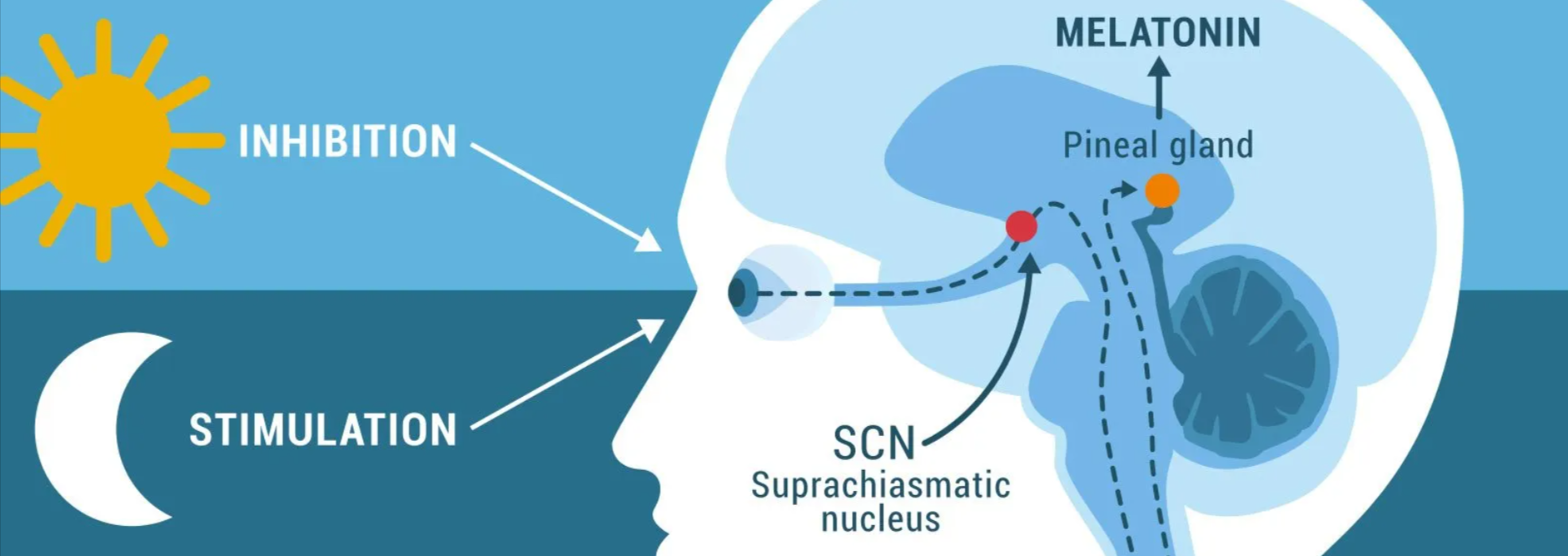
The body’s master clock is the suprachiasmatic nucleus of the hypothalamus. Light-sensitive cells in the retina tell that clock when it is day. The clock then signals the pineal through a long route that runs down the spinal cord and back up to the gland through the superior cervical ganglion. At night the pineal releases melatonin; light suppresses it or shifts its timing.6 Melatonin in turn helps stabilize and couple the body’s rhythms, especially core temperature and the sleep-wake cycle.6 The evening rise is one of the cues that makes a person drowsy and ready for sleep.
Sleep quality enhancement
Melatonin is widely used as a supplement for insomnia and jet lag, and the research gives it real but modest effects. A meta-analysis of 19 placebo-controlled trials with 1,683 participants found that melatonin shortened the time to fall asleep by about 7 minutes, lengthened total sleep by about 8 minutes and improved overall sleep quality, with effects that did not fade over continued use.7 For jet lag, a Cochrane review found that nine of ten trials showed melatonin taken close to the target bedtime at the destination reduced jet lag after flights crossing five or more time zones; doses between 0.5 and 5 mg worked similarly, though 5 mg helped people fall asleep faster.8 We cover other gentle sleep aids in our post on natural remedies for insomnia.
Antioxidant properties
Melatonin and several of its breakdown products neutralize free radicals directly and also stimulate the body’s own antioxidant enzymes, which is why Russel Reiter and colleagues described it as an antioxidant that “under promises but over delivers.”9 This role extends to immune regulation and to protecting neurons from oxidative damage. It also gives weight to the health side of pineal aging: the gland calcifies faster than any other tissue in the body, and heavy calcification is linked with reduced melatonin output and with several neurological conditions.10
Does the pineal gland make DMT?
DMT and spiritual experience
N,N-dimethyltryptamine is a short-acting psychedelic found in many plants and in trace amounts in the human body. Smoked or injected, it produces intense visions, a sense of leaving the body and, very often, encounters with seemingly intelligent beings. Between 1990 and 1995 Strassman ran the first new US government-approved human psychedelic research in a generation at the University of New Mexico, giving DMT to some 60 volunteers, many of whom described the sessions as mystical or as contact with other presences.5 Amazonian peoples have long used ayahuasca, a brew that pairs a DMT-containing plant with a vine that keeps the body from breaking the DMT down, in healing and initiation ceremonies, a practice we explore in psychedelic therapy and shamanism.
The link to near-death experience has some experimental support. In a placebo-controlled study at Imperial College London, 13 healthy volunteers given intravenous DMT scored significantly higher on a standard near-death experience scale than on placebo, and their reports overlapped with nearly every feature described by people who had actually come close to death.11 The geometric visions of these states have their own logic, which we look at in the geometric mind.
What the evidence on endogenous DMT shows
Here the popular story and the research part ways. DMT has been detected in human blood, urine and cerebrospinal fluid for decades, and the enzyme that makes it, indolethylamine-N-methyltransferase (INMT), is found in many tissues.12 In 2013 Steven Barker, Jimo Borjigin and Strassman detected DMT in fluid sampled from the pineal glands of living rats.13 In 2019 Borjigin’s group found INMT transcripts in the cortex, pineal gland and choroid plexus of rats and humans, and measured DMT in the rat cortex at levels comparable to serotonin. Those levels were the same in rats whose pineal glands had been removed, and DMT in the visual cortex rose after experimental cardiac arrest whether or not the pineal was intact.14
So the brain can make DMT, but the pineal gland is not its special source. Nichols points out that the gland is tiny and that the amounts of DMT measured in the brain are far too small to produce psychedelic effects; he offers other explanations for how stress and near death can alter consciousness without any DMT surge.1 Whether DMT plays a part in human near-death experience remains an open question that researchers are still testing.
If endogenous DMT does not exist to cause hallucinations, what is it doing? Researchers have proposed several normal physiological roles.
Neurotransmitter regulation
DMT acts on serotonin 5-HT2A receptors, on trace amine receptors and on the sigma-1 receptor, and the 2019 rat data show it released in cortex at concentrations similar to known neurotransmitters.1214 That has led some researchers to suggest that DMT works as a neurotransmitter or neuromodulator, influencing mood, perception and memory at levels far below those that would cause visions.
Neuroprotective properties
In 2009 a team led by Arnold Ruoho showed that DMT binds the sigma-1 receptor, a protein that helps cells cope with stress, and identified DMT as a natural regulator of it.15 In 2016 Attila Szabo and Ede Frecska found that DMT greatly increased the survival of human cortical neurons and immune cells grown in severe oxygen deprivation, an effect that ran through the sigma-1 receptor. They proposed that the body may produce DMT under stress to limit damage from hypoxia and ischemia.16
Natural regulatory role
A broader proposal is that endogenous DMT helps maintain balance in the central nervous system, as one of several trace compounds that tune how neurons respond to stress, inflammation and changing states. Barker’s review of more than half a century of research concludes that DMT’s role and function in the body are still unsettled and sets out the studies needed to settle them.12
Are there really consciousness crystals in the pineal gland?
Yes, there really are microcrystals in the pineal gland, though what they do is debated. Biomineralization is the process by which living organisms produce minerals, as in bone, teeth and shells. The pineal is famous for one kind: “brain sand,” the mulberry-shaped deposits of hydroxyapatite, the same calcium phosphate mineral found in bone, which build up with age and show on X-rays and CT scans.10
In 2002 a Ben-Gurion University team led by S. Baconnier and the chemical engineer Sidney Lang, a specialist in piezoelectric materials, reported a second, entirely separate kind. Using a special method to free crystals from the gland’s tissue, they examined them with scanning electron microscopy and found cubic, hexagonal and cylindrical crystals under 20 micrometers long, with sharp edges and rough surfaces. Energy dispersive spectroscopy showed only calcium, carbon and oxygen, and electron diffraction and Raman spectroscopy confirmed the mineral was calcite. Apart from the otoconia, the tiny crystals in the inner ear’s balance organs, this is the only known non-pathological calcite in the human body.2 The student at Sewanee had the crystals right. He just had their face wrong.
Some writers also claim the pineal holds magnetite, a magnetic iron oxide. Joseph Kirschvink’s group did find magnetite crystals in human brain tissue in 1992, but throughout the brain and its membranes rather than as a special pineal feature.17
The suggested functions of the pineal calcite remain largely hypotheses, and the evidence for each is limited and mostly indirect.
Piezoelectricity
Piezoelectric materials, such as quartz, produce an electric charge when squeezed. Ordinary calcite has a symmetrical crystal structure that does not do this. Baconnier’s team suggested that the complex texture of the pineal crystals might break that symmetry and make them piezoelectric, as is thought to happen with otoconia, and they linked the crystals to an earlier finding that pineal tissue doubles the frequency of laser light passed through it, an optical effect that requires a non-symmetrical structure.2 No study has yet shown the crystals generating electrical signals in a living gland.
Light sensitivity
In fish, amphibians and many reptiles the pineal complex really does sense light, and lizards and the tuatara have a “parietal eye” on top of the head with a lens and retina, a story we tell in PTSD and intuition. David Klein’s theory of pineal evolution traces the pinealocyte and the retinal photoreceptor to a common light-sensing ancestor cell, and holds that over evolution the two chemistries split, leaving primates with a pineal that does not detect light and an eye that does not make melatonin.18 In humans, light reaches the pineal only indirectly, through the eyes and the circadian clock. Nothing links the calcite crystals to light sensing.
Biomineralization regulation
Baconnier’s team argued that two distinct minerals in one small gland point to two different mechanisms of formation and probably two different biological functions.2 On the hydroxyapatite side, Dun-Xian Tan and Russel Reiter propose that pineal calcification is an active process that resembles bone formation, involving stem cells and melatonin itself, rather than passive wear and tear.10 How the calcite forms, and whether it regulates anything, is still unknown.
Magnetoreception
Many animals, from birds and sea turtles to bacteria, sense Earth’s magnetic field, and the idea that the pineal crystals might give humans a magnetic sense rests on analogy with them. In 2019 a Caltech team led by Connie Wang and Kirschvink reported that rotating an Earth-strength magnetic field around seated volunteers produced a repeatable drop in alpha brain waves, and argued that magnetite-based ferromagnetism is the most likely mechanism.19 That study did not involve the pineal gland, and calcite is not magnetic, so any role for the pineal crystals in human magnetoreception is conjecture.
What are the wildest theories about the microcrystals in the pineal gland?

The 2002 Bioelectromagnetics paper ended by noting that studies of a possible non-thermal interaction between the crystals and external electromagnetic fields were under way.2 That modest line became the seed of a much larger speculation: that crystals in the brain respond to outside waves and frequencies. None of the following has been established, but these are the versions proponents describe.
Electromagnetic field interaction
If the crystals responded to external electromagnetic fields, the theory goes, they could change neuronal firing and synaptic transmission and so alter thinking and perception. The serious scientific cousin of this idea concerns the brain’s own field: the biologist Johnjoe McFadden argues in his conscious electromagnetic information field theory that the electromagnetic field generated by neurons is where conscious information is unified. That theory needs no pineal crystals at all.
Resonance effects
A second version holds that the crystals resonate with particular external frequencies, often the Schumann resonances of the Earth’s atmosphere at about 7.8 hertz, and amplify or synchronize the brain’s own oscillations, shifting states of consciousness. The brain does have rhythms in that range, and alpha waves run at 8 to 13 hertz, but no study has shown pineal crystals tuning them. The idea echoes Franz Mesmer’s eighteenth-century theory of animal magnetism, a universal fluid that supposedly resonated through all bodies.
Information encoding and decoding
The most ambitious version treats the crystals as transducers that turn incoming waves into neural information and neural signals back into outgoing waves, so the brain could receive from and broadcast to the world around it. This is where the science ends and the next set of theories begins.
What are the most unscientific theories about the pineal gland?

These ideas circulate widely online and in some spiritual communities. They are beliefs, not hypotheses anyone has tested, and they mostly build on Blavatsky’s third eye and on Strassman’s DMT speculation. In the closing chapters of his book, Strassman himself entertained the possibility that DMT lets the brain perceive other levels of reality.5
Interdimensional gateway hypothesis
In this view the pineal gland, with its piezoelectric crystals, is a doorway to other dimensions or parallel universes. Meditation, breathwork, fasting or psychedelics are said to activate the crystals and open perception of realities outside ordinary consciousness. The beings people meet on DMT are taken as residents of those dimensions.
Telepathic transceiver theory
Here the crystals act as transmitters and receivers for telepathy. Their piezoelectric properties supposedly amplify and broadcast neural signals, allowing mind-to-mind contact between people or, in the Sewanee version, conversations with beings from other planets.
Consciousness amplification hypothesis
This idea holds that activated crystals heighten awareness and can bring enlightenment or psychic abilities. It drives the online practice of “decalcifying” the pineal gland through diets, fluoride avoidance, sun-gazing and special frequencies, on the reasoning that calcification has closed the third eye. Real pineal calcification does reduce melatonin output,10 but nothing shows that reversing it produces spiritual powers.
Ancient knowledge storage concept
The last version treats the crystals as a memory bank holding ancient or esoteric knowledge, sometimes linked to the Theosophical idea of the Akashic records, sometimes to Atlantis or to visiting extraterrestrials. Activating them would give access to the wisdom of lost civilizations. This is the theory my classmate was preaching, and it shares more with myth than with neuroscience.
Where on the pineal spectrum of belief do you fall?
Pineal beliefs run along a spectrum. At one end is the endocrinologist who sees a melatonin factory with some odd calcium deposits. Next is the researcher who finds DMT and calcite interesting and wants more data. Then comes the meditator who uses the “third eye” as a working image for attention between the brows. At the far end is my classmate, with Buddha-faced crystals, aliens and a candidate to vote for.
The pull of the gland makes sense through Rudolf Otto’s word “numinous.” In The Idea of the Holy (1917), Otto described the experience of the holy as a mysterium tremendum et fascinans, a mystery that both overwhelms and draws a person in.20 Carl Jung took the term up and treated numinous experience as a psychological fact worth careful observation, whatever its metaphysical source. You can trace that thread in Jung’s exploration of God and religion and in how to understand Carl Jung. A hidden gland at the center of the head, holding real crystals and possibly a visionary molecule, is a perfect hook for the numinous. The mistake is turning a symbol into an anatomy lesson, the same mistake that runs through much of the confusion between Jung and the New Age.
What does the pineal gland mean for therapy?
In practice the pineal gland matters to therapy in two ways. The first is sleep. Trauma, anxiety and depression all disrupt circadian rhythm, and poor sleep in turn makes emotional regulation harder. A therapist asks about sleep timing, light exposure, nightmares and late-night arousal, because a nervous system stuck in vigilance at night does not settle by willpower. Work that calms that vigilance, such as Brainspotting, which works with where the eyes rest and what the body feels while a person holds a distressing memory, often shows up first as better sleep.
The second is meaning. Clients sometimes arrive after an ayahuasca ceremony, a kundalini awakening, a near-death experience or a vivid dream that felt like contact with something larger. Some arrive having stitched such experiences into elaborate systems of crystals, frequencies and hidden knowledge. A depth-oriented therapist does not need to settle the metaphysics. We take the experience seriously as psychological reality, ask what it means in the person’s life and help them integrate it into an ordinary week, the approach behind therapy, spirituality and mysticism. That respect for inner experience is something mainstream practice has often lost, as we argue in how psychotherapy lost its way.
The pineal gland is a real organ with a real job, and a powerful image for something people keep encountering in themselves. At Taproot we work with both sides, the body’s rhythms and the psyche’s need for meaning, and Jungian therapy is where the numinous gets a hearing without anyone having to believe in crystal faces.
Frequently asked questions
Does the pineal gland produce DMT in humans?
No study has shown the human pineal gland producing psychoactive amounts of DMT. DMT has been found in rat pineal fluid and in the rat cortex at levels similar to serotonin, but those cortical levels stayed the same after the pineal was removed. The enzyme that makes DMT is present in human cortex, pineal and choroid plexus, so the brain as a whole, not the pineal, is the likely source.
Is the pineal gland really the third eye?
Not literally. In fish, frogs and many reptiles the pineal complex senses light, and some lizards have a parietal eye with a lens and retina. In humans the pineal gland does not detect light directly. The idea that it is a spiritual third eye was popularized by Helena Blavatsky’s The Secret Doctrine in 1888 and later New Age writing.
What are the crystals in the pineal gland made of?
The pineal gland holds two kinds of mineral. Brain sand is hydroxyapatite, the calcium phosphate found in bone, and it increases with age. In 2002 researchers also identified tiny calcite crystals, made only of calcium, carbon and oxygen, under 20 micrometers long. Apart from the inner ear’s otoconia, this is the only known non-pathological calcite in the human body.
Can you decalcify your pineal gland?
Online practices that promise to decalcify the pineal gland through diet, fluoride avoidance or sun-gazing have no research behind them as a route to spiritual abilities. Pineal calcification is real and is linked to lower melatonin output with age, and researchers such as Tan and Reiter have proposed ways to slow it, but no study shows reversing it opens a third eye.
Why did Descartes think the pineal gland was the seat of the soul?
René Descartes argued in The Passions of the Soul (1649) and in his letters that the soul is most directly joined to the body at the pineal gland. He chose it because it is a single, unpaired structure in a brain otherwise built in pairs, so he thought it could unite the double input of the senses, such as the two eyes, into one experience.
Related reading
- THe Weird History of Psychotherapy Part 2: Jung’s and the Bottom of Consciousness
- The Cult Psychology of The Manson Family
- The Most Common Images in Dreams and What They Mean
- The Mythic Wisdom of Joseph Campbell: Insights for Anthropology and Psychotherapy
- What Does the Garden of Eden Symbolize?
- Why IFS Works: Philosophy, Biology, and Neuroexperience
References
- Nichols, D. E. (2018). N,N-dimethyltryptamine and the pineal gland: Separating fact from myth. Journal of Psychopharmacology, 32(1), 30-36. https://doi.org/10.1177/0269881117736919
- Baconnier, S., Lang, S. B., Polomska, M., Hilczer, B., Berkovic, G., & Meshulam, G. (2002). Calcite microcrystals in the pineal gland of the human brain: First physical and chemical studies. Bioelectromagnetics, 23(7), 488-495. https://doi.org/10.1002/bem.10053
- Lokhorst, G. J., & Kaitaro, T. T. (2001). The originality of Descartes’ theory about the pineal gland. Journal of the History of the Neurosciences, 10(1), 6-18. https://doi.org/10.1076/jhin.10.1.6.5629
- Blavatsky, H. P. (1888). The secret doctrine: The synthesis of science, religion, and philosophy (Vols. 1-2). Theosophical Publishing Company.
- Strassman, R. (2001). DMT: The spirit molecule: A doctor’s revolutionary research into the biology of near-death and mystical experiences. Park Street Press.
- Claustrat, B., & Leston, J. (2015). Melatonin: Physiological effects in humans. Neurochirurgie, 61(2-3), 77-84. https://doi.org/10.1016/j.neuchi.2015.03.002
- Ferracioli-Oda, E., Qawasmi, A., & Bloch, M. H. (2013). Meta-analysis: Melatonin for the treatment of primary sleep disorders. PLoS ONE, 8(5), e63773. https://doi.org/10.1371/journal.pone.0063773
- Herxheimer, A., & Petrie, K. J. (2002). Melatonin for the prevention and treatment of jet lag. Cochrane Database of Systematic Reviews, (2), CD001520. https://doi.org/10.1002/14651858.CD001520
- Reiter, R. J., Mayo, J. C., Tan, D. X., Sainz, R. M., Alatorre-Jimenez, M., & Qin, L. (2016). Melatonin as an antioxidant: Under promises but over delivers. Journal of Pineal Research, 61(3), 253-278. https://doi.org/10.1111/jpi.12360
- Tan, D. X., Xu, B., Zhou, X., & Reiter, R. J. (2018). Pineal calcification, melatonin production, aging, associated health consequences and rejuvenation of the pineal gland. Molecules, 23(2), 301. https://doi.org/10.3390/molecules23020301
- Timmermann, C., Roseman, L., Williams, L., Erritzoe, D., Martial, C., Cassol, H., Laureys, S., Nutt, D., & Carhart-Harris, R. (2018). DMT models the near-death experience. Frontiers in Psychology, 9, 1424. https://doi.org/10.3389/fpsyg.2018.01424
- Barker, S. A. (2018). N,N-Dimethyltryptamine (DMT), an endogenous hallucinogen: Past, present, and future research to determine its role and function. Frontiers in Neuroscience, 12, 536. https://doi.org/10.3389/fnins.2018.00536
- Barker, S. A., Borjigin, J., Lomnicka, I., & Strassman, R. (2013). LC/MS/MS analysis of the endogenous dimethyltryptamine hallucinogens, their precursors, and major metabolites in rat pineal gland microdialysate. Biomedical Chromatography, 27(12), 1690-1700. https://doi.org/10.1002/bmc.2981
- Dean, J. G., Liu, T., Huff, S., Sheler, B., Barker, S. A., Strassman, R. J., Wang, M. M., & Borjigin, J. (2019). Biosynthesis and extracellular concentrations of N,N-dimethyltryptamine (DMT) in mammalian brain. Scientific Reports, 9, 9333. https://doi.org/10.1038/s41598-019-45812-w
- Fontanilla, D., Johannessen, M., Hajipour, A. R., Cozzi, N. V., Jackson, M. B., & Ruoho, A. E. (2009). The hallucinogen N,N-dimethyltryptamine (DMT) is an endogenous sigma-1 receptor regulator. Science, 323(5916), 934-937. https://doi.org/10.1126/science.1166127
- Szabo, A., Kovacs, A., Riba, J., Djurovic, S., Rajnavolgyi, E., & Frecska, E. (2016). The endogenous hallucinogen and trace amine N,N-dimethyltryptamine (DMT) displays potent protective effects against hypoxia via sigma-1 receptor activation in human primary iPSC-derived cortical neurons and microglia-like immune cells. Frontiers in Neuroscience, 10, 423. https://doi.org/10.3389/fnins.2016.00423
- Kirschvink, J. L., Kobayashi-Kirschvink, A., & Woodford, B. J. (1992). Magnetite biomineralization in the human brain. Proceedings of the National Academy of Sciences, 89(16), 7683-7687. https://doi.org/10.1073/pnas.89.16.7683
- Klein, D. C. (2004). The 2004 Aschoff/Pittendrigh lecture: Theory of the origin of the pineal gland, a tale of conflict and resolution. Journal of Biological Rhythms, 19(4), 264-279. https://doi.org/10.1177/0748730404267340
- Wang, C. X., Hilburn, I. A., Wu, D. A., Mizuhara, Y., Cousté, C. P., Abrahams, J. N. H., Bernstein, S. E., Matani, A., Shimojo, S., & Kirschvink, J. L. (2019). Transduction of the geomagnetic field as evidenced from alpha-band activity in the human brain. eNeuro, 6(2), ENEURO.0483-18.2019. https://doi.org/10.1523/ENEURO.0483-18.2019
- Otto, R. (1923). The idea of the holy (J. W. Harvey, Trans.). Oxford University Press. (Original work published 1917)














0 Comments