

Beyond the “Talking Cure”: A Comprehensive Guide to Somatic and Bottom-Up Trauma Therapies
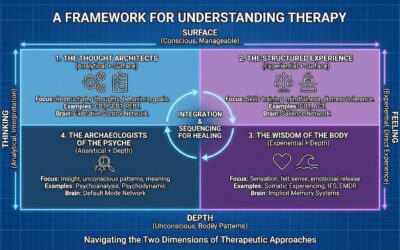
Trauma is a complex and pervasive issue that affects millions of people worldwide. For decades, the “gold standard” of treatment has been talk therapy—specifically Cognitive Behavioral Therapy (CBT) and Dialectical Behavior Therapy (DBT). These modalities operate on a “Top-Down” model: using the rational, thinking brain (the neocortex) to manage and suppress the emotional brain.
However, for many survivors of complex trauma (C-PTSD), this approach fails. Trauma is not just a story you tell; it is a physiological injury stored in the nervous system. When talk therapy hits a wall, it is often because the trauma is located in parts of the brain that language cannot reach. This guide explores the “Bottom-Up” revolution in psychotherapy—methods that target the body, the brainstem, and the nervous system directly to facilitate deep, lasting healing without endless talking.
Part 1: The Limitations of the “Medical Model”
How Corporate Forces Shaped Trauma Treatment
Why is CBT the default? The dominance of CBT and DBT is largely a result of economic forces, not clinical superiority. Insurance companies and corporate healthcare systems favor treatments that are:
- Short-term: Designed to be completed in 12–20 sessions.
- Manualized: Easy to replicate and study in controlled trials.
- Symptom-focused: Aimed at reducing immediate distress rather than resolving root causes.
While effective for symptom management, this approach often leaves the core wound untouched. Patients report feeling “gaslit” by therapies that ask them to reframe their thoughts while their bodies are still screaming in terror.
Part 2: The New Frontier of Brain-Based Therapies
1. Brainspotting: Where You Look Affects How You Feel
Developed by Dr. David Grand, Brainspotting is an evolution of EMDR that is more precise and flexible. It rests on a simple yet profound discovery: our eye position correlates with neural activity.
How it works: By locating a specific “brainspot” (eye position) where trauma is held, the therapist helps the client access the subcortical brain (the deep emotional center). This bypasses the “thinking brain” entirely, allowing for the rapid processing of frozen traumatic memories. Unlike EMDR, it does not require strict protocols, making it adaptable to the client’s unique neurology.
2. Emotional Transformation Therapy (ETT)
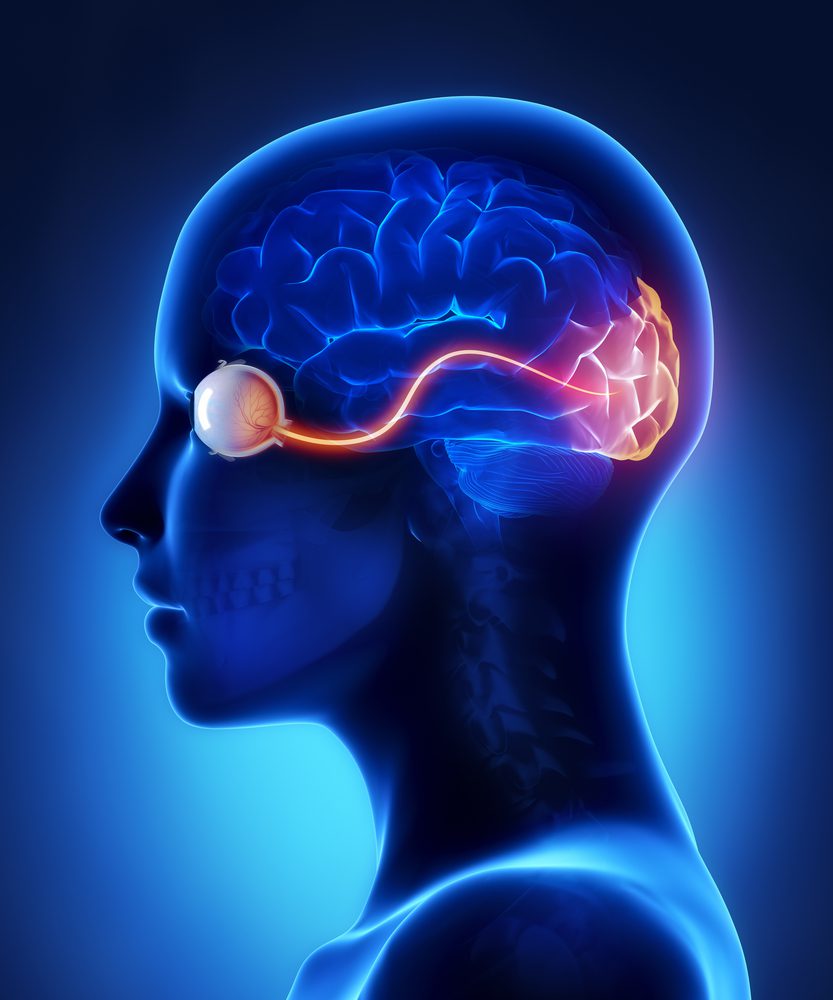
Emotional Transformation Therapy (ETT) creates a bridge between visual stimulation and emotional release. Developed by Dr. Steven Vazquez, ETT uses specific wavelengths of light and color to stimulate the brain’s neural pathways.
The Science: Light enters the eyes and travels directly to the hypothalamus, which regulates the nervous system. By using flickering light and specific colors while discussing trauma, ETT can “disrupt” the neural loop of trauma, often resolving issues in a fraction of the time of talk therapy.
3. QEEG Brain Mapping and Neurostimulation
We no longer have to guess what is happening in a traumatized brain; we can see it. QEEG Brain Mapping provides a literal map of neural dysregulation. Trauma often shows up as “hyper-coherence” (parts of the brain locked together in fear) or “hypo-coherence” (parts of the brain disconnected, causing dissociation).
The Intervention: Once mapped, clinicians can use Neurofeedback or Neurostimulation (tDCS/tACS) to gently retrain the brain waves. This is a non-invasive way to calm the “fight or flight” center physically, creating a neurological state of safety where therapy can finally work.
Part 3: Somatic and Body-Centered Therapies
1. Somatic Experiencing (SE)
Developed by Dr. Peter Levine, Somatic Experiencing is based on the observation that wild animals, despite constant life threats, rarely develop PTSD. They physically “shake off” the energy of the freeze response. Humans, constrained by social norms, “freeze” this energy in their bodies.
The Method: SE does not focus on the story of the trauma. Instead, it focuses on interoception (felt sense). The therapist helps the client track sensations in the body (tightness, heat, shaking) and slowly discharge the trapped survival energy. This restores the nervous system’s natural elasticity.
2. Lifespan Integration (LI)
Lifespan Integration is a gentle method that heals trauma by “proving” to the body that the trauma is over. Survivors often live in a time warp where the past feels like the present.
The Technique: The therapist guides the client through a “Timeline” of memories from birth to the present day. By rapidly viewing the flow of their life, the brain integrates the traumatic event into the larger narrative, moving it from “happening now” to “happened then.” This is particularly effective for attachment trauma and neglect.
3. Myofascial Release and Rolfing
Trauma is often stored in the fascia—the connective tissue that holds our muscles and organs. Chronic “bracing” against danger leads to permanent tension patterns. Structural integration therapies like Rolfing physically manipulate this tissue to release the “emotional armor,” often triggering spontaneous emotional release and relief.
Part 4: Parts Work and the Fragmented Self
Internal Family Systems (IFS)
Trauma fragments the personality. We develop “Managers” to keep us in control, “Firefighters” to numb the pain (often through addiction), and “Exiles” carrying the original hurt. Internal Family Systems (IFS) is a non-pathologizing approach that treats these parts as a system.
Rather than fighting symptoms, IFS welcomes them. By establishing a relationship between the “Self” (the core, undamaged essence) and the protective parts, the internal war ends. This is a profound way to heal complex trauma without the need to relive every painful detail.
Bibliography and Research
The efficacy of these modalities is supported by a growing body of research in neuroscience and traumatology. The links below connect to academic resources and foundational texts.
- American Psychological Association. (2017). Clinical Practice Guideline for the Treatment of PTSD.
- Grand, D. (2013). Brainspotting: The Revolutionary New Therapy for Rapid and Effective Change.
- Vazquez, S. R. (2005). Emotional Transformation Therapy: An Interactive Ecological Psychotherapy.
- Thatcher, R. W. (2010). Handbook of Quantitative Electroencephalography and EEG Biofeedback.
- Pace, P. (2003). Lifespan Integration: Connecting Ego States through Time.
- Levine, P. A. (1997). Waking the Tiger: Healing Trauma.
- Schwartz, R. C. (1995). Internal Family Systems Therapy.
- Van der Kolk, B. A. (2014). The Body Keeps the Score: Brain, Mind, and Body in the Healing of Trauma.











0 Comments