
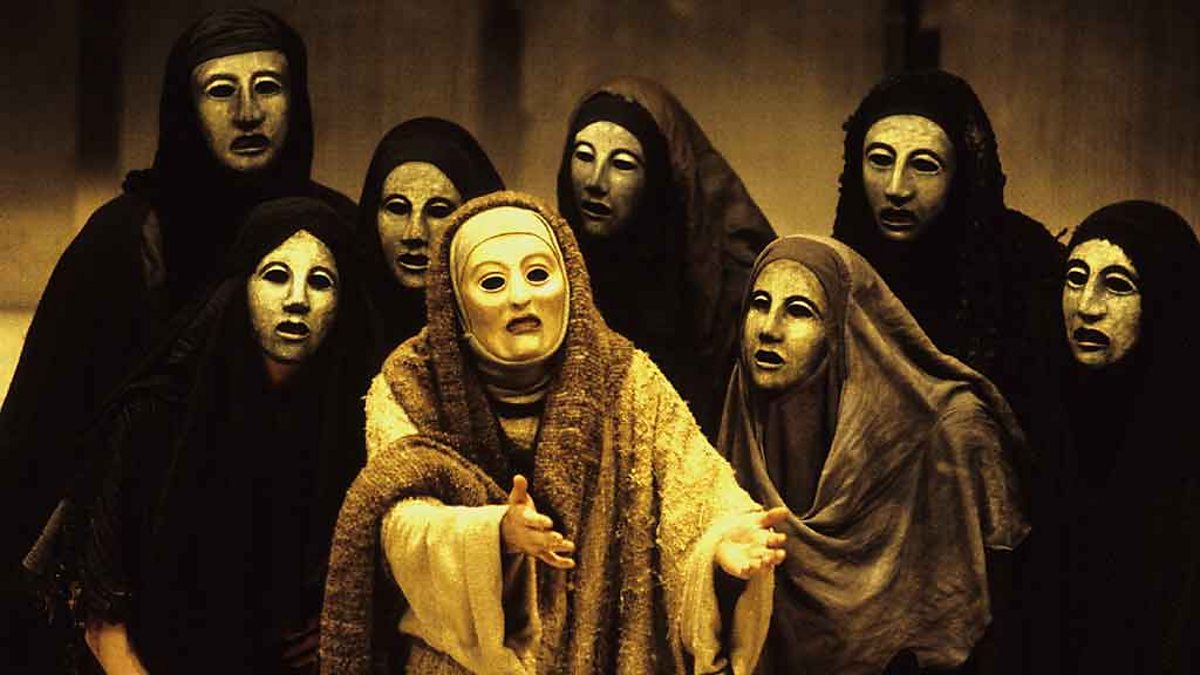
Aeschylus’ Oresteia, staged in Athens in 458 BCE, dramatizes a clash between two ways of knowing what is just. The Furies stand for instinctive, blood-bound retribution; Athena’s new court stands for argument, evidence and the citizens’ vote. Cassandra’s unheeded prophecies show what happens when intuition goes unheard, and the ending keeps both: the Furies are honored inside the democratic city rather than driven out of it.
Key takeaways
- Aeschylus staged the Oresteia in 458 BCE, and its final play turns a family chain of revenge killings into a public trial before a court of Athenian citizens.
- Cassandra’s true but disbelieved prophecies show intuitive knowledge failing to reach a community that only trusts reasoning from past events.
- The trilogy ends by honoring the Furies inside Athens, keeping the instinct that wrongdoing must have consequences while placing it under argued, collective judgment.
- The founding of the Areopagus court answers the reforms of Ephialtes in 462 BCE, which left that council chiefly the trial of homicide.
- Research on expert intuition, such as studies of angel investors and of domain experts, echoes the trilogy’s claim that trained gut knowledge and analysis work best together.
What happens in the Oresteia?
The Oresteia is the only complete tragic trilogy to survive from ancient Athens. Aeschylus entered it at the City Dionysia, the spring festival of Dionysus, in 458 BCE, and it won first prize. It was performed as one long day of theater: Agamemnon, The Libation Bearers (in Greek Choephori) and The Eumenides, followed by a satyr play, Proteus, which is lost.1 The three plays follow the House of Atreus through three generations of killing and end with something new: a trial.
In Agamemnon, a watchman on the palace roof at Argos waits for the beacon fire that will announce the fall of Troy. When the king comes home, his wife Clytemnestra welcomes him with honors fit for a god and then kills him in his bath, together with Cassandra, the Trojan princess he has brought back as a captive. Her stated reason is their daughter Iphigenia, whom Agamemnon sacrificed at Aulis ten years earlier so that his fleet could sail. Her lover Aegisthus has his own grievance: his father Thyestes was tricked by Agamemnon’s father Atreus into eating his own children.2
In The Libation Bearers, Orestes, Agamemnon’s son, returns from exile on the orders of Apollo’s oracle at Delphi. At his father’s tomb he meets his sister Electra, and together they plan the revenge. Orestes kills Aegisthus and then his mother. As soon as the deed is done he sees the Erinyes, the Furies who avenge kin-murder, coming for him, though no one else on stage can see them.3
In The Eumenides, Orestes flees first to Delphi, where Apollo purifies him, and then to Athens, where he clings to the ancient image of Athena on the Acropolis. Athena refuses to decide the case alone. She founds a court of Athenian citizens on the Hill of Ares, the Areopagus, to hear it. The votes are equal, Orestes goes free, and Athena then persuades the enraged Furies to accept a home and honors in Athens.4 The family story itself, read through Jung, is followed closely in an archetypal analysis of the Oresteia. Alongside the family story runs a second one: how the trilogy sets intuition against reason, and how that tension maps onto Athenian democracy.
Who was Cassandra, and why was no one able to believe her?
Cassandra was a daughter of Priam, king of Troy. The god Apollo wanted her and offered her the gift of prophecy. In Aeschylus’ version, which she tells herself on stage, she agreed to his advances and then broke her word. Apollo could not take back a divine gift, so he spoiled it: she would always see the truth, and no one would ever believe her.2
Her scene in Agamemnon is one of the longest and strangest in Greek tragedy. Agamemnon has gone inside to his death. Cassandra stays outside with the chorus of Argive elders, at first silent, then crying out to Apollo. She sees the past of the house: the children of Thyestes holding their own flesh, the blood soaked into the walls. The elders recognize this. She sees the present: a net, a bath, a cow goring a bull. The elders hear it and cannot follow. She sees the Erinyes themselves, a drunken troop of revellers who have settled in the house and will not leave. Finally she says plainly that they will see Agamemnon dead, and they still cannot take it in. Earlier, when she would not answer Clytemnestra’s orders to come inside, the queen had already decided she was mad.2
Aeschylus is careful about why she is not believed. The chorus are not stupid or hostile. They are frightened, they are old, and her knowledge arrives in images rather than arguments. Cassandra knows by seeing, and the people around her know by reasoning from what has already happened. The gap between those two ways of knowing, rather than any defect in the prophecy, is what kills Agamemnon and her. She walks into the palace knowing she will die there.
That is the tragedy of unheeded intuition in its purest form: accurate knowledge that cannot be translated into a form the listener can accept. The same pattern appears in families where one child sees what the adults will not admit and is treated as the problem for saying so, a dynamic described in the scapegoat who tells the truth. Cassandra is also the first person in the trilogy to see the Furies, which ties her intuition directly to the force that the last play must finally bring inside the law.
Why does Chiron belong beside the Oresteia?
Chiron, the wise centaur, does not appear in the Oresteia. He matters here because he gives the Greek imagination a second picture of intuitive knowledge, one in which wisdom is trusted rather than doubted. Most centaurs in Greek myth are drunk, violent and lustful; the Parthenon’s own sculptures show them fighting the Lapiths at a wedding feast. Chiron is the exception. Homer calls him the most just of the centaurs, and has Achilles learn healing herbs from him.
Chiron raised and taught a series of heroes, among them Achilles, Jason and Asclepius, the god of medicine. He was a healer, a hunter, a musician and a teacher, and he also had foresight: in Pindar’s ninth Pythian ode, Apollo, the god of prophecy himself, asks Chiron’s advice about the nymph Cyrene, and the centaur tells him what the future holds. The mythologist Karl Kerényi gathered these stories in The Gods of the Greeks (1951) and later wrote about Chiron and Asclepius as images of the physician’s calling.
Chiron’s own story ends in a wound. He was struck by one of Heracles’ arrows, poisoned with the blood of the Hydra, and because he was immortal he could neither heal nor die. In the version preserved in Apollodorus’ Library, he was released only when Prometheus took over his immortality. Jungian writers have made Chiron the emblem of the wounded healer, the helper whose own injury becomes part of what makes him able to help.
Half horse and half man, Chiron is a living bridge between the wild world and the civilized one. That is exactly the bridge the Oresteia tries to build at its close, when the animal ferocity of the Furies is given a place inside the city. Cassandra shows what happens when instinctive knowledge has no bridge to the community; Chiron shows what it looks like when it does.
How do Greek myths, and the Oresteia, treat intuition?
Greek myth treats intuitive knowledge as a gift with a cost. Seers such as Tiresias, Calchas and Cassandra see further than others and are often resented, mocked or blamed for what they see. Calchas, the seer of the Greek army, is the one who reads the omen at Aulis that leads to Iphigenia’s death. In these stories, the trouble is rarely that intuition is false. It is that the community has no reliable way to receive it.
The Oresteia is full of knowing that runs ahead of proof. The watchman on the roof says the house would tell its own story if it had a voice. The elders of the chorus sing of a fear that keeps hovering in front of their hearts even though they can name no reason for it. Yet when Agamemnon’s death cries finally ring out from the palace, the twelve old men debate one after another what to do, and do nothing. Clytemnestra knows the moment Troy falls through a chain of beacon fires she has arranged across the Aegean, a kind of intuition made into technology.2
The clearest example is a dream. The offerings that give The Libation Bearers its name are sent because Clytemnestra has dreamed that she gave birth to a snake, wrapped it like a baby and put it to her breast, and that it drew blood with the milk. Terrified, she sends Electra and the slave women to pour offerings at Agamemnon’s tomb. When Orestes hears the dream, he reads it at once: he is the snake.3 The psyche of the guilty mother knows what is coming before anyone tells her, a scene that reads almost like a case in Jungian dream interpretation.
The trilogy also names its own theory of knowledge. In the first long choral song of Agamemnon, the old men praise Zeus as the god who set mortals on the road to understanding by making it a law that we learn through suffering, pathei mathos.2 Knowledge in the Oresteia is not given in advance. It is paid for, and it often arrives in the body and the gut before it reaches speech.
At the same time, the trilogy shows the limits of acting on raw feeling. Each killing in the first two plays is justified by a powerful, honest sense of wrong, and each one produces the next. The cycle of blood vengeance cannot stop itself. By the end of The Libation Bearers the chorus asks where the fury will ever end. The answer the last play offers is not to suppress intuitive justice but to give it a place inside a slower, shared process of judgment. Intuitive knowledge and reasoned judgment each have their role, and the city needs both.
What does modern research say about intuition at work?
Modern decision research has returned, in its own language, to the questions the Oresteia raises. Psychologists generally define intuition as a judgment that arrives quickly, without conscious step-by-step reasoning, and with a feeling of knowing attached. The useful question has become when that feeling can be trusted.
One answer comes from studies of expertise. Erik Dane, Kevin Rockmann and Michael Pratt ran two experiments in which people judged either the difficulty of basketball shots or whether designer handbags were genuine or fake, and were told either to go with their gut or to analyze carefully. For people with high expertise in the domain, intuitive judgments were more accurate than analytic ones; people without that expertise gained no such advantage.5 Intuition, in this view, is compressed experience, much like the wisdom the Greeks attributed to an old teacher such as Chiron or to the elders of a tragic chorus.
A second answer comes from studies of high-stakes decisions under extreme uncertainty. Laura Huang and Jone Pearce studied angel investors, the people who put early money into new companies, using an interview study, a field experiment and a longitudinal test. They found that these investors combine expertise-based intuition with formal analysis, that intuition usually wins when the two conflict, and that the weight they put on their assessment of the entrepreneur predicted which ventures went on to extraordinary success four years later.6 Where the future is close to unknowable, a trained gut can see what a spreadsheet cannot.
The Cassandra problem appears in this research too. Daniel Kahneman, who spent his career documenting the errors of fast thinking, and Gary Klein, who spent his studying the expert intuitions of firefighters and military commanders, wrote a joint paper in 2009 setting out where they agreed. Intuition is reliable when the environment has regular patterns and the person has had long practice with clear feedback. They added that a person’s subjective confidence is not a good guide to whether a judgment is accurate.7 That cuts both ways: listeners cannot tell good intuition from bad by how sure the speaker sounds, so sound intuitions are easily dismissed along with poor ones.
Klein’s own field work gives a modern Cassandra. In Sources of Power he describes a fire commander who ordered his crew out of a burning house moments before the floor collapsed, and who at first could explain the decision only as a sixth sense. Only later, through careful interviewing, did the cues come out: the fire was too quiet and too hot for its apparent size.8 Organizations that demand a data-driven justification for every judgment can lose this kind of knowledge, just as the Argive elders lost Cassandra’s.
Business culture’s preference for explicit data has a parallel in Athens’ move toward a reasoned, procedural system of justice. The research does not say that analysis is the enemy of intuition. It says the best decisions come from people who know their domain well enough to trust their pattern recognition and who also have ways of checking it. That is close to the balance the Oresteia reaches when it moves from the instinctive justice of the Furies to Athena’s court without throwing the Furies away.
How does intuition shape the characters’ choices?
Beyond Cassandra’s visions, almost everyone in the trilogy acts from gut certainty. Clytemnestra’s plotting, Orestes’ conflict over killing his mother and the chorus’s constant foreboding all show different faces of intuitive knowing.
Clytemnestra embodies a dark form of intuitive justice. Aeschylus gives her the strongest mind and the sharpest tongue in the first play, and the chorus admits she speaks like a man of good judgment. Her case against Agamemnon is real: he killed their child. After the murder she claims that she is not Agamemnon’s wife at all but the ancient avenging spirit of the house, wearing her shape.2 She senses that the house’s long chain of crime must be answered, but she answers it in the house’s own language, with another killing, and so extends the chain instead of ending it.
Recognition in The Libation Bearers also runs on intuition. Electra knows her brother has returned from a lock of hair on the tomb and footprints that match her own, signs that a skeptical modern reader may find thin but that the play treats as the heart knowing before the eyes confirm.3
Orestes is torn between two obligations that each feel absolute: the duty to avenge his father, backed by Apollo’s threats, and the horror of killing his mother. At the decisive moment, with his mother baring her breast to him, he stops and asks his silent companion Pylades whether he should spare her. Pylades, who speaks only these three lines in the whole play, reminds him of Apollo’s oracle.3 Orestes then hands his case first to Apollo and later to Athena’s court. His path traces the move from private, felt certainty about justice to accepting a formal, collective judgment.
What political conflict does the Oresteia reflect?
The Oresteia sets two systems of justice against each other. On one side is the ancient law of blood vengeance, carried by the Erinyes. On the other is civic justice: a court, a procedure and a vote, founded by Athena. This was not an abstract question in 458 BCE.
Athens had been a democracy since the reforms of Cleisthenes around 508 BCE, but in 462 to 461 BCE the politician Ephialtes, with the support of the young Pericles, pushed through a sharper change. He stripped the Council of the Areopagus, a body of former magistrates who served for life, of most of its political powers, leaving it chiefly the trial of homicide. Power passed to the Assembly, the Council of Five Hundred and the large popular jury courts. Ephialtes was assassinated soon afterwards, and his conservative rival Cimon was ostracized. In the same years Athens broke with Sparta and made an alliance with Argos.9
Four years later Aeschylus staged a trilogy whose climax is the founding of the Areopagus as a homicide court, and in which the acquitted Orestes swears that Argos will be Athens’ ally forever.4 Scholars have argued for a century over where he stood. E. R. Dodds read the plays as supporting the reformed democracy while warning against civil strife; others have heard a conservative defense of the old council’s dignity. What nobody doubts is that the audience would have heard their own recent quarrels in the play.10 The strain between Athens and Sparta that began in these years would later become the Peloponnesian War, which Taproot has read through Jung in Athens as anima and Sparta as animus.
The old system, embodied by the Furies, rests on family obligation and personal vendetta. It is intuitive and emotional, rooted in the primal fear of violating blood ties. The new system brings in argued debate, a decision by many citizens and the idea that responsibility to the city can outrank loyalty to the clan. The trilogy asks how a community moves from the first to the second, and what it must keep from the first in order not to lose its moral force. Our sense of fairness has evolutionary roots that are older than any court, a theme explored in the neuroscience and evolution of justice and fairness.
The Erinyes and Athena: a clash of eras
The Erinyes are older than the Olympian gods. In Hesiod’s Theogony, one of the earliest works of Greek literature, they spring from the drops of blood that fell on Earth when Cronus castrated his father Uranus, so they are born from a crime against a parent.11 In The Eumenides they call themselves daughters of Night. Their task is to pursue those who shed kindred blood and to punish oath-breakers. They do not ask about motives. They belong to a world of clans and households, where the family is the only court there is.
Athena is a younger goddess of wisdom, strategy and crafts. She was born from the head of Zeus, with no mother, a birth that made her the natural image of mind and reason. In the Oresteia she represents a more urban, argued form of justice: she hears both sides, questions the parties and gives the decision to her citizens.4
The clash between them mirrors Athens’ move from an older, aristocratic and clan-based ethic to a democratic one. Yet the play does not simply defeat the old powers. Athena keeps the Furies’ central claim: that fear has a place in a just city. She tells her people to live neither without rule nor under a despot, and not to cast fear entirely out of the city, since a mortal who fears nothing will not be just. The Furies had said almost the same thing earlier in the play.4 The old intuition that wrongdoing must have consequences is not abolished. It is given a new home.
That is why the trilogy’s last title matters. “Eumenides” means “the Kindly Ones,” a name used for these goddesses in later cult; in the play’s final scene they are installed as honored goddesses of the city, given a sanctuary in a cave beneath the Areopagus, and escorted there in a torchlit procession wearing crimson robes.1 The emotional, intuitive side of justice survives in the new order, now joined to reason and to responsibility to the whole city.
What happens at the trial of Orestes?
The trial in The Eumenides is the turning point of the whole trilogy. It is the moment the house’s private chain of vengeance becomes a public case. Aeschylus does not present it as a clean break from the past. It is a hard negotiation between the old order and the new one.
The old values on trial
The Furies prosecute. Their position is simple and unbending: Orestes shed his mother’s blood, and that is all that matters. They are not interested in why. When Athena asks whether he acted under some compulsion, they answer that nothing could compel a son to kill his mother.4 This system gives clear rules but has no room for circumstances.
The limits show at once. Orestes killed his mother, but he did so to avenge his father, whom his mother had killed, after his father had killed his sister. When Orestes asks why the Furies never pursued Clytemnestra for murdering her husband, they reply that she did not kill a blood relative. The old law, fixed on one kind of act, cannot see the chain of events that led to it.
Apollo’s defense is no more satisfying. He argues that the mother is not truly a parent, only the nurse of the seed the father plants, and he points to Athena, born from Zeus with no mother, as proof.4 Modern readers often find this argument shocking, and it is meant to be partisan. It shows that neither the old powers nor the new god have a complete answer. That is why the case needs a court.
The new court and democratic practice
Athena chooses the best of her citizens and swears them in as a court that will last for all time. The court introduces several features that Athenians associated with their own democratic justice:
- Collective decision. Judgment no longer belongs to a god or an avenger alone. It becomes the responsibility of a body of citizens.
- Argued debate. Both sides speak, witnesses are heard, and the jurors weigh what they hear instead of applying a fixed rule.
- The secret ballot. The jurors drop voting pebbles into urns, the method Athenian juries used.
- Divine and human together. Athena takes part alongside the mortal jurors, joining respect for the sacred with the authority of citizens.
The votes are equal. Athena has already declared that her vote will go to Orestes, because she was born of no mother and favors the male in all things except marriage, and that a tie means acquittal.4 Orestes leaves for Argos a free man, promising friendship between the two cities.
The Furies then threaten to pour poison on the land and blight its crops and children. Athena does not overpower them. She persuades them, crediting Peitho, the goddess of Persuasion, and offers them a seat in the city, worship from its people and the duty of guarding its prosperity. After a long exchange they accept.4 This is the deeper resolution: the new system handles a hard moral case while still honoring the old order, and the instinctive force of retribution becomes a protector of the community.
The trilogy thus shows Athens leaving the bloody values of the past behind through change and integration rather than flat rejection. It suggests that a just society does not discard intuition and tradition but sets them alongside reason, debate and collective decision, the practices Athenians thought of as democratic.
What does the Parthenon have to do with the Oresteia?
The Parthenon was begun in 447 BCE, nine years after Aeschylus’ death and eleven years after the Oresteia. Its main structure was complete and the great gold-and-ivory statue of Athena Parthenos dedicated in 438 BCE, and the sculptures were finished by about 432 BCE.12 Aeschylus never saw it. It belongs, though, to the same Athens he was writing for: the confident, imperial democracy of Pericles that grew out of the reforms of the 460s.
The building was funded in part from the treasury of the Delian League, the alliance Athens led against Persia, whose treasury was moved from the island of Delos to Athens in 454 BCE. The Assembly voted the work, and the project employed a large share of the city’s craftsmen for years. Critics at the time, as Plutarch later reported, complained that the allies’ money was being spent to adorn Athens. Pericles’ answer was that the city had kept its side of the bargain by defending the allies.12 The Parthenon was civic pride in stone, and a statement of Athenian identity.
Its sculptures carried the same story the Oresteia tells. The east pediment showed the birth of Athena from the head of Zeus; the west showed her contest with Poseidon for patronage of Athens. The metopes showed the gods against the Giants, the Greeks against the Amazons and the Trojans, and the Lapiths against the centaurs, in each case order against chaos.12 The goddess who in Aeschylus’ play turns the Furies into guardians of the city now stood at its center as its patron.
The architects Ictinus and Callicrates, working under the sculptor Phidias, built in refinements that are still studied: the columns swell slightly, the floor curves upward toward its center, and the corner columns are thicker and set closer together. Almost no line in the building is perfectly straight, and the result looks more alive than a strictly geometric temple would. That union of traditional subject matter and new technique mirrors the trilogy’s own balance of old and new.
Who was Aeschylus?
Aeschylus was born around 525 BCE at Eleusis, near Athens, the home of the Eleusinian Mysteries, and died at Gela in Sicily in 456 or 455 BCE. He fought against the Persians at Marathon in 490 BCE, where his brother Cynegeirus was killed, and probably at Salamis in 480 BCE. The epitaph said to have been written for his tomb mentions only his courage at Marathon, not his plays.13
He won his first victory in the tragic competitions in 484 BCE and went on to win about thirteen. Ancient sources credit him with between seventy and ninety plays; seven survive under his name. Aristotle says he added the second actor to tragedy, which made real dialogue and conflict on stage possible.13 His career spans the years when Athens defeated Persia, built a naval empire and pushed its democracy further than any Greek city had done.
The surviving plays return again and again to the same concerns. The Persians (472 BCE), the only surviving tragedy about recent history, shows the defeat of Xerxes at Salamis through Persian eyes; its producer was the young Pericles. Seven Against Thebes (467 BCE) follows a family curse to the death of Oedipus’ sons. The Suppliants includes an assembly of citizens voting by show of hands, a picture of democracy on stage. Prometheus Bound, traditionally attributed to him, sets a rebel against a new and tyrannical Zeus. Recurring themes include:
- The consequences of hubris. Characters suffer for overreaching. Xerxes bridges the Hellespont; in the Oresteia, Agamemnon walks into his palace over sacred cloth.
- The cycle of violence. Violence breeds violence, and an inherited curse can pass down a family line until something new interrupts it.
- Fate and responsibility. Characters are both driven by necessity and responsible for their choices. Orestes is ordered by a god and still must answer for what he did.
- Justice and civic order. The plays keep asking how a community can govern itself fairly. The founding of the Areopagus in The Eumenides is the fullest answer he gave.
- Gods and mortals. The gods intervene constantly, and the line between divine and human law is always in question, as in Apollo’s command to Orestes and Athena’s founding of the court.
Aeschylus’ experience as a soldier and citizen in a fast-changing Athens gave him a deep understanding of conflict, both external and internal. The Oresteia can be read as his attempt to reconcile a violent past with the hope of a just and ordered future.
How do Agamemnon and Orestes differ?
The father and the son face similar choices, a terrible deed demanded by a god or a duty, and handle them in opposite ways. The contrast carries much of the trilogy’s argument about moral growth.
Agamemnon’s arrogance
Agamemnon embodies the hubris that so often brings down a tragic hero. Aeschylus shows it in several ways:
- The sacrifice of Iphigenia. Artemis holds the fleet at Aulis with contrary winds. The chorus describes how Agamemnon, once he put on the yoke of necessity, changed his mind toward the unholy and dared to kill his daughter so the war could go on.2 Military success comes before his bond with his child. Euripides later retold the scene in Iphigenia in Aulis.
- The Trojan War. A ten-year war fought, in name, for his brother Menelaus’ honor costs thousands of Greek lives. The chorus says the people of Argos grumble that men died for another man’s wife.
- The carpet scene. Clytemnestra spreads crimson-dyed cloths, precious enough for offerings to the gods, for him to walk on. He refuses, saying such honors belong to gods, and then gives in after a short argument. He knows the act is hubris and does it anyway.2
- Cassandra. He brings Cassandra home as a war prize and presents her to his wife, with no thought for her gift or her own wishes.
Agamemnon stands for the old heroic code, where glory and victory are what count and the human cost comes second.
Orestes’ values and growth
Orestes’ path through the trilogy is more complex:
- Duty to his father. He begins inside the old values, driven by the obligation to avenge Agamemnon.
- Moral conflict. Unlike his father, he hesitates at the decisive moment and suffers afterward, haunted by the Furies.
- Seeking judgment. He submits his case first to Apollo and then to Athena’s court, instead of claiming he was simply right.
- Accepting the new order. By taking part in the trial, he enters a civic way of settling conflict.
His arc moves from blood vengeance to civic justice, and his growth mirrors the change Aeschylus imagined for Athens.
What the contrast means
- Generational change. The move from father to son stands for change between generations in a whole society.
- Ethical development. Agamemnon follows the heroic code; Orestes doubts, suffers and asks to be judged.
- Political allegory. Agamemnon belongs to the world of kings; Orestes’ story ends in the founding of a citizen court.
- Tragedy and resolution. Agamemnon’s arrogance feeds the cycle of violence. Orestes’ willingness to submit to a new kind of justice is what lets it end.
What archetypes appear in the Oresteia?
Carl Jung argued that myths and tragedies last because they give shape to archetypes, inherited patterns of the psyche that show up in dreams, symptoms and stories across cultures.14 The Oresteia carries archetypal images on two levels at once: the individual psyche and the life of a whole society. Taproot has written more broadly about the archetypal wisdom of Greek tragedy and its influence on Jung.
This is not only a modern reading. In 1861 the Swiss scholar Johann Jakob Bachofen used the Oresteia in Mother Right as evidence for a historical shift from mother-centered to father-centered society, and Jung’s student Erich Neumann, in The Origins and History of Consciousness, read the trilogy as a stage in the ego’s struggle to free itself from the power of the Great Mother.
The individual level
- The Hero: Orestes. His trials and final release follow the pattern of individuation, Jung’s word for the lifelong process of becoming a whole and distinct person.
- The Great Mother: Clytemnestra. She shows both faces of the mother archetype, the one who grieves for her child and the one who devours. Her dream of nursing a snake is pure Great Mother imagery.
- The guides: Apollo and Athena. These gods play the part Jung gave to the spirit archetype, often personified as the wise old man: the figure who appears when the hero is stuck and offers insight, counsel and a way forward.14
- The Shadow: the Furies. They stand for the dark, instinctual side of the psyche that has to be faced and brought into relationship rather than merely repressed. Jung’s treatment of the shadow as something to be held in tension rather than defeated is set out in Jung’s shadow and the tension of opposites.
- The Anima: Electra. As Orestes’ sister and partner in the plot, Electra can be read as his anima, the feminine side of a man’s psyche that carries feeling and connects him to his depths. She disappears after the recognition and the planning, as Orestes moves into the masculine world of action and law. Sophocles gave her a far larger role in his Electra.
The societal level
- The Great Father: Agamemnon. He stands for traditional patriarchal authority and the old heroic order.
- The transformation: the trial. The founding of the Areopagus can be read as a kind of individuation for the city, in which opposing forces are joined in a new arrangement.
- The scapegoat: Iphigenia. Her sacrifice is the collective shadow: what a society is willing to destroy in the name of a greater good.
- Rebirth: Athens. The trilogy ends in a renewal of the city that keeps the old powers inside a more balanced order.
Tensions and resolutions
- Integration of the shadow. The Furies become honored goddesses of the city. Primitive, instinctual forces are integrated rather than locked away.
- Anima and animus. The relationships between Orestes and Electra, and between Orestes and Athena, suggest the development of the contrasexual side of the psyche.
- Individuation and the collective. Orestes’ journey mirrors individuation in one person, while the new court mirrors a similar process for Athens.
- The transcendent function. Jung used this term for the way the psyche, when two opposites are held in tension long enough, produces a third thing that neither could have produced alone.15 Athena’s settlement, which neither rejects the Furies nor obeys them, is a close dramatic picture of that process.
Read this way, the Oresteia works on several levels at once, addressing both individual psychological development and the transformation of a society. Its archetypes help explain why an ancient trilogy still speaks so directly to modern audiences.
How can the Oresteia help in therapy?
Many people who come to therapy are living some version of Cassandra’s story. They grew up in families where what they sensed was real and was still denied: a parent’s drinking, a hidden affair, a sibling in danger. They learned that their perceptions caused trouble, so they stopped trusting them. Part of the work is helping a person learn again that their felt sense of things carries information, and to tell the difference between intuition that comes from experience and alarms that come from old injury. Taproot has written about that difference in intuition and trauma and the ways they get confused.
The House of Atreus is also a picture of how harm passes down generations. Each person in the trilogy acts from a wound received from the one before. In therapy we look at the patterns a person inherited, the ways of loving, punishing and keeping secrets that came down the family line, so that the person can choose differently rather than simply repeat them. Parts-based therapy has its own way of working with these generational cycles.
The Furies are a fitting image for guilt, rage and dread that live in the body. They cannot be argued away, and attempts to suppress them usually make them louder. Jungian work treats such forces the way Athena treats the Furies: it gives them a hearing, finds out what they are protecting, and offers them a different job. Somatic therapy works the same ground through the body, tracking the gut feelings, tightness and startle responses where old fear is held, so that it can settle instead of driving behavior from below awareness.
Dreams belong here too. Clytemnestra’s snake dream is the kind of image clients bring every week: a picture that knows something before the waking mind does. Taking such images seriously, as the play does, is a direct way to hear what the psyche is trying to say.
Why does the Oresteia still matter?
The Oresteia brings myth, politics and psychology into a single work. Its questions about intuition, justice and social change, about how old and new values, gut knowledge and reasoned judgment can live together, belonged to the arguments of Athens in 458 BCE and still belong to ours.
From Cassandra, whose true knowledge goes unheard, to the founding of a court on the Areopagus, the trilogy asks how communities change and how they balance competing values and ways of knowing. The research on expert intuition in business shows the same problem in a modern form: accurate hunches are often hard to explain, and organizations that only trust what can be counted lose them. The contrast between Agamemnon’s arrogance and Orestes’ growth shows what becomes possible when old values are examined instead of simply obeyed.
The archetypal reading shows the trilogy’s psychological depth. Integrating the shadow, balancing the psyche and finding a third way between opposites are processes that belong to ancient myth and to ordinary psychological life. The Oresteia’s final claim is that progress comes not from throwing away the past but from joining older, intuitive kinds of knowledge to newer, reasoned ones, a balance reached through struggle and persuasion.
At Taproot, this is close to the center of the work. Our clinicians use myth, dreams and the body’s own signals to help people hear their Cassandra and make peace with their Furies. If that kind of work interests you, you can read more about Jungian therapy at Taproot.
Frequently asked questions
What is the main conflict in the Oresteia?
The main conflict in Aeschylus’ Oresteia is between two kinds of justice. The Furies demand blood for blood and ignore motives, while Athena founds a court where both sides argue and citizens vote. The trilogy resolves it by acquitting Orestes on a tied vote and then persuading the Furies to become honored protectors of Athens.
Why did no one believe Cassandra in Agamemnon?
In Aeschylus’ Agamemnon, Cassandra explains that Apollo gave her prophecy, and when she broke her promise to him he cursed her so that no one would believe her. On stage the Argive elders understand her visions of the house’s past but cannot grasp her warnings about Agamemnon’s murder, which happens moments later.
How is the Oresteia connected to Athenian democracy?
The Oresteia was staged four years after Ephialtes stripped the Council of the Areopagus of most of its political powers, leaving it chiefly homicide trials. In The Eumenides Athena founds the Areopagus as exactly that kind of court, with citizen jurors and ballot voting, so Athenian audiences heard their own recent political arguments in the play.
Who are the Eumenides?
The Eumenides, or Kindly Ones, is a later cult name for the Erinyes, the Furies who avenge crimes against blood relatives. Hesiod says they were born from the blood of Uranus. At the end of Aeschylus’ trilogy Athena persuades them to accept a sanctuary beneath the Areopagus and honors as guardians of Athens.
What does Jungian psychology see in the Oresteia?
Jungian readers see Orestes as the hero moving toward individuation, Clytemnestra as the devouring face of the Great Mother and the Furies as the shadow. Athena’s settlement, which neither rejects the Furies nor obeys them, resembles what Jung called the transcendent function: a new position that emerges when opposites are held in tension.
Related reading
- St. Augustine and the Foundations of Depth Psychology: How a Fourth-Century Bishop Became a Forefather of Modern Psychotherapy
- When Reality Breaks Our Rules: How Personality Types Defend Against Prediction Error
- Language as Mirror: How Saxon and Latinate Word Choices Reflect Values and Shape Therapeutic Practice
- Somatic Experiencing: Myths, Misconceptions, and FAQs
- The Trial of Carl Jung: Assessing a Legacy
- Anima and Animus in the The Bacchae: A Depth Psychological Perspective
References
- Goldhill, S. (2004). Aeschylus: The Oresteia (2nd ed.). Cambridge University Press. https://doi.org/10.1017/cbo9780511800269
- Aeschylus. (2009). Oresteia: Agamemnon (A. H. Sommerstein, Ed. & Trans.). Digital Loeb Classical Library, Harvard University Press. https://doi.org/10.4159/dlcl.aeschylus-oresteia_agamemnon.2009
- Aeschylus. (2009). Oresteia: Libation-Bearers (A. H. Sommerstein, Ed. & Trans.). Digital Loeb Classical Library, Harvard University Press. https://doi.org/10.4159/dlcl.aeschylus-oresteia_libation_bearers.2009
- Aeschylus. (2009). Oresteia: Eumenides (A. H. Sommerstein, Ed. & Trans.). Digital Loeb Classical Library, Harvard University Press. https://doi.org/10.4159/dlcl.aeschylus-oresteia_eumenides.2009
- Dane, E., Rockmann, K. W., & Pratt, M. G. (2012). When should I trust my gut? Linking domain expertise to intuitive decision-making effectiveness. Organizational Behavior and Human Decision Processes, 119(2), 187-194. https://doi.org/10.1016/j.obhdp.2012.07.009
- Huang, L., & Pearce, J. L. (2015). Managing the unknowable: The effectiveness of early-stage investor gut feel in entrepreneurial investment decisions. Administrative Science Quarterly, 60(4), 634-670. https://doi.org/10.1177/0001839215597270
- Kahneman, D., & Klein, G. (2009). Conditions for intuitive expertise: A failure to disagree. American Psychologist, 64(6), 515-526. https://doi.org/10.1037/a0016755
- Klein, G. (1998). Sources of power: How people make decisions. MIT Press.
- Podlecki, A. J. (1966). The political background of Aeschylean tragedy. University of Michigan Press.
- Dodds, E. R. (1960). Morals and politics in the Oresteia. Proceedings of the Cambridge Philological Society, 6, 19-31. https://doi.org/10.1017/s006867350000287x
- Hesiod. (2007). Theogony (G. W. Most, Ed. & Trans.). Digital Loeb Classical Library, Harvard University Press. https://doi.org/10.4159/dlcl.hesiod-theogony.2007
- Hurwit, J. M. (2004). The Acropolis in the age of Pericles. Cambridge University Press.
- Sommerstein, A. H. (2010). Aeschylean tragedy (2nd ed.). Bristol Classical Press.
- Jung, C. G. (1968). The archetypes and the collective unconscious (R. F. C. Hull, Trans.; 2nd ed., Collected Works Vol. 9, Pt. 1). Princeton University Press.
- Jung, C. G. (1969). The structure and dynamics of the psyche (R. F. C. Hull, Trans.; 2nd ed., Collected Works Vol. 8). Princeton University Press.














0 Comments