
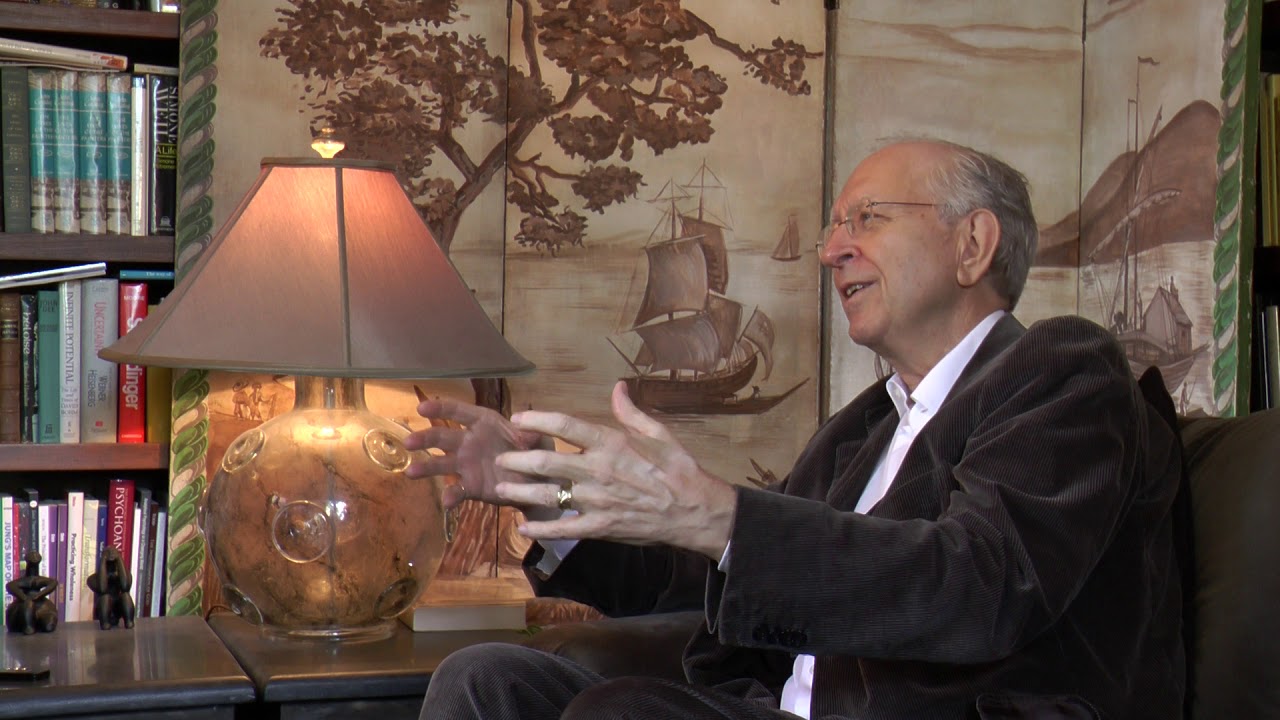
Murray Stein (born 1943) is an American Jungian analyst, based in Switzerland, who has spent five decades translating C.G. Jung’s psychology into clear, usable terms. He is best known for Jung’s Map of the Soul (1998) and In Midlife (1983). Psychologically, his work matters because it treats crisis, transition and spiritual hunger as stages of individuation rather than as signs of breakdown.
Key takeaways
- Murray Stein, born in 1943, is a Jungian analyst trained at Yale, Chicago and Zurich who served as IAAP president from 2001 to 2004 and ISAP Zurich president from 2008 to 2012.
- Jung’s Map of the Soul (1998) lays out Jung’s model of the psyche in a clear sequence, from the ego and complexes to the Self and synchronicity.
- Stein describes individuation as alternating analytic and synthetic movements, a spiral around a center rather than a straight climb.
- In Midlife (1983) uses van Gennep and Turner’s rites of passage to frame midlife as separation, liminality and reintegration, with Hermes as guide.
- Stein treats spirituality and religious symbols as central to individuation, from Jung’s critique of Christianity to comparisons with Zen enlightenment.
Who is Murray Stein?
Stein was born in Canada in 1943 and educated in the United States. He earned a B.A. and an M.Div. at Yale University, trained at the C.G. Jung Institute in Zurich, where he received his diploma as an analyst in 1973, and later completed a Ph.D. in religion and psychological studies at the University of Chicago.15 That double training in theology and depth psychology shapes almost everything he has written: he reads the psyche as a psychological reality and the religious life as one of its central expressions.
His books range across the whole of Carl Jung’s life and work: introductions for students, studies of individuation and transformation, essays on Christianity and spirituality, writing on clinical method, and, more recently, plays about Jung’s circle written with the Israeli analyst Henry Abramovitch, such as The Analyst and the Rabbi. His collected essays now fill more than ten volumes from Chiron Publications. What links them is a habit of taking one of Jung’s dense ideas and laying out, step by step, how it works in a person’s life.
His role in the international Jungian community
Stein has also carried a large share of the field’s institutional work. He was a founding member of the Inter-Regional Society of Jungian Analysts and of the Chicago Society of Jungian Analysts, served as president of the International Association for Analytical Psychology (IAAP) from 2001 to 2004, and was president of the International School of Analytical Psychology in Zurich (ISAP Zurich) from 2008 to 2012. He remains a training analyst there.15 The IAAP is the worldwide umbrella body that recognizes Jungian analysts and their training societies. With Nathan Schwartz-Salant he edited the Chiron Clinical Series, including The Borderline Personality in Analysis (1988), which brought clinical papers from many Jungian societies into one conversation; our profile of Nathan Schwartz-Salant covers his side of that partnership.
How does Stein explain Jung’s map of the psyche?
Jung’s Map of the Soul: An Introduction (1998) is the book most readers meet first.4 It walks through Jung’s model in a fixed order: the ego as the center of consciousness, the complexes that populate the personal unconscious, Jung’s theory of psychic energy, instincts and archetypes, the persona and the shadow, the anima and animus, the Self as the center and totality of the psyche, individuation, and finally synchronicity. Each chapter starts from Jung’s own texts in the Collected Works, so the book works as a guided reading rather than a summary from memory.
The book reached an unexpected audience in 2019, when the Korean group BTS named their album Map of the Soul: Persona after it. Stein responded with a short book, Map of the Soul: Persona, Our Many Faces (2019), and a follow-up, Map of the Soul: 7 (2020). For a clinician, the more important point is that the map gives clients and therapists a shared vocabulary for experiences that otherwise feel chaotic.
What does Stein mean by individuation?
Individuation is Jung’s term for the lifelong process by which a person becomes a psychological individual: distinct from family and collective expectations, and in conscious relationship with the unconscious. Stein’s The Principle of Individuation (2006) argues that this is perhaps Jung’s major idea, the backbone of the rest of his work.6
Stein describes individuation as two movements that alternate across a life. The first is analytic: a person separates from identifications with parents, roles and the persona, the social face that once felt like the whole self. The second is synthetic: material that was split off or never known, from the shadow to the images of dreams, is brought into relationship with consciousness. Because the two movements repeat, he describes the path as a spiral or a circling around a center, not a straight climb. Our companion piece, Stein on individuation as a lifelong architecture, follows this idea further.
Why the shadow matters in his model
The shadow is everything in the personality that the ego refuses to see as its own: anger, envy, ambition, tenderness, talent, whatever the family or culture taught a person to disown. Stein follows Jung in treating encounter with the shadow as the first and unavoidable task of individuation, because the disowned material does not disappear. It returns as projection onto other people, as symptoms, or as sudden behavior that feels foreign.4 When shadow material is recognized and owned, the energy that went into keeping it out of sight becomes available again, which is why people often describe shadow work as bringing back vitality. Our overview of the Jungian shadow gives the wider background.
Transformation and the emergence of the Self
In Transformation: Emergence of the Self (1998), based on his Fay Lectures at Texas A&M University, Stein uses the metamorphosis of a caterpillar into a butterfly as his central image.5 Adult transformation, he argues, is not gradual improvement but a reorganization in which a latent form of the personality takes over. He traces it through transformative images, transformative relationships and the lives of figures such as Rilke, Picasso and Jung himself. Stein’s use of “Self” here differs from the self of Heinz Kohut’s self psychology: for Kohut the self is built through empathic relationships, while for Jung and Stein the Self is an organizing center that is there from the start and gradually reveals itself.
Why does Stein see midlife as a liminal passage?
In Midlife: A Jungian Perspective (1983) is Stein’s most clinically used book.1 He borrows the structure of rites of passage from the anthropologist Arnold van Gennep and the idea of liminality from Victor Turner, for whom the liminal phase is the period “betwixt and between” two social identities.13 Stein applies the three phases to the middle of life.
- Separation. The identity built in the first half of life, around career, family role and achievement, stops holding. Stein describes this as a burial: the old self has to be mourned, not simply repaired.
- Liminality. A long, disorienting stretch in which a person is no longer who they were and not yet who they will be. Stein takes Hermes, the Greek god of boundaries and guide of souls, as the figure who presides over this phase.
- Reintegration. A new attitude forms, often with values that were sacrificed earlier now taking a central place.
Jung had already argued that the “afternoon of life” carries different tasks from the morning. Stein’s contribution was to give that idea a sequence a person can recognize from the inside, and to treat the confusion of the liminal phase as part of the process rather than as failure. The renewal that sometimes follows is what readers of Jung have called a second birth.
How does Stein connect psychology and spirituality?
Stein’s doctoral work became Jung’s Treatment of Christianity (1985).2 Its argument is that Jung related to his own Christian tradition the way an analyst relates to a patient: diagnosing its one-sidedness, especially its exclusion of evil and the feminine from the God image, and proposing a therapy for it. That reading still frames much discussion of Jung and religion.
His wider approach is inclusive. He does not privilege any one tradition, but treats experiences of the numinous and the variety of God images with respect, as real expressions of the psyche. In Practicing Wholeness (1996) and Minding the Self (2014) he writes about spirituality as a central feature of individuation rather than an add-on to it.38 Readers interested in the older roots of this view can turn to our piece on Christian mystics and Jungian thought.
Religious symbols and the self as imago Dei
Stein argues that religious symbols matter psychologically because they carry the pattern of the Self. In a 2008 paper in the Journal of Analytical Psychology, he examines Jung’s late claim, from Mysterium Coniunctionis, that the self is an image of God. He shows that Jung did not simply equate the two. The self, for Jung, is a union of opposites, personal and impersonal at once, which mirrors a Divinity that is itself both immanent and transcendent.7 In practice, this is why a Jungian analyst takes seriously a dream of a church, a mandala or a sacred animal: such images may be the psyche’s way of pointing toward its own center.
Alchemy, dreams and active imagination
Stein has also written and lectured on Jung’s study of alchemy, which Jung read as a record of projected psychological transformation. Operations such as separatio (separation) and coniunctio (union of opposites) give a language for the two movements of individuation described above. Our piece on what alchemy has to do with psychology explains the background. Stein places these images alongside the practical routes into the unconscious: dreams, active imagination and spiritual practice.
East and West
Stein has extended the dialogue beyond Christianity. In a 2019 paper he compares the advanced stages of individuation with enlightenment as pictured in the Zen Ten Ox-Herding Pictures, arguing that real common features exist while cultural differences must be respected.10 Elsewhere he sets Buddhist liberation beside the Jungian process. For Stein, psychology and spirituality are complementary ways of attending to the same depths, even though they have often been at odds historically.
What does Stein say about contemporary culture?
Stein’s cultural writing starts from a diagnosis: modern life is connected everywhere and coherent nowhere. In Jung’s Red Book for Our Time, a multi-volume collection he edits with Thomas Arzt, he asks whether people today, like Jung in 1913, need to leave the “spirit of the time” and follow the “spirit of the depths.”14 The phrases are Jung’s own, from The Red Book. Stein’s point is that fragmentation, speed and a lost sense of shared meaning leave individuals without the symbols that once held a life together.
Renewal of meaning
His response is not a return to old certainties. He argues that meaning has to be renewed from within, through a conscious relationship with the Self, with other people and with whatever a person experiences as transcendent. Soul: Treatment and Recovery (2015) collects essays on this theme, including pieces on narcissism, conscience and the ethics of individuation.9
Jungian ideas in cultural change
Stein also argues that individuation applies to groups. The tenth volume of his collected writings, Psychology and Society, gathers essays on the father’s role between family and society and on the collective psyche in postmodern times. Earlier, he and John Hollwitz edited Psyche at Work (1992), which applied analytical psychology to organizations and working life. In each case the claim is the same: the unconscious, the power of symbols and the pressure toward wholeness operate in institutions as well as in individuals.
How did Stein shape Jungian training and practice?
As IAAP president and later ISAP president, Stein helped set standards for how analysts are trained and assessed. His teaching emphasizes the link between theory and the consulting room. Four Pillars of Jungian Psychoanalysis (2022) sets out the foundations of Jungian analytic practice, with individuation as the organizing frame for the work.11 An analyst can ask where a person stands in their own individuation and let that guide the work.
His ideas also travel well outside Jungian circles. A therapist from any background can use the midlife model, the language of shadow and persona, or the idea that a spiritual crisis may be a developmental one. His plain style makes that borrowing easier, and his books are often the first Jungian texts that therapists in training read.
What his work offers for personal growth
For readers who are not therapists, Stein’s books describe a path: owning the shadow, letting an outgrown identity end, tolerating the in-between, and attending to dreams and symbols as messages from a larger part of the personality. He does not promise a finished state. Individuation, in his account, keeps going until the end of life.
How does Stein handle tradition, research and Jungian jargon?
Tradition and innovation
Stein belongs to what Andrew Samuels called the classical school, the strand closest to Jung’s own emphasis on the Self and individuation; our piece on Samuels’ map of the Jungian schools sets out the others. Some colleagues in the developmental and archetypal schools have wanted more departure from Jung. Stein’s answer has been to stay close to the texts while opening them to new partners: Buddhism, contemporary culture, organizational life and the Red Book material that only became public in 2009.
Research and clinical knowledge
Stein’s knowledge base is the one depth psychology has always used: the close study of dreams, symbols and the analytic relationship over years, case by case. He treats Jung as an empirical psychologist in that older sense, someone who worked from observed psychic experience. The fourth volume of his collected writings shows how that knowledge accumulates. It gathers his Ghost Ranch papers from 1983 to 1992 and essays on transference, types of countertransference, sleepiness in the analytic hour, envy and the faith of the analyst. Writers in the tradition have since begun connecting Jung’s ideas with neuroscience as well, and Stein’s map gives them a clear model to test those links against.
Making Jungian language accessible
Jungian vocabulary can put off new readers: archetype, anima, coniunctio, imago Dei. Much of Stein’s career has been an answer to that problem. He defines terms before using them, builds from ordinary experience, and in his plays lets Jung and his colleagues argue in conversation rather than in technical prose.
Where is Stein’s work heading?
Stein’s writing points toward three kinds of dialogue. The first is with other disciplines: anthropology, through his use of van Gennep and Turner; religious studies, through his work on Christianity and Buddhism; and neuroscience, which post-Jungian writers increasingly bring into the conversation, as our essay on post-Jungian thought and its philosophical neighbors discusses.
The second is with social and political life. Projection, the habit of seeing one’s own disowned traits in an enemy, is a Jungian idea with obvious use in an age of polarization. Stein’s essays on evil and the shadow apply it to collective life: a society that cannot own its shadow will keep finding it in others.
The third is with the next generation of analysts. Steven Herrmann’s 2025 study, Murray Stein: Individuation, Transformation, and the Ways to the Self in Jungian Psychology, is the first book-length assessment of his work, a sign that Stein is now read as part of the tradition’s history as well as its present.12
Where does Stein stand among Jungian thinkers?
Stein is often read alongside three earlier figures who also kept Jung’s ideas alive for later generations. Edward Edinger, in Ego and Archetype (1972), traced the cycle of inflation and alienation between ego and Self. Marie-Louise von Franz, Jung’s closest collaborator, wrote C.G. Jung: His Myth in Our Time (English edition 1975) and decades of work on fairy tales and alchemy. James Hillman broke away to found archetypal psychology and, in The Soul’s Code (1996), argued that each life carries an innate calling. Stein shares Edinger’s focus on ego and Self, von Franz’s respect for Jung’s late work, and some of Hillman’s concern for soul in culture, but his particular gift is synthesis and clear teaching.
The thread that runs through all his work is a vision of growth as transformation: the shadow integrated, the old identity mourned, the spiritual dimension of the psyche taken seriously, and the individual seen as part of a culture that also needs to change.
What does Stein’s work mean for therapy?
At Taproot we see Stein’s ideas at work most clearly with people in transition. Someone in their forties or fifties whose career, marriage or faith has stopped making sense is often told they are depressed or burned out. Stein’s midlife model offers another reading: the old structure may be ending because it has done its work, and the disorientation is the liminal phase of a passage. A therapist working this way helps the person mourn what is ending, stay with the uncertainty instead of rushing to rebuild the same life, and notice what is trying to emerge in dreams, images and bodily states.
Shadow work is the second application. When a client keeps meeting the same kind of person who enrages them, or keeps acting in ways they do not recognize, we look at what has been disowned. Parts-based approaches such as parts work give a practical way to meet those disowned pieces, and brain-based methods such as Brainspotting help when the material is held in the body as much as in memory. Spiritual crises, losses of faith and unexpected religious experiences are the third area: following Stein, we treat them as meaningful events in individuation rather than as symptoms to be removed.
Stein’s work reminds us that a crisis can be a threshold rather than a dead end. If you are in one of those in-between seasons, our Jungian therapy work in Hoover, Alabama, is built around the same map of the psyche he has spent his career drawing.
Frequently asked questions
Who is Murray Stein?
Murray Stein is a Jungian analyst and author, born in Canada in 1943 and now based in Switzerland. He studied at Yale, the C.G. Jung Institute in Zurich and the University of Chicago, led the International Association for Analytical Psychology from 2001 to 2004, and is a training analyst at ISAP Zurich, which he served as president from 2008 to 2012.
What is Jung’s Map of the Soul about?
Murray Stein’s Jung’s Map of the Soul (1998) is an introduction to Carl Jung’s model of the psyche. It moves chapter by chapter through the ego, complexes, psychic energy, archetypes, persona and shadow, anima and animus, the Self, individuation and synchronicity, staying close to Jung’s own texts. The Korean group BTS named a 2019 album after it.
What does Murray Stein say about the midlife crisis?
In his 1983 book In Midlife, Murray Stein treats the midlife crisis as a rite of passage. The identity of the first half of life ends and must be mourned, a person then passes through a liminal, in-between period guided by the figure of Hermes, and a new attitude to life eventually forms. The confusion is part of the passage, not a failure.
How does Murray Stein define individuation?
Murray Stein follows Jung in defining individuation as the lifelong process of becoming a distinct psychological individual in relationship with the unconscious. He describes two alternating movements: separating from identifications with roles, family and persona, and then integrating shadow and other unconscious material. Because these movements repeat, the path circles around the Self rather than climbing in a line.
Is Murray Stein’s work useful outside Jungian analysis?
Yes. Therapists of many orientations use Murray Stein’s midlife model, his clear account of shadow and persona, and his view that spiritual crises can be developmental. His books are often the first Jungian texts students read, and his plain style lets clients follow ideas such as liminality and individuation in their own lives.
Related reading
- Language as Mirror: How Saxon and Latinate Word Choices Reflect Values and Shape Therapeutic Practice
- Somatic Archeology: Excavating the Body’s Hidden Histories
- The Interpersonal Theory of Psychiatry: Harry Stack Sullivan’s Vision of the Social Self
- Clarissa Pinkola Estés: The Archetypal Storyteller and Healer
- Peter Sloterdijk: The Pioneering Metamodern Philosopher
- The Mystical Theology and Cosmology of Jakob Boehme: Insights for Jungian Psychology and the Individuation Process
References
- Stein, M. (1983). In midlife: A Jungian perspective. Spring Publications.
- Stein, M. (1985). Jung’s treatment of Christianity: The psychotherapy of a religious tradition. Chiron Publications.
- Stein, M. (1996). Practicing wholeness: Analytical psychology and Jungian thought. Continuum.
- Stein, M. (1998). Jung’s map of the soul: An introduction. Open Court.
- Stein, M. (1998). Transformation: Emergence of the self. Texas A&M University Press.
- Stein, M. (2006). The principle of individuation: Toward the development of human consciousness. Chiron Publications.
- Stein, M. (2008). “Divinity expresses the self …” An investigation. Journal of Analytical Psychology, 53(3), 305-327. https://doi.org/10.1111/j.1468-5922.2008.00729.x
- Stein, M. (2014). Minding the self. Routledge. https://doi.org/10.4324/9781315797632
- Stein, M. (2015). Soul: Treatment and recovery. Routledge. https://doi.org/10.4324/9781315762951
- Stein, M. (2019). Psychological individuation and spiritual enlightenment: Some comparisons and points of contact. Journal of Analytical Psychology, 64(1), 6-22. https://doi.org/10.1111/1468-5922.12462
- Stein, M. (2022). Four pillars of Jungian psychoanalysis. Chiron Publications.
- Herrmann, S. (2025). Murray Stein: Individuation, transformation, and the ways to the self in Jungian psychology. Routledge. https://doi.org/10.4324/9781003664024
- Turner, V. (1969). The ritual process: Structure and anti-structure. Aldine.
- Stein, M., & Arzt, T. (Eds.). (2017). Jung’s Red Book for our time: Searching for soul under postmodern conditions (Vol. 1). Chiron Publications.
- Stein, M. (n.d.). About. Murray Stein: The official website of Murray Stein. Retrieved November 14, 2026, from https://www.murraystein.com/wp/about/














0 Comments