
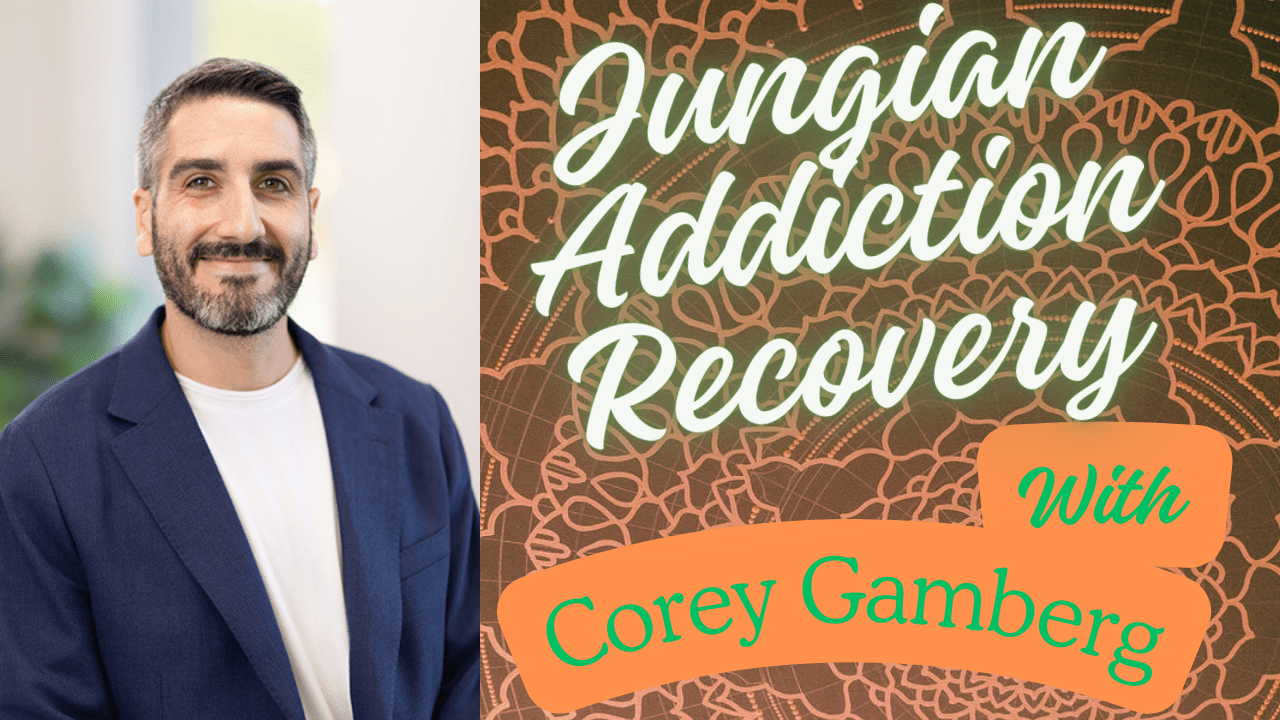
Jungian addiction recovery starts from a simple claim: staying sober is necessary, but lasting recovery asks for more than abstinence and changed behaviour. Corey Gamberg, Executive Director of Rockland Recovery Treatment Centers in Massachusetts, argues that 12-step programs are an essential first container, and that Jung, who helped inspire Alcoholics Anonymous, and James Hillman show what the soul needs once that container grows too small.
Key takeaways
- Corey Gamberg argues that lasting recovery needs more than abstinence and behaviour change: it needs bigger containers for the soul’s growth.
- Carl Jung’s 1926 analysis of Rowland Hazard, and his advice that only a spiritual experience could help, passed through the Oxford Group and Ebby Thacher to Bill Wilson and AA.
- Many people in long-term sobriety hit a crisis around four to six years, when the 12-step container that held them starts to feel confining.
- James Hillman’s archetypal psychology treats symptoms as the soul speaking, and gives recovery tools such as seeing through, myth and the aesthetic response.
- Gamberg keeps the 12 steps as the grounding stage and adds post-recovery work built on image, myth, ritual and beauty.
Gamberg made this case in a conversation on the Taproot Therapy Collective podcast. He is a person in long-term recovery, a licensed alcohol and drug counselor and a student of Jungian depth psychology. His phrase for what he is building is “bigger containers”: places that can hold people who have outgrown the treatment that first got them sober, without asking them to give up sobriety or the community that supported it.
How does addiction individuate?
Individuation is Carl Jung‘s word for the lifelong process by which a person becomes whole. Jung defined it as the process by which a person becomes “a psychological ‘in-dividual,’ that is, a separate, indivisible unity or ‘whole’,” brought about by an ongoing exchange between conscious life and the unconscious.1 It is not self-improvement. It is the slow integration of parts of the psyche the ego would rather not know about.
Gamberg extends the idea from persons to the problems they carry. “Everything individuates,” he says. “As a person moves through individuation, so does phenomena. The experience of addiction itself individuates, and the experience of recovery itself individuates.” In plain terms, addiction is not one fixed thing, and neither is recovery. Each develops and changes shape over time, in a culture and in a single life.
He points to his own history to show that addiction changes as a phenomenon: “I’m a drug addict who comes from the oxycontin era of drug addicts, and that’s not really something that we see as much today as we did 15 years ago. Heroin and fentanyl are very different. The increase in people using different drugs like methamphetamine has increased.” The drugs, their effects on the nervous system and the lives built around them differ from one era to the next, and the neuroscience of addiction differs with them.
If addiction changes, recovery has to change too. That conclusion drives Gamberg’s stated aim at Rockland Recovery, to stay “on the cutting edge of substance abuse treatment,” and it is the thread of everything that follows: a treatment model that cannot grow will eventually fail the people it once served well.
Why isn’t changing behaviour enough?
Most addiction programs lean on cognitive behavioral therapy, dialectical behavior therapy (DBT) and other manualized methods aimed at thoughts and behaviours. These teach skills: noticing triggers, tolerating cravings, interrupting a habit loop. Gamberg grants them a place, but argues that they rarely reach the wounds that made the substance necessary in the first place.
“Recovery just has to be more than the cessation of symptom and the change in behavior and not using. Because as someone in recovery for so long, obviously I’ve seen a lot of people who do that sort of thing—go to church, go to the meetings, they live that way of life—but they’re still struggling with all these underlying, more deeply rooted issues that just changing behavior doesn’t touch.”
A recovery built only on behaviour also tends to breed shame. If sobriety is measured purely by conduct, then any struggle, low mood or relapse reads as failure of character. Gamberg sees it instead as part of a natural process of growth and individuation. That difference matters clinically, because shame is one of the strongest drivers of hiding, isolation and return to use.
How did Carl Jung help inspire Alcoholics Anonymous?
The spiritual core of the 12 steps traces back to a consulting room in Zurich. The patient was Rowland Hazard III, a wealthy Rhode Island businessman whose drinking had resisted every treatment he tried. In the mid-1920s Carl Jung was, with Freud and Adler, one of the three best-known names in depth psychology, and Hazard went to him. Bill Wilson’s later retelling led historians to look for the treatment around 1930 or 1931. The historian Amy Colwell Bluhm, working from family correspondence, showed that Hazard’s analysis with Jung began in 1926.2
After the work in Zurich, Hazard drank again. When he went back, Jung told him that his case was close to hopeless from a medical point of view, and that his only hope lay in a genuine religious experience.6 Gamberg gives the gist of that moment in his own words: “I kind of misdiagnosed you. I thought you were a hard drinker, but you’re what people call a real alcoholic, and the only thing that’s going to help you is some sort of spiritual experience or spiritual transformation.” The book Alcoholics Anonymous records the same advice: that alcoholics have occasionally recovered through what it calls “vital spiritual experiences.”3
Hazard took the advice. He returned to the United States and joined the Oxford Group, the evangelical Christian movement led by Frank Buchman whose practices of self-inventory, confession, restitution and service later became much of the 12 steps. In 1934 Hazard and other Oxford Group members helped Ebby Thacher, an old drinking friend of Bill Wilson, avoid commitment to a state institution. Ebby got sober and, in late 1934, visited Wilson in New York to tell him what had worked. Wilson had his own spiritual experience at Towns Hospital that December, read William James’s The Varieties of Religious Experience while there, and in 1935 founded Alcoholics Anonymous in Akron, Ohio, with Dr. Bob Smith.45
In January 1961 Wilson wrote to Jung to thank him. Jung’s reply, dated 30 January 1961, explained that Hazard’s “craving for alcohol was the equivalent, on a low level, of the spiritual thirst of our being for wholeness, expressed in medieval language: the union with God.” He ended with a Latin formula: since alcohol is spiritus, the cure is “spiritus contra spiritum,” spirit against spirit.6 Gamberg’s conclusion follows directly: “Without Jung, we really don’t have this idea that spirituality or some sort of spiritual experience is the answer or one of the solutions for addiction.”
What counts as a spiritual experience in recovery?
Many people in early recovery stall on the word “spiritual,” either because they distrust religion or because they expect a single blinding conversion. Gamberg offers a psychological reading that needs no creed:
“A spiritual experience is when something happens to me that has happened so many times, yet I can experience it perspectively and embody it in a totally different way. I don’t react in my old behavior, I don’t react in my old thinking. I’m able to see something happening to me and respond in a completely different way that allows me to find more meaning in that experience versus some sort of resolution to it.”
Two capacities are packed into that definition. The first is metacognition, the ability to watch one’s own thoughts and feelings without being swept away by them. The second is what Gamberg calls a porous ego: a sense of self firm enough to stay intact while unconscious material comes through. Jung described the same exchange in his essay on the transcendent function, where the ego holds its ground while it lets images and emotions from the unconscious speak, and something new comes out of the tension. The 12-step tradition reached a similar idea from another side: the Big Book’s appendix on spiritual experience, borrowing a phrase from William James, says most members’ experiences are of the “educational variety,” a personality change that develops slowly rather than a sudden flash.3
What happens at the four-to-six-year mark in recovery?
One of Gamberg’s sharpest observations concerns what he calls the “four to six-year mark.” Somewhere in that window many people in long-term sobriety begin to struggle, not with the urge to use, but with the limits of the method that got them sober.
He frames the 12 steps as a myth in Jung’s sense, a living story that organises experience: “I believe that the 12 steps are a mythology. Mythology can be thought of as a psychic container. It holds our suffering, it gives our suffering context, it gives my suffering language, it gives my suffering ritual.” For the first several years, that container does its job. “But then that exact thing happens where you kind of take a step back, and the formulaic aspect of what you’ve been doing and the rigidity of what you’ve been doing starts to confine, and something in you is trying to grow beyond that.”
Gamberg treats this as a developmental crisis, not a relapse warning. The problem is the response it usually meets: “we don’t have places for those people to go that don’t want to return to use but also can admit that what they’ve been doing really isn’t working anymore.” Too often the community answers with “Oh, you’re overthinking it” or “Maybe your ego is getting in the way.” A depth approach reads the restlessness as the next stage of individuation asking for room.
Who was James Hillman, and why does he matter for addiction?
James Hillman (1926 to 2011) trained at the C. G. Jung Institute in Zurich, served as its director of studies through the 1960s, and in the early 1970s founded archetypal psychology. His central book, Re-Visioning Psychology (1975), argued for returning soul to psychology, and treated symptoms not as defects to be removed but as the way the soul speaks. Hillman called this “pathologizing”: the psyche’s own habit of expressing itself through illness, fantasy and disorder.7
Gamberg draws on that idea through the word itself:
“If you break down that word psychopathology—psyche pathos—that is the love of the soul. A symptom like depression is the soul’s way of loving us into seeing something about our lives that we cannot see from ego consciousness.”
Strictly, the Greek pathos means suffering or what one undergoes, and logos means an account, so psychopathology is the account of the soul’s suffering. Hillman’s point was that this suffering carries meaning and deserves to be heard. On that reading addiction is neither only a moral failing nor only a brain disease. Gamberg describes it as:
“this sort of Promethean rupture in the psyche—this desire to transcend and grab that fire and also feel divine in myself.”
That image comes from the Titan who stole fire from the gods and paid for it, a story Aeschylus dramatised in Prometheus Bound. It echoes Jung’s letter to Wilson: the craving is a thirst for something higher, aimed at the wrong object.
How can depression be worked with as a message?
Gamberg uses depression to show what Hillman’s approach looks like in practice:
“When you experience depression from a Hillman perspective, if you kind of work with it a little bit and embody the depression a little bit, you realize certain things. When you’re depressed, you watch different movies, you eat different food, you listen to different music, and you might dress differently. Through that experience with depression, you’re able to gain a perspective through that lens that you weren’t able to gain through your ego’s perspective prior.”
Instead of reaching straight for elimination, the approach invites curiosity: “What is this depression trying to show me? What perspective is it offering that my normal consciousness cannot access?” Hillman wrote that depression slows a person down and turns them toward depth, toward what has been ignored.7
Curiosity about depression is not a reason to stop medication or to sit alone with a mood that is getting worse. Anyone taking an antidepressant should change it only with the prescriber, and thoughts of suicide call for immediate help, in the US by calling or texting 988. Listening to what depression is saying works alongside medical care, not in place of safety.
What is the rhythm of suffering?
Gamberg’s phrase for the cyclical nature of hard times is “the rhythm of suffering,” and his model is the myth of Persephone. In the Homeric Hymn to Demeter, Hades carries Persephone into the underworld; her mother’s grief halts the growth of the earth; and Persephone returns each spring but must go down again every year. Descent is not an accident to be prevented but part of the pattern. Hillman built a whole book, The Dream and the Underworld (1979), on the idea that the psyche needs its underworld.8
“There is a rhythm to suffering. This idea that you’re in this process now and you’re sober and you’re helping other people and you’re showing up—by no means does it mean that you’re not going to suffer. Heartbreak is going to happen, relationships are going to end, jobs are going to end.”
The task is learning to go down differently: “We need to learn how to maneuver the underworld in a participatory way, not in a defensive way.” Gamberg contrasts a transcendence model, which tries to rise above painful emotion, with a depth model, which learns to move through it with awareness. The Greek myths and mystery cults were built around exactly this kind of descent and return.
What is post-recovery work?
Gamberg uses the term “post-recovery work” for treatment aimed at people who have stabilised in traditional recovery and now need a larger container for growth.
“It’s not walking away from recovery, but it’s changing the way we understand it,” he explains. “It’s moving away from formula and rigidness, and it’s moving into more of trying to deeply understand the roots of the problem in the first place, now that I’ve had some time away and I’ve stabilized.”
The method borrows Hillman’s “seeing through”: looking past the surface of a behaviour to the image and mythic pattern that animates it.7 Gamberg puts it this way:
“Behind the behavior of addiction, there is an image. The images of descent, the images of rupture, the images of longing and exile—these are the things that then need to be amplified in the individual’s experience and revisioned into their mythos.”
Amplification is Jung’s technique of enlarging a dream image or symptom by setting it beside parallel images from myth, religion and art, until its meaning comes into view. Jungian analyst David Schoen applied this to addiction in The War of the Gods in Addiction (2009), reading the addictive process as an archetypal force that the person meets, not a habit he simply chooses.9
Why do beauty and the aesthetic response matter in recovery?
Hillman argued that the soul is not only inside people but also in the world, the anima mundi, and that we meet it through the aesthetic response: the gasp, the sense that a thing in front of us is alive and beautiful.10 Gamberg turns that into a daily practice:
“Part of it is starting to have these little moments where you try to find the beauty in what’s right in front of you and appreciate what’s in front of you and see it as alive. You start to take more concern about the way you keep your home, you start to take more concern about the way you decorate your office, you start to take more concern about the way you’re eating and the food you’re eating.”
This is not lifestyle advice. Addiction flattens the world into one object of desire, and recovery includes learning to be moved again by ordinary things. Gamberg, carrying Hillman’s point into the clinic, says it bluntly: “If you go into your office and it’s bright fluorescent lights and there’s nothing on the walls and it’s all white, there’s no healing that’s going to happen there.” Hillman’s view that rooms and cities shape the soul runs through his later writing.10
How can myth reshape addiction treatment?
Gamberg brings myth directly into treatment, helping clients read their experience through figures such as Prometheus, who steals fire; Persephone, who descends and returns; and Tantalus, who stands in water that recedes whenever he bends to drink and beneath fruit that lifts away as he reaches, the purest image of craving in Greek literature.
“It’s bringing mythopoetics into the addiction space and allowing people to understand the addiction process as initiation, but also as a living myth for them. It’s part of their story.” Mythopoetic work gives what clinical language usually cannot: meaning, purpose, and a sense of belonging to a story larger than a diagnosis.
Where is addiction treatment heading?
Gamberg does not want to abandon the 12 steps. The research backs that respect: a 2020 Cochrane review found that manualized AA and Twelve Step Facilitation programs produced higher rates of continuous abstinence than other established treatments, including cognitive behavioral therapy.11 His argument is about what comes after. “AA and that 12-step model is great for that grounding experience, but it’s not a place to live in,” he says. “Recovery needs to evolve as addiction itself evolves.”
He sees that evolution in several elements:
- Longer timelines that treat recovery as ongoing individuation rather than a 30 to 60 day fix.
- Several modalities working together: talk therapy, body-based practice and archetypal psychology.
- Recognition of the soul dimension in addiction and recovery.
- Support for post-recovery growth that does not pathologise the wish for deeper meaning.
- Personal ritual and meaning-making in place of one-size-fits-all approaches.
How can therapists put these ideas into practice?
For clinicians and treatment providers, Gamberg suggests starting with small shifts in perspective:
- Treat symptoms as communications, not only as problems to remove.
- Encourage attention to beauty in clients’ homes and daily routines.
- Introduce mythological thinking through story and archetypal exploration.
- Help clients build personal rituals that connect them to meaning.
- Practise holding space rather than always offering solutions.
- Expect the rhythm of descent and return in recovery, and name it when it comes.
At Taproot we see the same pattern in people who come to us years into sobriety. In Jungian therapy we work with dreams, recurring images and the personal myth a client is living, which is where Gamberg’s “image behind the behavior” shows up. Much addiction is also built on unprocessed trauma held in the body, so we often pair that work with Brainspotting, which lets the nervous system process what talk alone does not reach. People raised around drinking often carry their own version of this story, which we take up in our work with adult children of alcoholics.
What lies beyond sobriety?
What emerges from Gamberg’s work is a picture of recovery that honours both the practical necessity of abstinence and the soul’s need for meaning, beauty and growth. “Recovery just has to be more than that,” he says. “We’re not saying anything bad about 12 steps or traditional recovery in that way. We’re just saying that inevitably it does lack, and what we need to find is where people can go in that moment or experience of lack.”
For people who are stable in recovery but hungry for something deeper, Jung’s original insight still holds: the craving was always a thirst for wholeness. Sobriety ends the wrong answer to that thirst. It does not end the thirst, and much of the real work starts there. The future Gamberg describes is not a choice between traditional and depth approaches but a set of bigger containers that can hold both.
If you have years of sobriety and feel that your recovery has stopped growing, our post-rehab addiction care in Hoover combines Jungian, somatic and trauma-focused therapy for exactly that stage. You can contact Taproot Therapy Collective to talk with a therapist.
Frequently asked questions
Did Carl Jung really influence Alcoholics Anonymous?
Yes. Jung analysed the American alcoholic Rowland Hazard in Zurich beginning in 1926 and told him that only a genuine spiritual experience could help. Hazard joined the Oxford Group, helped Ebby Thacher get sober in 1934, and Ebby carried the message to Bill Wilson, who co-founded Alcoholics Anonymous in 1935. Wilson thanked Jung by letter in 1961.
What does spiritus contra spiritum mean?
Spiritus contra spiritum is the Latin formula Carl Jung used in his 30 January 1961 letter to Bill Wilson. Because alcohol is called spiritus, the same word used for the highest religious experience, Jung suggested that the remedy for the craving is spirit against spirit: a real experience of meaning and wholeness in place of the drink.
What is Jungian addiction treatment?
Jungian addiction treatment looks past the behaviour of using to the images, myths and unmet longings behind it. Therapists work with dreams, symbols and personal myth, use amplification to connect a client’s images with mythic parallels, and treat recovery as part of individuation, the lifelong process of becoming whole, alongside sobriety and any 12-step support.
Why do some people struggle after years of sobriety?
Corey Gamberg observes that around four to six years many sober people stop struggling with cravings and start struggling with the rigidity of their recovery method. The structure that once held them begins to confine them. He reads this as growth asking for a larger container, not as a warning of relapse, and calls the next stage post-recovery work.
How did James Hillman think about symptoms like depression?
James Hillman, founder of archetypal psychology, held that symptoms are the soul expressing itself, a process he called pathologizing in Re-Visioning Psychology (1975). Depression, in his view, slows a person down and turns them toward depth. Exploring that meaning in therapy works alongside medical care, and any thoughts of suicide call for immediate help.
Related reading
- Is My Friend or Business Partner a Con Artist?
- The Emperor’s Inner Work: Marcus Aurelius, Meditations, and the Roots of Psychotherapy
- What Are Glimmers? The Polyvagal Key to Nervous System Healing
- Karl Friston and Carl Jung: The Unnoticed Rehabilitation
- The Weird History of Psychotherapy Part 5: The Perennial Philosophy
- Synthesizing Post-Freudian and Post-Jungian Perspectives on Trauma and the Psyche
References
- Jung, C. G. (1969). The archetypes and the collective unconscious (R. F. C. Hull, Trans.; 2nd ed., Collected Works Vol. 9, Pt. 1). Princeton University Press.
- Bluhm, A. C. (2006). Verification of C. G. Jung’s analysis of Rowland Hazard and the history of Alcoholics Anonymous. History of Psychology, 9(4), 313–324. https://doi.org/10.1037/1093-4510.9.4.313
- Alcoholics Anonymous World Services. (2001). Alcoholics Anonymous (4th ed.). Alcoholics Anonymous World Services.
- Kurtz, E. (1979). Not-God: A history of Alcoholics Anonymous. Hazelden.
- James, W. (1902). The varieties of religious experience: A study in human nature. Longmans, Green.
- Jung, C. G. (1975). Letters, Vol. 2: 1951–1961 (G. Adler & A. Jaffé, Eds.; R. F. C. Hull, Trans.). Princeton University Press.
- Hillman, J. (1975). Re-visioning psychology. Harper & Row.
- Hillman, J. (1979). The dream and the underworld. Harper & Row.
- Schoen, D. E. (2009). The war of the gods in addiction: C. G. Jung, Alcoholics Anonymous, and archetypal evil. Spring Journal Books.
- Hillman, J. (1992). The thought of the heart and the soul of the world. Spring Publications.
- Kelly, J. F., Humphreys, K., & Ferri, M. (2020). Alcoholics Anonymous and other 12-step programs for alcohol use disorder. Cochrane Database of Systematic Reviews, 2020(3), CD012880. https://doi.org/10.1002/14651858.CD012880.pub2



















0 Comments