

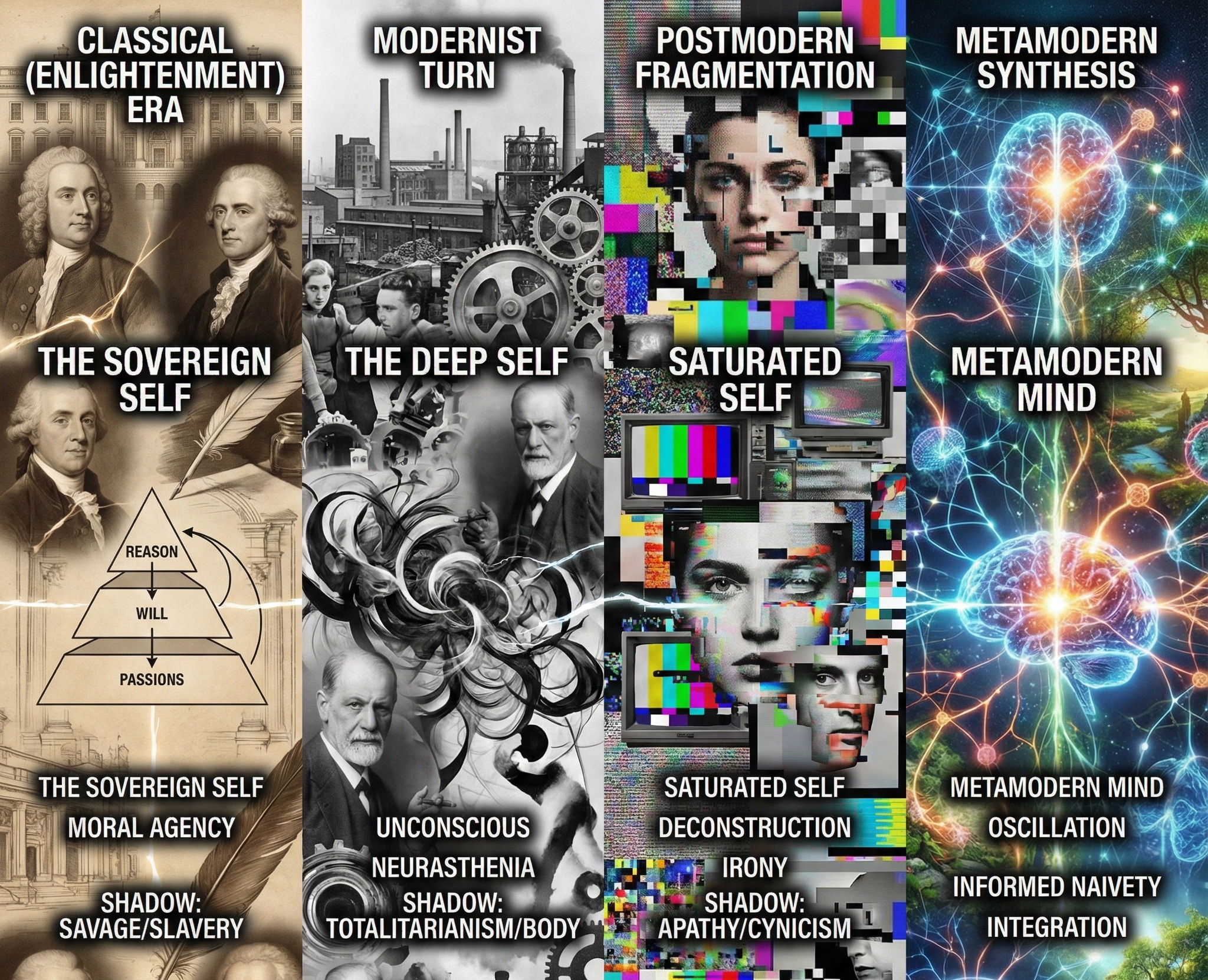
The genealogy of the American psyche is the history of how Americans have pictured the self: the sovereign, reason-ruled citizen of 1776, the deep and divided self of the Freudian century, the saturated, constructed self of the postmodern decades, and the oscillating, developing self of metamodernism. Each picture pushed something into a collective shadow, and what it pushed away returned as that era’s typical illnesses and politics.
Key takeaways
- Americans have pictured the self in four successive ways: the sovereign self of the republic, the deep modernist self, the saturated postmodern self and the oscillating metamodern self.
- Each era’s ideal of the self pushed something into a collective shadow, and that shadow returned as the era’s typical illnesses, from neurasthenia to narcissism to hyperreflexive burnout.
- Slavery and the dispossession of Native peoples formed the shadow of the Enlightenment self; Jefferson’s 1820 image of holding a wolf by the ear captures the bind.
- Metamodernism, as Vermeulen and van den Akker described it in 2010, oscillates between modern enthusiasm and postmodern irony and tries to integrate every earlier stage.
- Therapy for the metamodern self combines depth work on the shadow, parts work such as IFS and body-based methods such as Brainspotting with a search for meaning.
Why does the American psyche have a genealogy?
American history is usually told as conventions, wars, booms and inventions. Underneath runs a second history: what Americans have believed a person is. The shape of the self, the line between sanity and madness, and whether there is an unconscious at all have been answered differently in different generations, and each answer changed what doctors treated, what preachers preached and what voters feared.
The idea that the self has a history is more than a philosopher’s conceit. In 1990 the psychologist Philip Cushman argued in American Psychologist that every era constructs its own configuration of the self, and that psychology, by treating its own era’s self as universal, ends up serving that era without seeing it. His alternative was what he called a historically situated psychology1. He developed the argument at book length in Constructing the Self, Constructing America (1995), a history of American psychotherapy read as a history of the American self.
The genealogy runs through four eras: classicism, from 1776 to about 1890; modernism, from about 1890 to 1960; postmodernism, from about 1960 to 2000; and metamodernism, from about 2000 to now. The dates are rough boundaries, not walls. Each era has what Fredric Jameson called a cultural logic, a set of assumptions so widely shared that they feel like common sense, and each logic decides both how people see themselves and what they refuse to see.
The refused material is what Carl Jung called the shadow. For an individual it is the part of the personality the conscious ego will not own. Jung also wrote of a collective shadow, the disowned side of a whole culture, which tends to be projected onto enemies, minorities and scapegoats. The Jungian shadow is the hinge of this genealogy. Each American self-image left a distinct shadow, and that shadow surfaced in polarized politics, in mass pathologies and in the particular symptoms that filled each era’s clinics.
The present era is the fourth. In “Notes on Metamodernism” (2010), the cultural theorists Timotheus Vermeulen and Robin van den Akker described a new “structure of feeling”, a phrase they borrowed from the critic Raymond Williams, that “oscillates between a modern enthusiasm and a postmodern irony”2. Talk of a meaning crisis, waves of digital anxiety and the burnout so many clients bring into therapy make more sense once they are seen as the shadow of this fourth self. How a culture understands the self decides how it treats suffering, how it organizes its politics and how it meets its future. That is why the genealogy matters to a therapist.
What was the sovereign self of the early republic?
Faculty psychology and Scottish common sense
The psychology of the early republic was not a by-product of its politics. It was a foundation the politics stood on. Educated Americans of the founding generation learned their picture of the mind from the Scottish Enlightenment, above all from Thomas Reid, whose Inquiry into the Human Mind on the Principles of Common Sense (1764) and Essays on the Intellectual Powers of Man (1785) answered David Hume’s skepticism by insisting that ordinary perception and moral sense can be trusted. John Witherspoon, the Scottish minister who became president of the College of New Jersey, later Princeton, in 1768, taught this common sense philosophy to a generation of students that included James Madison, and he signed the Declaration of Independence.
Immanuel Kant, writing in Königsberg, worked with a related division of the mind into powers of knowing, feeling and desiring, one for each of his three Critiques, and German idealism would later reach American readers through the Transcendentalists. In the colleges and pulpits of the republic, though, the working psychology was Scottish: practical, moral and confident that the mind can see itself clearly. Hume appeared mainly as the skeptic who needed refuting.
In this picture, known as faculty psychology, the mind is a fixed structure of distinct powers: reason, will, memory, imagination and the passions or affections. College textbooks such as Thomas Upham’s Elements of Mental Philosophy (1831) and his treatise on the will (1834) set out the faculties and their proper order. Health meant good government. Reason sat as the executive, the passions were the restless population it had to rule, and the will carried out reason’s decisions.
The model is old. In Plato‘s Phaedrus the soul is a charioteer driving two winged horses, one noble and obedient, the other unruly and driven by appetite, and the charioteer stands for reason. The Republic divides the soul into reason, spirit and appetite. American faculty psychology was in effect a Christian and republican version of that Platonic soul, with the will added as the muscle that holds the reins.
The sovereign self and self-mastery
The ideal person of this era can be called the sovereign self: autonomous, unified and able to regulate itself morally. Identity was essentialist. Character was a fixed core that stayed the same across settings, and the aim of life was not self-expression, a later Romantic and modernist value, but self-mastery. Aristotle’s ethics stood behind the ideal, with virtue understood as a settled habit of choosing well, built by practice until right action becomes second nature and the parts of the soul are ordered toward the good.
The political consequences were direct. If the person was a small republic in which reason must govern passion, the nation was a large person in which the reasoning classes must govern the passionate many. The founders’ fear of mob rule, visible in Madison’s worry about faction in Federalist No. 10 and in the indirect election of senators and presidents, mirrored their fear of passion ruling the individual soul. The model citizen was the man of character: stoic, rational and integrated.
Even the Delphic command “know thyself”, which Socrates made the center of philosophy, was read in this key. To know oneself was to know one’s duties and to carry them out through disciplined will. Introspection was moral bookkeeping, not exploration.
Moral treatment: madness as a failure of self-government
Madness, in this framework, was a breakdown of the mind’s internal government. The reform known as moral treatment, begun by Philippe Pinel in Paris and by the Quaker William Tuke at the York Retreat in 1796, reached America through institutions such as the Friends Asylum outside Philadelphia, founded in 1813. “Moral” then meant psychological as much as ethical. The method replaced chains with kindness, but it also relied on order: regular hours, useful work, religious exercises and a calm, well-designed building, so that the patient’s own powers of self-restraint could be exercised and rebuilt.
By mid-century the asylum superintendent Thomas Story Kirkbride had turned the method into architecture: long, light-filled buildings whose very layout was meant to model the ordered mind. The historian Gerald Grob has traced how these hopeful institutions spread across the states and how, by the 1870s, overcrowding and chronic cases wore the optimism down3. The logic of the cure held throughout: a disordered mind would recover by living inside an ordered world, and the will would grow stronger with use, like a muscle, until the hierarchy of the faculties was restored.
There was little room for an unconscious in this model. The mind was assumed to be transparent to itself. The classical questions were “What is right?” and “How do I know?”, questions of ethics and of knowledge, rather than “What do I feel?” That orientation toward moral and epistemic truth over emotional truth held until the modernist turn.
What did the Enlightenment self push into its shadow?
Every ideal of the self casts a shadow. Because the American Enlightenment identified so strongly with reason, order and light, its shadow filled with whatever it labeled irrational, dark and chaotic. Jung’s idea of a collective shadow, the disowned side of a whole people, gives a way to read the darker side of American classicism without reducing it to individual hypocrisy.
Projection onto the “savage”
The first target was the Indigenous population. In the mental map of the early republic, civilized man stood as a fortress of reason against a savage wilderness. The Declaration of Independence itself accuses the king of inciting “the merciless Indian Savages”. Native Americans were cast as the embodiment of untamed passion: violent, impulsive and irrational. That was propaganda, and it was also a psychological defense. By locating savagery in the other, white Americans could keep their image of themselves as rational.
Read from a Jungian angle, the dispossession and killing of Native peoples, carried forward by the Indian Removal Act of 1830 and the forced marches that followed, was among other things a war against the Enlightenment’s own disowned shadow: shadow projection on the scale of a civilization. Friedrich Nietzsche later gave this pattern a philosophical method. In On the Genealogy of Morality (1887) he argued that moral systems grow out of what they hide, and that a culture’s values can protect its self-image while it carries out the violence it disowns. The word genealogy, applied to the American psyche, is borrowed from him.
“The wolf by the ear”: slavery and the shadow of dependency
The deepest part of the classical shadow was slavery. The American ideals of liberty and autonomy were sustained, psychologically and economically, by absolute domination. That produced a split in the national psyche, and no one shows it more clearly than Thomas Jefferson.
Jefferson was the model of the American Enlightenment: scientific, eloquent on the rights of man, author of the Declaration. Over his lifetime he enslaved more than 600 people. A Jungian reading treats this as more than hypocrisy. It is a form of possession by the shadow, in which the sovereign self of the master rests entirely on the labor of the enslaved, and the vulnerability of that dependence has to be fiercely denied.
Jefferson put the bind into words during the Missouri crisis. In a letter to John Holmes dated April 22, 1820, he wrote: “we have the wolf by the ear, and we can neither hold him, nor safely let him go. justice is in one scale, and self-preservation in the other.”4 The image is exact. The thing held is dangerous, the holder knows it, and fear keeps him gripping it.
The shadow of the era was the repressed knowledge that the self-made man was a myth. The autonomous white male subject was built out of the dependency and violence he claimed to abhor. Keeping that knowledge down took enormous psychic energy and produced a rigid, brittle cultural persona with little tolerance for ambiguity. Hegel’s master-slave dialectic, from the Phenomenology of Spirit (1807), describes the same structure: the master’s identity depends on recognition from the one he dominates, and the one who looks independent turns out to be the dependent one.
Why did faculty psychology collapse?
The classical model came apart in the second half of the nineteenth century. Industrialization, the carnage of the Civil War, which killed more than 600,000 soldiers between 1861 and 1865, and the biological account of human origins in Charles Darwin’s On the Origin of Species (1859) wore away belief in a static, divinely ordered mind. Faculty psychology could not explain the nervous disorders spreading through the new cities, and the concept of will could not account for automatic behaviors and hysterical symptoms that defied conscious control.
Psychology itself turned. William James published The Principles of Psychology in 1890 and described consciousness as a stream rather than a set of compartments, with open impatience for the old talk of separate faculties. Neurologists, meanwhile, were filling their waiting rooms with patients whose bodies were doing things their wills had not chosen.
The return of the body
The passage from classicism to modernism can be described as the return of the repressed body. The classical model depended on keeping the somatic and the emotional in their place, and as the Victorian century went on that suppression became impossible to sustain. The hysterical paralyses, fits and losses of feeling that Jean-Martin Charcot exhibited at the Salpêtrière in Paris, and that Josef Breuer and Sigmund Freud analyzed in Studies on Hysteria (1895), were the body’s revolt against a disembodied reason.
Physics supplied the new picture. Hermann von Helmholtz’s 1847 statement of the conservation of energy, carried into physiology by Ernst Brücke, Freud’s teacher in Vienna, encouraged a view of the mind as an energy system. Freud’s libido is energy that cannot be willed out of existence. Block the steam and the boiler bursts: repress the drive and it returns as symptom. The wolf Jefferson feared could no longer be held by the ear. It had got inside, and a new psychology was needed to account for the dark, irrational forces of the mind.
That somatic turn has a long afterlife. Antonio Damasio‘s Descartes’ Error (1994) argued, from patients with damage to the prefrontal cortex, that emotion and bodily signals are part of reasoning rather than its enemies. Henri Bergson had anticipated the point philosophically in Time and Free Will (1889) and Matter and Memory (1896), treating consciousness as lived duration bound to a body. Body-based trauma therapies such as Brainspotting work from the same recognition: what the faculties could not govern is held in the nervous system and can be reached through it.
How did modernism discover the deep self?
The turn to interiority
Around 1900 the republic of faculties gave way to the deep self of modernism. If the classical question was “How do I govern myself?”, the modernist question was “Who am I, really?” Philosophers call this the turn to interiority. Søren Kierkegaard had prepared it in the 1840s, insisting in Concluding Unscientific Postscript (1846) that truth is subjectivity, and in The Concept of Anxiety (1844) that anxiety is the dizziness of freedom. Arthur Schopenhauer’s The World as Will and Representation (1818) had already placed a blind, striving will beneath the reasoning intellect.
The discovery of the unconscious
The central psychological event of the era was the discovery of the unconscious. Freud and Jung, with James approaching the same territory through the subliminal or subconscious self he explored in The Varieties of Religious Experience (1902), showed that the conscious will, the king of the classical era, was moved by large forces it did not see. The self was no longer a unitary moral agent. It was a conflict between a conscious ego and an unconscious that Freud called the id and that Jung mapped as a personal and a collective unconscious, with the shadow among its first figures.
The event had an American address. In September 1909 G. Stanley Hall brought Freud and Jung to Clark University in Worcester, Massachusetts, where Freud gave the five lectures later published as Five Lectures on Psycho-Analysis. James, already ill, came to hear them. Within a generation psychoanalysis had more cultural influence in the United States than anywhere else.
From character to personality
The shift moved meaning inward. Meaning was found less in civic duty or moral law and more in the private depths of the person. The sociologist Philip Rieff called the new type “psychological man”, first in Freud: The Mind of the Moralist (1959) and then in The Triumph of the Therapeutic (1966). The historian Warren Susman traced the same change in American advice literature, where the nineteenth century’s language of character, duty and honor gave way after 1900 to a vocabulary of personality: magnetic, fascinating, attractive. Personality replaced character as the social currency.
Philosophy described the new interior with more care. Edmund Husserl’s phenomenology, from the Logical Investigations (1900 to 1901) to Ideas (1913), set out to describe consciousness as it is lived, layer by layer. Maurice Merleau-Ponty‘s Phenomenology of Perception (1945) argued that this consciousness is embodied and historically situated: the body is not an object the mind owns but the place from which a world appears.
Psychoanalysis and the depth metaphor
The clinical answer to the deep self was psychoanalysis. The analyst became a secular priest, an expert in decoding the hidden language of dream, slip and symptom. The era fixed in place the depth metaphor that still runs through popular culture: truth is buried, hidden, and has to be dug up. The French philosopher Gaston Bachelard studied the hold of such spatial images in The Poetics of Space (1958), where the house, with its cellar of dark fears and its attic of clear thought, becomes a map of the psyche, and he drew openly on Jung to make the case.
Behaviorism and the engineered self
Behaviorism offered a rival modernist vision. John B. Watson‘s manifesto “Psychology as the Behaviorist Views It” (1913) declared that psychology should predict and control behavior and drop introspection altogether. B. F. Skinner later treated the inner life as a black box that did not need opening, only conditioning. This was the Fordism of psychology, with efficiency, prediction and control as its goals, and it descended from the empiricism of John Locke and David Hume, which built the mind out of associations laid down by experience.
Analysis and behaviorism disagreed about almost everything except one article of faith, the modernist belief that an expert armed with science could solve the riddle of the human being.
What was the shadow of the machine age?
The crowd
While intellectuals explored the unconscious, industrialization reshaped everyone else. Modernism was the age of the crowd. As villages and congregations dissolved into cities, the individual became an atom in a mass society. Hannah Arendt argued in The Origins of Totalitarianism (1951) that this atomization, and the loneliness that came with it, prepared the ground in which totalitarian movements grew.
Neurasthenia: the disease of the machine age
The first price of the transition was paid in nerves. In 1869 the New York neurologist George Miller Beard brought the diagnosis of neurasthenia, nervous exhaustion, into wide use, and in American Nervousness (1881) he blamed it on modern civilization itself: steam power, the periodical press, the telegraph, the sciences and the mental activity of women5. Americans were thought to be especially prone. The condition earned the nickname “Americanitis”, which James, himself treated for neurasthenia, helped popularize. On Beard’s model the demands of speed, punctuality and mechanical efficiency drew down a limited store of nerve force, the modern subject’s nervous capital.
Historians have since read neurasthenia as a diagnosis that carried the era’s anxieties about American identity, masculinity, class and empire. Men of business were sent West to ranch and hunt; women were prescribed S. Weir Mitchell’s rest cure, whose cruelty Charlotte Perkins Gilman exposed in “The Yellow Wallpaper” (1892). The politics and schisms of that age of nervousness shaped the birth of modern psychotherapy itself.
Neurasthenia revealed the shadow of the industrial self: the body. As the mind tried to become a flawless machine, the body rebelled through hysteria and nervous weakness. Hysteria was the somatic shadow of a culture that ranked the mechanical and rational above the organic and emotional, the irrational forcing its way back into the room in the language of symptoms.
Totalitarianism as psychic epidemic
Jung argued that modernity’s attempt to rationalize the world, stripping it of myth, religion and the irrational, created a psychic vacuum. The gods did not vanish. In his 1929 commentary on The Secret of the Golden Flower he wrote, “The gods have become diseases”6. The repressed religious instinct and the denied collective shadow attached themselves to political ideologies instead.
Jung’s essay “Wotan” (1936) described National Socialism as the eruption of an archaic god in the German psyche, and in later work he called such movements psychic epidemics. Fascism and Stalinism can be read this way: outbreaks of a collective shadow in which the alienated mass man fused with the mob and committed the very barbarism the Enlightenment believed it had banished. The Holocaust joined industrial efficiency, modernity’s pride, to an archaic hatred possessed by the shadow. Depth psychologists have been working out how therapists have understood war ever since.
The Frankfurt School took the question into empirical research. Theodor Adorno, working with Else Frenkel-Brunswik, Daniel Levinson and Nevitt Sanford, published The Authoritarian Personality in 1950. Its F-scale was a questionnaire meant to measure readiness for fascism in ordinary Americans, and its central finding was that rigid deference to authority tends to travel with contempt for outgroups and a refusal to look inward7. Walter Benjamin’s 1935 essay “The Work of Art in the Age of Its Technological Reproducibility” supplied the cultural half of the diagnosis: fascism, he wrote, aestheticizes politics, offering the masses spectacle and self-expression in place of their rights.
The Bomb and the age of anxiety
In America the modernist era culminated in the postwar dream of suburban rationality, consumer progress and containment. The shadow arrived as the Bomb. The supreme achievement of modernist science, nuclear fission, spread a low, steady existential dread. W. H. Auden named the period in his long poem The Age of Anxiety (1947), and Rollo May’s The Meaning of Anxiety (1950) brought the theme into American psychology.
Containment of communism abroad mirrored containment of the instincts at home. The historian Elaine Tyler May made the parallel explicit in Homeward Bound (1988), showing how Cold War policy and the ideal of the tightly managed suburban family reinforced each other. The modernist self was a fortress, besieged by the id from within and the Bomb from without.
Existentialism gave that condition a language. Jean-Paul Sartre‘s Being and Nothingness (1943) and his 1945 lecture Existentialism Is a Humanism described a person condemned to be free in a world without given meaning. Martin Heidegger had already named the experience of thrownness in Being and Time (1927): finding oneself in a world one did not choose, facing death without the comfort of inherited certainties. When May, Ernest Angel and Henri Ellenberger published the anthology Existence in 1958, these ideas entered American psychotherapy directly, just as the nuclear age made them feel urgent.
How did postmodernism break the self apart?
The collapse of the grand narrative
By the 1960s the modernist project was cracking. The grand stories of science, progress and rational expertise had passed through Auschwitz and Hiroshima and were now passing through Vietnam. A deep skepticism took hold. Jean-François Lyotard gave it its best-known definition in The Postmodern Condition (1979): postmodernism is “incredulity toward metanarratives”. Fredric Jameson, in Postmodernism, or, The Cultural Logic of Late Capitalism (1991), described the period’s art and life as marked by a “waning of affect” and the loss of historical depth.
If modernism went looking for the deep self, postmodernism doubted there was one to find. French theorists questioned the subject itself. Michel Foucault closed The Order of Things (1966) with the image of man as a recent invention that might be erased like a face drawn in sand at the edge of the sea, and Jacques Derrida’s Of Grammatology (1967) treated meaning as an endless play of differences with no fixed center. Gianni Vattimo, with Pier Aldo Rovatti, named the mood “weak thought” in Il pensiero debole (1983): a thinking that gives up claims to absolute foundations. In America this was not only academic theory. It became a way of living.
The saturated self
The social psychologist Kenneth Gergen gave the era its sharpest psychological diagnosis in The Saturated Self (1991)8. His argument was that technologies of social saturation, from the telephone and the automobile to television, jet travel and electronic mail, expose each person to a vast range of voices, values and ways of life, and pull each person into more relationships, projects and commitments than any earlier generation had to carry.
The modernist self, with its single coherent identity, could not absorb the bombardment. It came apart into what Gergen called multiphrenia: a splitting into many partial selves, each answering to a different context. One person could be a corporate shark by day, a New Age seeker by night and an ironic, detached observer on the weekend. The authentic self started to look like nostalgia, replaced by a sense of self as fragmented and decentered, assembled from the roles a crowded life requires.
Irony as defense
The dominant emotional tone of postmodernism was irony. Sincerity looked naive and belief looked dangerous. Irony became a defensive posture, a way of staying detached from a world where meaning had come loose. Ludwig Wittgenstein’s later philosophy supplied part of the scaffolding. His Philosophical Investigations (1953) treated meaning as use within language games and argued against the possibility of a private language, and Lyotard built The Postmodern Condition partly on those language games: if every claim belongs to a game, no game can judge the others.
The culture of narcissism
Christopher Lasch’s bestseller The Culture of Narcissism (1979) named the era’s character9. Drawing on the psychoanalysts Otto Kernberg and Heinz Kohut, Lasch argued that the narcissism he saw around him was not self-love but self-preservation, a fragile self organized around survival. He extended the point in The Minimal Self (1984), where the beleaguered person shrinks to a core that can simply get through the day. Recent readers often credit Lasch with anticipating social media: a culture of curated images, preoccupation with appearance and thin connection.
With institutions eroding and the future uncertain, the self collapsed into the immediate present. People turned to the self-project of fitness, therapy and lifestyle because the public world felt beyond control. Without a stable community to reflect a coherent identity back to them, postmodern people had to keep seeking validation simply to feel real. Cushman named the result the empty self, a self that experiences an inner absence of community, tradition and shared meaning, and he showed how consumer culture, and some kinds of psychotherapy, offered to fill it with goods, experiences and expertise1.
What did postmodern irony repress?
If the modernist shadow was the violent id, the postmodern shadow was a suffocating gray: meaninglessness. In Freud and Philosophy (1965) Paul Ricoeur grouped Marx, Nietzsche and Freud as masters of a “school of suspicion”, thinkers who taught readers to look behind every stated meaning for a hidden interest. Ricoeur’s question, and the postmodern problem, was how meaning could be recovered once suspicion had taken every foundation apart.
Capitalist realism
The British critic Mark Fisher called the condition capitalist realism: the widespread, barely conscious belief that there is no alternative to the present system10. He took as his motto the line, which he credited to Jameson and Slavoj Žižek, that it is easier to imagine the end of the world than the end of capitalism. Even rebellion became merchandise, from the Che Guevara t-shirt to the alternative band sold back to its own fans.
Fisher, who taught teenagers at a further education college, described the mass pathology this produced. He called it reflexive impotence: people know things are bad, they know they can do nothing about it, and the knowledge fulfills itself. He also described a depressive hedonia, an inability to do anything except pursue pleasure. People could deconstruct every ideology but could not build a new one. Fisher argued that the rising tide of depression in capitalist societies should be read as a political fact rather than a private chemical one.
Simulation and the loss of depth
The postmodern shadow was the repression of sincerity and depth. To care deeply was to be exposed; to believe in a truth was to be a fool. The culture repressed the soul and left a flat, shiny surface of images. Jean Baudrillard described this in Simulacra and Simulation (1981) as hyperreality, a world in which copies without originals come first and the simulation becomes more real than what it once represented.
Narrative therapy and the problem-saturated story
Clinical psychology adapted through social constructionism and narrative therapy. In Narrative Means to Therapeutic Ends (1990), Michael White and David Epston treated a client’s trouble not as a biological defect or a buried conflict but as a problem-saturated story the person had come to live inside11. Drawing on Foucault, on Gregory Bateson’s cybernetics and on the psychologist Jerome Bruner, they helped clients externalize the problem, find the exceptions to it and re-author their lives. Hans-Georg Gadamer‘s hermeneutics, set out in Truth and Method (1960), with its picture of understanding as a dialogue in which two horizons fuse, runs through the collaborative therapies of the same years, such as the “not-knowing” stance of Harlene Anderson and Harry Goolishian.
The goal of therapy moved from insight, the modernist excavation, to re-authoring, a postmodern edit. The therapist stopped being the expert and became a collaborator. That was a liberation: it depathologized clients and challenged oppressive uses of diagnostic power. It also had a shadow. By denying deep structures such as biology, the body and the archetypes, the more extreme constructionist therapies could leave clients adrift in relativity. If everything is just a story, what makes any healing real? That question points toward the need for a new synthesis.
What is metamodernism and why did it arise?
Why the postmodern critique ran out
Metamodernism arose because postmodernism exhausted itself. Postmodern critique worked like a herbicide. It killed the weeds of fascism, racism and dogmatism by exposing their claims to truth. It also killed the crops, leaving the cultural soil unable to grow meaning or community. Irony and deconstruction are good tools of critique, but they cannot answer climate change, artificial intelligence or a crisis of meaning. No one can deconstruct their way out of an ecological collapse.
Faced with what some writers now call the meta-crisis, the interlocking ecological, economic and mental health crises, ironic detachment stopped being adaptive. Capitalist realism showed that cynicism serves the status quo: whoever believes nothing can change will not try to change anything. Metamodernism grew as a survival response, a need to believe in something again and to rebuild a large story that is humble and self-correcting but strong enough to guide collective action. Wisdom traditions that scientific psychology has mostly ignored, from Christian mysticism to Buddhist and Taoist thought, became resources for that rebuilding.
Oscillation and informed naivety
Timotheus Vermeulen and Robin van den Akker gave the new sensibility its theory in 2010. Their key term is oscillation. Metamodernism, they wrote, “oscillates between a modern enthusiasm and a postmodern irony, between hope and melancholy, between naïveté and knowingness”, and they described it as “a kind of informed naivety, a pragmatic idealism”2. They took the prefix less from meta as self-reference than from Plato’s metaxy, the condition of being in between. Knowing that every narrative is constructed, the metamodern person commits to one anyway, because commitment is necessary to live.
The idea reached a wider American audience through the poet and journalist Seth Abramson, whose essays on metamodernism in The Huffington Post argued that the new sensibility offers a way past postmodern cynicism that keeps its critical insights. In 2014 the country singer Sturgill Simpson said an Abramson essay had helped inspire his album Metamodern Sounds in Country Music. The debate about what comes after the postmodern now runs well beyond art criticism.
Philosophers supplied resources. Jürgen Habermas’s The Theory of Communicative Action (1981) defended a reason grounded in dialogue rather than certainty, a reason that can survive postmodern critique. John D. Caputo’s The Weakness of God (2006) proposed a weak theology in which faith answers an unconditional call rather than an all-powerful sovereign, a way of being religious after deconstruction.
The developmental self and the dividual
The metamodern self is an oscillating, developmental self. It accepts the postmodern discovery that the self is constructed and joins it to the modernist desire for growth and direction. Gilles Deleuze’s word “dividual”, from his “Postscript on the Societies of Control” (1990), names one side of this: a person broken into data points, profiles and passwords. Gilbert Simondon’s theory of individuation, developed in his doctoral work of 1958, names the other side: an individual is never a finished thing but an ongoing process of becoming that always carries a charge of unresolved potential.
Metamodernism also brings back hierarchies of growth. Postmodernism treated all perspectives as equal, a condition Ken Wilber called flatland in Sex, Ecology, Spirituality (1995). Metamodern writers draw on developmental psychology, especially Michael Commons’s Model of Hierarchical Complexity, a method for scoring how many levels of organization a task or a line of reasoning coordinates, to argue that some perspectives are more complex, inclusive and integrated than others. The goal of the self is neither simply to be, the postmodern ideal, nor to achieve, the modern one, but to develop: in Wilber’s terms, from egocentric to ethnocentric to worldcentric and finally to what he calls Kosmocentric awareness.
Jean Gebser anticipated this developmental turn. In The Ever-Present Origin, published in German between 1949 and 1953, he traced human consciousness through archaic, magic, mythical and mental structures and described an emerging integral structure that does not discard the earlier ones but makes them transparent and holds them together.
What is the shadow of the digital age?
The digital unconscious
The defining feature of metamodern mass psychology is what can be called the digital unconscious. Much of what the collective unconscious once did has been handed to digital infrastructure. Algorithms now do work that myths used to do: they shape desire, direct attention and connect people in invisible webs of meaning, mostly outside anyone’s awareness. Ernst Cassirer’s Philosophy of Symbolic Forms (1923 to 1929) offers a framework. Cassirer held that human beings live in worlds built from symbols, in myth, language, art and science, and digital media are a new symbolic form through which a shared digital collective unconscious takes shape.
Hyperreflexivity
The shadow of this digital integration is hyperreflexivity. The term comes from phenomenological psychiatry. Louis Sass and Josef Parnas used it in 2003 for the exaggerated self-consciousness found in schizophrenia, in which aspects of one’s own experience come to be felt as external objects, paired with a weakened sense of simply existing as the source of one’s own actions12. Sass had already argued, in Madness and Modernism (1992), that modern art and modern madness share this turn of awareness back on itself.
Social media spreads a milder, everyday version of the same structure. The self is always watching itself be watched, curating its life for an algorithmic other in a hall of mirrors. The result is a paralysis of the will: so much effort goes into monitoring the representation of a life that the life itself becomes hard to live.
Polarization as regression
The collective shadow also shows itself as political polarization. As the world grows more complex, a metamodern problem, many people regress to simpler modes of being: modernist nationalism or premodern fundamentalism. Peter Sloterdijk has described human cultures as immune systems, most fully in his Spheres trilogy (1998 to 2004) and in You Must Change Your Life (2009). On that reading these movements are immunological barriers thrown up against overwhelming complexity.
The alt-right and the various fundamentalisms are political movements, and they are also psychological defenses against the vertigo of metamodern complexity. They offer the certainty that the metamodern mind craves and cannot honestly possess without oscillation. Philosophy and anthropology have much to teach psychology about this dynamic, because it is cultural before it is clinical.
Hanzi Freinacht and the listening society
One influential framework for the era comes from Hanzi Freinacht, the pen name of the Swedish sociologist Daniel Görtz and the Danish writer Emil Ejner Friis. In The Listening Society (2017) Freinacht argues that politics must move from a welfare state concerned with external welfare, money and jobs, to a listening society concerned with internal welfare: psychological growth and emotional needs13.
Freinacht’s claim is that the bottleneck of civilization is no longer resources but psychology. If most citizens remain at a modern or postmodern level of development, they cannot govern a global digital civilization, so the self becomes a political project. Freinacht builds his stages on Commons’s model and calls for a new Bildung, the old German ideal of deep emotional, moral and civic formation, which Lene Rachel Andersen and Tomas Björkman also revived in The Nordic Secret (2017). The idea has older roots. Friedrich Schelling’s System of Transcendental Idealism (1800) told the history of self-consciousness as a sequence of developmental epochs, and Christopher Partridge’s two-volume The Re-Enchantment of the West (2004 and 2005) documents the return of spirituality in popular culture that any such project has to meet.
How does metamodern therapy work with the self?
Clinical work is adapting to the metamodern turn through integration and reconstruction. The therapist is no longer only a collaborator in re-storying, the postmodern role, or an analyst decoding the unconscious, the modern one, but a developmental partner. At Taproot we think the future of therapy lies in this kind of synthesis: several ways of working, oriented toward growth, meaning and complexity, and held together by a clear sense of the whole person in the room.
Internal Family Systems as a metamodern model
Internal Family Systems, developed by Richard Schwartz from the 1980s onward, may be the clearest metamodern therapy. Its postmodern element is multiplicity. It treats the psyche as a system of parts, exiles that carry pain, managers that try to prevent it and firefighters that douse it when it breaks through, and so it honors the fragmented experience of the postmodern person.
Its modern, even classical, element is the Self with a capital S, a core of calm, curiosity and compassion that is never destroyed and is capable of leading the system. That is a return to a kind of essentialism, but a flexible, non-dogmatic one. Its metamodern synthesis is the movement between parts and Self. The shadow, carried by the exiles, is neither repressed, as the classical self would have it, nor only analyzed, as the modernist would, but befriended and unburdened.
Research shows what this looks like in practice. In a randomized trial with 79 patients with rheumatoid arthritis, Nancy Shadick and colleagues found that a nine-month IFS-based program reduced overall pain and improved physical function, and that gains in joint pain, self-compassion and depressive symptoms were still present a year after it ended14. A depth-oriented clinician will also hear in IFS an echo of Wilfred Bion’s container and contained: the Self holds what a part cannot bear, much as the analyst’s mind holds what the patient cannot yet think.
Acceptance and Commitment Therapy
Acceptance and Commitment Therapy, developed by Steven Hayes, Kirk Strosahl and Kelly Wilson, whose first full text appeared in 1999, follows a similar metamodern logic. It uses mindfulness, a stance of observing thoughts without believing them, which resembles postmodern distance, to support committed action toward chosen values, which is modernist sincerity and agency. It accepts the tragic fact that a human mind will always produce pain and builds a meaningful life around that fact. Joining the parts language of IFS to the values work of ACT is one of the more fruitful integrations in current practice.
The shadow in the consulting room
Each era handled the shadow differently, and the differences show up in clinical work. The classical stance treats the shadow, as sin or passion, as something to suppress or expel. The modern stance, Freudian or Jungian, treats it as dangerous but necessary to integrate if neurosis is to lift. The postmodern stance treats the shadow as a social construction and asks why anything was labeled dark in the first place, taking apart the binary of light and dark.
The metamodern stance treats the shadow as golden as well as dark. Jung held that the shadow contains positive qualities the ego has refused, and Jungian writers such as Robert A. Johnson in Owning Your Own Shadow (1991) have written about the gold hidden there: unlived potential, a repressed sublime, the creative energy that development needs. The therapist helps the client move into the shadow and back again, retrieving energy, creativity and lost parts, as IFS does with exiles, to fuel growth toward the next stage of complexity. Goethe’s Theory of Colours (1810), which held that color arises where light meets darkness, offers a poetic image of this: without the dark there would be no color at all.
Meaning, relevance and soul-making
Metamodern therapy also takes on the meaning crisis directly. The phrase was popularized by the cognitive scientist John Vervaeke, whose fifty-part lecture series Awakening from the Meaning Crisis (2019) argued that much modern suffering comes from a breakdown in what he calls relevance realization, the capacity to sense what matters. Clients today do not only suffer from symptoms. They suffer from a loss of relevance, from feeling cut off from any larger story. The therapist becomes something like a midwife of meaning, helping a client compose a larger narrative of their own life that connects them to community, history and the cosmos, without falling back into premodern superstition. The work then moves beyond symptom reduction toward what James Hillman, borrowing a phrase from a letter of John Keats, called soul-making.
That work can draw on what some writers call technologies of the sacred: meditation, ritual, and the renewed psychedelic research that the psychiatrist Ben Sessa called The Psychedelic Renaissance (2012). Gilbert Durand’s Les structures anthropologiques de l’imaginaire (1960) shows how images cluster into a small number of patterns that recur across cultures, and Plotinus’s Enneads describe the soul’s turning back toward its source. The aim is to re-enchant the world without sliding into pre-rational superstition. Nietzsche announced the death of God in The Gay Science (1882), and Alan Watts spent books such as The Wisdom of Insecurity (1951) searching for a way to live with meaning after it.
Some of this work happens through what metamodern writers call serious or transformative play. The historian Johan Huizinga, in Homo Ludens (1938), described the magic circle of a game, a space set apart where different rules hold. The therapy hour can be such a circle, a place where a client experiments with new ways of being and perceiving and meets what has been called the post-secular sacred. Saul Kripke’s Naming and Necessity, lectures given at Princeton in 1970, offers an unexpected help. On Kripke’s account a name refers through a chain of use reaching back to a real first naming, not through a description that could be swapped for another. Words spoken in a session can work the same way, binding a person to something real rather than to a simulation.
Hyperreflexivity and digital burnout in the room
The digital gaze produces a recognizable clinical picture. Clients are the star, director and critic of their own film, monitoring themselves without pause, and the split awareness blocks connection and flow. W. E. B. Du Bois coined “double consciousness” in The Souls of Black Folk (1903) for the far harsher experience of Black Americans forced to see themselves through a contemptuous white gaze, a reminder that the digital shadow has roots in the classical one. Parents who live under the digital gaze also pass the habit of self-surveillance on to their children.
Metamodern therapies target this directly. ACT trains an observing self that can step back from the inner evaluator and out of the hall of mirrors. IFS helps the client unblend from manager parts preoccupied with image and control. The aim is to restore sincere, direct experience on the far side of reflection, what Ricoeur in The Symbolism of Evil (1960) called a second naïveté. Walter Ong’s Orality and Literacy (1982) describes the presence and immediacy of oral cultures; the second naïveté is something like that presence regained by people who have passed through literacy and the screen.
Body-based methods matter here because hyperreflexivity is attention turned against itself. In Brainspotting, the therapist and client find an eye position linked to activation and stay with it, letting the body process what reflection has been circling. Somatic work brings the client back to sensation, where experience happens before it is watched. At Taproot we use these methods alongside Jungian and existential work because the overwatched self usually needs both: a way back into the body and a story large enough to live in.
Therapy and the listening society
Freinacht’s listening society implies that therapy should not only fit individuals back into a broken system, the old critique of modernist therapy, but help them outgrow the system so they can change it. The therapist becomes a developmental agent.
Carl Rogers’s unconditional positive regard, set out in his 1957 paper on the necessary and sufficient conditions of therapeutic change, gives safety. Developmental challenge gives direction. Robert Kegan’s In Over Our Heads (1994) described orders of consciousness that he and Lisa Lahey later named the socialized mind, the self-authoring mind and the self-transforming mind15. Therapy that combines regard with challenge can help a client move from a socialized mind, which seeks validation and is caught in postmodern narcissism, through self-authorship toward the fluid, self-transforming mind that metamodern writers hope for. The clinic becomes a laboratory for the new society.
The historian Theodore Porter’s Trust in Numbers (1995) is a useful caution for that laboratory. Porter showed how quantification became a technology of trust for professions under public pressure, and how standards of objectivity grew from social needs rather than neutral discovery. Clinical frameworks always carry their culture’s assumptions about truth, measurement and the self, and the frameworks of this era are no exception.
How do the four eras compare?
Read together, the four eras form a dialectic of the American self trying to understand and govern itself. Classicism held that the self is a unity, rational and sovereign, and it repressed the irrational. Modernism held that the self is a duality of conscious and unconscious, and it repressed the spiritual and the meaningful in favor of the scientific. Postmodernism held that the self is a multiplicity, fragmented and constructed, and it repressed sincerity and depth. Metamodernism holds that the self is a process, oscillating, developmental and integrative, that tries to include all the earlier stages while facing the new complexity of the digital age.
| Feature | Classicism (1776–1890) | Modernism (1890–1960) | Postmodernism (1960–2000) | Metamodernism (2000–present) |
|---|---|---|---|---|
| Concept of self | Sovereign, rational, unitary | Deep, neurotic, interior | Fragmented, saturated, constructed | Oscillating, developmental, dividual |
| Dominant faculty | Will and reason | Unconscious and drive | Language and discourse | Metacognition and awareness |
| Typical pathology | Melancholy, mania, moral insanity | Neurasthenia, hysteria | Narcissism, borderline states, depression | Burnout, hyperreflexivity, anxiety |
| Collective shadow | The “savage”, the irrational | The mob, the automaton | Meaning, sincerity, reality | The algorithm, certainty, complexity |
| Clinical goal | Moral restoration | Insight, adjustment | Deconstruction, re-storying | Integration, development, meaning |
| Key modalities | Moral treatment | Psychoanalysis, behaviorism | Narrative therapy, social constructionism | IFS, ACT, integrative and body-based work |
| Cultural logic | Universal truth | Scientific truth | Relative truth | Pragmatic, felt truth |
| Political psyche | The republic of reason | The welfare state | Identity politics | The listening society |
The American shadow has moved from the bodies of the oppressed under classicism, to the industrial machine under modernism, to the apathy of the consumer under postmodernism, and now to the algorithmic feedback loop of the digital sphere. The metamodern synthesis keeps classicism’s will and agency, modernism’s depth and its science of brain and unconscious, and postmodernism’s attention to context and plurality, and it adds development and oscillation, a move Wilber calls “transcend and include”. Narrative therapy had already pointed this way by joining Bateson’s feedback loops to the client’s story. The labyrinth in Jungian psychology, an old symbol of individuation, fits the synthesis: a winding path that leads through complexity toward a center and asks for both surrender and deliberate steps.
The meaning crisis, political polarization and the mental health epidemic are not only signs of decay. They can be read as the birth pangs of a new stage of consciousness, because the old structures, modernist institutions and postmodern deconstruction, can no longer hold the complexity of the world that has been built. Meeting the new shadow takes a psychology as systemic as it is spiritual and as political as it is clinical: a listening society able to hold the pain of the transition and to grow a mind that can move between the tragic and the utopian, the digital and the real, the self and the other.
At Taproot we work with people living inside this genealogy: the burned-out professional, the anxious young adult watching their own feed, the person who believes in nothing and wants to believe in something. Our Jungian therapy meets the shadow each era left behind, and the body-based and parts-based work beside it reaches what reflection alone cannot.
Frequently asked questions
What is the genealogy of the American psyche?
The genealogy of the American psyche is a history of how Americans have understood the self: the reason-ruled sovereign self of 1776, the deep self of Freud and Jung, the fragmented saturated self of the postmodern decades and today’s oscillating metamodern self. It argues that each picture repressed something, and that the repressed material returned as that era’s characteristic illnesses and political conflicts.
What is faculty psychology?
Faculty psychology was the dominant picture of the mind in early America. Drawn from Thomas Reid and the Scottish common sense philosophers, it divided the mind into distinct powers such as reason, will, memory, imagination and the passions, with reason governing and the will executing. Mental health meant good internal government, which is why the asylums of the era relied on moral treatment.
What does metamodernism mean in psychology?
Metamodernism is a term Timotheus Vermeulen and Robin van den Akker used in 2010 for a sensibility that oscillates between modern enthusiasm and postmodern irony, which they called informed naivety. In psychology it describes a self that knows its stories are constructed yet commits to growth and meaning anyway, and therapies that integrate depth, parts and body-based work.
What is the saturated self?
The saturated self is Kenneth Gergen’s term, from his 1991 book of that name, for a person flooded by technologies of social connection such as telephones, television, air travel and email. Exposed to so many voices and relationships, the coherent modernist self splits into many context-bound selves, a condition Gergen called multiphrenia.
What is hyperreflexivity?
Hyperreflexivity is a term from phenomenological psychiatry, used by Louis Sass and Josef Parnas for an exaggerated self-consciousness in which parts of one’s own experience feel like external objects. A milder everyday version appears under social media, where people constantly watch themselves being watched, which can drain spontaneity and leave them exhausted and disconnected.
What did Mark Fisher mean by capitalist realism?
Mark Fisher’s Capitalist Realism (2009) described the widespread belief that there is no alternative to the current economic system, summed up in the line that it is easier to imagine the end of the world than the end of capitalism. Fisher linked it to reflexive impotence and depressive hedonia, and read rising depression as a political fact.
Related reading
- The Gnostic Cure: Why the Future of Trauma Therapy is the Recovery of Reality
- Paul Tillich and the Soul’s Depth: The Enduring Relevance of an Existentialist Theologian for Depth Psychology and Psychotherapy
- Eugene Gendlin: A Biographical Timeline
- Illuminating the Mind: Lessons Psychology Can Learn from Anthropology and Philosophy
- The Riddle of the Self: A Depth Psychological Analysis of Sophocles’ Oedipus Rex
- Karl Friston and Carl Jung: The Unnoticed Rehabilitation
References
- Cushman, P. (1990). Why the self is empty: Toward a historically situated psychology. American Psychologist, 45(5), 599–611. https://doi.org/10.1037/0003-066X.45.5.599
- Vermeulen, T., & van den Akker, R. (2010). Notes on metamodernism. Journal of Aesthetics & Culture, 2(1), 5677. https://doi.org/10.3402/jac.v2i0.5677
- Grob, G. N. (1994). The mad among us: A history of the care of America’s mentally ill. Free Press.
- Jefferson, T. (1820, April 22). Letter to John Holmes. Thomas Jefferson Papers, Library of Congress.
- Beard, G. M. (1881). American nervousness: Its causes and consequences. G. P. Putnam’s Sons.
- Jung, C. G. (1967). Commentary on “The secret of the golden flower.” In Alchemical studies (R. F. C. Hull, Trans.; Collected Works, Vol. 13). Pantheon Books. (Original work published 1929)
- Adorno, T. W., Frenkel-Brunswik, E., Levinson, D. J., & Sanford, R. N. (1950). The authoritarian personality. Harper & Brothers.
- Gergen, K. J. (1991). The saturated self: Dilemmas of identity in contemporary life. Basic Books.
- Lasch, C. (1979). The culture of narcissism: American life in an age of diminishing expectations. W. W. Norton.
- Fisher, M. (2009). Capitalist realism: Is there no alternative? Zero Books.
- White, M., & Epston, D. (1990). Narrative means to therapeutic ends. W. W. Norton.
- Sass, L. A., & Parnas, J. (2003). Schizophrenia, consciousness, and the self. Schizophrenia Bulletin, 29(3), 427–444. https://doi.org/10.1093/oxfordjournals.schbul.a007017
- Freinacht, H. (2017). The listening society: A metamodern guide to politics, book one. Metamoderna.
- Shadick, N. A., Sowell, N. F., Frits, M. L., Hoffman, S. M., Hartz, S. A., Booth, F. D., Sweezy, M., Rogers, P. R., Dubin, R. L., Atkinson, J. C., Friedman, A. L., Augusto, F., Iannaccone, C. K., Fossel, A. H., Quinn, G., Cui, J., Losina, E., & Schwartz, R. C. (2013). A randomized controlled trial of an internal family systems-based psychotherapeutic intervention on outcomes in rheumatoid arthritis: A proof-of-concept study. The Journal of Rheumatology, 40(11), 1831–1841. https://doi.org/10.3899/jrheum.121465
- Kegan, R. (1994). In over our heads: The mental demands of modern life. Harvard University Press.

















0 Comments