
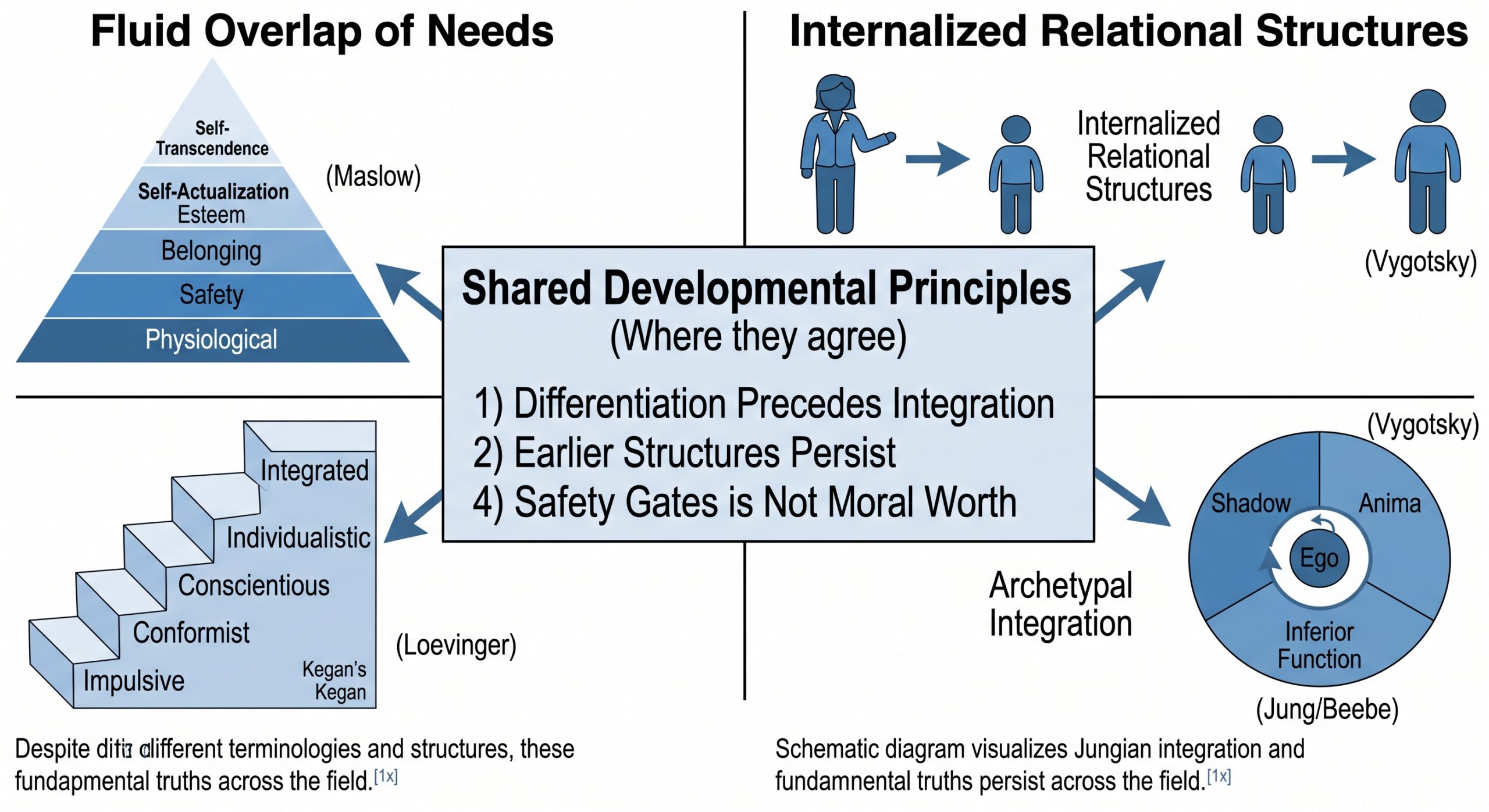
Hierarchies in psychology are stage models that rank needs, conflicts, kinds of reasoning or states of the nervous system from earlier to later. Maslow ranked needs, Erikson lifespan crises, Kohlberg moral reasoning and Kegan the structure of the self, while Jung described individuation as a spiral rather than a ladder. Laid side by side, they share a core that survives the evidence: safety gates complexity, earlier structures persist, and a later stage is not a better person.
Key takeaways
- Maslow never drew a pyramid; the shape was first published by Charles McDermid in 1960, and Maslow himself said his hierarchy was not rigid.
- Kohlberg built his moral stages from interviews with 72 boys, which is why Carol Gilligan asked whose maturity his scale described.
- Loevinger and Kegan describe development as the self learning to see what it was embedded in, which is close to what insight and parts work do.
- Jung’s individuation is a spiral of return rather than a ladder of ascent, and therapy often needs both kinds of movement.
- Across the models, safety gates complexity, earlier structures persist, and a later stage means more complexity, not more human worth.
Every generation of psychologists seems to arrive at the same instinct: the mind develops in stages, the stages stack, and the stack means something. Maslow drew needs. Erikson drew crises. Kohlberg drew moral reasoning. Loevinger drew the ego. Wilber drew almost everything at once. Students usually meet these models one at a time, in different courses, and rarely see them together. The interesting part is not any single hierarchy. It is what happens when you lay them over each other and watch where they agree, where they contradict each other, and where they quietly smuggle in a judgment about what a good human being looks like.
Each major model can be asked the same three questions: what it actually claimed, what the evidence says, and what is left once the classroom version is stripped away.
Did Maslow draw the hierarchy of needs as a pyramid?
Start with the most famous model, because much of what students are taught about it is wrong. Abraham Maslow’s 1943 paper “A Theory of Human Motivation” proposed five groups of basic needs: physiological, safety, love or belonging, esteem, and self-actualization. His claim was that a lower need, when badly unmet, tends to dominate attention, and that a higher need becomes more pressing as the lower ones are partly satisfied.1
He did not draw a pyramid, and he did not describe a rigid sequence. In the same paper he wrote that the hierarchy “is not nearly as rigid as we may have implied,” listed exceptions such as people for whom self-esteem seems more important than love, and stressed that most behavior is driven by several needs at once. He even offered illustrative figures: an average person might have perhaps 85 percent of physiological needs met, 70 percent of safety needs, 50 percent of love needs, 40 percent of esteem needs and 10 percent of self-actualization needs, all at the same time.1
The pyramid came from management writing. Todd Bridgman, Stephen Cummings and John Ballard searched Maslow’s papers and the business literature and traced the first published pyramid to a 1960 article by the consulting psychologist Charles McDermid in Business Horizons. Textbooks then spread the shape because it fit neatly on a slide, and it became fixed to Maslow’s name even though he never used it.2
Maslow also kept revising. In his last years, in the 1969 paper “The Various Meanings of Transcendence” and the essays collected in The Farther Reaches of Human Nature (1971), he described self-transcendence as a motivation beyond self-actualization: a pull toward causes, other people and the sacred that goes past personal fulfillment. Mark Koltko-Rivera has shown how rarely this later version appears in textbooks, and how much it changes the theory, since the top of the hierarchy is no longer the self at all.3 It grew out of his earlier studies of peak experiences, the brief moments of awe and unity he described in the late 1950s and 1960s, though the two ideas are not the same. We trace the full arc of his thinking, and the distortions it picked up, in Maslow’s life and influence.
The strength of the model is that it names something real. People in danger do not pursue meaning, and you cannot do insight work with someone whose housing is unstable or who has not slept in three days. The weakness is that, read as a strict law about the order of needs, it has never held up well. In Gallup World Poll data from 123 countries, Louis Tay and Ed Diener found that Maslow’s needs did look universal, but people drew well-being from social and respect needs even when basic needs were unmet.4 The hierarchy describes a tendency, not a fixed sequence.
What did Erikson’s psychosocial stages add?
Erik Erikson replaced needs with tensions. In Childhood and Society (1950) he set out eight stages, each posing a conflict: trust versus mistrust, autonomy versus shame and doubt, initiative versus guilt, industry versus inferiority, identity versus role confusion, intimacy versus isolation, generativity versus stagnation, and integrity versus despair.5 Each resolution leaves a residue that shapes the next. Unlike Maslow, Erikson ran his model across the whole lifespan, into old age, which was unusual at the time.
Two features make Erikson more useful clinically than he is often given credit for. First, resolution is never total. You do not finish trust; you carry a ratio of trust to mistrust forward. Second, the themes of a stage can be reopened. A midlife divorce can reopen identity. A serious diagnosis late in life can reopen autonomy and shame. We cover the stages, his work on identity formation and his wider influence in Erikson’s life, theory and legacy.
The strength is the lifespan scope and the honesty that development is never clean. The weakness is method. Erikson’s evidence was clinical observation, anthropological fieldwork and psychobiography, such as Young Man Luther (1958) and Gandhi’s Truth (1969), not measurement. Later researchers such as James Marcia, whose 1966 identity-status interview turned the identity stage into something that could be assessed, had to build the measures themselves.
Piaget and Vygotsky: the cognitive fork
Jean Piaget built the most rigorously staged model of the group: sensorimotor, preoperational, concrete operational and formal operational thought. Unlike most stage theorists, he showed the transitions with tasks a child could fail or pass. In the classic conservation task, a child watches the same amount of water poured from a short, wide glass into a tall, thin one. A typical four-year-old says the tall glass now holds more; a typical seven- or eight-year-old says the amount has not changed. That is an observation, not an opinion. Our profile of Piaget’s account of cognitive development goes through the stages in detail.
What Piaget got wrong was timing and universality. Later researchers found children capable of operations earlier than he claimed when the task made sense to them: in James McGarrigle and Margaret Donaldson’s 1974 “naughty teddy” studies, many more young children conserved number when a toy bear seemed to mess up the row by accident. Formal operational thought also turned out to be far from universal in adults. Piaget himself conceded in 1972 that adults may reach formal operations only in their own areas of skill and work.6 His account remains the scaffolding everyone else builds on, even where it has been corrected.
Lev Vygotsky, who died in 1934, offered the sharpest alternative, and it matters most for therapy. Where Piaget saw a child constructing knowledge largely alone, Vygotsky saw development as social at root: every higher function appears first between people and only later inside the individual. His zone of proximal development is the gap between what a person can do alone and what they can do with help, which is close to a precise description of what a therapist does.7 Vygotsky’s significance has grown as the field has moved toward relational models.
The fork matters. Piaget’s hierarchy is internal and maturational. Vygotsky’s is relational and mediated by language and other people. Nearly every later stage theory inherits one assumption or the other, usually without saying which.
Kohlberg’s moral stages and the critique that reshaped the field
Lawrence Kohlberg extended Piaget into moral reasoning: six stages in three levels, preconventional, conventional and postconventional, running from avoiding punishment up to universal ethical principles. He presented dilemmas, the best known being whether a man named Heinz should steal a drug he cannot afford to save his dying wife, and scored the reasoning rather than the answer. That method was clever, and it still is.
The problem was the sample. Kohlberg’s 1958 doctoral study interviewed 72 Chicago-area boys aged 10, 13 and 16, and he followed many of them for the next twenty years.8 In that long follow-up, stage 5 was uncommon and no one was scored at stage 6, which Kohlberg came to treat as a theoretical endpoint rather than a stage people were observed to reach.
Carol Gilligan, who worked with Kohlberg at Harvard, argued in In a Different Voice (1982) that his scoring ranked an ethic of care below an ethic of justice, and that this reflected whose reasoning had been studied rather than a real developmental ceiling.9 The research that followed complicated her claim as well as his. Lawrence Walker’s 1984 review found few consistent sex differences in Kohlberg stage scores, and Sara Jaffee and Janet Hyde’s meta-analysis found only small differences in orientation: women slightly more often used care reasoning and men slightly more often used justice reasoning.10 The debate never fully settled, but it permanently changed how developmental psychology thinks about the neutrality of its own instruments.
The strength is the method: score the reasoning, not the conclusion. The weakness is the lesson every reader of stage theory should carry: a hierarchy built from a narrow sample will encode that sample’s values and call them maturity.
Loevinger and Kegan: how the ego learns to see itself
Jane Loevinger’s model of ego development is the most empirically careful of the adult hierarchies, largely because she built a real instrument to measure it. The Washington University Sentence Completion Test asks people to finish stems such as “When I am criticized…” and scores each answer against defined stages.11 Her sequence runs from impulsive and self-protective through conformist, self-aware, conscientious and individualistic to autonomous and integrated. What develops is not intelligence or morality but the complexity of the frame a person uses to organize experience: how they understand themselves, other people, rules and inner conflict.
Robert Kegan sharpened this into something clinically useful. In The Evolving Self (1982) he argued that development happens when something you were embedded in becomes something you can look at.12 At one stage your relationships have you; at the next, you have your relationships. In Over Our Heads (1994) he traced how adult life demands these shifts, and in later work with Lisa Lahey he named the three adult forms the socialized, self-authoring and self-transforming minds. The move always has the same shape: what was subject becomes object.
This is close to a formal description of what insight-oriented therapy does. A client who says “I am anxious” is embedded in the anxiety. A client who says “there is an anxious part of me that shows up when I am criticized” has made the anxiety an object they can relate to. That shift is the work, and it is why parts-based approaches such as IFS can produce movement where insight alone stalls.
The strength of both models is that they are measurable, focused on adults and legible in a clinical room. The weakness is pace. Ego development moves over years, and most adults settle in the middle of Loevinger’s range, well before the top. Anyone promising rapid stage advancement is selling something.
Neumann: consciousness as a mythological sequence
Erich Neumann’s The Origins and History of Consciousness, published in German in 1949 and in English in 1954 with a foreword by Jung, is the strangest entry here and the one most worth a student’s time.13 Neumann argued that the development of individual consciousness repeats a mythological sequence found across cultures: the uroboros, the serpent eating its own tail, as an undifferentiated beginning; the Great Mother as an engulfing maternal phase; the separation of the World Parents, in which opposites first divide; and the hero’s struggle to establish an independent ego, ending in the transformation myths of the captive and the treasure.
Taken literally as history, the scheme cannot be defended. Taken as a phenomenology of how differentiation feels, with the terror of separation, the pull back toward fusion and the aggression it takes to individuate, it is uncomfortably accurate, and it maps onto clinical material in ways the more sober models do not. Our review of Neumann’s book goes through each stage, and a wider look at Neumann’s archetypal psychology places the book within the rest of his work.
Is Jung’s individuation a hierarchy at all?
Here the comparison gets interesting. Jung’s individuation is the odd one out, because it is not a ladder.
Individuation does not ascend. It circles. The task is not to leave earlier stages behind but to integrate what was split off: the shadow, the contrasexual anima or animus, the inferior function. Movement is toward wholeness rather than height, and the material you most need is usually the material you have been climbing away from. In Psychology and Alchemy (1944) Jung wrote that the path of individuation seems at first to go round in circles and on closer study turns out to be a spiral, with the same dream motifs returning at intervals in changed form. For the fullest treatment see Carl Jung: Explorer of the Soul, and for the process itself, the labyrinth as a model of individuation and Murray Stein’s account of its architecture.
This is a direct structural challenge to every other model here. Kegan says development means making the old frame an object. Jung says development means going back for what the frame left out. Both can be true; they describe different motions.
Edward Edinger pushed this furthest. In Ego and Archetype (1972), building on a term Neumann introduced, he described the ego-Self axis: development as a repeated cycle of inflation, when the ego identifies with the larger Self, alienation, when the connection breaks, and reconnection. Edinger’s model is closer to a pendulum than a staircase. Michael Fordham did the necessary work of bringing Jung into contact with actual infant and child research, describing how a primary self in the infant “deintegrates” to meet the world and then reintegrates, a process he traced in Children as Individuals (1969). We cover Fordham’s integration of developmental and analytical psychology separately.
Beebe: hierarchy inside the personality
John Beebe’s eight-function model applies hierarchy in a different direction: not across time but within one psyche at any moment. Beebe proposed that each of Jung’s cognitive functions occupies an archetypal position. The dominant function carries the hero, the second the good parent, the third the eternal child, and the inferior function carries the anima or animus. Four shadow positions follow: the opposing personality, the critical parent, the trickster and the demonic personality. He set the model out most fully in Energies and Patterns in Psychological Type (2016).
Whatever one thinks of type theory, the structural insight holds: parts of a personality have different status, and the low-status parts behave as low-status things always do. They get projected onto other people, they erupt under stress, and they carry what the dominant function refuses. The Beebe model is worth knowing even if you never use a type indicator.
Polyvagal theory: hierarchy in the nervous system
Stephen Porges‘s polyvagal theory, first set out in 1995, is openly hierarchical, and it is the only model here grounded in evolutionary history. It describes three response systems laid down in order: dorsal vagal immobilization or shutdown, the oldest; sympathetic mobilization for fight or flight; and the ventral vagal social engagement system, the newest and specifically mammalian.14 Under threat, we lose them in reverse order: social engagement first, then mobilization, then collapse. Porges took the principle of dissolution from the neurologist John Hughlings Jackson, who argued in his 1884 Croonian Lectures that damage or stress strips away the most recently evolved functions first.
Clinically this is the most immediately usable hierarchy on the list, because it tells you where a person is and what is available to them right now. Someone in dorsal collapse cannot access insight, and asking them to reframe a thought is asking for something the nervous system has taken offline. Our guide to the biology of safety covers the theory, and the piece on glimmers covers practical application.
Some physiologists, notably Paul Grossman, have challenged parts of the evolutionary account, especially the claim that respiratory sinus arrhythmia, the rise and fall of heart rate with breathing, is unique to mammals and a direct index of the social engagement system.15 Porges has answered these points in later papers. For the clinician the hierarchy of states stands on what can be seen in the room: a client who goes flat and far away, a client who cannot sit still, a client who can laugh. We look at a mythological reading of the theory in your nervous system as a storyteller.
Wilber: the hierarchy of hierarchies
Ken Wilber’s integral model, laid out in books such as Integral Psychology (2000), tries to stack all of the above into one framework of quadrants, levels, lines, states and types. Its central move is that different theories describe different developmental lines, cognitive, moral, emotional, interpersonal and spiritual, which can progress at different rates. Someone can be cognitively advanced and morally stunted, which single-line models cannot account for.
That is the real contribution. The lines idea dissolves a lot of pointless argument between stage theorists. His other lasting contribution is the pre/trans fallacy, first set out in a 1980 essay: pre-rational and trans-rational states can look alike from outside, so mystical experience gets misread as regression and regression gets romanticized as mysticism. Both mystics and people in psychosis get misfiled as a result.
The weakness is scope. Wilber synthesizes across fields faster than any one person can check, and the model as a whole is hard to test. Read him for the organizing questions rather than the answers. We cover the integral vision and, more usefully for students, where Wilber’s ideas actually come from.
What do the stage models agree on?
Strip the vocabulary and four claims survive across nearly every model.
- Differentiation comes before integration. You have to separate things before you can hold them together. Piaget, Neumann, Kegan and Jung all say this in different languages.
- Earlier structures persist. Nothing is outgrown, only included in something larger. This is why regression under stress is universal and not pathological in itself.
- Safety gates complexity. Maslow said it in terms of needs, Porges in terms of the vagus nerve, Vygotsky in terms of support from a more capable other. Threat narrows the range of what a person can do.
- Development is not moral worth. A later stage means more complexity, not more virtue. Loevinger and Kegan said so plainly, yet the field kept reading the top of each ladder as the best kind of person, and Kohlberg’s all-male sample is a permanent reminder of what happens when that distinction slips.
Where do the models break?
The models divide on one question: does development mean going up, or going back for what you left?
The ascent models, Maslow, Kohlberg, Loevinger, Kegan and Wilber, treat earlier stages as scaffolding to build past. The return models, Jung, Neumann, Edinger and most of depth psychology, treat earlier material as unfinished business that will keep surfacing until it is integrated.
In practice, therapy needs both. A person who has never differentiated, who cannot yet tell their own wishes from a parent’s, needs the ascent. A person who is highly differentiated and hollow, successful and articulate and cut off from feeling, needs the return. Telling which is which is most of the clinical skill, and no hierarchy will do it for you.
Advice for students writing about stage theories
If you are writing about these models, three habits will make your work better than most of what is published.
- Name the evidence base. Kohlberg had 72 boys. Loevinger had a validated instrument. Neumann had mythology. These are not equivalent kinds of claim and should not be cited as though they were.
- Ask whose maturity is being described. Every hierarchy encodes a value. Find it and say what it is.
- Watch for the pyramid problem. Maslow’s shape was drawn by someone else and attributed to him for more than sixty years. Check whether the diagram you were taught is actually in the source.
The same questions are worth asking of theorists who resisted stage thinking or worked around it, from Alfred Adler and Karen Horney to Donald Winnicott, Viktor Frankl and James Hillman.
How do developmental hierarchies help in therapy?
A therapist uses these maps less to place someone on a rung than to answer a practical question: what can this person do right now, and what kind of movement is being asked of them? Each model sharpens a different part of that question.
The nervous system comes first. If someone arrives in shutdown or high alarm, the first job is to widen what their body can tolerate, which is why we use body-based methods such as Brainspotting and somatic therapy to work with the state directly before asking for reflection. Brainspotting uses a fixed eye position linked to a felt sense in the body to help a person process material that talking alone keeps circling.
Kegan’s subject-object move describes what parts work does. When a client can say “a part of me panics” instead of “I panic,” the panic has become something they can be curious about, and that opening is where change begins. Vygotsky’s zone of proximal development describes the relationship that makes the step possible: the therapist holds what the client cannot yet hold alone, until they can.
Jung’s spiral describes the clients for whom more achievement is not the answer. Anxiety after a promotion, depression in a life that looks fine from outside, or a midlife crisis that reopens Erikson’s question of identity often call for the return: work with dreams, the shadow and the parts of the self that were left behind on the way up.
At Taproot we treat these hierarchies as tools for listening, never as verdicts on a person’s worth. The work moves between the body, the parts of the self and the deeper patterns Jung described, and our Jungian therapy is where the return, going back for what was left behind, gets the most room.
Frequently asked questions
Who actually created Maslow’s pyramid?
Abraham Maslow described a hierarchy of needs in 1943 but never drew it as a pyramid. Historians Todd Bridgman, Stephen Cummings and John Ballard traced the first published pyramid to consulting psychologist Charles McDermid’s 1960 article in Business Horizons. Management textbooks then spread the image, and it has been attached to Maslow’s name ever since.
Is Maslow’s hierarchy of needs supported by research?
Partly. Maslow’s needs appear across cultures, and in Gallup data from 123 countries Tay and Diener found that meeting them predicts well-being. But people gained well-being from social and respect needs even when basic needs were unmet, so the strict order does not hold. Maslow himself said the hierarchy was not rigid.
What was Carol Gilligan’s criticism of Kohlberg?
In her 1982 book In a Different Voice, Carol Gilligan argued that Lawrence Kohlberg’s moral stages, first built from interviews with 72 boys, ranked an ethic of care below an ethic of justice. Later meta-analyses found only small sex differences in moral orientation, but her argument changed how psychologists think about bias built into developmental measures.
What is Robert Kegan’s subject-object theory?
Robert Kegan’s subject-object theory says a person develops when something they were embedded in, such as their relationships or their emotions, becomes something they can step back and look at. What was subject becomes object. In therapy the same shift happens when a client moves from saying I am anxious to noticing a part of them that gets anxious.
How is Jung’s idea of individuation different from other stage theories?
Most stage theories describe climbing past earlier stages. Carl Jung described individuation as a spiral in which the same themes return at deeper levels, and the work is to integrate what was split off, such as the shadow and the inferior function. Development moves toward wholeness rather than height.
Why is polyvagal theory described as a hierarchy?
Stephen Porges’s polyvagal theory orders three nervous system states by evolutionary age: dorsal vagal shutdown, sympathetic fight or flight, and ventral vagal social engagement. Under threat, people lose the newest system first. Therapists use the model to judge what a person can access in the moment, since someone in shutdown cannot yet use insight.
Related reading
- Why Do We Need Matter to Tell Us We Matter? Psychotherapy’s Search for Meaning Between Science and Spirit
- The Parachute Problem: What a Number Can Hold, What It Can’t, and the Ceremony We Perform So We Never Have to Notice the Difference
- The Ground Truth Revolution: Why Academic Psychology Resists the Fastest-Growing Trauma Therapy in the World
- Is the DSM Dying? Rethinking Suffering
- The Primacy of the Body: Why Somatic and Brain-Based Therapies Outperform Talk Therapy for Emotional Dysregulation
- On Arrogance and Excellence: Deconstructing the Double Binds of Modern Psychotherapy
References
- Maslow, A. H. (1943). A theory of human motivation. Psychological Review, 50(4), 370–396. https://doi.org/10.1037/h0054346
- Bridgman, T., Cummings, S., & Ballard, J. (2019). Who built Maslow’s pyramid? A history of the creation of management studies’ most famous symbol and its implications for management education. Academy of Management Learning & Education, 18(1), 81–98. https://doi.org/10.5465/amle.2017.0351
- Koltko-Rivera, M. E. (2006). Rediscovering the later version of Maslow’s hierarchy of needs: Self-transcendence and opportunities for theory, research, and unification. Review of General Psychology, 10(4), 302–317. https://doi.org/10.1037/1089-2680.10.4.302
- Tay, L., & Diener, E. (2011). Needs and subjective well-being around the world. Journal of Personality and Social Psychology, 101(2), 354–365. https://doi.org/10.1037/a0023779
- Erikson, E. H. (1950). Childhood and society. W. W. Norton.
- Piaget, J. (1972). Intellectual evolution from adolescence to adulthood. Human Development, 15(1), 1–12. https://doi.org/10.1159/000271225
- Vygotsky, L. S. (1978). Mind in society: The development of higher psychological processes (M. Cole, V. John-Steiner, S. Scribner, & E. Souberman, Eds.). Harvard University Press.
- Colby, A., Kohlberg, L., Gibbs, J., & Lieberman, M. (1983). A longitudinal study of moral judgment. Monographs of the Society for Research in Child Development, 48(1–2). https://doi.org/10.2307/1165935
- Gilligan, C. (1982). In a different voice: Psychological theory and women’s development. Harvard University Press.
- Jaffee, S., & Hyde, J. S. (2000). Gender differences in moral orientation: A meta-analysis. Psychological Bulletin, 126(5), 703–726. https://doi.org/10.1037/0033-2909.126.5.703
- Loevinger, J. (1966). The meaning and measurement of ego development. American Psychologist, 21(3), 195–206. https://doi.org/10.1037/h0023376
- Kegan, R. (1982). The evolving self: Problem and process in human development. Harvard University Press. https://doi.org/10.4159/9780674039414
- Neumann, E. (1954). The origins and history of consciousness (R. F. C. Hull, Trans.). Princeton University Press. (Original work published 1949)
- Porges, S. W. (1995). Orienting in a defensive world: Mammalian modifications of our evolutionary heritage. A polyvagal theory. Psychophysiology, 32(4), 301–318. https://doi.org/10.1111/j.1469-8986.1995.tb01213.x
- Grossman, P., & Taylor, E. W. (2007). Toward understanding respiratory sinus arrhythmia: Relations to cardiac vagal tone, evolution and biobehavioral functions. Biological Psychology, 74(2), 263–285. https://doi.org/10.1016/j.biopsycho.2005.11.014



















0 Comments