
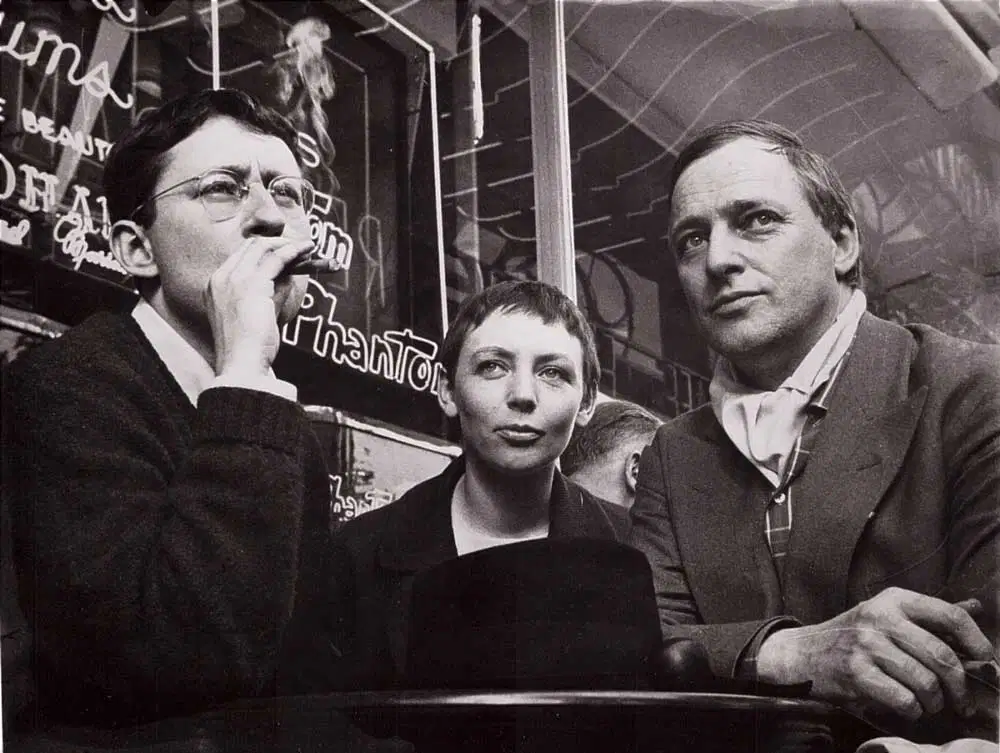
The Situationist International (SI) was a small group of artists, writers and revolutionaries, founded in Italy in 1957 and dissolved in 1972, whose leading voices were Guy Debord and Raoul Vaneigem. They argued that modern life had become a “spectacle” of images that turns people into passive spectators, and they fought it with pranks, hijacked images and playful experiments in living. In psychological terms they behaved like the mythic trickster.
Key takeaways
- The Situationist International was founded at Cosio di Arroscia, Italy, in July 1957 and wound up by Guy Debord and Gianfranco Sanguinetti in 1972.
- Debord’s The Society of the Spectacle (1967) argued that life lived directly has been replaced by representation, a social relationship mediated by images.
- Détournement, the constructed situation, psychogeography and the dérive were the group’s playful tools for breaking the hold of consumer routine.
- The Situationists behaved like the mythic trickster, inverting the culture’s own images, and Jung saw the trickster as a collective shadow figure.
- For therapy, the Situationists name the feeling of watching one’s own life from outside, and point toward play, the shadow and lived experience as ways back.
What was the Situationist International?
The SI set out to fuse art, politics and everyday life into a single revolutionary practice. Its members did not want to make better paintings or better political parties. They wanted people to stop living second-hand lives arranged by advertisers, planners and bosses, and to start constructing their own moments of freely chosen experience. They called those moments “situations,” which is where the group’s name comes from.
The central idea was the spectacle, set out by Guy Debord in La Société du spectacle (1967), translated as The Society of the Spectacle.1 For Debord the spectacle meant the domination of social life by images, representations and commodities, which produces passive consumption, isolation and a thinner, borrowed kind of experience. Vaneigem’s Traité de savoir-vivre à l’usage des jeunes générations, published the same year and known in English as The Revolution of Everyday Life, made the same case from the side of the individual: boredom, humiliation and the loss of pleasure in ordinary days.2
The group’s methods had a mischievous streak that is easy to miss if you know only the theory. They forged, plagiarised, mocked, disrupted and joked. They rewrote comic strips, hijacked a student union’s budget and drifted through cities with no destination. That is why it makes sense to read them through the trickster archetype: the boundary-crossing, convention-defying figure of world mythology who upsets the established order through cunning, play and inversion. Like the trickster, the SI aimed to disrupt the existing order through unconventional tactics, from détournement, the subversive reuse of existing cultural material, to the construction of situations.
Reading the SI this way connects it to anthropology, to psychology and to Jungian thought. Their emphasis on play, spontaneity and desire echoes the trickster’s transgressive and renewing qualities. Their story also shows the trickster’s darker side: sectarian quarrels, purges and a habit of turning on friends. Both sides matter for anyone interested in how people break out of lives that feel scripted for them.
Where did the Situationists come from?
The SI grew out of the avant-garde milieu of postwar Paris. In 1952 Debord, then twenty, and a handful of young radicals broke away from Isidore Isou’s Lettrist movement to form the Letterist International. The Letterists made sound poetry and films, wrote manifestos, and spent long nights drifting through the cafés and backstreets of the Left Bank. They drew on Dada, Surrealism and Marxism, and they shared the conviction that art should not be a separate activity hung on museum walls but a way of changing how life is lived.6
Their early stunts already had the trickster’s signature. In October 1952 the Letterists disrupted Charlie Chaplin’s Paris press conference for Limelight, handing out a leaflet that attacked the beloved clown as a sentimental fixture of the culture industry. From 1954 to 1957 they published a bulletin called Potlatch, named after the gift-giving feasts of the Pacific Northwest and sent out free rather than sold.3
On 28 July 1957, at Cosio di Arroscia in northern Italy, the Letterist International merged with the International Movement for an Imaginist Bauhaus, led by the Danish painter Asger Jorn, and with the London Psychogeographical Association, which was more or less the English artist Ralph Rumney. The new group took the name Situationist International.6 Its journal, Internationale situationniste, ran to twelve issues between 1958 and 1969 and carried the group’s attacks on consumer society, on the bureaucratic socialism of the Soviet bloc and on the cultural conformity of the postwar West.3
The SI was also sectarian. Debord and the inner circle excluded members who strayed from the line, made deals with galleries or simply disagreed too often. In 1962 most of the German and Scandinavian artists were expelled or left, and the group shifted from art and urbanism toward a more explicitly political theory of revolution and workers’ councils. Over its fifteen years, far more people were expelled or resigned than ever belonged at one time.5
What is the society of the spectacle?
The spectacle was the cornerstone of Situationist theory, and it is often misread as a complaint about television. Debord meant something wider. The book opens by rewriting the first line of Marx’s Capital: where Marx saw wealth appearing as an immense accumulation of commodities, Debord saw life appearing as an immense accumulation of spectacles. “Everything that was directly lived,” he wrote, “has moved away into a representation.”1
His fourth thesis is the one most often quoted, and the one that makes the idea psychological rather than merely technological:
“The spectacle is not a collection of images; it is a social relationship between people that is mediated by images.”1
The point is that we come to relate to each other, and to ourselves, through representations: the brand that tells us who we are, the career that tells us what we are worth, the curated picture of a life that stands in for the life. Under the spectacle, individuals become spectators who consume pre-packaged images and goods instead of shaping their own lives.
Debord tied this to capitalism. Once production is organised around commodities, culture, politics and personal identity are all drawn into the market and sold back to us. He distinguished a “concentrated” spectacle, built around a leader’s image in state-run economies, from a “diffuse” spectacle of abundant consumer choice in the West, and in Comments on the Society of the Spectacle (1988) he argued the two had fused into an “integrated” spectacle. In this sense the spectacle is not just a distortion of reality but an expression of what Marx called alienation and what the Hungarian philosopher Georg Lukács called reification: human relations taking on the cold appearance of relations between things.15
What are détournement and the constructed situation?
To fight the spectacle the Situationists developed two main practices. The first was détournement, a French word meaning diversion, hijacking or misappropriation. Debord and Gil J. Wolman laid out the method in “A User’s Guide to Détournement” (1956): take existing images, texts, films or slogans and put them into a new arrangement that turns them against their original meaning.3 They liked to cite the nineteenth-century poet Lautréamont: “Plagiarism is necessary. Progress implies it.” Debord himself détourned that line in thesis 207 of The Society of the Spectacle.
Examples ran from the crude to the elegant. Situationists replaced the speech bubbles in romance and adventure comics with dialogue about alienation and revolution. Asger Jorn bought amateur landscape paintings in flea markets and painted monsters and graffiti over them, exhibiting the results in 1959 as “Modifications.” René Viénet took a Hong Kong martial arts film and dubbed it with a Situationist soundtrack as Can Dialectics Break Bricks? (1973). In each case the familiar is made strange, and the viewer is jolted out of the half-sleep in which advertising works best.
The second practice was the construction of situations. In his “Report on the Construction of Situations” (1957), the founding document of the SI, Debord described a situation as a deliberately built moment of life, a temporary ambience made by a group of people together with their setting, raised to a higher quality of passion and play.4 A situation was meant to be a rupture in routine that opened new possibilities for creativity, desire and self-realisation.
The Situationists believed this was the real road out of the spectacle. Rather than waiting for a distant revolution, radicals should begin experimenting with new forms of life and relationship now. That emphasis on transforming everyday life, rather than on abstract programmes and party lines, was the hallmark of the SI and the thing that separated it from the orthodox left. It owed a debt to the Dutch historian Johan Huizinga, whose Homo Ludens (1938) had argued that play is older than culture and runs through law, war, poetry and ritual. The first issue of the SI’s journal in 1958 included a short “Contribution to a Situationist Definition of Play” that took up Huizinga and tried to strip play of its competitive element.93
What are unitary urbanism, psychogeography and the dérive?
The Situationists saw the city as the place where the spectacle is built in concrete. Modern planning divided life into zones for sleeping, working, shopping and commuting, and it shaped people’s movements as surely as advertising shaped their wants. On this point they learned from the Marxist philosopher Henri Lefebvre, whose Critique of Everyday Life (first volume 1947) had already made the routines of daily life a subject for serious theory. Debord and Lefebvre were close from about 1958 until a quarrel in the early 1960s.10
Against functional planning the SI proposed unitary urbanism: an approach to architecture that would combine art, technology and play to make environments built around desire rather than around traffic and consumption. Ivan Chtcheglov’s “Formulary for a New Urbanism,” written in 1953 under the name Gilles Ivain and published in the first issue of the journal, dreamed of a city of moods and quarters for every emotion. The Dutch painter Constant Nieuwenhuys spent some fifteen years on New Babylon, a model of a world city on raised platforms that its nomadic inhabitants would constantly rebuild for play.5
Psychogeography was the research arm of this project. Debord defined it in 1955 as the study of the specific effects of the geographical environment, consciously organised or not, on the emotions and behaviour of individuals. Its main method was the dérive, or drift. In “Theory of the Dérive” (1956) Debord described it as a rapid passage through varied ambiences in which a small group lets go of its usual reasons for moving, such as work or errands, and lets itself be drawn by the attractions and repulsions of the terrain.3 It was not aimless wandering. The drifters noted where a street pulled them in, where a square made them uneasy, where one district abruptly gave way to another, and some drew maps of these currents, such as Debord’s cut-up map of Paris, “The Naked City” (1957).
Historians have compared the dérive with the nineteenth-century flâneur, the idle stroller of Baudelaire’s Paris whom Walter Benjamin made into a figure of modern experience. Tom McDonough has shown that the Letterists’ drift had a rougher, more deliberately transgressive edge than the flâneur’s leisurely gaze, closer to the vagrant and the delinquent than to the shopper.13
What happened to the SI in May 1968 and after?
The SI’s moment came in 1968. Two years earlier, in Strasbourg, students sympathetic to the group won election to the university’s student union and spent its funds printing about ten thousand copies of Mustapha Khayati’s pamphlet On the Poverty of Student Life, a scathing attack on students as docile future managers. The scandal made the SI notorious among young radicals across France.3
When students and workers rose in May 1968, the Situationists were one small group among many, but their ideas and phrases were everywhere. Members joined the Occupation Committee of the Sorbonne and then formed the Council for Maintaining the Occupations, which pushed for workers’ councils and printed posters and songs. Walls in Paris carried slogans in the Situationist spirit, and Debord’s own 1953 chalked graffito, “Ne travaillez jamais” (Never work), became a touchstone for the movement. The general strike, which involved around ten million workers at its height, seemed for a few weeks to confirm the SI’s claim that everyday discontent could become revolution.6
The aftermath broke the group. Internal disputes and accusations multiplied, new members came and went, and Raoul Vaneigem resigned in November 1970. In 1972 Debord and the Italian Situationist Gianfranco Sanguinetti published The Veritable Split in the International, which wound the SI up, arguing that the group had done its historical work and was now in danger of becoming a celebrity, a spectacle of revolt admired by fans rather than a living practice.5
For a group that never had more than a few dozen members at a time, its afterlife has been large. The SI’s critique of consumerism, media manipulation and alienated everyday life shaped punk, especially through Malcolm McLaren and the designer Jamie Reid’s work for the Sex Pistols, and later fed the anti-globalisation movement, culture jamming and “subvertising.” Its emphasis on play, creativity and spontaneity still inspires artists, activists and urban walkers around the world.14
Why call the Situationists tricksters?
The trickster is found in myths across the world: Hermes in Greece, Loki in Norse myth, Coyote and Raven in North America, Eshu among the Yoruba, Anansi in West Africa and the Caribbean. He lies, steals, changes shape and crosses every line, and in doing so he often brings something new into the world, from fire to language to the markets themselves. Lewis Hyde, in Trickster Makes This World (1998), argues that the trickster is the spirit of the doorway and the boundary, and that cultures need such figures to stay alive and to change.8 His cousin the jester archetype does similar work inside the king’s court.
Inversion and sabotage
Détournement is the trickster’s favourite move: take the master’s tools and turn them against the master. Hermes steals Apollo’s cattle by making them walk backwards; the Situationists stole the speech bubbles of comics and the frames of films and made them say the opposite of what they were built to say. By turning the instruments of the spectacle against themselves, the SI aimed to expose how empty and arbitrary consumer society’s messages are.
Play and reenchantment
The SI’s faith in play, spontaneity and imagination echoes the trickster’s playful and subversive side. For the Situationists, constructing situations was a way of reenchanting the world, filling ordinary life with surprise, wonder and possibility. Their utopia, a society where work and play, art and life would no longer be separate, resembles the role the trickster plays in many traditional cultures: the clown at the ceremony who mocks the sacred so that the sacred stays alive.
Paradox inside the group
Even the SI’s group life had a tricksterish quality. Its members argued constantly, challenged each other’s positions, and broke apart and recombined. The Situationists presented this as rigour and as a refusal of hierarchy. It also reflected the trickster’s love of paradox and contradiction, and of the carnival’s overturning of roles: the same people who denounced leaders followed Debord, and the same group that preached freedom expelled its friends.
Jung, the trickster and the shadow
From a Jungian perspective the SI’s trickster energy can be read as an attempt to bring back what a society represses. Carl Jung wrote “On the Psychology of the Trickster-Figure” for Paul Radin’s study of the Winnebago trickster cycle, published in English in 1956 with a commentary by the mythologist Karl Kerényi.7 Jung called the trickster a “collective shadow figure,” a summing up of the inferior, unruly traits that a civilised culture pushes out of sight. The Jungian shadow is everything we refuse to see in ourselves, and Jung believed that when it is ignored it returns in uglier form. By releasing transgressive energy into public life, the SI hoped to shatter the illusions of the spectacle and change both consciousness and social relations.
The same depth is visible in the SI’s interest in myth, symbol and the unconscious, inherited from Surrealism. Debord’s films use images in a way that feels closer to dream than to documentary. His first film, Howls for Sade (1952), had no images at all: a white screen while voices spoke and long stretches of black screen in silence, ending with twenty-four minutes of darkness. Later films such as The Society of the Spectacle (1973) and In girum imus nocte et consumimur igni (1978) cut together advertisements, war footage, Westerns and street scenes so that the culture’s own images comment on themselves. Cornelius Castoriadis, whose group Socialisme ou Barbarie Debord briefly joined in 1960 and 1961, would later describe the “social imaginary” as the deep source from which each society creates its meanings, an idea that sits close to Jung’s collective unconscious as a reservoir of shared images and energies.
The SI also differed from classical Jungian thought. Jung focused on individuation, the inner work of becoming whole. The Situationists insisted that personal liberation could not be separated from changing the material and social world. Their goal was not only to explore the depths of the psyche but to build a world in which, in the words of Marx and Engels’ Communist Manifesto, the free development of each would be the condition for the free development of all.
How do the Situationists connect to anthropology and sociology?
The SI’s interest in gift, festival and ritual echoes thinkers who looked to premodern societies for an alternative to the cold logic of utility. Marcel Mauss, in The Gift (1925), showed that in many societies exchange is a matter of honour, obligation and relationship rather than profit, and he described the potlatch of the Kwakwaka’wakw and other peoples of the Pacific Northwest, where chiefs competed by giving away or destroying wealth.11 Georges Bataille built on Mauss in “The Notion of Expenditure” (1933) and The Accursed Share (1949), arguing that every society must spend its surplus in festivals, sacrifice, luxury or war. The Letterists’ bulletin Potlatch was a direct nod to this tradition.
Like these thinkers, the Situationists were interested in how shared acts of lavish spending, destruction and transgression could dissolve hierarchies and create new solidarities. Potlatch feasts, ancient sacrificial rites and the carnivals of medieval Europe all fed their picture of a world turned upside down, where sacred and profane, high and low would meet. The anthropologist Victor Turner would later name this experience communitas: the intense, levelling fellowship that appears in the liminal, in-between phase of a ritual, when ordinary statuses are suspended.
The SI’s anti-colonial politics set them apart from the romantic primitivism of some earlier avant-gardes. They wrote in support of the Algerian revolt against France and, in “The Decline and Fall of the Spectacle-Commodity Economy” (1965), defended the Watts uprising in Los Angeles as a revolt against the commodity itself.3 For the Situationists the point was not to idealise or imitate premodern cultures but to draw from them principles of revolt and self-determination that could serve the present.
That project ran parallel to the radical anthropology of the late 1960s and 1970s, which questioned the discipline’s ties to colonial rule. Dell Hymes edited Reinventing Anthropology (1972), a collection that called for an anthropology accountable to the people it studied; Stanley Diamond contributed “Anthropology in Question” and went on to found the journal Dialectical Anthropology.12 These anthropologists worked independently of the SI, but they shared its suspicion of detached expertise.
Sociology offers closer kin. Lefebvre’s critique of everyday life came first and taught the young Situationists a great deal; his later phrase “the bureaucratic society of controlled consumption,” from Everyday Life in the Modern World (1968), restates in sociological language much of what the SI meant by the spectacle.10 Jean Baudrillard, who studied under Lefebvre, took the analysis in his own direction in The Consumer Society (1970) and Simulacra and Simulation (1981), arguing that signs no longer hide reality but replace it.
For all these affinities the SI guarded its independence fiercely. It had little patience for academic jargon, and it constantly warned against “recuperation,” the process by which a culture absorbs and defuses the ideas that oppose it. For the Situationists radical theory was inseparable from radical practice, and a concept was worth only what it could change in the concrete conditions of everyday life.
Where did the Situationists fall short?
An admirer of the SI can still see its limits. The most obvious was its sectarianism. The habit of total opposition led the group to reject allies, and the cycle of exclusions created an atmosphere of suspicion and self-righteousness that sometimes put purity ahead of results.
The theory had tensions too. The critique of the spectacle was powerful and prescient, but at times it reduced every cultural and political struggle to a single economic logic. The SI welcomed automation as a way to end drudgery while also attacking the technocratic faith in “progress,” and it never fully reconciled the two attitudes.
For all their talk of “realising art” and “abolishing work,” the Situationists never described in detail what a liberated society would look like. Their call for workers’ councils, which owed much to the Dutch council communist Anton Pannekoek, read more as poetry than as a plan, and their dismissal of reforms as “spectacular” concessions could slide into an all-or-nothing purism.
Finally, the trickster has risks of his own. Provocation can puncture complacency, but it can also become an empty gesture or a performance for an in-group. The celebration of play and spontaneity sometimes downplayed the patient, unglamorous work that lasting change requires. Myth knows this as well: the trickster who outwits everyone usually ends up outwitting himself.
How do the Situationists sit among media and cultural theorists?
The SI belongs to a wider conversation about how media and consumer culture shape the psyche. Edward Bernays, Freud’s nephew, had shown in the 1920s how public relations could steer desire, and the psychology of advertising he helped build is exactly the machinery the Situationists wanted to hijack. Erich Fromm, in The Sane Society (1955), described the “marketing orientation,” a character that experiences itself as a commodity for sale, a close cousin of Debord’s spectator.
Marshall McLuhan published Understanding Media in 1964, three years before Debord’s book; where McLuhan was fascinated by how media reshape the senses, Debord saw the same changes as a form of domination. Neil Postman‘s Amusing Ourselves to Death (1985) made a similar argument for American television, warning that entertainment had become the form of all public discourse. Vilém Flusser on technical images, Friedrich Kittler on media as the hardware of thought, Lev Manovich on the language of new media, Claude Shannon and Warren Weaver’s mathematical theory of communication, and Donna Haraway‘s cyborg each describe parts of the same machinery that the SI called the spectacle.
The existentialists sit nearby too. Albert Camus‘s rebel, who says no to an absurd order and yes to life, shares the SI’s refusal, and Søren Kierkegaard‘s attack on “the public” as a faceless crowd that lets no one be a self anticipates the passive spectator. In the language of cultural psychology, the Situationists walked the left-hand path of transgression and individual revolt rather than the right-hand path of order and conformity.
Glossary of Situationist International concepts
Détournement
- The hijacking or recontextualising of existing images, texts, films and ideas so that they undermine their original meaning and carry a new, satirical or revolutionary one.
- A key Situationist tactic for challenging the language and imagery of consumer capitalism and the society of the spectacle, set out by Debord and Wolman in 1956.
- Examples include altered advertisements, rewritten comic strips, overpainted flea-market canvases and redubbed films.
Dérive
- A drift through a city in which a small group drops its usual motives for moving and follows the pulls and repulsions of the terrain, in order to study its psychogeography.
- A way of exploring urban space outside the routines of work and shopping, and of noticing how different places evoke different moods and behaviour.
- The aim was to break habitual, alienated relations with the city and make room for freer and more playful ways of living in it.
Unitary urbanism
- A proposed approach to architecture and planning that would end the division of the city into zones for living, working and consuming and create spaces for play, creativity and community.
- Against modernist functional planning, it called for cities organised around real human desire and the construction of situations.
- Constant’s New Babylon and Chtcheglov’s “Formulary for a New Urbanism” are its best-known utopian plans.
Constructed situation
- A deliberately built moment of life, made by a group together with its surroundings, meant to raise experience to a higher level of passion and play and to expose the passivity of ordinary routine.
- It anticipated a future society built on the continuous free construction of situations.
- Situationist gatherings, scandals and interventions were early, partial attempts at the idea.
Psychogeography
- In Debord’s 1955 definition, the study of the specific effects of the geographical environment, consciously organised or not, on people’s emotions and behaviour.
- A way of investigating how urban space is arranged to encourage consumption and docility, and of experimenting with alternatives.
- Through the dérive and maps such as “The Naked City,” the Situationists looked for freer ways of inhabiting and altering the city.
Spectacle
- In Debord’s analysis, the dominant form of modern capitalist society, in which directly lived experience is replaced by representation and passive consumption.
- Social life becomes an endless stream of commodified images, advertisements, media and brands that monopolise appearances and define what counts as real.
- Debord insisted that the spectacle is not a collection of images but a social relationship between people mediated by images, one that hides and justifies domination.
Alienation
- For the Situationists, the condition of life and labour under capitalism in which people are cut off from their own creativity, desire and power and live as isolated consumers and workers.
- Everyday life becomes a matter of accepting roles, habits and wants supplied by the culture and the spectacle.
- The SI sought to overcome alienation through the collective “realisation of art” in everyday life.
Radical subjectivity
- The Situationist, and especially Vaneigem’s, emphasis on lived experience, desire, spontaneity and creativity as the basis of revolutionary theory and practice.
- Against the abstract, bureaucratic “objective” Marxism of the Stalinist parties, it affirmed each person’s passionate refusal of an alienated life.
- Vaneigem saw the liberation of subjectivity through the revolution of everyday life as the key to a real social revolution.
Recuperation
- The process by which subversive ideas, practices and styles are repackaged and absorbed back into mainstream society, losing their sting.
- The Situationists saw it as a constant threat to any avant-garde: revolts become fashions and slogans become products.
- The SI tried to resist it through constant innovation, scandal and refusal, and Debord ended the group partly to keep it from being recuperated.
Anti-cinema
- The Situationist critique and practice of film against the narrative conventions of commercial cinema.
- If the spectacle makes viewers passive, anti-cinema aimed to wake up their critical consciousness and creativity.
- Key works include Debord’s Howls for Sade (1952), Critique of Separation (1961) and the found-footage film The Society of the Spectacle (1973).
Realisation and abolition of art
- The Situationists inherited Dada’s and Surrealism’s drive to merge art and life but judged both had failed. In Debord’s formula, Dada tried to abolish art without realising it, and Surrealism tried to realise art without abolishing it.
- For the SI, realising art meant not making art a specialist profession but spreading creative activity through every part of life, through the construction of situations.
- Borrowing Marx and Engels’ phrase from The German Ideology, they looked to “the real movement which abolishes the present state of things” to make every person the artist of their own everyday life.
What can therapy learn from the Situationists?
The Situationists were not therapists, but they asked a question that comes into every therapy room: whose life am I living? Many people arrive describing something close to Debord’s spectator. They have done what was expected, collected the approved roles and possessions, and still feel that their life is happening on a screen a few feet away. Depression, chronic anxiety, burnout and a flat, numb boredom often carry this quality. Vaneigem’s descriptions of daily humiliation and lost pleasure read at times like a clinical account of those states.
In Jungian therapy we treat that flatness as meaningful rather than as a fault to be corrected. The trickster usually turns up when a life has become too orderly: in dreams of thieves and clowns, in slips and accidents, in an urge to break something. We work with those images as messages from the shadow, the parts of a person that were exiled to keep the peace, and help the person integrate that energy rather than either suppressing it or acting it out destructively. Play matters here. Donald Winnicott argued in Playing and Reality (1971) that psychotherapy happens in the overlap of two people playing, and that it is in playing that a person discovers a self that feels real.
The dérive has a quiet clinical cousin in attention to the body and to place. Somatic and brain-based approaches such as Brainspotting start from the observation that where we look, and where we are, changes what we feel. Noticing how a particular room, street or memory lands in the body is a kind of personal psychogeography, and it can reveal what the conscious story leaves out.
The SI’s warnings also apply to therapy itself. Recuperation happens inside people too: a moment of real change can be turned into a new script, a self-improvement product or a performance of having healed. At Taproot we try to keep the work tied to lived experience rather than to borrowed images of wellness, and to the existential questions of freedom, responsibility and meaning that the Situationists, for all their fury, were asking.
The Situationists wanted people to stop watching their lives and start living them, and they reached for play, mischief and the shadow to do it. That aim is close to the heart of depth-oriented therapy. If you notice the trickster stirring in your own life, as restlessness, rebellion or a sense that something has to break, the therapists at Taproot work with that energy through Jungian, somatic and existential therapy, and you can contact Taproot Therapy Collective to begin.
Frequently asked questions
Who founded the Situationist International?
The Situationist International was founded on 28 July 1957 at Cosio di Arroscia in Italy by merging Guy Debord’s Letterist International, Asger Jorn’s International Movement for an Imaginist Bauhaus and Ralph Rumney’s London Psychogeographical Association. Debord remained its central figure, and Raoul Vaneigem became its second major theorist until he resigned in 1970.
What does Debord mean by the spectacle?
For Guy Debord the spectacle is not simply mass media or advertising. In The Society of the Spectacle (1967) he describes it as a social relationship between people that is mediated by images, a condition in which what was once directly lived has become representation, so that people become passive spectators of lives organised around commodities.
What is a dérive in psychogeography?
A dérive, French for drift, is the Situationist practice of moving through a city without the usual purposes of work or shopping, letting the pulls and repulsions of different streets and districts guide the route. Guy Debord described it in 1956 as a way of studying psychogeography, the effect of surroundings on emotion and behaviour.
Why are the Situationists compared to the trickster archetype?
The Situationists are compared to the trickster because they crossed boundaries and turned the culture’s own tools against it, rewriting comics, overpainting kitsch canvases and redubbing films. Like Hermes or Coyote, they used mischief and play to disrupt order, and Jung’s view of the trickster as a collective shadow figure helps explain the energy they released.
What role did the Situationists play in May 1968?
The Situationists were a small group during the May 1968 uprising in France, but their ideas spread widely. Members sat on the Sorbonne Occupation Committee and then formed the Council for Maintaining the Occupations, which called for workers’ councils. Their 1966 Strasbourg pamphlet On the Poverty of Student Life had already made them known among students.
Related reading
- Eugene Gendlin: A Biographical Timeline
- The Theories and Ideas of Rollo May
- The Interpersonal Theory of Psychiatry: Harry Stack Sullivan’s Vision of the Social Self
- Hannah Arendt: The Ethics of Politics, The Politics of Art
- The Object Relations Theory of Ronald Fairbairn:
- The Significance of Lev Vygotsky in Psychology and Education
References
- Debord, G. (1994). The society of the spectacle (D. Nicholson-Smith, Trans.). Zone Books. (Original work published 1967)
- Vaneigem, R. (2012). The revolution of everyday life (D. Nicholson-Smith, Trans.). PM Press. (Original work published 1967)
- Knabb, K. (Ed. & Trans.). (2006). Situationist International anthology (Rev. ed.). Bureau of Public Secrets.
- McDonough, T. (Ed.). (2002). Guy Debord and the Situationist International: Texts and documents. MIT Press.
- Wark, M. (2011). The beach beneath the street: The everyday life and glorious times of the Situationist International. Verso.
- Plant, S. (1992). The most radical gesture: The Situationist International in a postmodern age. Routledge.
- Radin, P. (1956). The trickster: A study in American Indian mythology (with commentaries by K. Kerényi and C. G. Jung). Philosophical Library.
- Hyde, L. (1998). Trickster makes this world: Mischief, myth, and art. Farrar, Straus and Giroux.
- Huizinga, J. (1949). Homo ludens: A study of the play-element in culture. Routledge & Kegan Paul. (Original work published 1938)
- Lefebvre, H. (1991). Critique of everyday life: Vol. 1. Introduction (J. Moore, Trans.). Verso. (Original work published 1947)
- Mauss, M. (2002). The gift: The form and reason for exchange in archaic societies (W. D. Halls, Trans.). Routledge. (Original work published 1925) https://doi.org/10.4324/9780203407448
- Hymes, D. (Ed.). (1972). Reinventing anthropology. Pantheon Books.
- McDonough, T. (2002). The crimes of the flaneur. October, 102, 101-122. https://doi.org/10.1162/016228702320826470
- Marcus, G. (1989). Lipstick traces: A secret history of the twentieth century. Harvard University Press.











0 Comments