
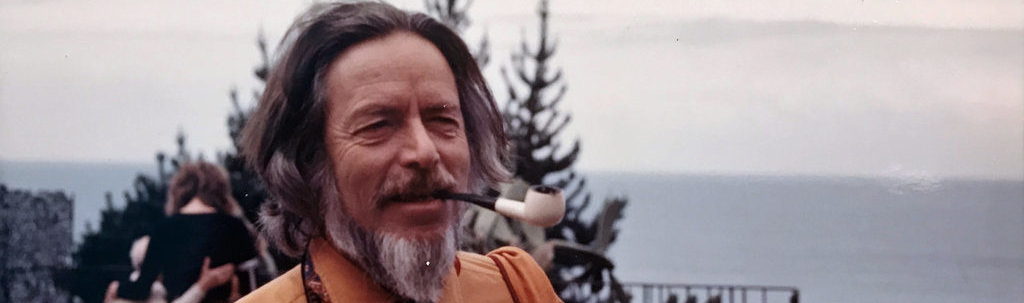
Alan Watts (1915 to 1973) was a British-born writer and broadcaster who translated Zen Buddhism, Taoism and Vedanta into plain Western language. Books such as The Wisdom of Insecurity (1951), The Way of Zen (1957) and Psychotherapy East and West (1961) argued that much human anxiety comes from mistaking a lonely, separate ego for the whole self, an idea that still shapes depth and humanistic psychotherapy.
Key takeaways
- Alan Watts (1915-1973) was a British-born writer and broadcaster who explained Zen, Taoism and Vedanta to Western audiences in plain language.
- Watts argued that the skin-encapsulated ego, the feeling of being a separate self behind the eyes, is a social convention and a major source of anxiety.
- In Psychotherapy East and West (1961) he described Eastern traditions as ways of liberation that resemble psychotherapy more than religion.
- Watts lived with heavy drinking, three marriages and money troubles, and he died in his sleep on Mount Tamalpais in November 1973, aged 58.
- His ideas about reversed effort, wu wei and a self larger than the ego remain useful in Jungian, existential and somatic therapy.
Who was Alan Watts?
Alan Wilson Watts was not an academic philosopher, a scholar of Sanskrit or Japanese, or a trained psychologist. He called himself a philosophical entertainer, and the label fits: his gift was explanation. He took ideas that Western readers found foreign or forbidding and made them sound like common sense, using examples from music, dance, cooking and biology.
He arrived in a postwar America organised around consumer goods, scientific confidence and conventional church religion, and he spoke to that culture the way a Zen koan speaks to a student: by puzzling it. Through his books, radio talks and seminars he introduced a very large audience of readers and listeners to Zen, Taoism and Vedanta as ways of living rather than museum pieces. His work fed directly into the 1960s counterculture, the human potential movement and the early vocabulary of transpersonal psychology.
For therapists the most useful questions about Watts are psychological ones. How did an English schoolboy become an Episcopal priest and then the best-known voice of Eastern thought in America? And how do his ideas about the illusion of the separate ego meet Jung’s idea of individuation, and the anxiety, identity and fear of death that clients bring into a consulting room?
How did his interest in the East begin?
Watts was born on 6 January 1915 in Chislehurst, Kent, on the edge of London. His father, Laurence Watts, worked for the Michelin tyre company; his mother, Emily, taught at a boarding school whose pupils were largely the children of missionaries to China. Returning families brought her gifts of Chinese and Japanese art, and the young Watts grew up among painted landscapes and ceramics that showed a very different picture of nature from the one taught in church.
He was educated at the King’s School, Canterbury, where he was expected to move towards the Church of England. Instead he read Lafcadio Hearn on Japan, and by his mid-teens he was calling himself a Buddhist.
The Buddhist Lodge in London
As a teenager Watts joined the Buddhist Lodge in London, led by the barrister Christmas Humphreys, and worked for it, including editing its journal, later called The Middle Way. In 1932, aged 16 or 17, he wrote a booklet, An Outline of Zen Buddhism, and in 1936, at 21, he published his first book, The Spirit of Zen, which drew heavily on the Japanese scholar D.T. Suzuki.1 That same year he met Suzuki in person at the World Congress of Faiths in London. Watts never went to university; the Lodge, its Theosophist-leaning members and its library were his education.
From these years he took the conviction that the great religions share one underlying insight, the idea later popularised as the perennial philosophy. Unlike many Western converts, who treated Buddhism as an ethical code or a religion of renunciation, Watts was drawn to the aesthetic and experiential side of Zen: its spontaneity, its humour and its suspicion of words. He saw in it a remedy for the stiff manners of the English class system and the guilt-laden morality he associated with the church. That tension, between the spontaneity of Zen and the rigidity of Western institutions, ran through the rest of his career.
Why did Watts become a priest, and why did he leave?
In 1938 Watts married Eleanor Everett, whose mother, Ruth Fuller Everett (later Ruth Fuller Sasaki), was a serious student of Zen, and the couple moved to New York. There he studied briefly with the Zen teacher Sokei-an Sasaki and published The Meaning of Happiness (1940), a book that already set Eastern ideas beside the psychology of Carl Jung.
Then, to the surprise of his Buddhist friends, he enrolled at Seabury-Western Theological Seminary in Evanston, Illinois. He was ordained an Episcopal priest in the mid-1940s and served as chaplain at Northwestern University until 1950.10 He did not see this as a betrayal of Buddhism. In Behold the Spirit (1947) he argued that Christianity had lost touch with its own mystical core, the direct experience of union with God described by its contemplatives, and that Asian traditions could help it recover that core.2
His sermons and teaching drifted further from orthodoxy, and by 1950 his first marriage had broken down. In the spring of that year he resigned from the ministry and left Chicago for a farmhouse near Millbrook in upstate New York, where he began writing The Wisdom of Insecurity. Early in 1951 he moved to San Francisco at the invitation of Frederic Spiegelberg to teach at the American Academy of Asian Studies, where he later served as dean. This was the start of his freelance life as a writer and speaker, and of his most influential work. The Taoism of Lao Tzu, which he had loved since adolescence, became more and more central to that work, until his last book, Tao: The Watercourse Way, published after his death in 1975.
What are the core ideas in Alan Watts’s philosophy?
Watts wrote more than twenty books and gave hundreds of recorded talks, but a handful of ideas recur in all of them. Each one challenges a habit of mind that most Westerners never think to question.
The skin-encapsulated ego
Watts’s best-known phrase is the skin-encapsulated ego. In The Book: On the Taboo Against Knowing Who You Are (1966) he described the ordinary Western sense of self as a hallucination: the feeling that “I” am a small, separate thing living somewhere behind the eyes, looking out at a foreign and often hostile universe.8 He borrowed the Hindu idea of maya, usually translated as illusion, to argue that this separation is a convention of language and society, not a fact.
His alternative image was that we do not come into the world from outside; we come out of it, the way a wave comes out of the ocean or a leaf grows from a tree. A person is something the whole universe is doing at one particular place, an opening through which it experiences itself. Watts thought this reframing loosened the grip of isolation and the dread of death, because the self that seems to die alone is a social fiction laid over a much larger process.
The wisdom of insecurity
Subtitled A Message for an Age of Anxiety, The Wisdom of Insecurity (1951) argues that the hunger for safety and certainty is itself the main source of insecurity.3 The more we try to fix the present moment in place, the more it slips away, and the more anxious we become about losing it. Watts called this the law of reversed effort: a swimmer who fights to stay on the surface sinks, while one who relaxes into the water floats.
The image of water fits the point well. Clutched in a fist it runs out between the fingers; held in an open, cupped hand it stays. Watts linked this to the Taoist principle of wu wei, often translated as effortless or non-forcing action, which he explained at length in The Way of Zen (1957).4 Wu wei is not passivity. It is acting with the grain of a situation rather than against it, as a carpenter works with the grain of wood.
The double bind of morality
Watts was sharply critical of the guilt built into Western moral teaching. He used the term double bind, taken from his friend the anthropologist Gregory Bateson, whose research group described the double bind in 1956 as a communication that issues contradictory demands and forbids the listener to point out the contradiction or leave the situation.11 Society, Watts said, commands us to be good, loving and spontaneous, yet love and spontaneity cannot be produced on command. Trying to force oneself to be unselfish only becomes a subtler form of self-concern.
His answer was that real kindness grows out of the felt recognition that we are bound up with one another and with nature, not out of fear of punishment. Clinicians who work with shame will recognise the pattern: the harder a person scolds themselves into being better, the more stuck they get. Bateson’s idea has since been followed into work on trauma and the double bind, where contradictory messages in childhood leave a person unable to act without feeling wrong.
How did Alan Watts influence psychotherapy?
Watts was a philosopher, not a clinician, but his influence on mental health was wide. He taught at the Esalen Institute in Big Sur in its early years, and he lectured on the same college and growth-centre circuit as Abraham Maslow and Carl Rogers. He was not a collaborator of either man, but his books gave many readers and therapists a philosophical language for the move from Freud’s focus on pathology towards the growth-oriented view of humanistic psychology, and for the existential concerns that writers such as Rollo May brought into practice.
Psychotherapy East and West
His most direct statement on therapy is Psychotherapy East and West (1961).6 Its central claim is that Buddhism, Taoism, Vedanta and yoga resemble psychotherapy more than they resemble Western religion or philosophy. Watts called them ways of liberation: methods for freeing a person from the conditioning of their society, its rules, roles and definitions of who they are.
On this reading the guru and the therapist do similar jobs. Neurosis, for Watts, was often a case of mistaken identity: the person suffers because they have believed the social story that they are a separate, isolated ego that must defend itself against the world. The helper’s task is less to repair a broken mechanism than to help the person see through the game they have been taught to play. Watts was struck by the work of Jay Haley, who described how therapists sometimes place patients in benign double binds, and he compared this to the way a Zen master uses a koan to exhaust a student’s ordinary reasoning until something gives.
Watts and Jungian thought
Watts admired Jung, and in 1958, on a trip to Europe with his father, he visited him at his home in Küsnacht.9 Both men were interested in the union of opposites and in the intelligence of the unconscious. Jung had written his own commentaries on Eastern texts, collected in Psychology and Religion: West and East.15 Watts’s picture of a larger identity beneath the ego sits close to Jung’s concept of the Self, the centre and totality of the psyche, and his critique of social roles parallels Jung’s account of the persona.
Watts also helped spread the idea that the rejected parts of the personality, what Jung called the shadow, have to be accepted and integrated rather than fought or cut away. Where Jung spoke of a long process of individuation, Watts tended to speak of a sudden shift of perspective, but they were describing the same move away from identifying with the ego alone.
Psychedelics and the experience of ego dissolution
Watts first took LSD in the late 1950s and later experimented with mescaline and psilocybin. In The Joyous Cosmology (1962), which carried a foreword by Timothy Leary and Richard Alpert, he described these states as a temporary dissolving of ego boundaries in which the unity he had written about became something felt rather than argued.7 He knew Timothy Leary well and argued with him about how such experiences should be used; in 1967 he hosted the Houseboat Summit with Leary, Allen Ginsberg and Gary Snyder on his Sausalito ferryboat.
Watts did not treat the drugs as an end in themselves. In a 1968 paper in the California Law Review he defended the religious seriousness of psychedelic experience,12 and he became known for the advice that once you get the message, you should hang up the phone.7 His framing of altered states as a route to insight anticipated present-day psychedelic research: in a 2006 Johns Hopkins study, most volunteers given psilocybin in a supportive setting rated the session among the most personally meaningful experiences of their lives.13 The older lineage of psychedelic therapy and shamanism lies behind that research, and the work of Stanislav Grof carries the same questions into transpersonal psychology.
How did Watts shape culture and the arts?
Watts was a bridge between the Beat writers of the 1950s and the hippies of the 1960s. His evening lectures in San Francisco spilled into the coffee houses where the Beat poets gathered, and Jack Kerouac wrote a thinly disguised version of him, Arthur Whane, into The Dharma Bums (1958).14 In the same year Watts published his essay “Beat Zen, Square Zen, and Zen,” which gently criticised both the Beats’ use of Zen as a licence for doing as they pleased and the rigid formalism of monastery Zen.
The voice of the airwaves
From 1953 Watts broadcast on KPFA, the listener-supported radio station in Berkeley, and his later series “Way Beyond the West” was carried on stations across the country. In 1959 and 1960 he presented the public television series Eastern Wisdom and Modern Life. His talent for explaining ideas such as sunyata, the Buddhist teaching of emptiness, through analogies with music and dance won him an audience of artists, musicians and students far beyond the universities.
That audience has kept growing. Recordings of his lectures circulate widely online, are set to music by electronic and lo-fi producers, and an imagined version of Watts appears as an artificial intelligence in Spike Jonze’s film Her (2013). Few mid-century philosophers are still heard this often by people in their twenties.
Ecology and the extended body
Watts was writing about ecological consciousness long before sustainability became a familiar word. In Nature, Man and Woman (1958) he argued that the Western habit of treating nature as a machine to be mastered is a kind of collective madness, tied to a split between mind and body and between spirit and sex.5 In The Book he described the environment as our extended body: a person and their world are one field, so damaging the world is self-harm on a larger scale. These arguments anticipated the ecopsychology that Theodore Roszak named in 1992 and the soul-in-the-world psychology of James Hillman.
What was Alan Watts’s shadow side?
A full picture of Watts has to include the rascal. He did not claim to be a saint, and he was not one. He married three times, to Eleanor Everett in 1938, Dorothy DeWitt in 1950 and Mary Jane Yates King in 1964, and he fathered seven children. Money was a recurring problem. His drinking grew heavier through the 1960s, and by the end of his life he was dependent on alcohol. He died in his sleep at his cabin on Mount Tamalpais on 16 November 1973, aged 58.10 His biographer Monica Furlong gave her British edition the title Genuine Fake, and Watts himself liked to say he was an entertainer, not a holy man.
From a Jungian angle, these contradictions make him more useful, not less. Watts lived out the Trickster archetype: the figure who mocks pretension, breaks rules and carries insight alongside obvious human failings. He showed that real understanding and real flaws can live in the same person. He also warned against the guru trap, telling his audiences not to worship the teacher but to look where his finger was pointing.
Where does Watts sit among the mystics?
Watts saw himself as one voice in a long conversation about direct experience of the sacred, and readers who come to him often go on to the older figures he drew on or resembled. In Behold the Spirit and later books he read Christian contemplatives such as Meister Eckhart, Johannes Tauler, Jan van Ruusbroec, Pseudo-Dionysius, John Scottus Eriugena, Nicholas of Cusa and Jakob Boehme alongside the Taoist Lao Tzu and the Sufi poet Rumi, looking for the shared experience of a self larger than the ego.
The wider family includes Teresa of Avila, St. John of the Cross, Angelus Silesius, Simone Weil and Martin Buber; the ancient strands of Pythagoras, Neoplatonism, Gnosticism, Mani and Hermes Trismegistus; the medieval thinkers Robert Grosseteste and Amalric of Bena; the visionary Emanuel Swedenborg; and the alchemists Zosimos of Panopolis and Gerhard Dorn, whom Jung read closely. Each offers a different route to the experience Watts tried to put into plain words.
What does Watts offer a therapist and a client?
At Taproot, Watts’s ideas show up in the therapy room constantly, even when his name never comes up. Many people arrive with anxiety that comes from exactly the struggle he described: an exhausting effort to control feelings, outcomes and other people so as finally to feel safe. Helping someone notice the law of reversed effort, that the fight against a feeling often feeds it, can be the turning point in work with panic, rumination and insomnia.
His critique of the skin-encapsulated ego also speaks to existential anxiety: fear of death, isolation and meaninglessness. In Jungian and existential work we listen for the point where a person’s identity has narrowed to a role, a persona that must be defended at all costs, and we help them make room for parts of themselves that were exiled. Watts’s distinction between deliberate effort and wu wei is close to what we see in somatic therapy and in brain-based trauma work, where change often comes when the nervous system is allowed to settle rather than pushed.
His interest in attention without striving also overlaps with the contemplative practice described on our mindfulness and meditation page. Watts would add a warning that fits therapy too: meditation done in order to become a better, calmer person can turn into one more way of fighting oneself.
Why does Alan Watts still matter?
We are more connected by technology than any generation before us, yet loneliness and anxiety are widespread. We have more information than ever and less sense of what to do with it. Watts offers one way out of that trap. He reminds us that life is not a problem to be solved but a reality to be lived, and that the anxious effort to secure ourselves is often what keeps us insecure.
His blend of Eastern philosophy and Western psychology still gives people a set of tools for the oldest questions: how to face death, how to bear uncertainty, and who we are under the roles we play. Whether someone is struggling with existential dread or simply with the search for identity, Watts invites them to laugh at what he called the cosmic game, in which the universe plays hide-and-seek with itself.
If these questions are alive for you, depth-oriented therapy is a place to work with them directly, at your own pace and in your own language. You can contact Taproot Therapy Collective to talk with one of our therapists.
Frequently asked questions
What is Alan Watts best known for?
Alan Watts is best known for translating Zen Buddhism, Taoism and Vedanta into everyday Western language. His most read books are The Wisdom of Insecurity (1951), The Way of Zen (1957) and The Book: On the Taboo Against Knowing Who You Are (1966), and his recorded radio talks from KPFA in Berkeley are still widely shared online.
What did Alan Watts mean by the skin-encapsulated ego?
Alan Watts used the phrase skin-encapsulated ego for the common feeling that you are a small, separate self living inside your head and looking out at a hostile world. He argued that this feeling is a convention of language and society, and that a person is really something the whole universe is doing at one place.
Was Alan Watts a Buddhist or a Christian?
Alan Watts was both at different times. He called himself a Buddhist as a teenager in London, then trained at Seabury-Western Theological Seminary and served as an Episcopal priest and Northwestern University chaplain until 1950. After leaving the church he taught Asian philosophy in San Francisco and never joined any single religious institution again.
Did Alan Watts know Carl Jung?
Yes. Alan Watts drew on Carl Jung’s psychology as early as The Meaning of Happiness (1940), and in 1958 he visited Jung at his home in Kusnacht, Switzerland, while travelling in Europe with his father. Watts’s idea of a self larger than the ego is often compared to Jung’s concept of the Self.
How did Alan Watts die?
Alan Watts died in his sleep on 16 November 1973, aged 58, at his cabin on Mount Tamalpais in Marin County, California, shortly after returning from a lecture tour. Biographers, including Monica Furlong, describe years of heavy drinking that had worn down his health by the end of his life.
Related reading
- Emanuel Swedenborg’s Mystical Visions and Their Influence on Carl Jung’s Psychology
- Who Is Stanislas Dehaene? The Neuroscientist Who Discovered How Consciousness Ignites in the Brain
- Charles Eames: Pioneering Designer of the Modern Era
- The Trial of Carl Jung: Assessing a Legacy
- Donald Winnicott: Post Freudian Progress
- Ivan Pavlov: Pioneer of Classical Conditioning
References
- Watts, A. W. (1936). The spirit of Zen: A way of life, work and art in the Far East. John Murray.
- Watts, A. W. (1947). Behold the spirit: A study in the necessity of mystical religion. Pantheon Books.
- Watts, A. W. (1951). The wisdom of insecurity: A message for an age of anxiety. Pantheon Books.
- Watts, A. W. (1957). The way of Zen. Pantheon Books.
- Watts, A. W. (1958). Nature, man and woman. Pantheon Books.
- Watts, A. W. (1961). Psychotherapy East and West. Pantheon Books.
- Watts, A. W. (1962). The joyous cosmology: Adventures in the chemistry of consciousness. Pantheon Books.
- Watts, A. W. (1966). The book: On the taboo against knowing who you are. Pantheon Books.
- Watts, A. W. (1972). In my own way: An autobiography, 1915-1965. Pantheon Books.
- Furlong, M. (1986). Zen effects: The life of Alan Watts. Houghton Mifflin.
- Bateson, G., Jackson, D. D., Haley, J., & Weakland, J. (1956). Toward a theory of schizophrenia. Behavioral Science, 1(4), 251-264. https://doi.org/10.1002/bs.3830010402
- Watts, A. (1968). Psychedelics and religious experience. California Law Review, 56(1), 74-85. https://doi.org/10.2307/3479497
- Griffiths, R. R., Richards, W. A., McCann, U., & Jesse, R. (2006). Psilocybin can occasion mystical-type experiences having substantial and sustained personal meaning and spiritual significance. Psychopharmacology, 187(3), 268-283. https://doi.org/10.1007/s00213-006-0457-5
- Kerouac, J. (1958). The Dharma bums. Viking Press.
- Jung, C. G. (1958). Psychology and religion: West and East (R. F. C. Hull, Trans.; Collected Works Vol. 11). Pantheon Books.







0 Comments